

Quick answer
After a crash injures your face, you can claim on your own PIP or MedPay coverage, claim against the other driver's insurer, use uninsured motorist coverage, or sue. As of November 2026, Florida allows 2 years to sue for negligence and Maryland allows 3. Florida's pain-and-suffering rule names "significant and permanent scarring or disfigurement." Find your state's deadline first.
Legal options for victims of car accident face injuries depend on two things: who pays your bills, and whether you can claim for the scar itself. Both answers change at the state line. A no-fault state is a state where your own policy pays your injury costs first, whoever caused the crash. NHTSA's April 2025 overview of 2023 crashes estimates 2.44 million people were injured in US traffic crashes that year. This page is general legal information for US readers, not legal advice. Laws vary by state, so ask a licensed attorney in your state, or your state bar's referral service, to apply them to your crash.
Three dates matter first: Florida's 14-day window for first PIP care, a HIPAA provider's 30 days to act on a records request, and your state's lawsuit deadline. Where we could verify it, that deadline runs from two years in Florida and Virginia to six in Minnesota.
Key takeaways
- Florida lets pain claims proceed for significant and permanent scarring or disfigurement.
- Minnesota's general injury deadline is six years; Florida and Virginia allow two.
- Facial repair can need more surgery 6 to 12 months later.
- Maryland kept contributory negligence in 2013, so slight fault there can bar recovery.
- Five example deadlines came from our checker; New York's came from a browser check.
Five routes to payment after a face injury
You may use more than one route, in an order set by the state's insurance system and by whether the other driver carried enough coverage. In a no-fault state, your own personal injury protection (PIP) pays first. New York's regulator says PIP is built to pay "regardless of who is at fault or whether there was any negligence."
In Florida, section 627.736 pays "Eighty percent of all reasonable expenses" for medically necessary care. The limit is $10,000 in medical and disability benefits as of November 2026, and the list of covered care names "dental" services, which matters for broken teeth. The full $10,000 needs a listed provider, a dentist among them, to find an "emergency medical condition." Without that finding, the cap is $2,500. And it applies only if you get initial care "within 14 days after the motor vehicle accident."
Other no-fault states set other limits. New York's no-fault coverage pays economic losses "up to $50,000 per person" as of November 2026, according to the New York Department of Financial Services. Minnesota's section 65B.44 sets a minimum of $20,000 for medical expense loss per person, plus a separate $20,000 total for income loss and similar costs. MedPay is optional coverage on your own policy. The California Department of Insurance's auto guide says it "pays limited medical expenses" for people hurt in the car you're driving, "whether or not you are at fault." Your declarations page shows whether you've got it and the limit.
Beyond your own policy sits a third-party claim against the other driver's liability insurer, and here, unlike with PIP, fault is the whole question. New York's regulator puts it in one line: "You must establish that the other party was at fault." DFS adds that New York suits can cover economic losses that exceed no-fault benefits, and past the threshold below they can also cover pain and suffering. If the other vehicle was a commercial truck, federal carrier records come into play, and our walkthrough of federal truck crash rules covers them.
Uninsured and underinsured motorist coverage (UM/UIM) steps in when the at-fault driver has no insurance or too little, and you claim it from your own insurer. California's guide calls it coverage for when the other driver "does not have insurance or does not have enough insurance." Florida's section 627.727 puts UM in every policy that carries bodily injury liability, unless a named insured signs "a written rejection" on a state-approved form. In New York, extra coverage called SUM can apply when the other driver's limits are lower than yours, though it can't exceed your own bodily injury limits.
The fifth route is a lawsuit against the at-fault driver, open or closed by the threshold, fault and deadline rules below. If bills arrive before any claim pays, our list of first steps when a bill lands that you cannot cover covers payment plans.
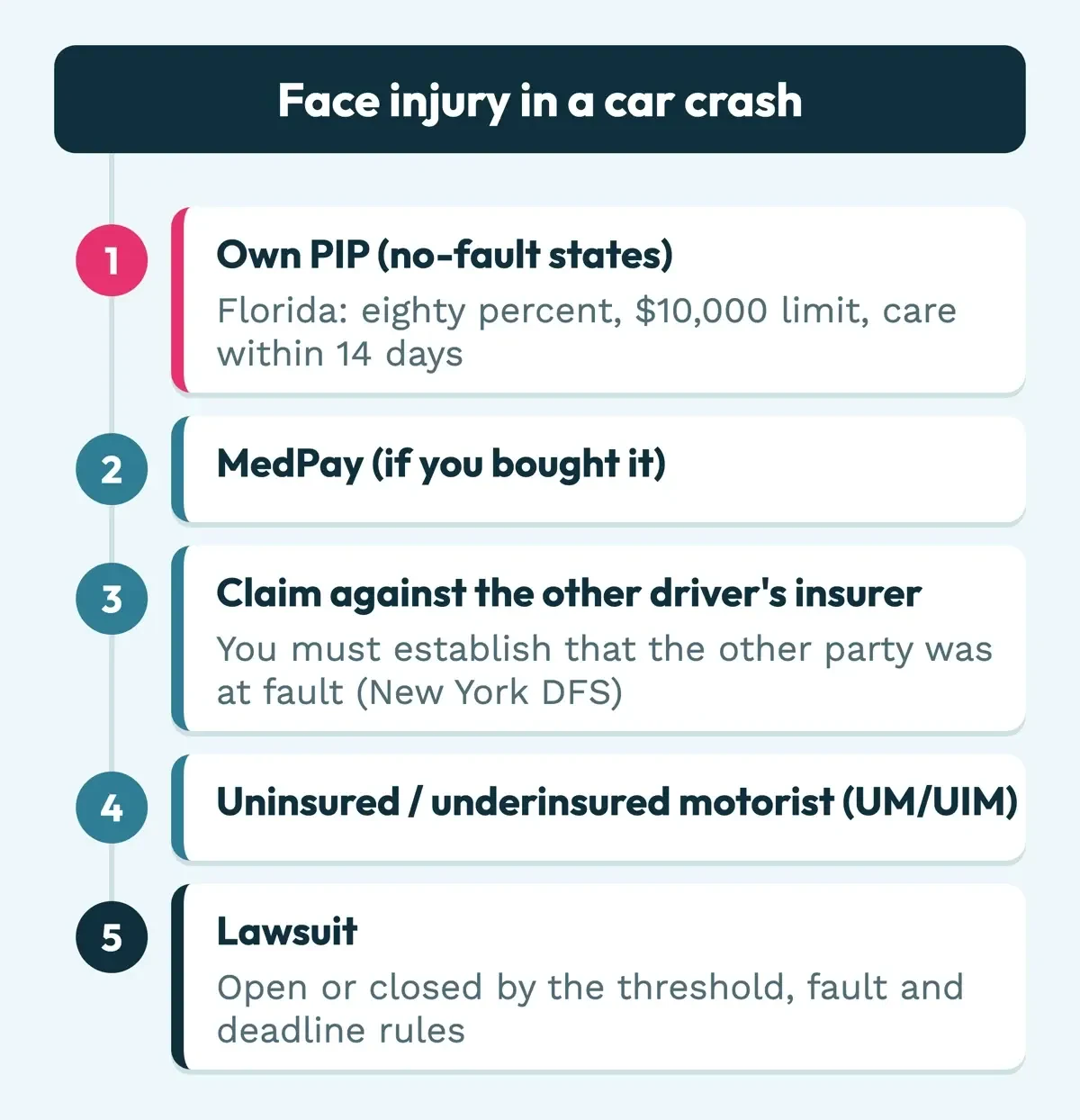 Diagram by DigitalTreed from Florida 627.736 and 627.727, Minnesota 65B.44, the New York DFS auto guide and the California DOI auto guide, read November 15, 2026.
How scarring and disfigurement count in no-fault states
A claim for pain, suffering and the change in your face is separate from the bills, and no-fault states limit it by statute. Florida's section 627.737(2) allows damages for pain, suffering and mental anguish only for listed injuries, and one of them is "Significant and permanent scarring or disfigurement." A separate item covers permanent injury "other than scarring or disfigurement."
Minnesota uses a money test and a list. Under section 65B.51, no one recovers for noneconomic loss unless certain medical costs pass $4,000 (as of November 2026). The other doors are "permanent disfigurement," permanent injury, death, or disability for 60 days or more. New York allows a pain-and-suffering suit "only if a 'serious injury' (as defined in the Insurance Law) is sustained," its regulator says. That list sits in Insurance Law section 5102(d), which names "significant disfigurement; a fracture" among the injuries that count. The statutes site blocked our script; the section was checked in a browser on November 15, 2026.
| Florida | Listed injuries only (627.737(2)) | Yes: "significant and permanent scarring or disfigurement" |
| Minnesota | Medical costs over $4,000, or a listed injury (65B.51) | Yes: "permanent disfigurement" |
| New York | "Serious injury" under Insurance Law 5102(d) | Yes: "significant disfigurement" and "a fracture" |
Whether a scar is "significant and permanent" is partly a medical call, and the answer can take months. MedlinePlus's page on scars says they "usually fade over time but never go away completely."
How your share of fault changes the outcome
The state's fault rule decides whether your own mistakes shrink the payment or end it. Florida and Minnesota, two of the states we read, compare fault in percentages. Under Florida's section 768.81(6), a person found more than 50% at fault for their own harm "may not recover any damages." Minnesota's section 604.01 allows recovery if your fault "was not greater than" the other side's, though damages are then "diminished in proportion" to your share. In a made-up example, a Florida driver found 20% at fault can still recover from the other driver, with the award cut by that 20% share. At an example 60%, the claim against the other driver ends. PIP still pays, since it ignores fault.
Maryland's rule, as of its top court's 2013 ruling, is contributory negligence, where even slight fault can bar the claim. In Coleman v. Soccer Association of Columbia, decided July 9, 2013, Maryland's highest court was asked to drop that rule. It declined, reaching "the same conclusion" as its 1983 Harrison decision, which left any change to the legislature. The District of Columbia narrowed the same old rule by statute. Under DC Code 50-2204.52, added by a 2016 law, the negligence of a pedestrian or other vulnerable road user bars recovery only when it's greater than the defendants' combined negligence.
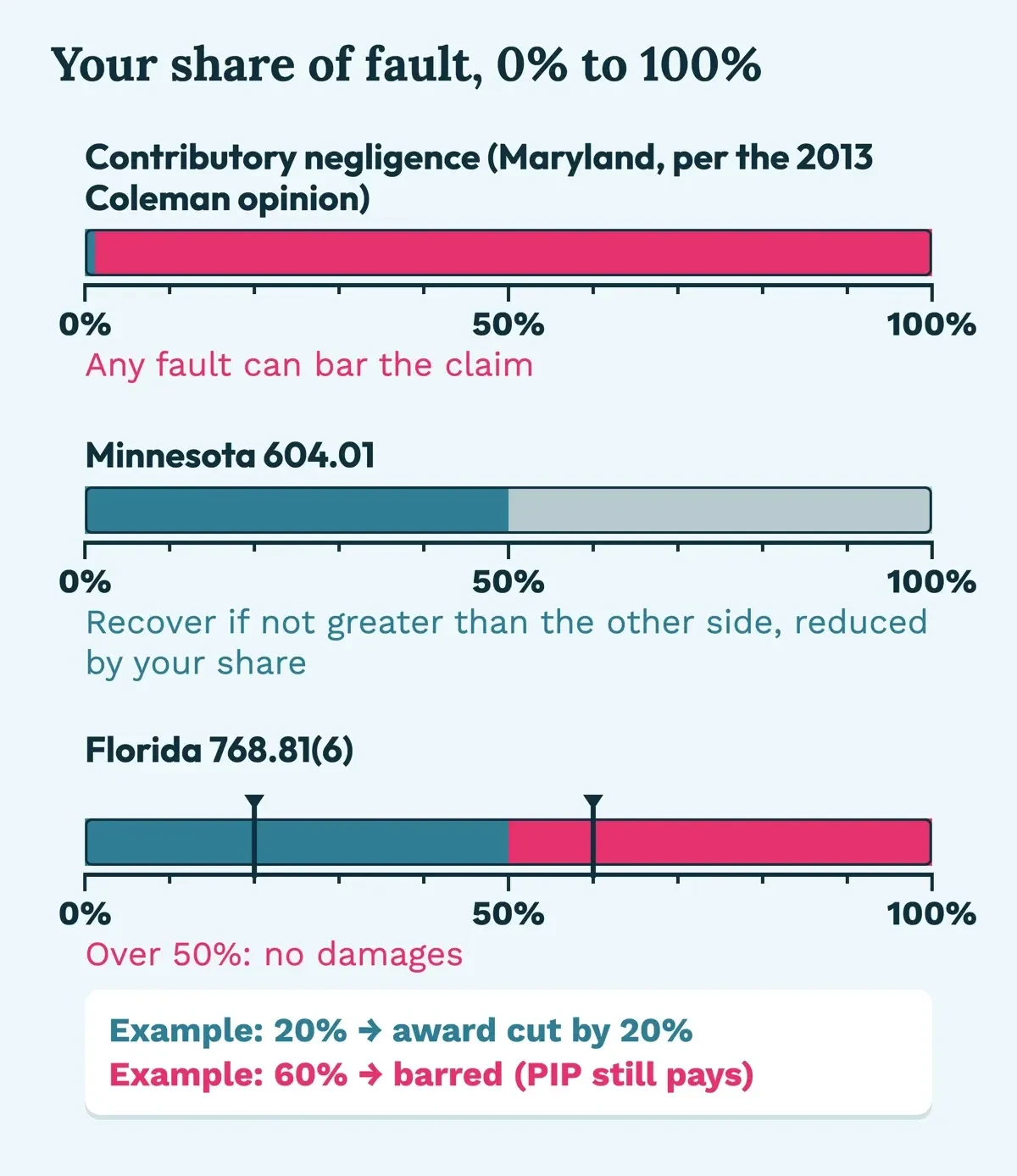 Diagram by DigitalTreed from Florida 768.81(6), Minnesota 604.01 and the 2013 Coleman opinion, read November 15, 2026. Example shares only.
We did not check for a later Maryland statute or ruling. Other states may use the rule too; we read current fault rules only for Florida, Minnesota and DC.
Which deadline applies in your state?
The statute of limitations is the last day to file a lawsuit. Florida's section 95.11(5)(a) lists "An action founded on negligence" under its two-year limit. Virginia's section 8.01-243(A) gives "every action for personal injuries" two years after the claim accrues; Maryland's general rule in section 5-101 is three years. Minnesota's section 541.05 gives six years for "any other injury to the person." New York's CPLR 214(5) lists "an action to recover damages for a personal injury" among actions that "must be commenced within three years." We read the other four states' rules with plain requests and New York's in a browser, after a bot check, all on November 15, 2026.
Two questions sit outside those rules: when the clock starts, and the exceptions for minors or for claims against a city or state agency. Put both to a lawyer licensed there. Insurance steps run on shorter clocks, and our first-72-hours checklist after a car crash covers the earliest ones.
What we tested
We built a Python checker and ran it on November 15, 2026 against six made-up example crashes, all dated October 1, 2026. It applies only the rules quoted above, counts each deadline from the crash date, and returns "not verified" for any rule we couldn't read. The fault shares we've used are invented.
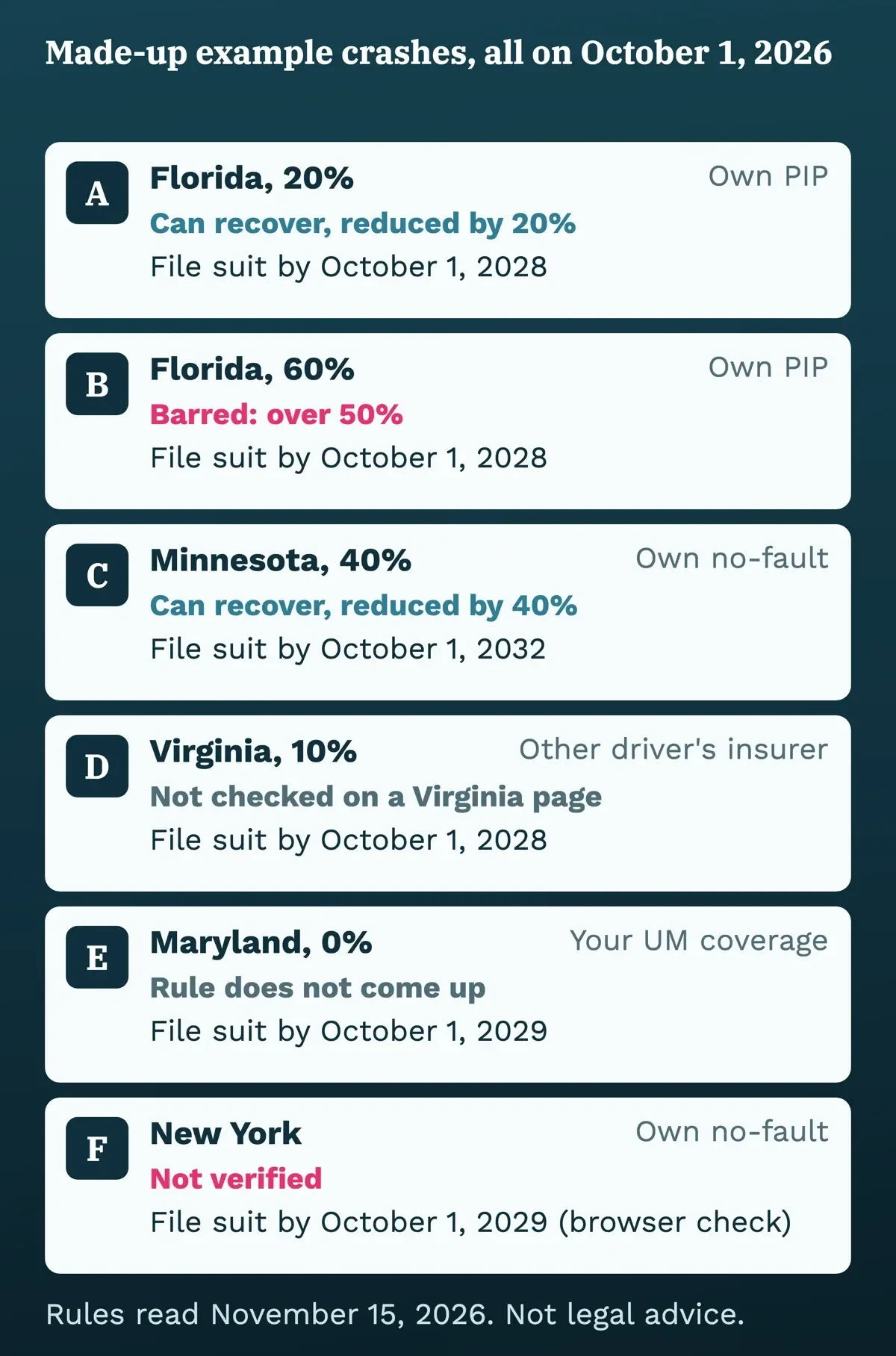 Drawn by us from our route checker output on 127.0.0.1, run November 15, 2026, with Crash F dated from a browser check that day. All six crashes are made-up examples.
Six example crashes and where each one lands
Crash D's fault cell is the checker's own flag: it read no Virginia page on fault, only a list in a 2013 Maryland dissent.
| A: Florida, 20% your fault, cheek cut | Own PIP (care by October 15, 2026) | Can recover, reduced by 20% | October 1, 2028 |
| B: Florida, 60% your fault, chipped teeth | Own PIP (care by October 15, 2026) | Barred: over 50% | October 1, 2028 |
| C: Minnesota, 40% your fault, broken nose | Own no-fault, $20,000 medical | Can recover, reduced by 40% | October 1, 2032 |
| D: Virginia, 10% your fault, eyebrow cut | Other driver's insurer; MedPay if bought | Not checked on a Virginia page | October 1, 2028 |
| E: Maryland, 0% your fault, uninsured driver | Your UM coverage, if you have it | Rule does not come up | October 1, 2029 |
| F: New York passenger, jaw fracture | Own no-fault, up to $50,000 | Not verified | October 1, 2029 (browser check) |
The checker dated five of the six, from October 1, 2028 for Florida and Virginia to October 1, 2032 for Minnesota: a four-year spread. The formula is the crash date plus the state's years. Crash B shows how the two routes split. Florida PIP still pays that driver's bills, but the claim against the other driver ends at 60% fault. Crash C's $3,200 of example medical costs sits under Minnesota's $4,000 line, so a pain claim there would rest on disfigurement or another listed injury. Crash E, with no fault, skips the fault rule.
The checker left Crash F blank, because New York's statutes site answered our script with a bot check. Using CPLR 214(5), checked in a browser, the formula gives October 1, 2029, and the jaw fracture fits "a fracture" in section 5102(d). New York's fault rule stays unchecked.
Building the record for a face injury
A face injury keeps changing for months. MedlinePlus's facial trauma page lists "Prevent scars, if possible," among treatment goals. It adds: "More surgery may be needed in 6 to 12 months to correct changes in appearance." How a scar looks depends on the wound's size and depth, where it is and how long it takes to heal. Your age and inherited tendency to scar count too. In an example, a Florida driver hurt on October 1, 2026 might not see the final result until April to October 2027 if more surgery follows. The two-year deadline under section 95.11 still falls on October 1, 2028.
Keep these items in the claim file:
- Photos of your face on a fixed schedule, same room and light, dated in the file name.
- ER, surgeon and dentist records, including imaging reports for any fracture.
- Each bill and each PIP or MedPay statement, in date order.
- Notes on what you couldn't do: missed work, eating, sleep, and days in public.
- Any doctor's note on whether a scar or change is permanent.
Providers covered by HIPAA face a federal deadline for records. Under 45 CFR 164.524, a covered provider "must act on a request for access no later than 30 days after receipt." One extension of up to 30 more days is allowed, and any fee must be "reasonable, cost-based." Phone shots of paper bills merge into one file with our JPG to PDF converter. When records arrive as images, our walkthrough on making scanned PDFs searchable helps you find a date or a doctor's note without paging through every scan. Keep a second copy off your phone; our cloud storage explainer compares where it can live.
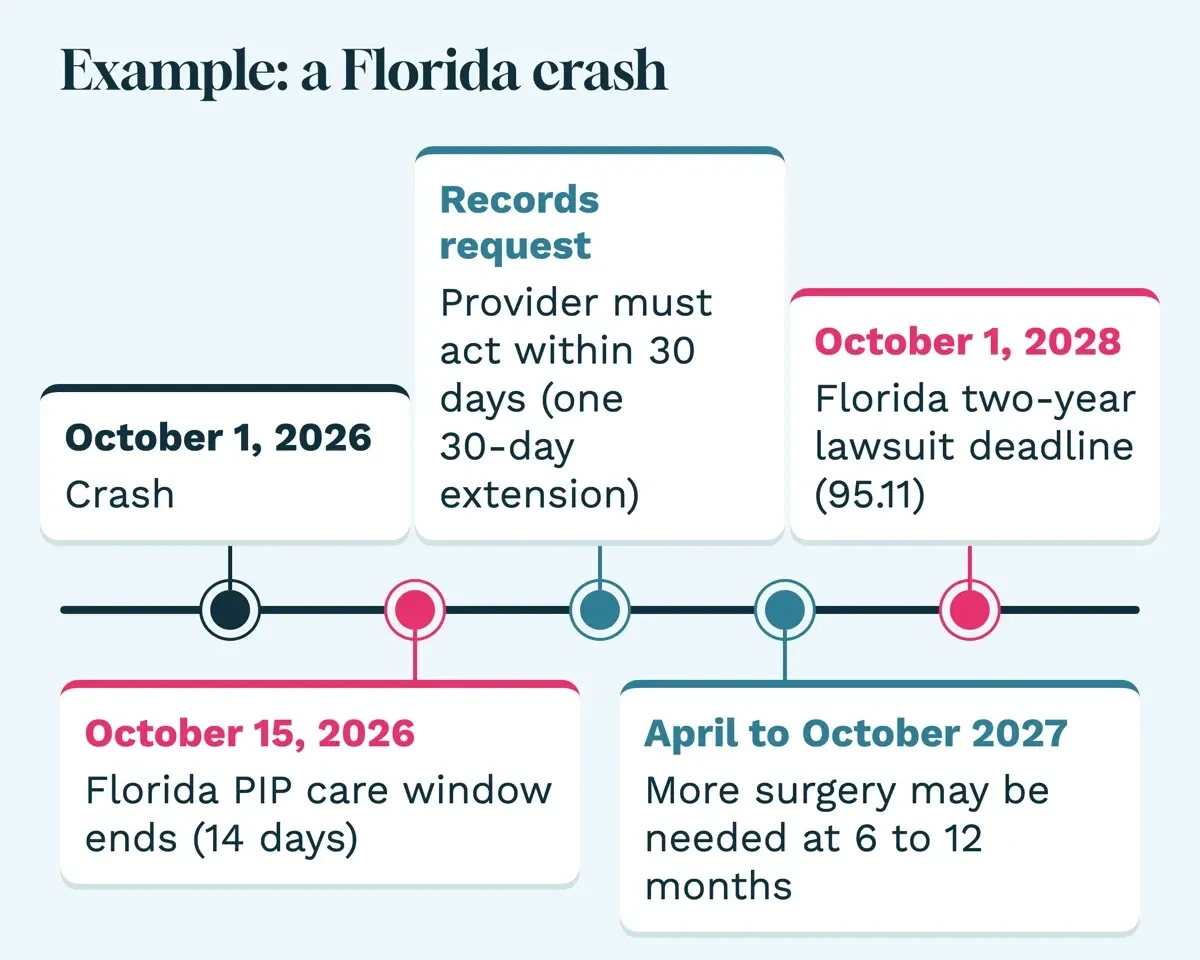 Diagram by DigitalTreed: example Florida crash on October 1, 2026, using 627.736, 45 CFR 164.524, MedlinePlus and 95.11, read November 15, 2026.
Finding a lawyer through a bar referral service
The New York State Bar Association referral service shows how a bar referral works. Its page says referrals are free and a first half-hour consultation costs $35 as of November 2026, with personal injury listed as an exception. It adds that "LRS staff are NOT attorneys," that it doesn't set lawyers' fees, and that you should hear back within five working days of submitting the form. On a low income, the USAGov legal aid page points to the Legal Services Corporation, LawHelp.org and law school clinics.
The ABA keeps a directory of lawyer referral services by state. Our script couldn't open it on November 15, 2026. We haven't seen what it lists.
Many injury lawyers charge contingency fees. Pennsylvania's Rule of Professional Conduct 1.5(c) says a contingent fee agreement "shall be in writing." It must state the percentages at settlement, trial or appeal, the expenses to be deducted, and whether those expenses come out before or after the fee. At the end, the lawyer owes a written statement showing the outcome and "the remittance to the client." Your state's rule may word this differently.
Before you sign, ask for your own signed copy of the fee agreement. File it with your crash records. Before you email big scans to a lawyer, our PDF compressor can shrink them.
When the insurer stalls: filing a complaint with the state regulator
If a claim sits unpaid with no answer, your state's insurance regulator takes complaints against insurers. New York's DFS complaint page runs an online form that covers an "insurance company," and it warns that "we may share a copy of your complaint with the company." DFS also ranks auto insurers by the share of consumer complaints upheld against them over a two-year period, counting only complaints that reached DFS. Those complaints "typically involve issues like delays in the payment of no-fault claims," it says. California's Department of Insurance consumer help page offers "Ask a question or file a complaint" and lists the hotline 1-800-927-4357.
In other states, the NAIC keeps a list of state insurance departments. Its site refused our script on November 15, 2026. We can't confirm what it shows.
Whichever office you use, bring dates: when you filed the claim, each call, and what was promised. New York's portal also takes added papers, such as a Letter of Authorization, after you file.
What we could verify on November 15, 2026
We read every rule on its government or court page on November 15, 2026, by plain request or, for two New York pages that blocked our script, in a browser. No sign-in.
| Florida PIP, threshold, fault rule, UM and 2-year deadline | Confirmed | Florida Statutes 627.736, 627.737, 768.81, 627.727, 95.11 |
| Minnesota no-fault limit, threshold, fault rule, 6-year line | Confirmed | Minnesota Statutes 65B.44, 65B.51, 604.01, 541.05 |
| Virginia 2 years, Maryland 3 years | Confirmed | Virginia Code 8.01-243; Maryland CJP 5-101 |
| Maryland contributory negligence | Confirmed as of 2013 | Coleman opinion; no later Maryland change checked |
| Fault rules in Virginia and other states | Not checked | No current state page read |
| New York serious-injury list and 3-year deadline | Checked in a browser | Insurance Law 5102(d); CPLR 214(5) |
| ABA referral directory, NAIC list | Not opened | Both sites sent a bot check |
Read your state's current statute, or ask your state bar's referral service, before you count on any deadline here, because statutes can change after our date. In New York, the fault rule is the open item; we didn't read it.
Questions about face-injury claims
Frequently asked
Does health insurance or no-fault pay first in New York?
No-fault does. New York's regulator says "No-Fault is also primary to health insurance, which means it pays first" after an auto accident.
Can I turn down uninsured motorist coverage in Florida?
Yes, in writing. Section 627.727 requires a signed rejection on an approved form headed "You are electing not to purchase certain valuable coverage."
Can a New Yorker with no auto policy still claim after a hit-and-run?
DFS says you may still qualify through MVAIC and should file "promptly (because there are stringent time limits)."
How many people were killed in US car crashes in 2023?
NHTSA counted 40,901 deaths in 2023, down 4.3% from 42,721 in 2022, in its April 2025 overview.
How we made this guide: Primary pages only, starting with 13 state statutes, one DC Code section, a 2013 Maryland opinion and a HIPAA rule. We added two state insurance regulators, MedlinePlus, an NHTSA report, the NYSBA referral page, USAGov's legal aid page and Pennsylvania's fee rule. The ABA and the NAIC refused our script, so nothing from them is quoted. New York's statutes site refused it too; Insurance Law 5102(d) and CPLR 214(5) were checked in a browser on November 15, 2026. Facts checked by the DigitalTreed team on November 15, 2026.
This November 2026 rewrite replaces a 2024 overview that had no sources. It adds the state rules, a dated verification table and the example crash checker.
Sources
- Florida Statutes 627.736: Required personal injury protection benefits
- Florida Statutes 627.737: Tort exemption; limitation on right to damages
- Florida Statutes 627.727: Uninsured and underinsured vehicle coverage
- Florida Statutes 768.81: Comparative fault
- Florida Statutes 95.11: Limitations other than for the recovery of real property
- Minnesota Statutes 65B.44: Basic economic loss benefits
- Minnesota Statutes 65B.51: Tort action limitations
- Minnesota Statutes 604.01: Comparative fault
- Minnesota Statutes 541.05: Various cases, six years
- Code of Virginia 8.01-243: Personal action for injury to person or property
- Maryland Courts and Judicial Proceedings 5-101: Three-year limitation
- Court of Appeals of Maryland: Coleman v. Soccer Association of Columbia (2013), PDF
- Code of the District of Columbia 50-2204.52: Contributory negligence limitation
- GovInfo: 45 CFR 164.524, Access of individuals to protected health information (CFR revised as of October 1, 2025), PDF
- New York Insurance Law 5102: Definitions (serious injury)
- New York CPLR 214: Actions to be commenced within three years
- New York DFS: Auto insurance information for consumers
- New York DFS: File a complaint
- California Department of Insurance: Auto insurance 101
- California Department of Insurance: Consumer help
- MedlinePlus: Facial trauma
- MedlinePlus: Scars
- NHTSA: Overview of Motor Vehicle Traffic Crashes in 2023 (DOT HS 813 705)
- New York State Bar Association: Lawyer Referral Service
- American Bar Association: Lawyer referral directory
- Pennsylvania Rules of Professional Conduct: Rule 1.5, Fees
- USAGov: Find a lawyer and affordable legal aid
- NAIC: State insurance departments


Comments
No comments yet. Start the conversation below.