

Quick answer
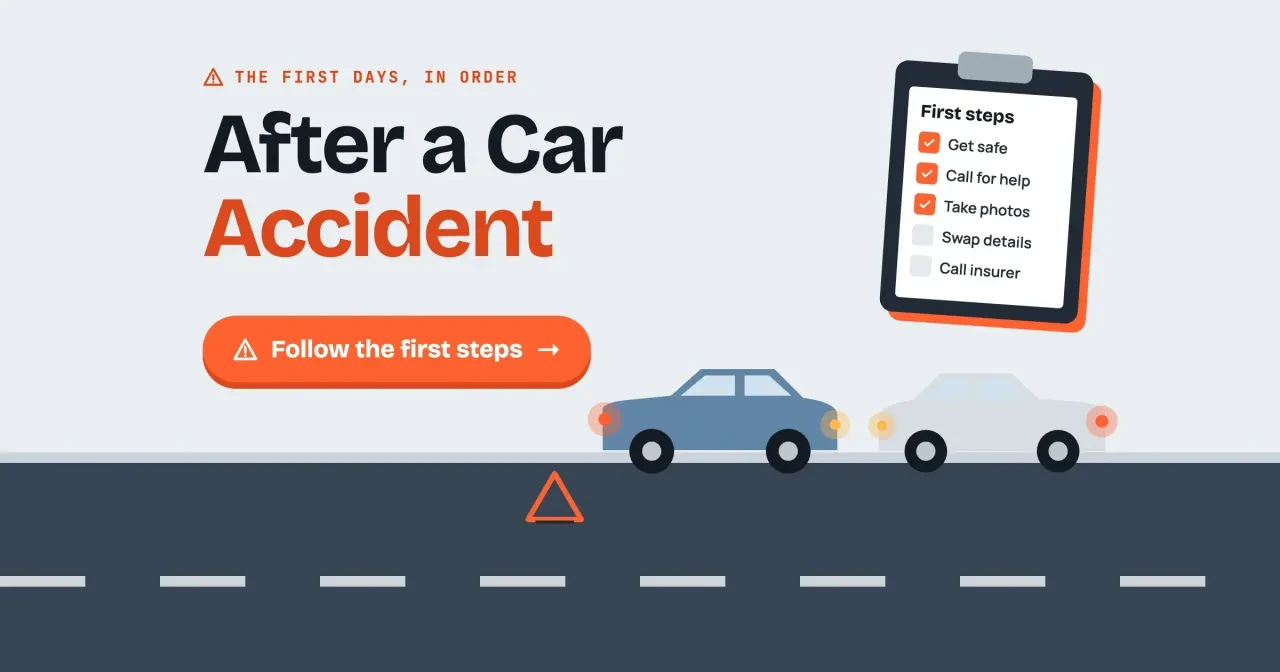
After a car accident, get safe, call 911 if anyone is hurt, take photos, swap details and call your insurer. Each step appears in the NAIC or Texas Department of Insurance guide as of October 2026, though neither lists them in exactly this order. Deadlines vary: Florida wants a driver's written report within 10 days when the crash doesn't require a law enforcement report. State rules follow.
The bumper's cracked, both cars are stopped, and you're not sure what to do after a car accident like this one. A crash report is the written record of the collision that an officer or, in some states, a driver files. We describe the rules, which isn't legal advice about your crash. Claim disputes go to your state insurance department's consumer line, and fault or injury questions to a licensed attorney.
We start at the scene, then cover when to call 911 or the police and what information to swap. Crash report duties and deadlines, telling your insurer, and at-fault versus no-fault states follow. What we tested, the two states side by side, and when people talk to a lawyer about a contingency fee close it out.
Key takeaways
- Florida required police notice for injuries or $2,000+ damage in October 2026.
- Without a required police report, Florida drivers filed within 10 days (October 2026).
- Florida PIP paid medical bills only after care within 14 days (October 2026).
- Texas insurers had to confirm a claim within 15 days of notice (October 2026).
- Our October 30, 2026 test found six dated deadlines in five made-up crashes.
What to do at the scene, in order
The scene steps below come from insurance regulators, not from a law firm or an insurer selling a policy. The NAIC's consumer guide to auto insurance and the Texas Department of Insurance auto guide each cover some of them, in their own order.
- Get safe. Check whether you or anyone with you is hurt, since that decides whether the next call is 911.
- Call 911 if anyone is hurt. The NAIC guide puts it plainly: "Call 911 if someone's injured."
- Move the car if it still drives. "If your car is drivable, move it out of traffic," the same guide says.
- Take photos and notes. Record the time, date, exact location, weather and road conditions.
- Swap details with the other driver and get witnesses' names and phone numbers.
- Call your insurer on the claim number printed on your insurance card.
Some states turn these steps into law. In Florida, section 316.061 says a driver in a damage-only crash "shall immediately stop" and stay at the scene until the information duties are met. Leaving early is a crime there, a second-degree misdemeanor. The same section requires a driver to "make every reasonable effort to move the vehicle" when a damaged car is blocking traffic. Section 316.062 adds a duty to give injured people "reasonable assistance," including arranging a ride to a doctor or hospital when treatment is clearly needed. Photos sit before the swap in our list because both guides ask for the time, place and weather, and those are easiest to record while you're still standing there.
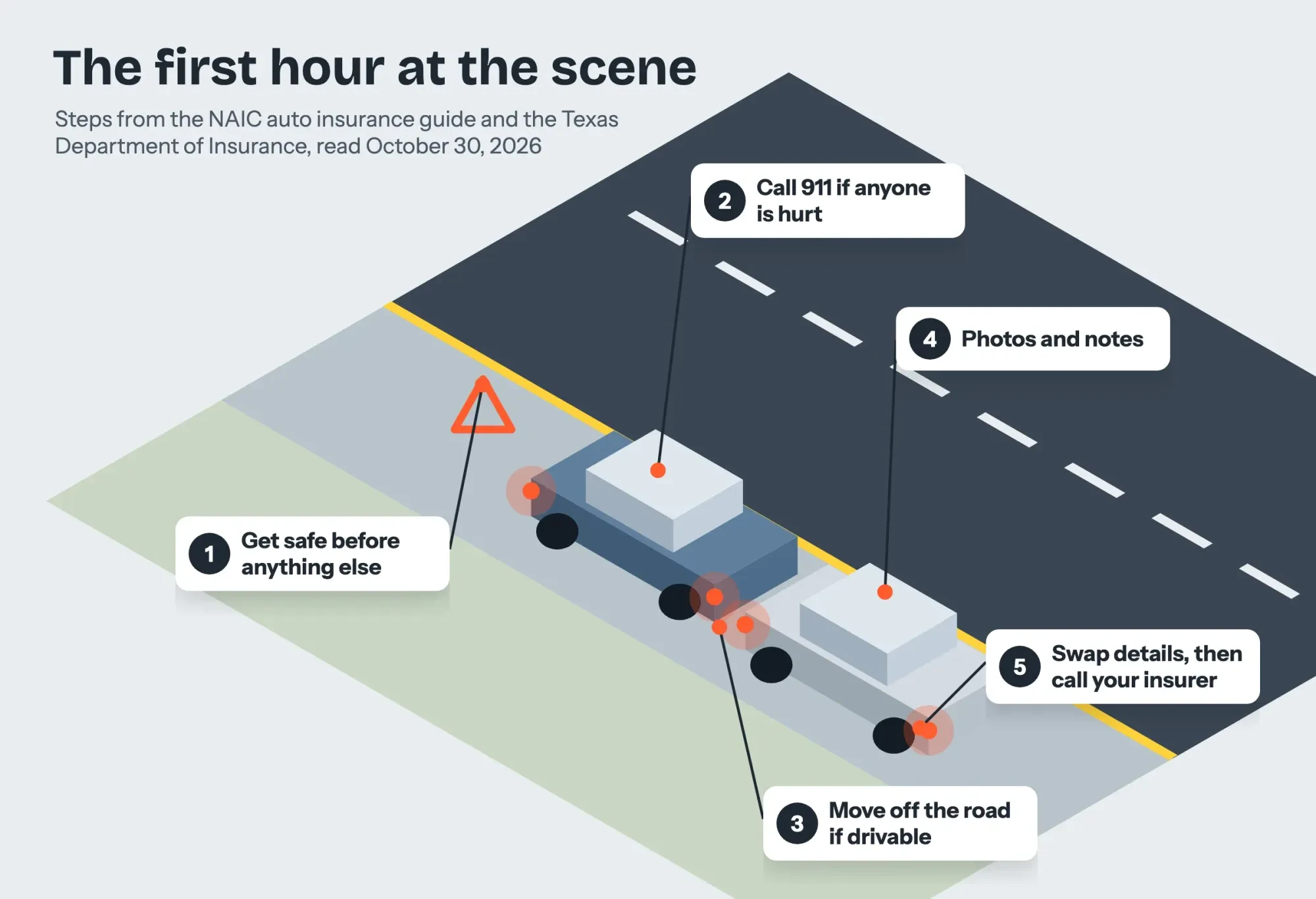 Diagram by DigitalTreed: the first-hour steps in this guide's order, each taken from the NAIC or Texas Department of Insurance guide (read October 30, 2026).
When do you have to call 911 or the police?
Once the cars are safe, call 911 whenever anyone is injured. The Texas guide's claim tips say "Call the police if anyone was injured," and the NAIC guide says the same for 911. A hit-and-run needs the police too. In Texas, "Your uninsured motorist coverage won't pay for a hit-and-run accident if you didn't report it to police," according to the department. There's a third trigger in that guide with nothing to do with damage or injuries: if the other driver won't name their insurance company, call the police. If you can't get the details at all, the NAIC says to "write down their driver's license number and license plate number to give to your insurance company."
Some states also set a dollar line for damage. Florida's section 316.065 requires notice "immediately by the quickest means of communication" after injury, death, or damage "in an apparent amount of at least $2,000" (as of October 2026).
Our made-up case A, with $1,500 of damage and no injury, falls under that line, so Florida's law doesn't require the call.
Information to swap with the other driver
Beyond the police call, the swap of details is short. It goes both ways. Florida's section 316.062 requires each driver to "give his or her name, address, and the registration number of the vehicle," and to show a license on request. The insurance side comes from the claim guides. Texas tells drivers to write down "the exact name of the other driver's insurance company, the company's phone number, and the policy number." It also offers a shortcut: "take a picture of the other driver's insurance card." The NAIC guide adds the car's make, model, year and plate, plus the officer's name and badge number.
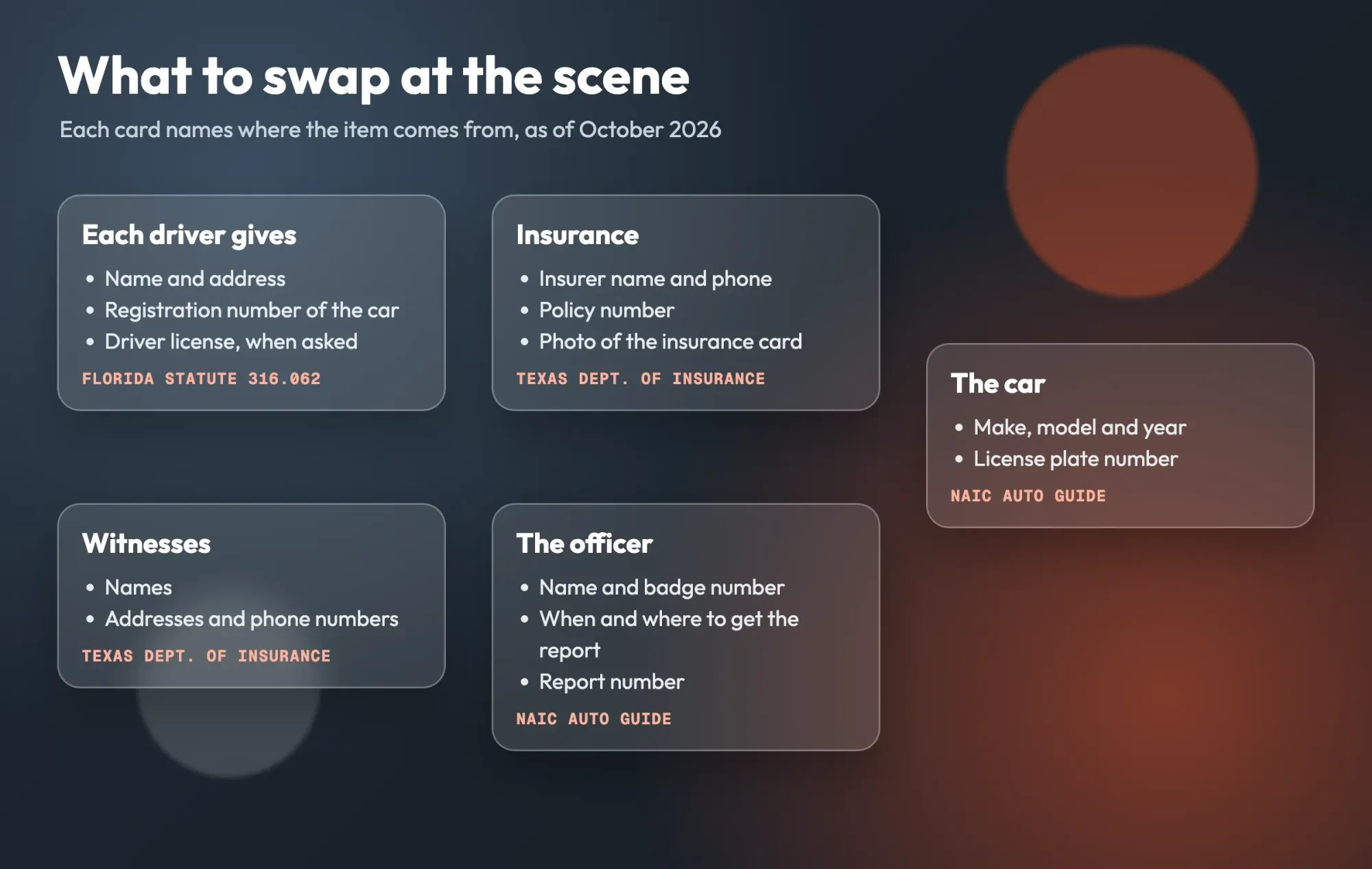 Drawn by us: each card names its source, Florida Statute 316.062, the Texas Department of Insurance guide or the NAIC guide, as worded in October 2026.
Florida's 316.062, the Texas guide and the NAIC stop at names, addresses, plates and policy numbers. None of them asks for your Social Security number or a bank account, so a request for either at the scene goes beyond the rules. The limits on who may use that number are in why a Social Security number is not public.
Filing a crash report: state duties and deadlines
Those details also feed the crash report. Who files it depends on the state and on whether an officer came. In Florida, an officer files the long-form report for crashes with a death, an injury or a complaint of pain. A car towed away by a wrecker is another case, and so is a crash that "Involved a commercial motor vehicle." When no officer report is required, section 316.066(1)(e) gives the job to the driver. The driver "shall, within 10 days after the crash, submit a written report of the crash to the department" (as of October 2026). For other crashes an officer handles, the officer fills in a short form or hands out an exchange-of-information form.
Texas works differently. Its Department of Transportation crash records page says the Driver's Crash Report (Form CR-2) "is no longer retained by TxDOT" after a 2017 law. Drivers given a CR-2 "should retain this information for their records."
For any other state, start with the motor vehicle agency in USA.gov's state motor vehicle services directory. A crash with a semi adds federal carrier records, such as driver logs, which the truck rules that apply after a big rig crash explain.
Telling your insurer, and the deadlines it works to
Call your own insurer without waiting for any crash report. The NAIC says to "call the phone number on your proof-of-insurance card as soon as possible," and Texas adds that "Most companies have deadlines for filing claims."
Have your notes ready before you dial: the time and place, the other driver's details, the report number and any medical visits. Florida's PIP law lets an insurer require written notice "as soon as practicable" under section 627.736(4). The NAIC also says to "keep track of the dates of any conversations you have with your agent or adjuster." Because Florida lets an insurer ask for written notice, send the adjuster your scene photos as one dated file rather than showing them on a phone. Our free tool for turning JPG photos into one PDF works in the browser.
Tow, storage and repair charges may land on your card before any claim pays, so match each line on the statement to its paper receipt and the claim number. If one doesn't match the bill, the steps for disputing a card charge you do not recognize come with their own deadlines. When repairs would cost more than the car's value, the TDI guide limits payment to "only up to its actual cash value." Ask the adjuster in writing how that value was set. The renters example on how actual cash value differs from replacement cost shows that math with numbers.
Your own Texas insurer then works to dates set in state law. Under the TDI guide, a company must confirm your claim "within 15 days of getting notice." It then accepts or rejects it "within 15 business days of getting all the information it needs from you." If it needs longer, it "can take 45 days" and must say why. Once it agrees to pay, the check is due "within five business days" (as of October 2026). Those deadlines cover your own company only. "The prompt payment law doesn't apply if another driver's insurance company is paying the claim," the guide says.
If you and the adjuster disagree, the NAIC suggests working it out with the insurer first, then asking "for help from the consumer services personnel at your state insurance department."
That department step is why the NAIC can tell drivers "your insurer doesn't have the last word." Its directory of state insurance departments lists every office.
At-fault vs no-fault states
Once the claim is open, who pays for injuries depends on the state. In an at-fault state the driver who caused the crash pays through liability insurance. In a no-fault state, your own policy pays first.
Texas puts injury costs on the driver who caused the crash. "Texas law requires drivers to show proof they can pay for the accidents they cause," the TDI guide says. Its auto insurance FAQ puts it in fewer words: "Liability insurance pays for the other driver's repairs and medical bills." Its minimum is called 30/60/25 (as of October 2026). That's "$30,000 of coverage for injuries per person, up to a total of $60,000 per accident, and $25,000 of coverage for property damage." "All auto policies in Texas include PIP coverage," the guide adds, and to drop it "you must tell the company in writing."
Florida is a no-fault state. The NAIC's definition fits it: "your own insurance company pays for injuries to you and your passengers regardless of who's at fault." Under section 627.736, personal injury protection covers the named insured, household relatives, passengers and people struck while not in a vehicle. It pays "Eighty percent of all reasonable expenses" for medical care, to a $10,000 limit. The catch is timing. It applies only if the person gets initial care "within 14 days after the motor vehicle accident" (as of October 2026). Reimbursement is capped at $2,500 if a provider finds no emergency medical condition, and the full $10,000 needs a finding that there was one.
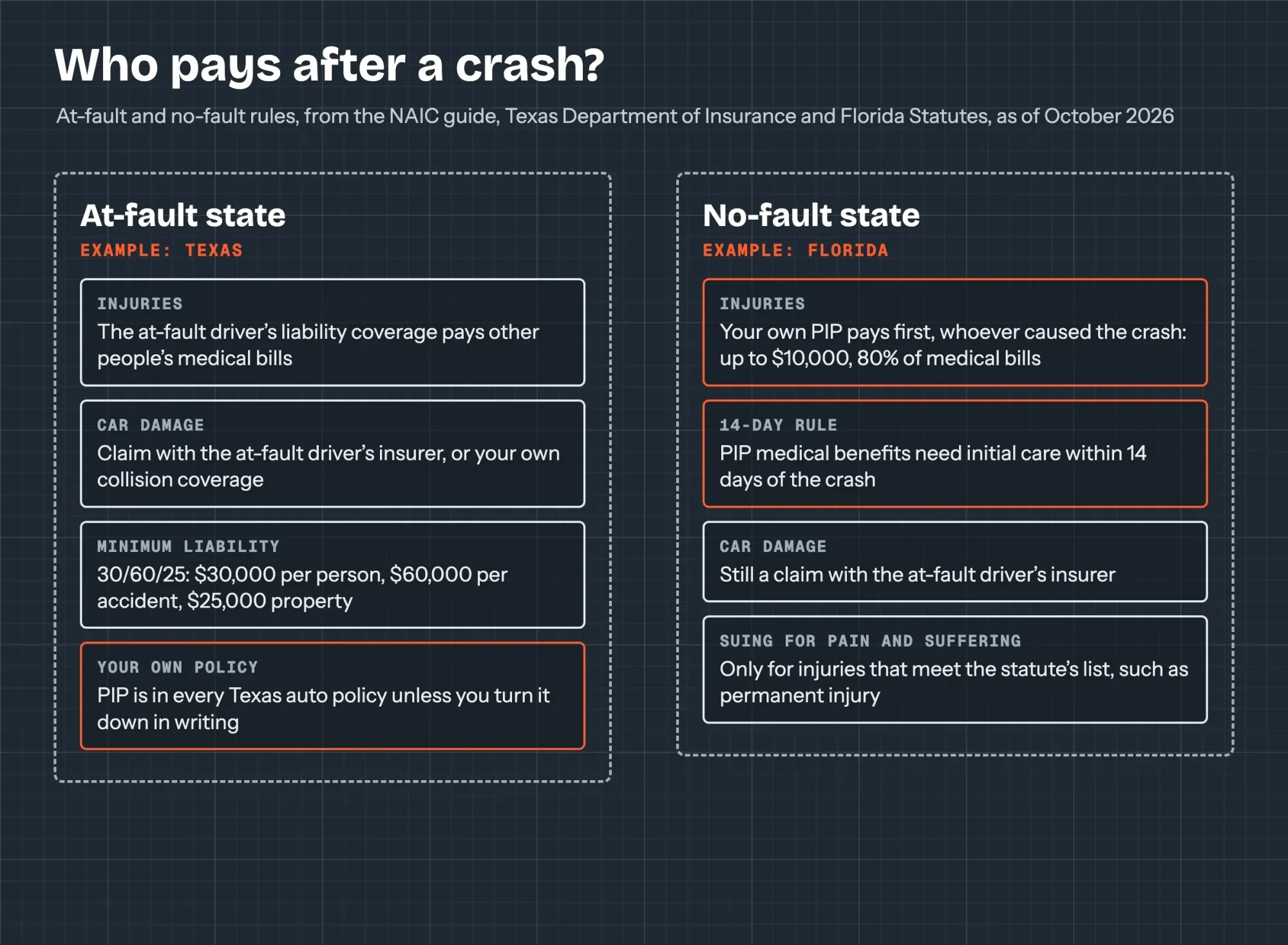 Diagram by DigitalTreed: Texas rules from TDI pages, Florida rules from sections 627.736 and 627.737, no-fault definition from the NAIC guide (October 2026).
No-fault rules don't cover the car itself. The NAIC says "you still must file a claim with the at-fault driver's insurance company to be paid for damage to your vehicle." Florida's section 627.737 also limits pain-and-suffering suits to listed injuries, such as "Permanent injury within a reasonable degree of medical probability."
What we tested
We wrote a small deadline checker in Python and fed it five made-up crashes, all at 5:40 p.m. on Tuesday, October 6, 2026. We opened its results page from 127.0.0.1. It applies only the rules quoted in this guide.
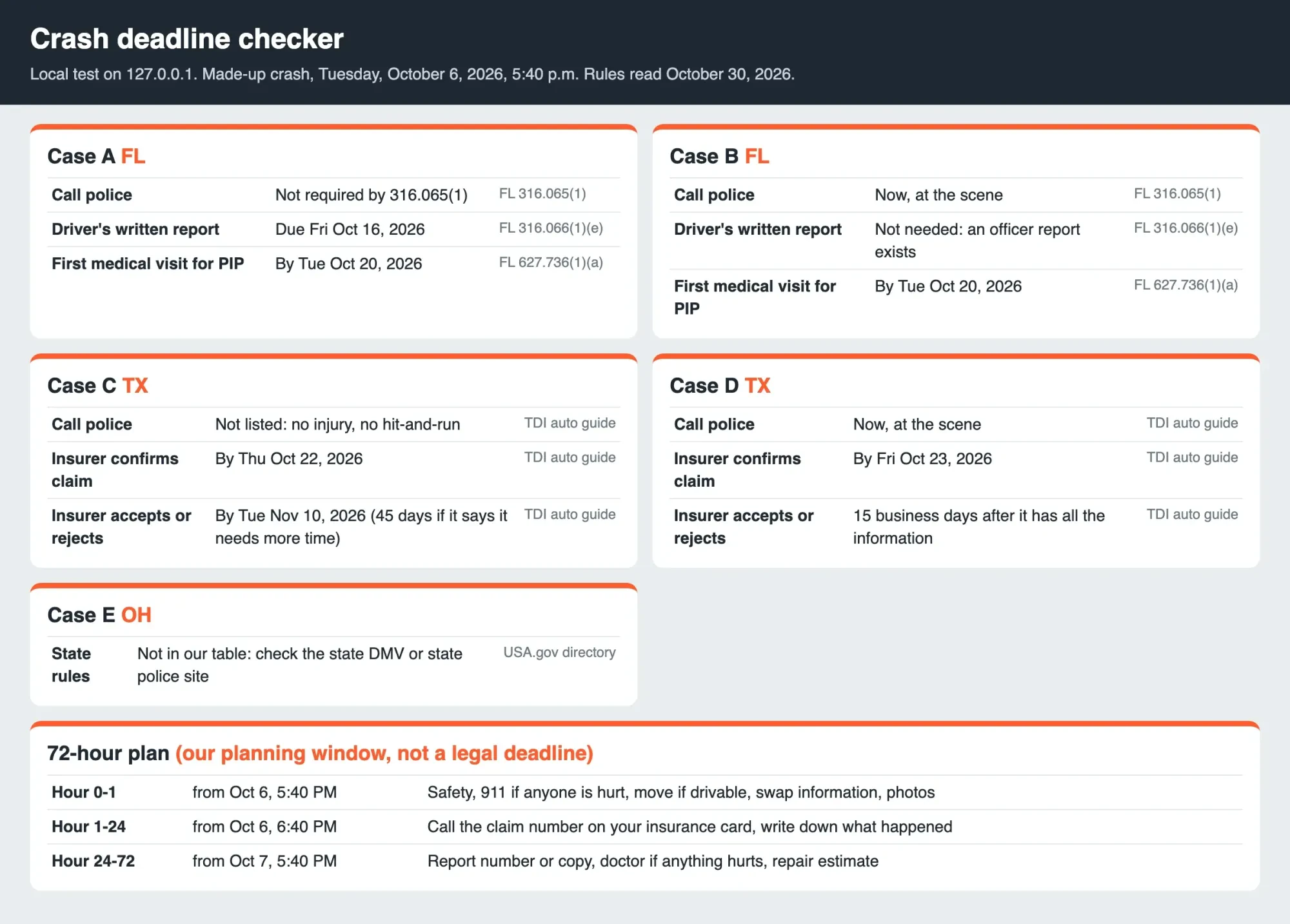 Screenshot: our crash deadline checker on 127.0.0.1, October 30, 2026.
Florida and Texas deadlines side by side
Florida counts calendar days from the crash, while Texas counts from the day your insurer hears about it, so the same Tuesday crash lands on different dates.
| A (Florida) | No injury, $1,500 damage, no officer | Not required by 316.065(1) | Driver report due Fri Oct 16, 2026 | PIP care by Tue Oct 20, 2026 |
| B (Florida) | Passenger hurt, $4,000 damage, officer came | Now, at the scene | Driver report not needed | PIP care by Tue Oct 20, 2026 |
| C (Texas) | No injury, insurer told Oct 7, all papers Oct 20 | Not listed by TDI | Insurer confirms by Thu Oct 22, 2026 | Decision by Tue Nov 10, 2026 |
| D (Texas) | Hit-and-run, no injury, insurer told Oct 8 | Now, at the scene | Insurer confirms by Fri Oct 23, 2026 | 15 business days after all papers |
| E (Ohio) | No injury, $3,000 damage | Not in our table | Not in our table | Check the state DMV |
That's six dated deadlines across five crashes. Not one falls inside the first 72 hours. The 72 hours hold the steps you control (the scene, the photos, the swap and the first call to your insurer), and each of them comes before any legal date. Case A shows the catch in Florida: with no injury and $1,500 of damage, nobody has to call the police, so the 10-day written report falls to the driver. In Florida, October 6 + 10 days = October 16 for the driver's report, and October 6 + 14 days = October 20 for PIP care. Case C's decision lands on November 10, 15 business days after October 20. Case E returns nothing because we didn't read Ohio's pages.
When people talk to a lawyer, and what a contingency fee is
Not every claim involves a lawyer. For Texas claims under $20,000 (as of October 2026), the TDI guide points to Justice Court and says "You don't need an attorney." The NAIC lists hiring "an attorney or a public adjuster" as one option if your figure and the insurer's differ. Questions about fault, an injury, or Florida's lawsuit threshold are the ones to take to a lawyer. Time limits are the other reason to ask early. Florida's section 95.11(5) lists "An action founded on negligence" under its two-year limit (as of October 2026), and when that clock starts is a legal question.
Some lawyers charge a contingency fee. That means the fee depends on the result. Pennsylvania's Rule of Professional Conduct 1.5 says a fee "may be contingent on the outcome of the matter." Oregon's Rule 1.5 lists "whether the fee is fixed or contingent" among the factors in judging a fee. Pennsylvania also says what the paper must show. "A contingent fee agreement shall be in writing and shall state the method by which the fee is to be determined." That covers the percentage at settlement, trial or appeal, and whether expenses come out before or after the fee. Your own state's rule may differ, so ask to see the written agreement before you sign.
If the fee is what holds you back, USA.gov's legal aid page says its listed programs "may help you find a free or low-cost attorney." Tow or ER bills that arrive before any claim pays have emergency bill options, from the biller to a credit union loan.
Car crash questions people ask
Frequently asked
Will my insurance company drop me after one accident?
Usually not, according to Texas regulators. The TDI FAQ says "Companies probably won't drop you after the first wreck," though many wrecks or tickets can raise rates.
What if the other driver had no insurance or drove away?
Uninsured motorist coverage may pay, and in Texas "Insurance companies must offer you this coverage," says TDI. For a hit-and-run, report it to police first, since TDI says the coverage won't pay an unreported one.
How do I get the police report?
Ask the officer "when and where to get the accident report," as the NAIC guide suggests. In Texas, TxDOT sells officer reports online: $6 regular, $8 certified (October 2026).
Do I have to see a doctor after a crash in Florida?
No statute we read requires a visit, but Florida PIP pays medical benefits only when initial care happens within 14 days. Hospitals, licensed physicians, dentists, chiropractic physicians and advanced practice registered nurses registered under s. 464.0123 count, under 627.736(1)(a).
How we made this guide: Our sources were Florida's statutes, three Texas Department of Insurance pages, TxDOT's crash records page and the NAIC consumer guide. Then we ran five made-up crashes through a local checker. Florida's motor vehicle agency and the ABA answered our fetches with a 403 error, and Texas's statute site needs scripts, so none is quoted. Facts checked by the DigitalTreed team on October 30, 2026.
This address first carried, from August 8, 2025, a short piece on finding legal representation after a crash. It has been replaced with the scene steps, two states' deadlines, and the results of our checker.
Sources
- NAIC: A Consumer's Guide to Auto Insurance (PDF)
- NAIC: Directory of state insurance regulators
- Texas Department of Insurance: Auto insurance guide
- Texas Department of Insurance: Auto insurance FAQ
- Texas Department of Insurance: Working with an insurance adjuster
- Texas Department of Transportation: Crash reports and records
- Florida Statutes 316.061: Crashes involving damage to vehicle or property
- Florida Statutes 316.062: Duty to give information and render aid
- Florida Statutes 316.065: Crashes; reports; penalties
- Florida Statutes 316.066: Written reports of crashes
- Florida Statutes 627.736: Required personal injury protection benefits
- Florida Statutes 627.737: Tort exemption; limitation on right to damages
- Florida Statutes 95.11: Limitations other than for the recovery of real property
- Pennsylvania Code: Rule of Professional Conduct 1.5, Fees
- Oregon State Bar: Oregon Rules of Professional Conduct (PDF)
- USA.gov: State motor vehicle services
- USA.gov: Find a lawyer for affordable legal aid


Comments
No comments yet. Start the conversation below.