

Quick answer
Big rig crashes bring federal FMCSA records that car crashes lack. As of October 2026, a carrier keeps driver logs at least 6 months. A for-hire carrier hauling general freight in a truck rated 10,001 pounds or more carries at least $750,000 in liability coverage. Hazmat loads raise it to $1,000,000 or $5,000,000. The USDOT number on the cab door ties the truck to those records, so photograph it first.
Maybe a tractor-trailer clipped your car, and the driver's card names a company you've never heard of. Truck accident federal regulations are the rules the Federal Motor Carrier Safety Administration (FMCSA) writes into Title 49 of the Code of Federal Regulations. They bring a second party into the picture: the carrier. Nothing here is legal advice. If the crash is yours, a licensed lawyer in the state where it happened is who to ask.
The difference that matters most is time. A carrier may lawfully discard a driver's hours log 6 months after receiving it, and its inspection reports after 3 months. So the records below are worth naming early and by section number.
Key takeaways
- Carriers had to keep driver logs for at least 6 months in October 2026.
- For-hire freight trucks over 10,000 pounds needed $750,000 liability coverage in October 2026.
- Both sides of the cab must show the carrier name and USDOT number.
- NHTSA's crash recorder page leaves out devices that log truck drivers' hours.
- Adverse-condition notes turned a failing made-up log into a pass on October 30, 2026.
What changes when the other vehicle is a commercial truck?
Most of the scene plays out like any collision, and our first-days checklist for any car crash walks through it. What's new with a big rig is the company behind the driver.
Registration is the trigger. FMCSA's USDOT number page says interstate companies hauling cargo "must be registered with the FMCSA and must have a USDOT Number." FMCSA describes that number as the identifier for a company's safety information from "audits, compliance reviews, crash investigations, and inspections." Its weight line is a rating of 10,001 pounds or more. So a box truck rated at that weight on a delivery route counts the same as an 18-wheeler. The company that arranged the load may be a freight broker instead of the carrier. As of October 2026, FMCSA's insurance chart lists brokers with a $75,000 surety bond or trust fund, not the liability coverage a carrier files.
Registration also starts paperwork a car owner never keeps. Part 395 makes the carrier track every driver's hours, and part 396 makes it keep inspection reports for 3 months and repair records for a year.
A registered carrier also carries a federal insurance minimum and lists each serious crash in a register of its own. Under 49 CFR 390.3(e), every employer "shall be knowledgeable of and comply with" the rules that apply to its operations.
After a crash, three parts of 49 CFR matter most: part 395 for hours and logs, part 387 for insurance, and part 390 for markings and the register. FMCSA's USDOT page adds that some states require "their intrastate commercial motor vehicle registrants to obtain a USDOT Number," so check with the state where the truck is registered.
Finding the USDOT number on the cab door
That company's name should be painted on the cab door. Under 49 CFR 390.21, the truck shows the carrier's "legal name or a single trade name" and its FMCSA number. That number carries the prefix USDOT. The marking has to "Appear on both sides" of the truck and must be "readily legible, during daylight hours, from a distance of 50 feet." If another company's name is on the truck too, the operating carrier's name follows the words "operated by." The rule covers the truck that pulls, so a trailer can carry another company's name. A photo from a few steps back, with the whole door in frame, reads better later than an angled close-up.
Photograph the left door, the right door and the trailer, since a leased truck can show one company on the cab and another on the trailer. Write the USDOT number on paper as well; the 50-foot rule is a daylight test, and a night photo may blur it.
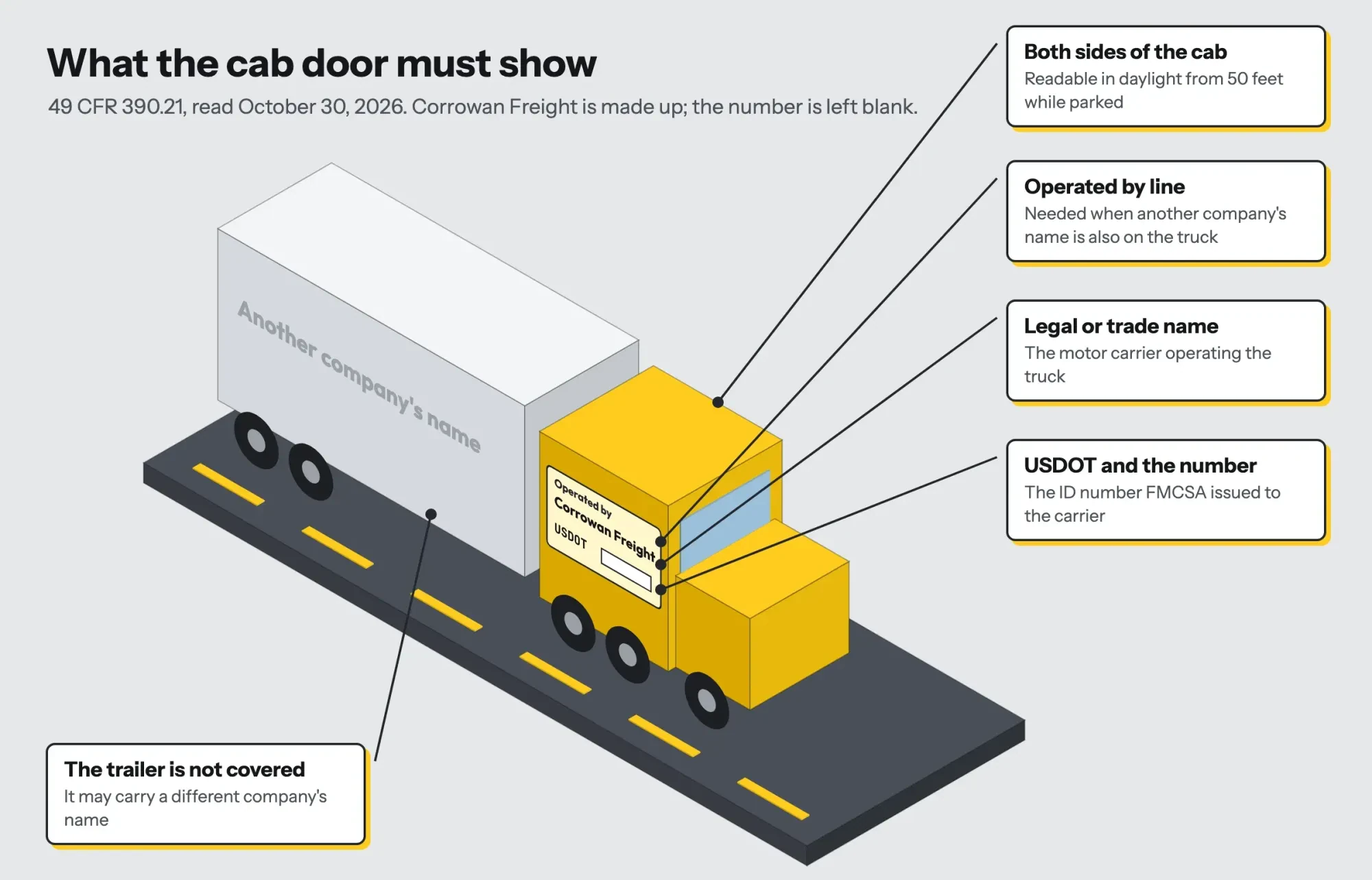 Diagram by DigitalTreed: what 49 CFR 390.21 requires on the cab, read October 30, 2026. Corrowan Freight is a made-up carrier, and the number is left blank.
The lookup is FMCSA's own. Its registration page links the SAFER Company Snapshot under the label "USDOT Status." SAFER refused our script and our browser on October 30, 2026, so we don't describe its screens here.
Hours-of-service limits in 49 CFR 395
Once the carrier is named, the next question is the driver's hours at the moment of the crash. For freight trucks, 49 CFR 395.3 sets the limits, and FMCSA's summary of the hours-of-service rules repeats them in a table. A shift can't start "without first taking 10 consecutive hours off duty." There's no driving "after a period of 14 consecutive hours" from coming on duty, and inside that window "A driver may drive a total of 11 hours." A bus runs on different numbers: the same FMCSA table gives passenger drivers 10 hours of driving after 8 hours off, inside a 15-hour on-duty limit.
Then come breaks and weekly totals. Driving stops once "more than 8 hours of driving time have passed without at least a consecutive 30-minute interruption." Off duty, sleeper berth and on-duty time all count as that stop. A carrier that runs trucks every day caps drivers at 70 hours on duty in 8 days, while one that doesn't run trucks daily uses 60 hours in 7. Taking "34 or more consecutive hours" off duty restarts the count. FMCSA's summary adds a detail people miss: "Off-duty time does not extend the 14-hour period." A driver working 10-hour days with no 34-hour break reaches the 70-hour cap after the seventh day, as log E in our test shows.
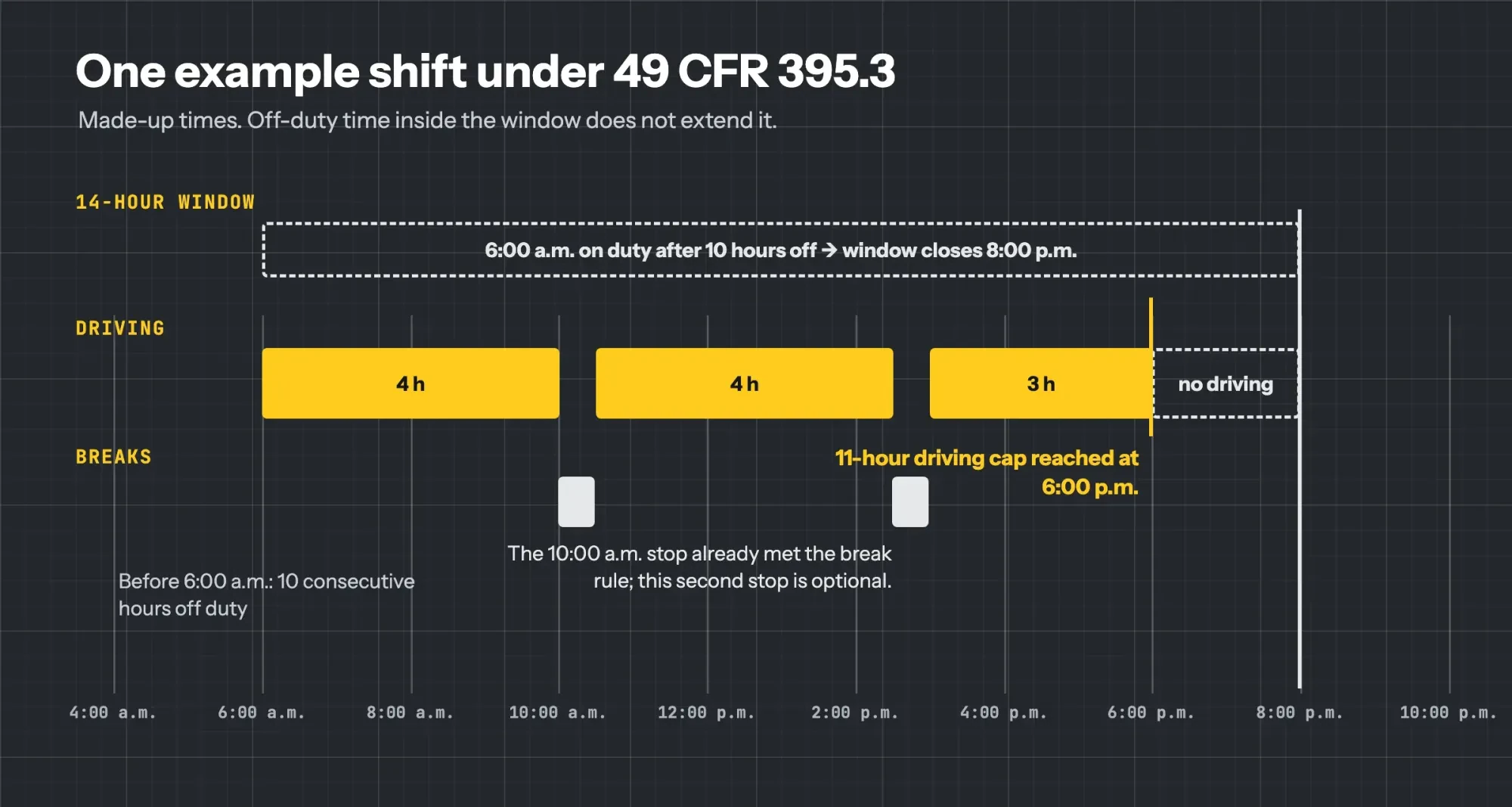 Diagram by DigitalTreed of the freight limits in 49 CFR 395.3, read October 30, 2026. Example shift only; the clock times are made up.
Here's an example shift, with made-up times. A driver comes on duty at 6:00 a.m. after 10 hours off. The 14-hour window then closes at 8:00 p.m., however much of the day goes to waiting. Driving 6:00 to 10:00, stopping 30 minutes, then driving 10:30 to 2:30 puts the driver at 8 hours of driving. The 10:00 stop already met the 30-minute break rule, so the second 30-minute stop is the driver's choice. After it, three more hours from 3:00 reach the 11-hour cap by 6:00 that evening. Any driving after that breaks the 11-hour rule, even though the window stays open for two more hours.
Three exceptions change the math. A driver who meets adverse driving conditions may drive "not more than two additional hours," under 49 CFR 395.1(b). The 2020 hours-of-service final rule lets a driver split the 10 hours off. One part is at least 7 hours in the sleeper berth and the other at least 2, and neither counts against the 14 hours. Under 395.1(e), short-haul drivers who stay within 150 air miles of their usual work reporting location and finish within 14 hours don't keep a log at all. Their carrier keeps time records for 6 months instead.
Driver logs: what the ELD records and who keeps it
Those limits get checked against the driver's record of duty status, which on most big rigs lives in an electronic logging device the carrier installs. 49 CFR 395.8(a) says a carrier "must install and require each of its drivers to use an ELD." That's been the rule since December 18, 2017, after Congress told the Department of Transportation to require the devices in 49 U.S.C. 31137, passed in 2012. FMCSA's ELD page puts it simply: "An ELD synchronizes with a vehicle engine to automatically record driving time." Paper or electronic, the log uses four statuses: off duty, sleeper berth, driving, and on duty not driving.
Some trucks use paper. The same section allows paper for a driver logging "not more than 8 days within any 30-day period," some driveaway-towaway trips, and trucks "manufactured before model year 2000."
Under 49 CFR 395.8(k), the carrier keeps these records "for a period of not less than 6 months from the date of receipt." The driver carries only the last 7 days.
Logs aren't the only paper trail. 49 CFR 395.11 adds supporting documents for each driver and each 24-hour period: bills of lading, dispatch and trip records, expense receipts, fleet messaging records and payroll records. Section 395.22(i) requires a "back-up copy of the ELD records" on a separate device, also kept 6 months. Each supporting document has to show the driver's name or ID, the date, the nearest city or town, and a time that converts to local time. That's what lets fuel receipts and dispatch times be checked against the log's hours and places. Pay records count too, since the rule lists any "payroll record, settlement sheet, or equivalent document that indicates payment to a driver."
An ELD isn't a black box. NHTSA keeps the two apart. Its event data recorder page says a crash recorder keeps data "for a brief period of time (seconds, not minutes)" around a crash. It doesn't count devices that log "hours of service for truck operators." NHTSA's recorder rule, 49 CFR 563.3, covers vehicles of 8,500 pounds or less, so it doesn't set what a big rig's electronics keep. That's why a request to preserve records should name all electronic data, not only the log. It should also go out early, while the log's 6-month clock is still running and the supporting documents still exist.
What we tested
Our test fed six made-up logs into a Python checker on October 30, 2026, for a made-up carrier, Corrowan Freight, each ending in a crash on October 26. It tests four limits minute by minute and skips sleeper splits.
Two logs passed and four broke one limit each. Log A crashed at 13:40 inside every limit, with 6 hours 40 minutes of driving. Log B had driven 11 hours 20 minutes, 20 minutes past the limit. Log C drove only 9 hours 10 minutes but crashed 14 hours 40 minutes after starting at 04:00, and a 3-hour off-duty dock wait didn't pause that clock. Log D went 8 hours 30 minutes without a 30-minute stop. Log E, on its eighth 10-hour day, was at 75 hours 45 minutes in 8 days. Log F repeated B's day with adverse conditions marked, and the 2 extra hours made it a pass.
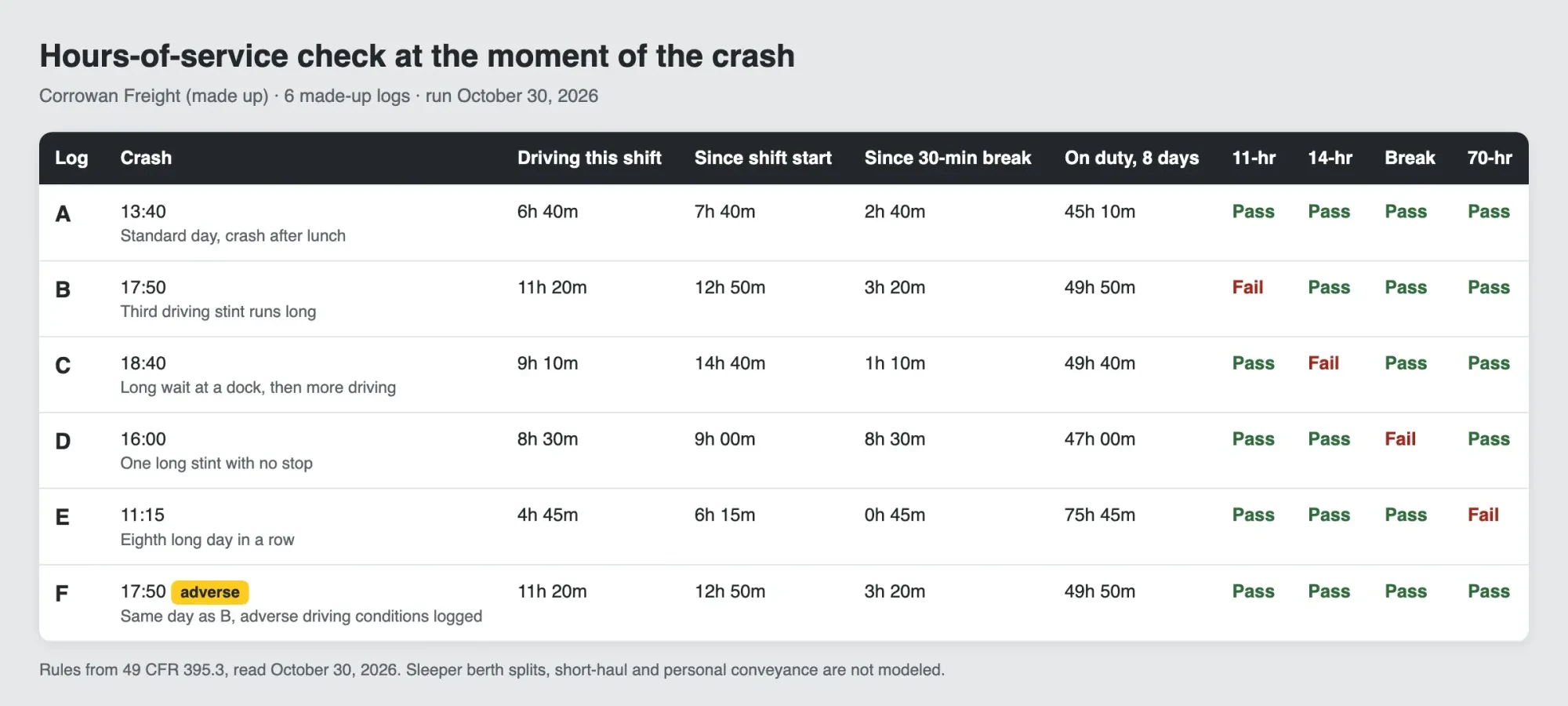 Logs A to F, all made up, as our hours checker on 127.0.0.1 graded them on October 30, 2026 (screenshot).
Carrier insurance minimums under 49 CFR 387
Beyond the logs, insurance is the other big difference, because federal law sets a floor. 49 CFR 387.7(a) bars a carrier from operating until it "has obtained and has in effect the minimum levels of financial responsibility." The amounts sit in 49 CFR 387.9. FMCSA's Licensing and Insurance site, where insurers file a carrier's proof of coverage, refused our requests on October 30, 2026. FMCSA's chart for property carriers cites 49 CFR 387.303. Congress set the base in 49 U.S.C. 31139: the level "shall be at least $750,000," and FMCSA's insurance filing requirements page lists these minimums for property carriers, as of October 2026:
| For-hire, general freight | Under 10,001 pounds | $300,000 |
| For-hire, general freight | 10,001 pounds or more | $750,000 |
| Certain hazardous materials, such as oil | 10,001 pounds or more (eCFR schedule) | $1,000,000 |
| For-hire and private, explosives, poison gas or radioactive materials | Any | $5,000,000 |
| For-hire, household goods (movers) | 10,001 pounds or more | $750,000, plus $5,000 cargo |
These are floors a carrier must keep on file as of October 2026, not a measure of what any crash is worth. FMCSA won't grant a carrier operating authority until those minimums are "on file with FMCSA." Interstate and for-hire carriers show that coverage with an MCS-90 endorsement on the policy, or an MCS-82 for a surety bond, under 49 CFR 387.15. Movers also need $5,000 in cargo cover. State car minimums are a separate, lower layer. California's insurance requirements page puts its own limit this way: "Does not include any additional Insurance requirements for Commercial and/or Fleet Vehicles."
Which truck records exist, and how long they are kept
Read on October 30, 2026, the rules set eight different minimums, from 7 days for the copy in the cab to 3 years for the accident register:
| Driver's copy of the log, in the truck | 49 CFR 395.8(k)(2) | The previous 7 days |
| Driver vehicle inspection reports | 49 CFR 396.11 | 3 months from the date written |
| Records of duty status (ELD or paper) | 49 CFR 395.8(k)(1) | 6 months from receipt |
| ELD backup copy on a separate device | 49 CFR 395.22(i) | 6 months |
| Supporting documents (bills of lading, dispatch, receipts, messages, pay) | 49 CFR 395.11(c) | 6 months, tied to 395.8(k) |
| Short-haul time records | 49 CFR 395.1(e)(1)(iv) | 6 months |
| Inspection, repair and maintenance records | 49 CFR 396.3(c) | 1 year, and 6 months after the truck leaves the carrier |
| Accident register, with copies of state crash reports | 49 CFR 390.15(b) | 3 years after each accident |
The shortest clocks come first in that list. Under 49 CFR 396.11, inspection reports are kept "three months from the date the written report was prepared," while maintenance records fall under 49 CFR 396.3(c). The longest clock is the accident register in 49 CFR 390.15(b), kept "for 3 years after the date of each accident." It also holds "Copies of all accident reports required by State or other governmental entities or insurers." Each register entry lists the date, the city and state, the driver's name, the number of injuries and deaths, and whether hazardous materials other than fuel spilled. The periods are minimums; a carrier may keep records longer, but these sections don't require it.
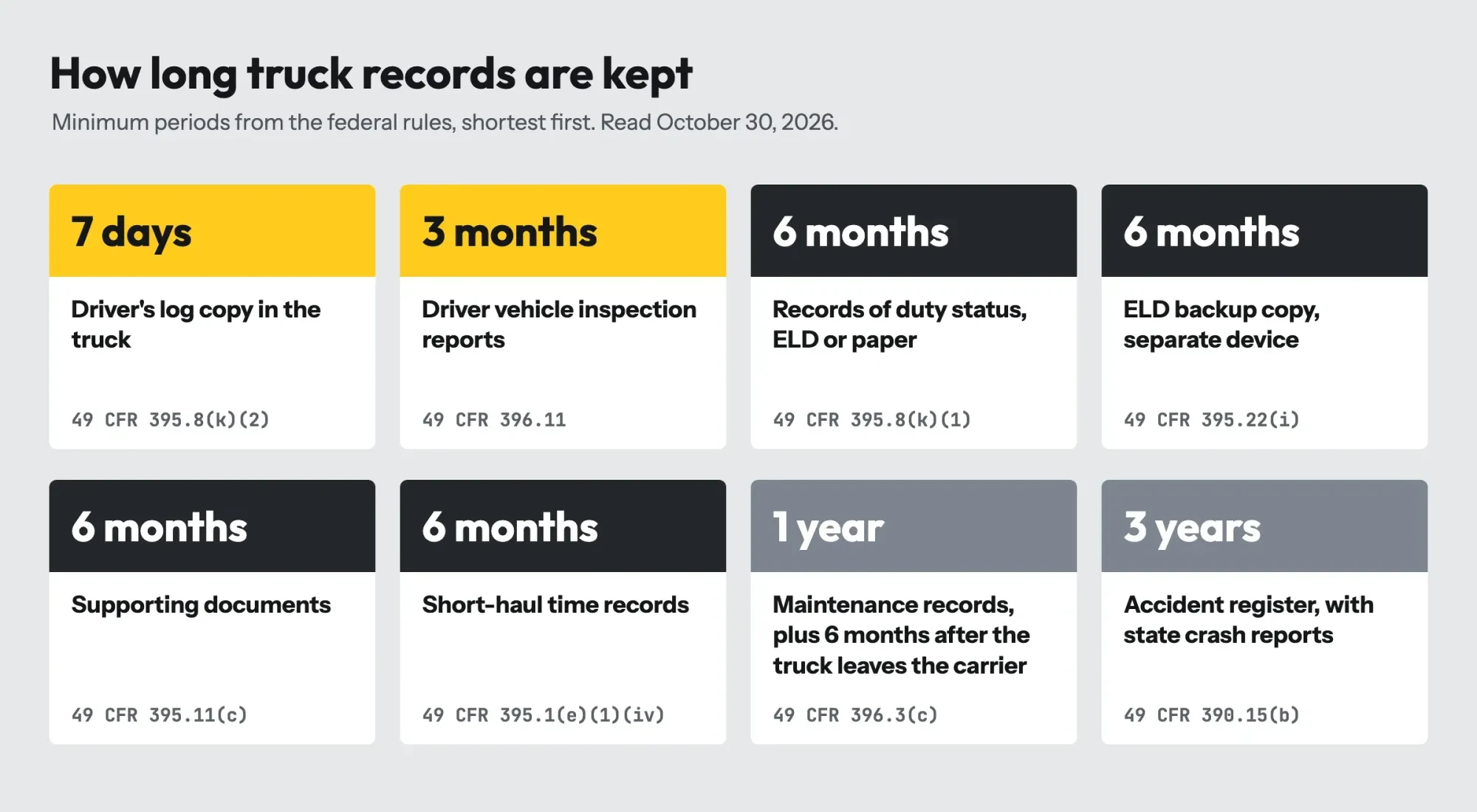 Drawn by us from 49 CFR 395.8, 395.11, 395.22, 396.11, 396.3 and 390.15, read October 30, 2026. Minimum periods only.
Preserving evidence in the first days after a truck crash
Those clocks shape the steps. A carrier may discard a log once its 6 months pass. The useful moves lock records in early, and they run in this order:
- Photograph both sides of the cab and the trailer, with the USDOT number, the carrier name and any "operated by" line readable.
- Write down the truck and trailer plates, the driver's name and the carrier name exactly as painted.
- Note the crash time to the minute, since a limit can turn on 20 minutes, as log B showed.
- Get the police report number and ask the officer how to request the report.
- Send the carrier a written request to keep the driver's logs, supporting documents, inspection reports and any electronic data from the truck.
- File your state's crash report if the crash meets its threshold, and keep a copy.
A licensed attorney can send that written request for you, on letterhead and with the section numbers above. Texts with the driver or the carrier's adjuster belong in the file too. If you switch phones, our steps for moving every message thread to a new iPhone keep them.
Keep the photos, the police report number, tow and repair receipts and every letter from the carrier in one dated folder. Keep a second copy that isn't on the phone; our comparison of cloud storage options covers where that copy can live.
State crash-report duties: California and New York as examples
The carrier's accident register under 49 CFR 390.15(b) keeps copies of these state reports for 3 years, and our car-crash checklist covers your own filing. We name two states from their own forms; for anywhere else, check the DMV or state police site of the state where the crash happened.
California's SR-1 form says crashes must be reported to the DMV "within 10 days if there was an injury, death or property damage in excess of $1,000." That's the form's text as of October 2026.
New York's MV-104 report form sets the same 10 days and a similar dollar line. "You must report within 10 days any crash occurring in New York State causing a fatality, personal injury or damage over $1,000 to the property of any one person." Missing New York's window "is a misdemeanor," and California's form says "Untimely reporting could result in DMV suspending a driver license." Both forms ask for the vehicle's insurance details. If a copy comes back as a scanned image, our walkthrough on turning a scanned PDF into searchable text pulls the words out. Keep a copy of whatever you file; phone shots of a paper form merge into one file with our JPG to PDF converter.
Where a lawyer fits in
The federal rules say what a carrier must keep, not who caused the crash. Fault is a question for a licensed attorney in the state where the crash happened. It's worth asking while the 6-month log clock still has time left. Your state bar's lawyer referral service is one neutral way to find one, and these sections give that person specific records to request by section number. Bring the USDOT number, the carrier name as painted, your photos, the police report number and a copy of any written request you sent. Before you email big scans to an attorney or insurer, our PDF compressor can shrink them.
Tow-yard storage, ER and body-shop bills can arrive before anyone has looked at fault. Our list of what to try first when a bill you can't cover lands covers hardship plans and medical bill rights.
Frequently asked: truck crash rules
Frequently asked
Does the truck driver have to be tested for drugs and alcohol after a crash?
Sometimes. 49 CFR 382.303 requires tests after a fatal crash, or after a citation when someone is hurt or a vehicle is towed. Alcohol testing stops at 8 hours, drugs at 32.
What counts as bad weather for the extra 2 driving hours?
49 CFR 395.2 covers snow, ice, sleet, fog and unusual road or traffic conditions the driver didn't know about, and couldn't reasonably know, before setting out.
What counts as an accident under FMCSA rules?
49 CFR 390.5 counts a death, an injury treated "away from the scene," or a vehicle towed away with disabling damage.
How we made this guide: We read 16 eCFR sections, two U.S. Code sections and two Federal Register rules. Then came four FMCSA pages, one NHTSA page, two state DMV forms and one California DMV page. SAFER and FMCSA's insurance site refused our requests. Facts checked by the DigitalTreed team on October 30, 2026.
The August 2025 post here was a general piece on hiring a lawyer after a big rig crash. This October 30, 2026 rewrite adds the federal rules, record clocks and our hours test.
Sources
- eCFR: 49 CFR 395.3, Maximum driving time for property-carrying vehicles
- eCFR: 49 CFR 395.1, Scope of rules (adverse conditions, short-haul)
- eCFR: 49 CFR 395.8, Driver's record of duty status
- eCFR: 49 CFR 395.11, Supporting documents
- eCFR: 49 CFR 395.22, Motor carrier responsibilities (ELD)
- eCFR: 49 CFR 387.7, Financial responsibility required
- eCFR: 49 CFR 387.9, Financial responsibility, minimum levels
- eCFR: 49 CFR 387.15, Forms (MCS-90)
- eCFR: 49 CFR 390.3, General applicability
- eCFR: 49 CFR 390.5, Definitions
- eCFR: 49 CFR 390.15, Assistance in investigations and special studies
- eCFR: 49 CFR 390.21, Marking of self-propelled CMVs
- eCFR: 49 CFR 382.303, Post-accident testing
- eCFR: 49 CFR 396.3, Inspection, repair, and maintenance
- eCFR: 49 CFR 396.11, Driver vehicle inspection reports
- eCFR: 49 CFR 563.3, Event data recorders, application
- 49 U.S.C. 31137: Electronic logging devices (govinfo)
- 49 U.S.C. 31139: Minimum financial responsibility (govinfo)
- Federal Register: Hours of Service of Drivers, June 1, 2020 (85 FR 33396)
- Federal Register: Electronic Logging Devices final rule, December 16, 2015 (80 FR 78292)
- FMCSA: Summary of Hours of Service Regulations
- FMCSA: Electronic Logging Devices
- FMCSA: Insurance Filing Requirements
- FMCSA: Do I Need a USDOT Number?
- FMCSA SAFER: Company Snapshot
- NHTSA: Event Data Recorder
- California DMV: SR-1 Report of Traffic Accident Occurring in California
- California DMV: Auto Insurance Requirements
- New York DMV: MV-104 Report of Motor Vehicle Accident


Comments
No comments yet. Start the conversation below.