
Quick answer
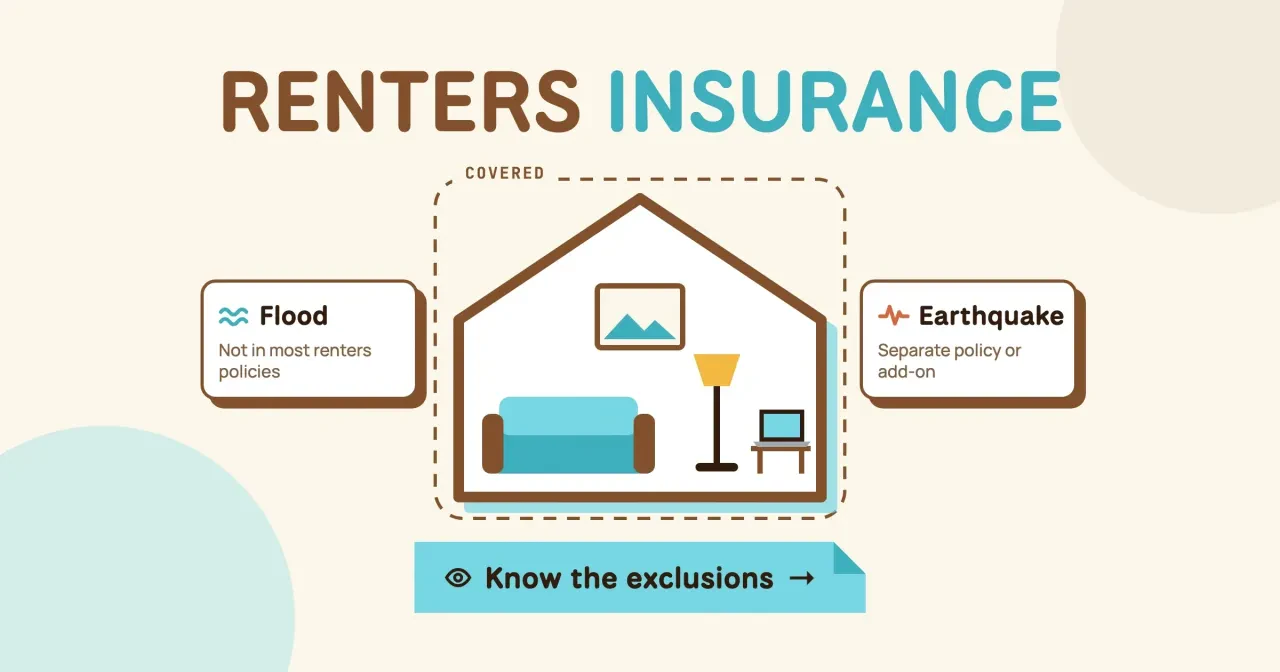
Renters insurance covers your belongings, your liability to others and extra living costs after a covered loss, but not the building, floods or earthquakes (as of October 2026). The replacement cost line decides whether a claim pays today's price, and in our example fire it was worth $1,839.29. List what you own first, then compare quotes line by line.
Your new lease wants proof of renters insurance before move-in. The two quotes in your inbox describe renters insurance coverage with terms like Coverage C, actual cash value and a deductible. Renters insurance is a policy that covers a tenant's belongings and personal liability, while the landlord's policy covers the building. This guide explains the rules; it isn't insurance advice. For your own policy, ask a licensed agent or your state insurance department, listed in the NAIC directory of state insurance departments.
First comes what renters insurance covers. Then we look at the actual cash value or replacement cost line, with an example inventory run through a local estimator. After that come the smaller limits inside your personal property limit, flood and earthquake, and loss of use and liability in dollars. The last sections cover a lease that asks for a policy, comparing two renters quotes, what MyWebInsurance.com says about itself, and filing a claim. Each rule is quoted from the Texas or California insurance department, the NAIC or FEMA, with the date we read the page.
Key takeaways
- In our October 2026 example, replacement cost paid $1,839.29 more than ACV.
- A replacement cost policy pays the second check after you replace items.
- Texas lists $500 for jewelry and watches as a common limit (October 2026).
- California's January 2026 guide lists loss of use as 20% of Coverage C.
- FEMA says NFIP flood policies typically start 30 days after purchase (October 2026).
What does renters insurance cover?
The answer splits at the walls: the Texas Department of Insurance says on its renters insurance page that "your landlord's insurance won't cover your personal items." The NAIC glossary defines renters coverage as contents coverage that "does not include the structure." So if a kitchen fire ruins the cabinets and your sofa, the cabinets go to the building owner's policy, and the sofa goes to yours. Texas also takes the coverage past your front door: its renters page says personal property coverage reaches "even items stolen out of your car or while you're traveling." That puts a laptop taken from a parked car under the renters policy, in TDI's description.
Inside the policy there are usually four parts, and the California Department of Insurance guide to homeowners and renters insurance (Form 401, revised January 2026) gives them letters:
- Coverage C, personal property: your belongings, at an amount you choose, "subject to a minimum as determined by your insurance company."
- Coverage D, loss of use: extra living costs while you can't live there, listed as "20% of Coverage C."
- Coverage E, personal liability: "Generally subject to a minimum of $100,000."
- Coverage F, medical payments to others: "Generally Subject to a minimum of $1,000."
Those are California's numbers as of October 2026, and another state's quotes may use different minimums, so check your own state's page first. If terms like premium and deductible are new to you, our explainer on what insurance is covers the basics.
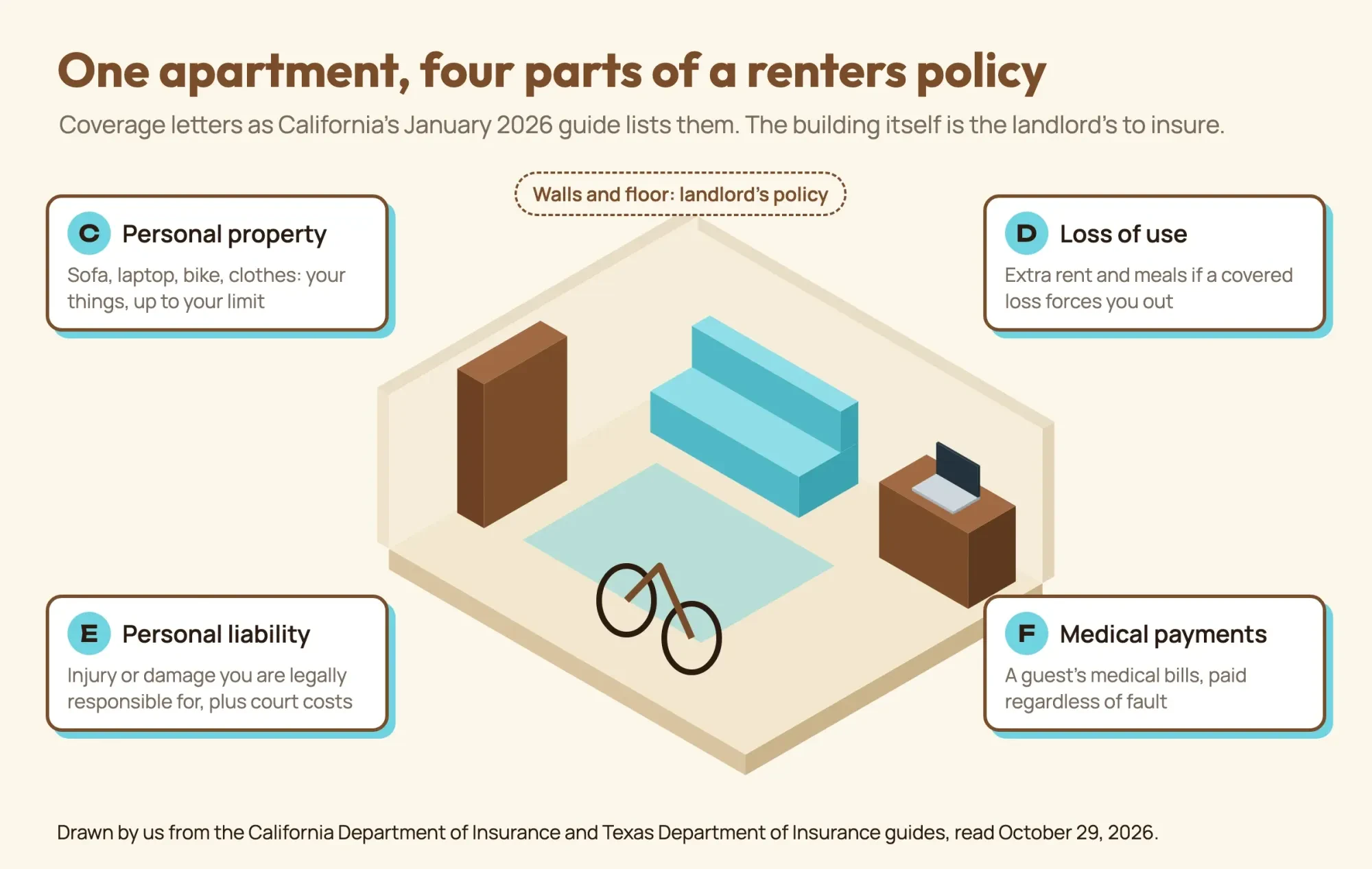 Drawn by us from the California and Texas insurance department guides, read October 29, 2026. Coverage letters follow the California guide.
Actual cash value or replacement cost: the line that changes the check
How much a claim pays per item comes down to one line on the quote. The NAIC glossary says actual cash value "in most cases" is "replacement cost minus depreciation," and the TDI home insurance guide uses the same formula. Replacement cost, per the glossary, is "the cost of replacing property without a reduction for depreciation due to normal wear and tear." TDI's renters page shows the gap with a laptop. You paid $1,300 two years ago, and the same kind now sells for $500. In TDI's words, "a basic renters policy would pay $500 if your laptop was destroyed."
Replacement cost coverage costs more, and TDI's home guide says it pays in two parts: "If you have replacement cost coverage, you'll get two checks." The first is the actual cash value, and the rest comes only after you've replaced the item, which is why TDI tells you to keep receipts.
We ran the same idea on a bigger example. Our made-up inventory has seven items worth $7,000 at today's prices, a $5,000 personal property limit, a $500 deductible and a $500 jewelry limit. The math works in four steps:
- Actual cash value per item = today's price × (1 − age ÷ expected life). The ring isn't depreciated in our example.
- Jewelry counts at no more than the $500 jewelry limit.
- The actual cash value policy pays the lower of (actual cash value total − $500) and the $5,000 limit.
- The replacement cost policy pays the lower of (today's total − $500) and $5,000, in two checks.
In the example fire, the items cost $7,000.00 today, and their actual cash value came to $4,360.71. The jewelry limit cut $700 and the deductible took $500, so the actual cash value policy paid $3,160.71.
The replacement cost policy paid $5,000.00, as checks of $3,160.71 and $1,839.29. Without the $5,000 limit, it would've paid $5,800.00. In the example burglary (laptop, bike and ring, $2,700.00 today), the policies paid $1,065.00 and $1,500.00, a $435.00 gap, since only the laptop and bike had lost value. That second check is money you front yourself, since the insurer pays it only after the replacements are bought and you can show what you paid. Putting them on a card has an interest cost, which our guide to financing purchases with a credit card works through.
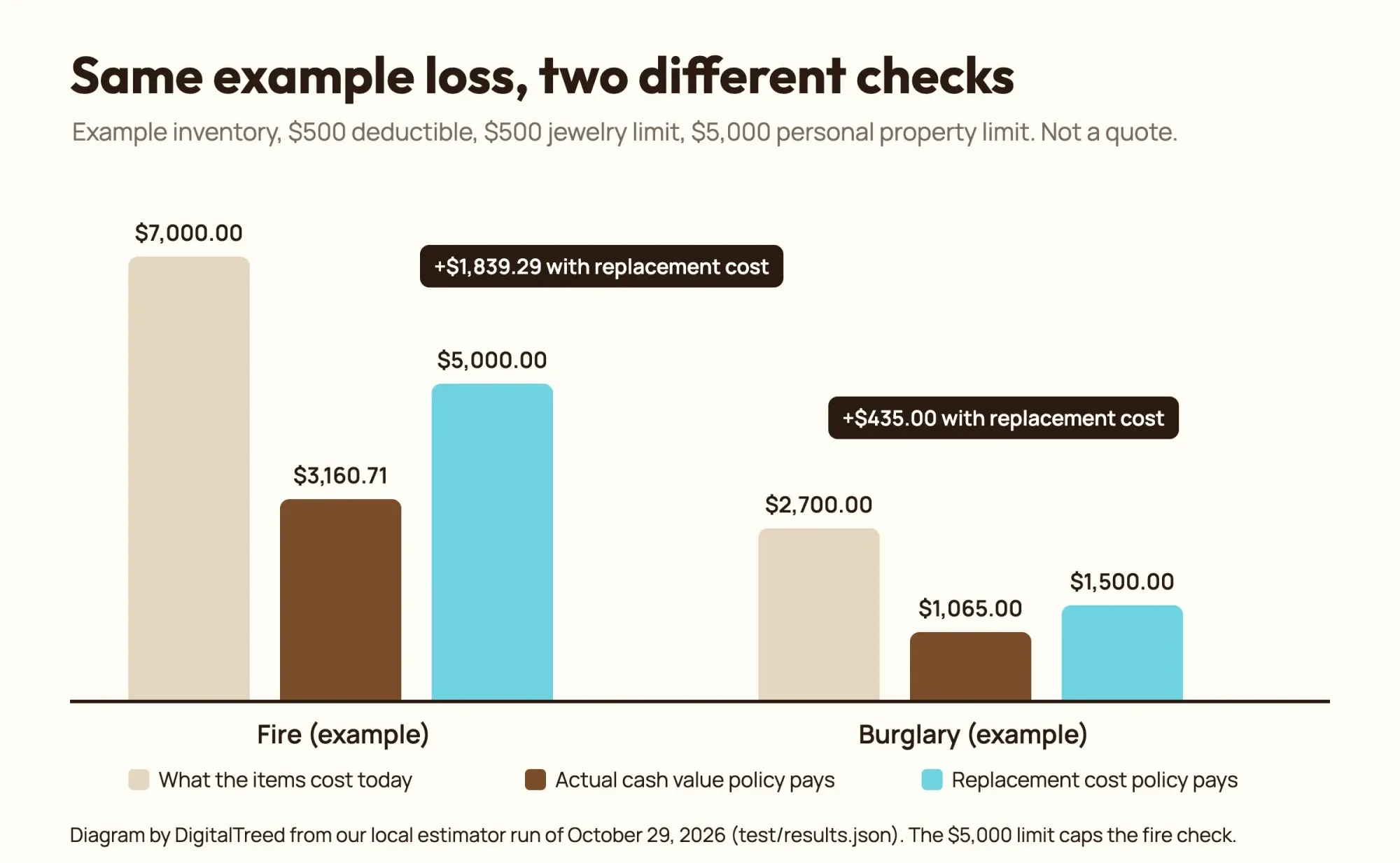 Diagram by DigitalTreed from our estimator run of October 29, 2026. Example inputs only; the $5,000 limit caps the fire check.
What we tested
We wrote the estimator in Python and ran it on 127.0.0.1 on October 29, 2026. Depreciation is straight-line, and that's our simplification; insurers use their own tables. A second copy in JavaScript, loaded in a browser, matched the Python run on all 14 values we compared.
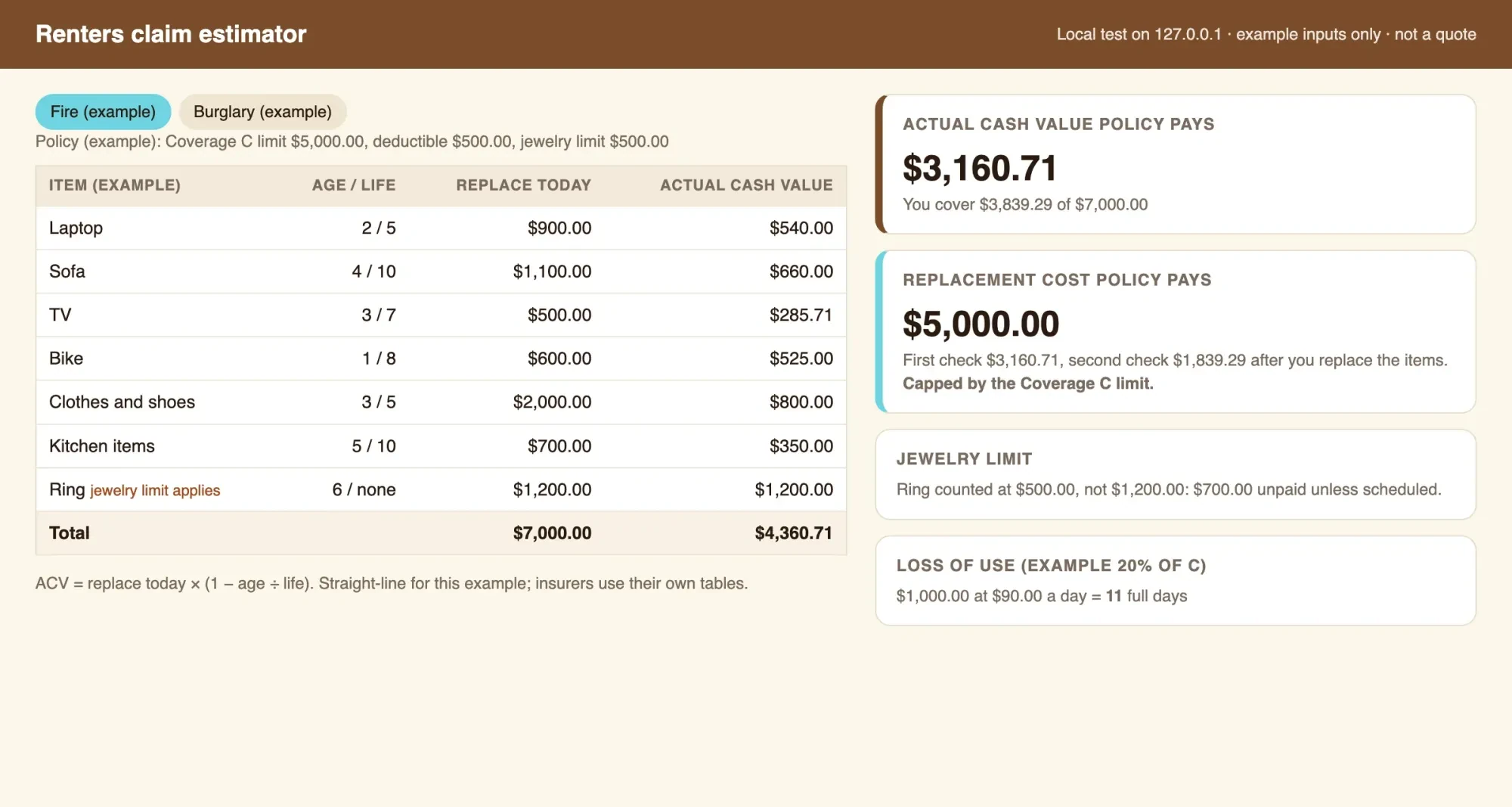 Screenshot: our renters claim estimator on 127.0.0.1, October 29, 2026, fire example. Invented inventory, not a quote.
The smaller limits inside your personal property limit
That ring points to a second thing a quote can hide: some kinds of property have their own, much lower cap. TDI's renters page says "Common limits are $100 for cash, $2,500 for items used for business, and $500 for jewelry and watches."
The NAIC homeowners insurance page says most policies limit theft of furs or jewelry to $500, and it puts firearms or computers at "probably $1000." California's guide explains why this matters. These limits "are included in the overall contents limit," so they don't add money on top. They cap what one kind of item can draw from it. The fix it names is an endorsement, "sometimes referred to as a 'rider' or a 'floater'," that lists a valuable item at its own value. In our example, the $1,200 ring had no rider and lost $700.
Work gear is the other common gap. The NAIC says that if you store business inventory or supplies at home, "it is not likely covered." TDI lists $2,500 as a common limit for business items. If you sell crafts from a spare room or keep a client's laptop at home, ask the agent how that property is handled before anything happens to it. None of these limits helps if you don't know what you own. The NAIC suggests a list by room or category, with receipts, model and serial numbers, and photos or video.
Keep a copy outside the apartment, and if a phone is easier than a spreadsheet, the NAIC's Home Inventory app builds the same list with photos. The California home inventory page warns that after a loss, it's hard to remember everything you had.
Flood and earthquake need their own coverage
Water claims split by where the water came from. TDI says most renters policies cover "certain kinds of water damage" along with fire, smoke and theft, and the NAIC's homeowners page says damage from leaky pipes "is likely covered."
Flood water from outside is different. The NAIC flood insurance page says "flood peril is not typically covered through most homeowners and renter's insurance policies." TDI's renters page agrees.
Renters can still buy flood coverage, though it's a separate policy. FEMA's flood insurance page says the National Flood Insurance Program "provides flood insurance to property owners, renters and businesses." Its fact sheet on basement coverage adds that contents coverage "must be purchased separately." California's guide gives the size as of October 2026: "Renters may also purchase up to $100,000 of coverage for their personal belongings." Timing's what matters most. FEMA says "there is typically a 30-day waiting period for an NFIP policy to go into effect." The NAIC and TDI pages give the same 30 days. Damage before the start date isn't covered, the NAIC says, so a policy bought once a storm is forecast can start too late.
Earthquake follows a similar pattern. The NAIC says no standard insurance policy covers catastrophic earthquake damage, and companies offer an earthquake endorsement for an extra premium.
The California Earthquake Authority renters page says that "in most cases, damage to your home from an earthquake is not covered by a renters insurance policy." In California, it adds, "a separate policy is needed." Ask each quote whether it's an endorsement or a separate policy.
Loss of use and liability, in dollars
Coverage D and Coverage E pay costs rather than things: the hotel after a fire, or a guest's medical bill. Both have limits. Loss of use, which TDI calls additional living expenses, covers "rent, food, and other costs you wouldn't have if you were still in your home."
That coverage stops at a dollar limit, and past that point, TDI warns, "you'll have to pay the rest of your additional living expenses out of your own pocket." A percentage limit is easy to work out. California lists loss of use as "20% of Coverage C." With our example $5,000 personal property limit, that's $1,000 (0.20 × $5,000). At an example $90 a day in extra costs, it covers 11 full days ($1,000 ÷ $90 = 11.1). TDI notes that repairs can sometimes take months. Since only the extra counts, it helps to know your normal weekly food spending, the number our grocery budget guide builds.
Liability protects your savings rather than your stuff. TDI's home guide says it pays medical bills, lost wages and other costs for people you're legally responsible for injuring. "It also pays your court costs if you're sued because of an accident." The NAIC says the coverage "follows you wherever you go," with exceptions "such as auto or boating accidents." A crash on the way home goes to your auto policy instead, the case our after-a-car-accident steps walk through. One more NAIC warning: a policy "may exclude liability coverage for certain breeds of dogs or exotic pets," so dog owners should find that clause by name.
Medical payments to others is simpler. It'll pay for guests' injuries up to a limit per person and per accident, and the NAIC says "payment is made regardless of legal liability." A guest who trips on your rug can get a doctor's bill paid without anyone proving fault.
When your lease asks for a policy
Whether you must carry it depends on the lease, and TDI's renters page says: "Renters insurance isn't required by law. Some landlords might require you to have a renters policy."
That's Texas's statement as of October 2026, so for any other state, open that state's insurance department page from the NAIC directory and look for its renters guide. Then read the clause for what it actually asks. If it names a liability amount, match it against Coverage E on the quote. If it asks for proof, the declarations page is the part of the policy that lists your coverages and limits. TDI adds a check of its own: "Make sure the policy you buy will pay to replace your personal property." Anything you can't match to a line on the quote is worth asking the landlord about in writing.
Two renters quotes, compared line by line
Once the lease is clear, comparing quotes means putting the same lines side by side. California's guide tells shoppers to "compare prices, policy coverage and conditions, and complaint information." The NAIC's homeowners page names your state insurance department, consumer publications and your public library as unbiased sources on what insurers charge for identical coverage. We turned those pages into the 11-line sheet below. Fill in both columns first, and don't look at the premium until the end. The deductible line is a trade-off the NAIC spells out: "a policy with a $100 deductible will cost more than one with a $250 deductible."
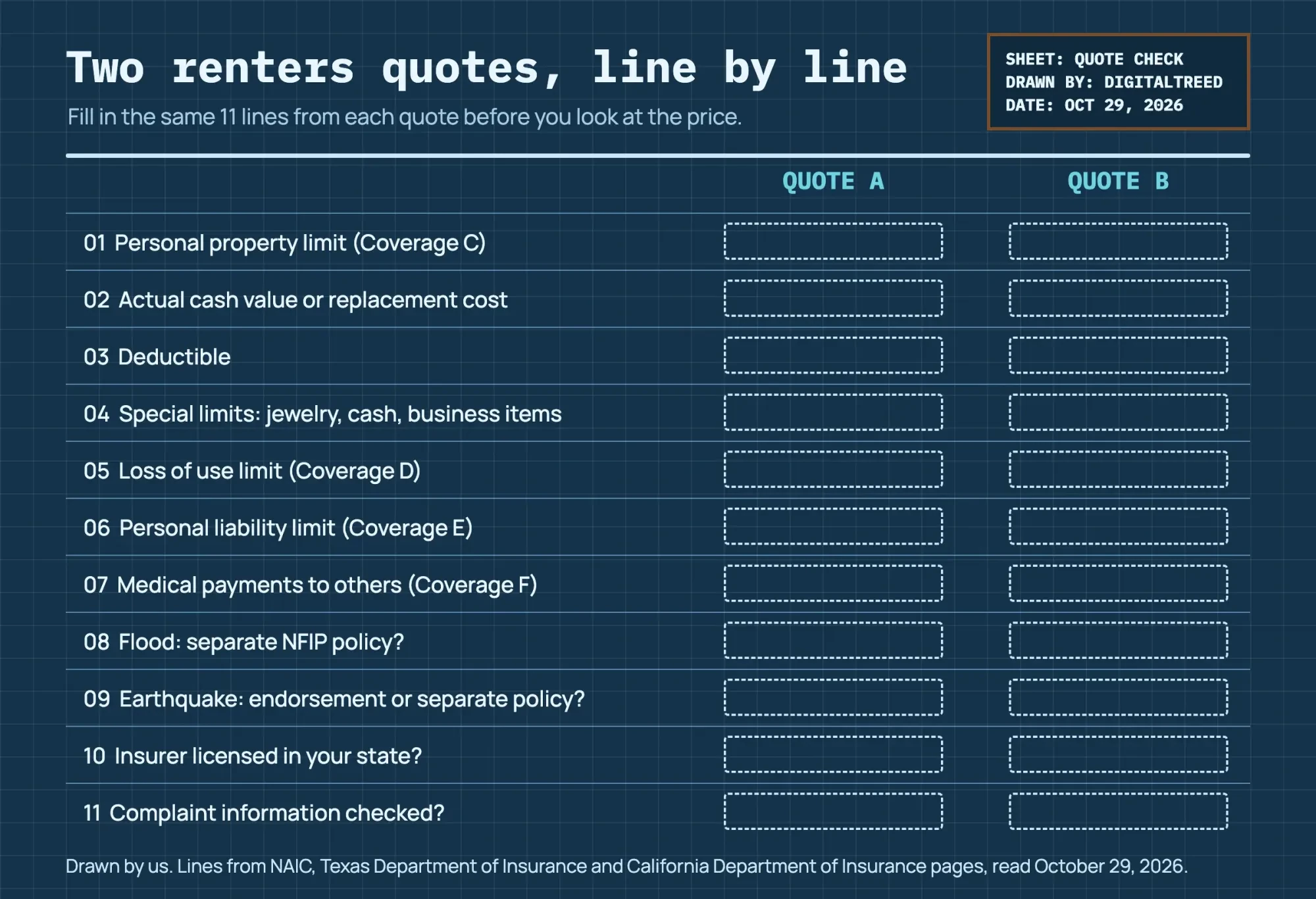 Drawn by us. The 11 lines come from NAIC, Texas and California insurance department pages read October 29, 2026.
In our example, every check shrank by the $500 deductible. With an example $1,000 deductible instead, the example fire's actual cash value check drops from $3,160.71 to $2,660.71 ($4,360.71 − $700 − $1,000). If $1,000 at claim time is a stretch, the monthly saving math in our article on getting rich quick, realistically applies to a deductible fund too.
Then check the company, not just the price. The NAIC's Consumer Insurance Search searches insurance companies by name.
The NAIC also asks users "to also check your state's insurance department website to confirm the Company or HMO is licensed." Agents can be checked too, and California's license status search shows "the license status and discipline history" of agents, brokers and adjusters by name or license number.
Some states help with price as well. California's guide says "CDI premium surveys can help with premium comparison," and TDI's home guide points Texans to HelpInsure.com for company discounts.
A quote form asks for your name and home address, so read the domain before typing them. Our guide to telling a lookalike finance website from the real one shows how to read the address and look up the domain record before typing anything.
MyWebInsurance.com's home page and disclaimer
This page's address carries the MyWebInsurance.com name, so we read two of its pages on October 29, 2026: the home page and the disclaimer.
The MyWebInsurance.com home page is titled "MyWebInsurance.com Official Site: Auto, Home, Life & Health Insurance." It lists articles such as "Renters Insurance 101: What Every Renter Should Know," and says its tools "allow consumers to compare quotes from top insurance providers." Its disclaimer page states: "MyWebInsurance.com is not a licensed insurance agency, broker, or carrier." It also has an affiliate disclosure. If you click a link "and make a purchase or request a quote, we may earn a commission at no additional cost to you." Before buying through any site, run the insurer and any agent named on the quote through your state's license search.
Filing a claim, and where to complain
After a loss, the first steps decide how smoothly the claim goes. TDI's home guide lists them in this order:
- List the damaged property, and take photos or video before any repairs.
- Make only temporary repairs: "The insurance company might deny your claim if you make permanent repairs before it sees the damage."
- Keep receipts for replacements, since "you may need to prove to the insurance company that you replaced destroyed items."
- Keep receipts for extra living costs too, which California's guide also asks for.
Texas also puts the insurer on a clock: under Texas law, as TDI describes it, your company must tell you it got the claim within 15 days. It must then accept or deny it "within 15 business days of getting all the information it needs from you," and a denial must explain why in writing. TDI says it must then "send you a check within five business days after it agrees to pay your claim." A company that needs more time can take 45 days to decide, TDI says, as long as it tells you the reason.
When you and the insurer disagree, the NAIC complaint guide says to try the company first. Next comes your state department of insurance, which "can investigate complaints for free." In Texas, that's the TDI help line at 800-252-3439. If talking it through doesn't work, TDI's home guide lists further options, and California's guide points readers to the CDI Hotline. If the claim leaves rent or bills unpaid in the meantime, our financial emergency options guide puts the free and low-cost help in order.
On two real quotes, the inventory gives the Coverage C number to ask for. The replacement cost line, the special limits and any rider are the lines you'll compare before the premium. In our example, that line was worth $1,839.29 on a fire, and a rider would've covered the $700 the ring lost.
Renters insurance questions
Frequently asked
Does my parents' homeowners policy cover my things at college?
Possibly. TDI says a dependent's things may be covered by the parents' homeowners policy. "This coverage is usually limited to 10% of the personal property coverage in the homeowners policy."
Is water from a burst pipe the same as a flood?
No. The NAIC's homeowners page says "water damage from leaky pipes, siding and roofs is likely covered, but ground-water damage from rain, run-off or snow-melt is not."
Does renters insurance cover mold or pests?
Often not. The NAIC's homeowners page says policies "often exclude covering the cost of damage from mold" and that termite or rat damage is "not typically covered."
What if I disagree with the adjuster?
TDI says to tell the insurer why first. In Texas you can also hire a public adjuster, who charges fees, and TDI notes that "public adjusters must have a TDI license."
How we made this guide: Each coverage rule was matched against two public pages, mostly from the Texas and California insurance departments, the NAIC, FEMA and the California Earthquake Authority. Where only one page states a rule, we quote it. We also read two MyWebInsurance.com pages. Our estimator ran on 127.0.0.1 with an invented inventory, and its browser copy matched on 14 of 14 values. Facts checked by the DigitalTreed team on October 29, 2026.
First published April 2025 as a renters insurance overview under the MyWebInsurance.com name. Rewritten October 29, 2026 around the policy lines that change a claim check, with a tested estimator.
Sources
- NAIC: Homeowners Insurance consumer page
- NAIC: Flood Insurance consumer page
- NAIC: Glossary of Insurance Terms
- NAIC: Home Inventory
- NAIC: How to File a Complaint
- NAIC: State Insurance Departments directory
- NAIC: Consumer Insurance Search
- FEMA: Flood Insurance
- FEMA: What Does Flood Insurance Cover in a Basement
- Texas Department of Insurance: Renters insurance, what does it cover
- Texas Department of Insurance: Home insurance guide
- California Department of Insurance: Residential Insurance, Homeowners and Renters (January 2026)
- California Department of Insurance: Home Inventory
- California Department of Insurance: Check License Status
- California Earthquake Authority: Renters
- MyWebInsurance.com: home page (read October 29, 2026)
- MyWebInsurance.com: disclaimer (read October 29, 2026)


Comments
No comments yet. Start the conversation below.