
Quick answer
As of November 12, 2026, technoexpress.in opens a sign-in sales app called TechnoExpress POS, not tech articles, on a domain registered July 28, 2026. Archived pages of the 2021-2023 Techno Express blog name no owner. Of 9 claims in our 2023 Technoexpress.in review, 0 were fully backed and 2 partly. Before trusting any overseas review site, check its registry record, paid-link labels and the maker's US page.
This Technoexpress.in review replaces our December 2023 post and asks whether the site's tech news and buy links deserve trust today. Technoexpress.in is a web address under India's .in country domain, and Wayback Machine captures show it running a WordPress tech blog called Techno Express from December 2021 to November 2023.
Those blog pages now exist only as archive captures. Our view: treat any article, price or buy link under this name as unverified. Buy only once the maker's own page agrees.
Key takeaways
- Technoexpress.in now loads a sign-in sales app, not tech articles.
- The current registration began July 28, 2026, long after the blog stopped.
- Of 9 claims in our 2023 review, 0 were fully backed, 2 partly.
- The FTC says a paid-link label belongs right next to the link.
- Check the US model number and FCC ID on the maker's pages first.
Technoexpress.in today: a sign-in app, not a news site
On November 12, 2026, a plain request to technoexpress.in got a normal 200 answer with almost nothing in it. The 1,092-byte page holds the title TechnoExpress, an empty app container and one script. Its server header reads X-Robots-Tag: noindex, nofollow, which asks search engines to leave the page out of results. Its robots.txt file says Disallow: / to every crawler, so whoever runs it doesn't want it found through search at all. The plain HTTP address hands visitors to the HTTPS one through an Amazon Web Services load balancer.
The site's web app manifest, the small file that lets a site install like a phone app, names it TechnoExpress POS. It describes the app as "works offline for sales" and opens it at /express, and POS here means point of sale, the checkout software a shop runs at the counter. We read the app's one script as plain text and didn't run it. It lists a /login page and 97 app paths for sales, reports, finance and admin, and its 53 GST mentions point to invoice screens for India's Goods and Services Tax. Signing in wasn't an option for us, since it's a shop's private system.
The registry record for technoexpress.in shows the current registration began on July 28, 2026 and runs to July 28, 2029, through GoDaddy. It lists the registrant as a business in Karnataka, India. No person is named. The IANA entry for .in lists the National Internet Exchange of India as manager of the whole .in domain.
| Where we looked | How | Result (November 12, 2026) |
|---|---|---|
| technoexpress.in (HTTPS) | Plain request | 200: a 1,092-byte app shell titled TechnoExpress, marked noindex, nofollow |
| Web app manifest | Plain request | Name: TechnoExpress POS; start page /express |
| robots.txt | Plain request | Disallow: / for every crawler |
| App script | Text match only | Sign-in, sales, reports and GST invoice screens |
| www and .co.in names | DNS lookup | NXDOMAIN: no such name in DNS |
| Registration data (RDAP) | RDAP query | Registered July 28, 2026; a business in Karnataka, India; no person named |
| Wayback Machine | Archive captures | Tech blog 2021-2023; redirects to unrelated sites in 2024 |
Two look-alike names, www.technoexpress.in and technoexpress.co.in, returned NXDOMAIN, the DNS answer for a name that doesn't exist.
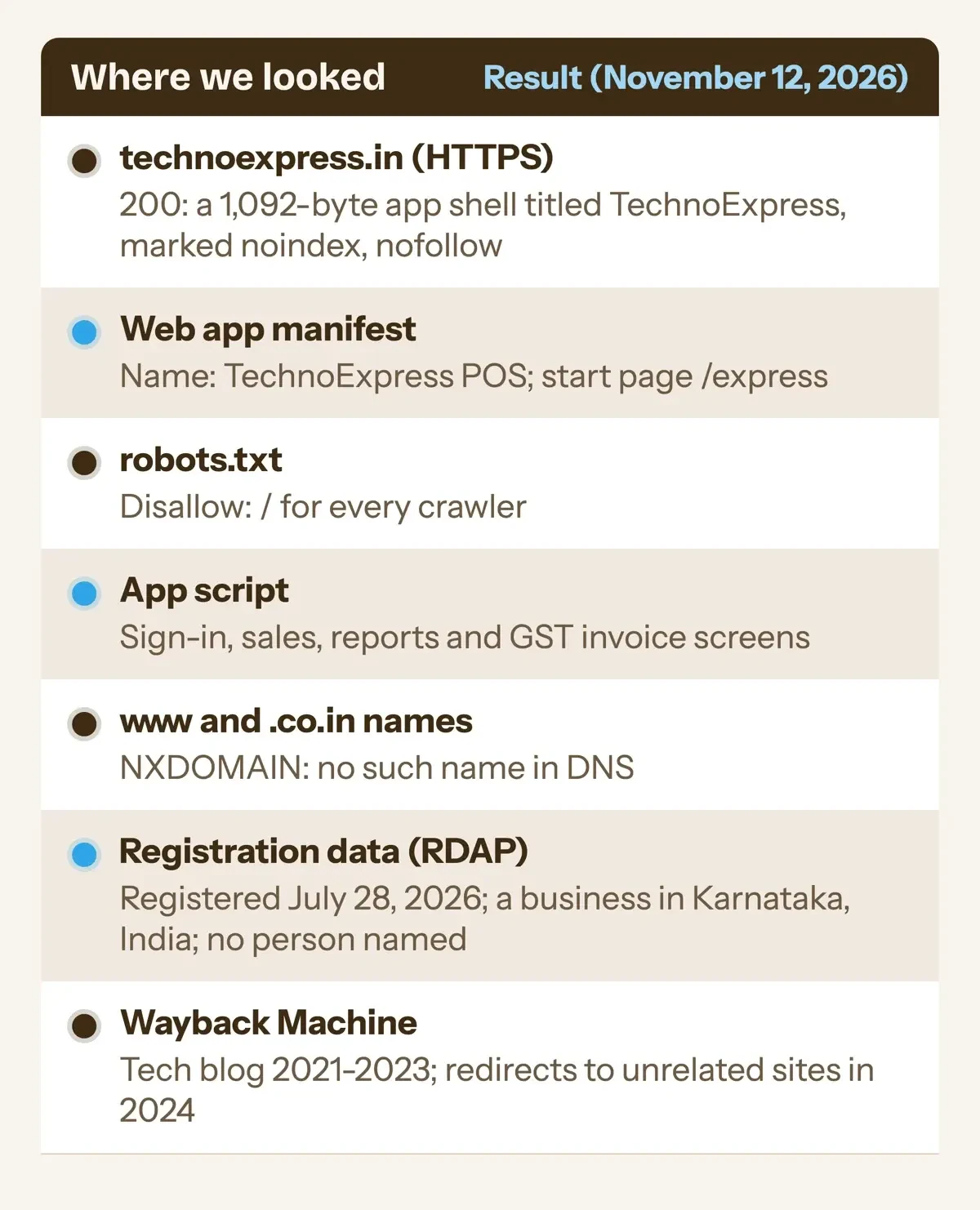 Diagram by DigitalTreed of the seven address, registry and archive checks we ran on November 12, 2026.
What we tested
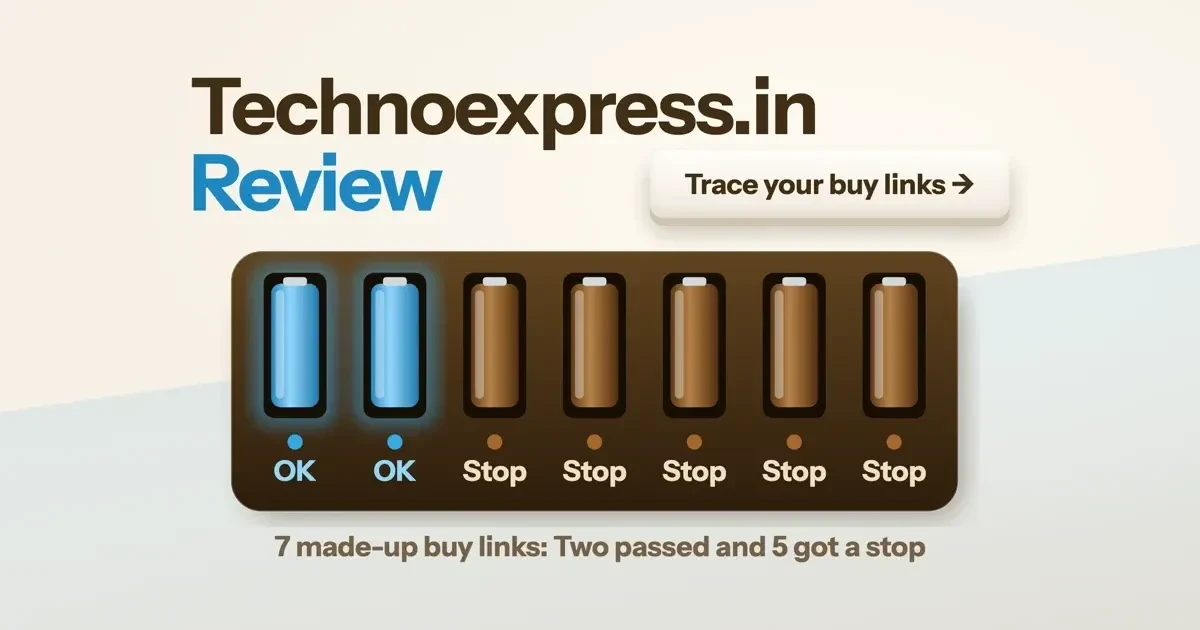
Three small scripts ran on November 12, 2026, each sending plain requests under a DigitalTreed name; one handled the DNS, web, registry and archive checks listed earlier. A second matched 9 claims from our 2023 post against 8 saved pages from the site: 0 backed, 2 partly backed and 7 not found. A third served a made-up earbuds review with 7 buy links on 127.0.0.1, our test machine, and traced each one. Two passed and 5 got a stop.
What the 2021-2023 Techno Express blog published
Because the live address shows no articles, the blog survives only in the Wayback Machine. It holds 12 home page captures with a normal answer, from December 26, 2021 to November 28, 2023. The three we opened are titled "Techno Express - Let's Connect With Tech World," and their page code shows WordPress with Google's Site Kit plugin. The November 2023 capture lists eight categories: Computer, Crypto, Games, Mobile, Movies Updates, News, Status and Technology. Its newest monthly archive is February 2023. That's nine months before the capture.
No byline appears on the three home pages we saved, and the 2022 contact page gives only a Gmail address, with no person or company name. Its fine print names a different website as the one that "reserves the right to remove any content received from users/readers". That points to a copied template. The disclaimer is stock text calling everything "published in good faith and for general information purpose only." Neither page mentions affiliate links or sponsored posts.
Captures from July 22, September 16 and December 6, 2024 show the address forwarding visitors elsewhere with a 301 redirect. The July one went to a Linktree contact page for an adult-entertainment brand, while the later two went to a Google results page for a French dating term.
The archive can't tell us who set those up, or whether the old registration had lapsed by then.
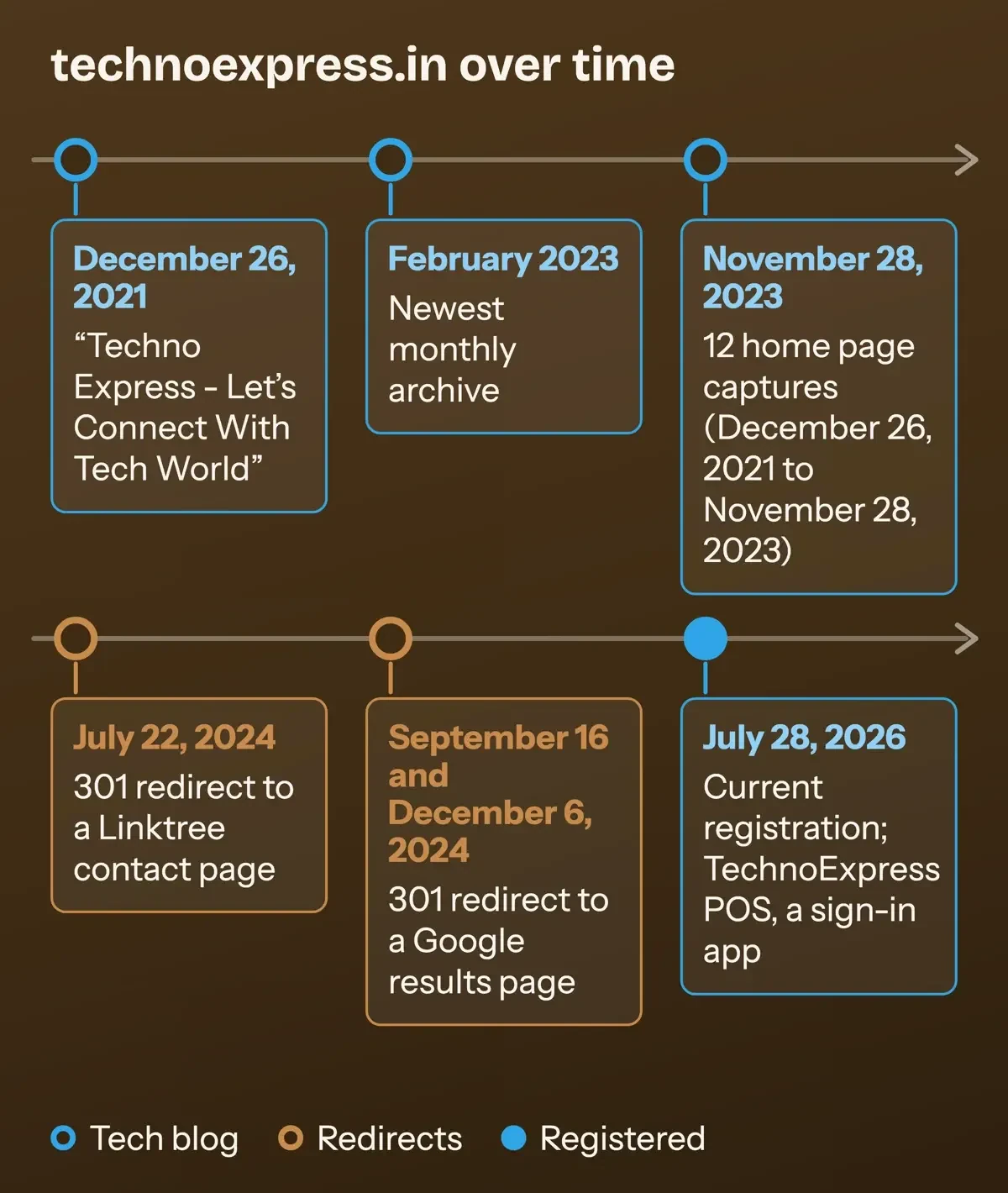 Diagram by DigitalTreed, from Wayback Machine captures and the .in registry record, read November 12, 2026.
Our 2023 post's owner story, a "Lawrence Stubbs" with "over 20 years of experience", isn't on any page we saved. Nothing else we found confirms it. Of the topics it promised, only the Mobile and Crypto categories partly match the saved pages.
| Claim in our 2023 post | What the saved pages show |
|---|---|
| The owner is Lawrence Stubbs, with 20+ years in tech | No name on any page we saved; the contact page lists only a Gmail address |
| The owner runs an IT services company | Not found |
| It covers cell phone reviews | A Mobile category exists; no review wording found |
| It covers cryptocurrency updates | A Crypto category exists |
| It covers AI and network security | Not found |
| A team of experts writes in-depth analysis | No bylines, author pages or team page found |
| E-commerce, finance and healthcare benefited | Not found; nothing on the pages backs it |
The archive holds the home, contact and disclaimer pages, not every article, so a claim could sit on a page we never saw.
Who runs an overseas tech site?
Unlike the archive, a site's registry record shows when the current holder took the name, which makes it the quickest public clue to who runs it. Before reading it, rule out a fake address; our guide to telling a lookalike finance site from the real one shows the tricks. For a country domain like .in, start at IANA's RDAP server list, which sends .in lookups to the registry's own server at rdap.nixiregistry.in. ICANN Lookup covers .com and other generic names. Our checker couldn't read its script-built page. Our Cookape site check walks through reading one of these records line by line.
Read three dates: registration, last change and expiry. A registration newer than the articles you're reading means the name changed hands, as it did here in 2026. Say an earbuds review is dated 2023 and the domain was registered in 2026: whoever runs the site now didn't write that review and doesn't stand behind it. Google's spam policies name the reuse of old domains. They define expired domain abuse as when "an expired domain name is purchased and repurposed primarily to manipulate search rankings." The March 5, 2024 Search Central post announced that rule alongside two others. We're not saying technoexpress.in broke it. The record shows only that the name meant different things in different years.
Contact pages are the second check. This one listed only a Gmail address and another site's name, so we couldn't trace an editor.
How can you tell if a tech review is paid?
In the US, paid reviews fall under the Endorsement Guides the FTC enforces. Their section on material connections, 16 CFR 255.5(a), says a tie that could sway a review, if readers wouldn't expect it, "must be disclosed clearly and conspicuously." Free products count. In one example, a tool maker sends an influencer a lathe "in the hope that the influencer would post about it," and the influencer should still disclose it.
For commissions, the FTC's answers to common endorsement questions say "The closer the disclosure is to your recommendation, the better." They add that a label reading Paid link placed "right next to an affiliate link should be an adequate disclosure", but "a “buy now” button would not be adequate." For a clean setup from the publisher's side, read our guides to labeling and placing affiliate links and automating review requests within FTC rules.
Section 255.1(d) of the Guides' general rules also holds advertisers liable "for failing to disclose unexpected material connections between themselves and their endorsers." The FTC's June 29, 2023 announcement of the updated Guides warned that a platform's built-in disclosure tool "might not be an adequate disclosure."
For hands-on claims, the FTC's reviews rule at 16 CFR 465.2 bars selling a review that misstates "That the reviewer or testimonialist used or otherwise had experience with the product." An overseas site may never answer to a US regulator, so use these rules as your own yardstick when you read one. By that yardstick, the three Technoexpress.in home pages we saved never use the words "affiliate" or "sponsored." This is a summary, not legal advice; for a dispute, talk to a US consumer attorney.
Check ads and buy links without clicking through
Even with a paid label in place, a link can land somewhere else. The FBI's December 21, 2022 IC3 warning described criminals buying search ads that lead to copies of real brand sites. It warned that "A malicious domain name may be similar to the intended URL but with typos or a misplaced letter." The FTC's advice on malware adds that "Scammers place bogus ads for software on social media sites and on search engines."
On a computer, hover over a link to read its address first. On a phone, long-press it.
To see where buy links really end, our script served a made-up earbuds review with 7 buy links on 127.0.0.1. It then followed each redirect one step at a time with HEAD requests, and for one link it also read our own local page once, to spot a page-level redirect. A HEAD request asks a server where a link goes without loading the page or running its scripts. Every shop in the test uses a reserved .example name that can't resolve on the real internet.
| Made-up link | Hops | Lands on | Paid label | Result |
|---|---|---|---|---|
| Maker's page: maker.example/x200 | 0 | maker.example | No | OK |
| Buy at store.example: store.example | 2 | store.example | Yes | OK |
| Buy at store.example: store.example | 3 | store.example | No | Stop: passes through a tracking redirect with no paid-link label |
| Deal at store.example: store.example | 1 | st0re.example | Yes | Stop: lands on st0re.example, not store.example |
| Get the companion app: Download app | 2 | 127.0.0.1 | No | Stop: file download (application/vnd.android.package-archive) |
| Price check: See today's price | 1 | 127.0.0.1 | No | Stop: page-level redirect (meta refresh); HEAD trace stops |
| Coupon: Get coupon | 2 | none (loop) | No | Stop: redirect loop |
Only two links passed: the direct one to the maker's page and the labeled two-hop affiliate link. One went through three tracking hops with no label, and another promised store.example but landed on st0re.example, with a zero where the o should be. The last three led to an app file download, a page-level redirect our trace couldn't follow, and a loop.
If a buy link ends anywhere you didn't expect, stop there and type the shop's address yourself. If you already tapped a bad one, our steps after clicking a suspicious link cover PC, Mac and phone.
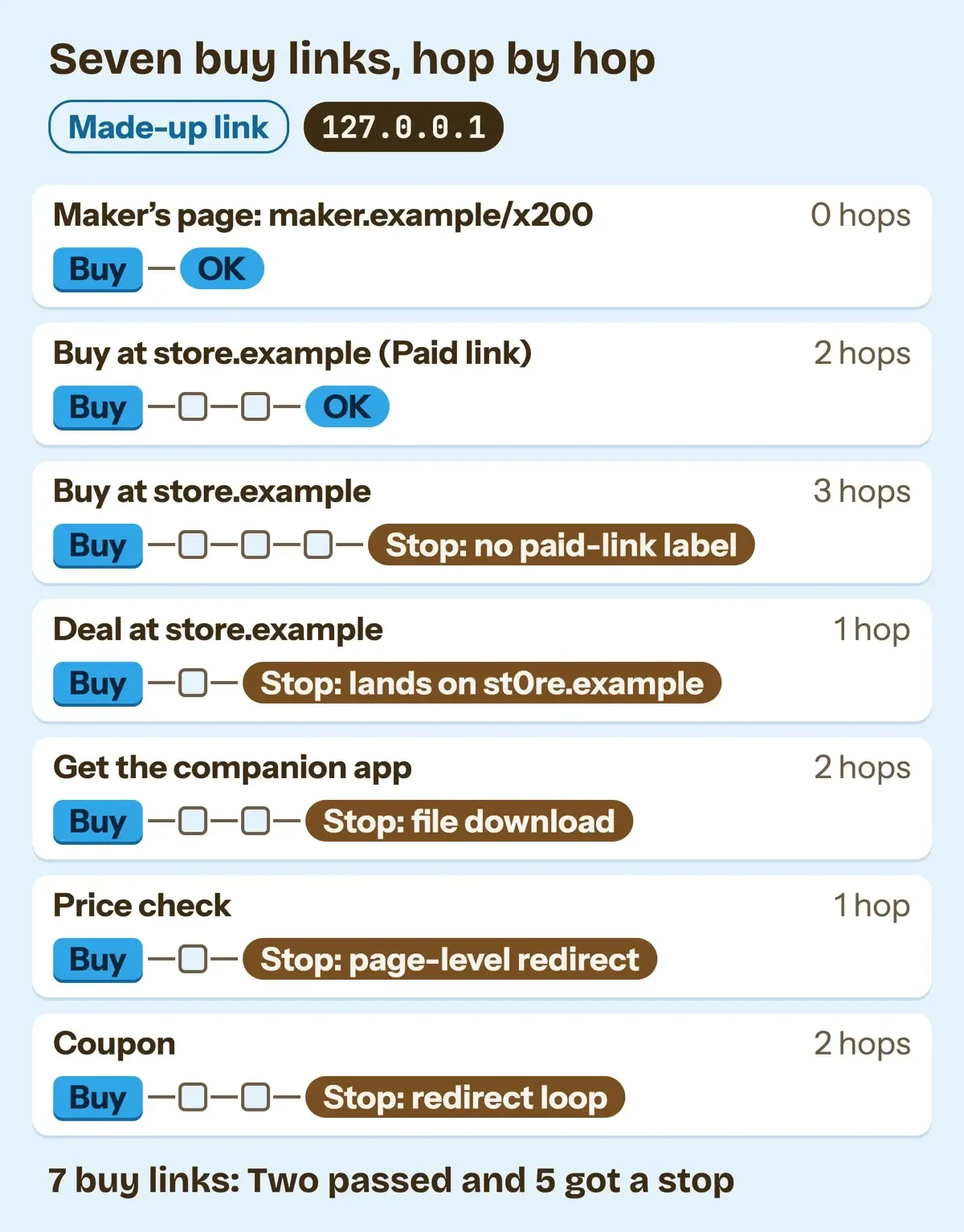 Drawn by us from our local buy-link trace on 127.0.0.1 with 7 made-up links, November 12, 2026.
Confirm a product claim on the maker's US page
Even an honest overseas review may describe a model the US never gets. Apple's Identify your iPhone model page, read November 12, 2026, lists the iPhone Duo as model A3447 for the "United States, Puerto Rico". Other buyers get A3719, A3721 or A3720, depending on the country. Radio gear adds a US rule. Under 47 CFR 2.803, "No person may market a radio frequency device" without a valid FCC equipment authorization. 47 CFR 2.925 requires a label code "preceded by the term FCC ID in capital letters". The FCC also has an FCC ID page, which sent our checker a 403 bot-block, so we didn't see what it offers.
For orders shipped from abroad, CBP's internet purchases page says imported goods "must clear CBP and may be subject to the payment of duty." The FTC's warranty guide says a warranty "must be available for you to read before you buy", online or in a store.
We'd run these five checks on the maker's or a US agency's page, never on the review site's own summary.
- Find the US model number on the maker's US site and match it to the listing.
- Look for the code after the words FCC ID on the label photo.
- Read the warranty for the country where the seller ships from.
- Search the CPSC recall list for the exact model.
- Ask the seller in writing who pays duty and return shipping.
The CPSC recalls page searches US product recalls by name. If the seller is a shop you've never heard of, read our online store check first. Our steps to cancel a subscription and dispute a charge help if a payment goes wrong, and the four checks for must-read blogs work on tech sites too.
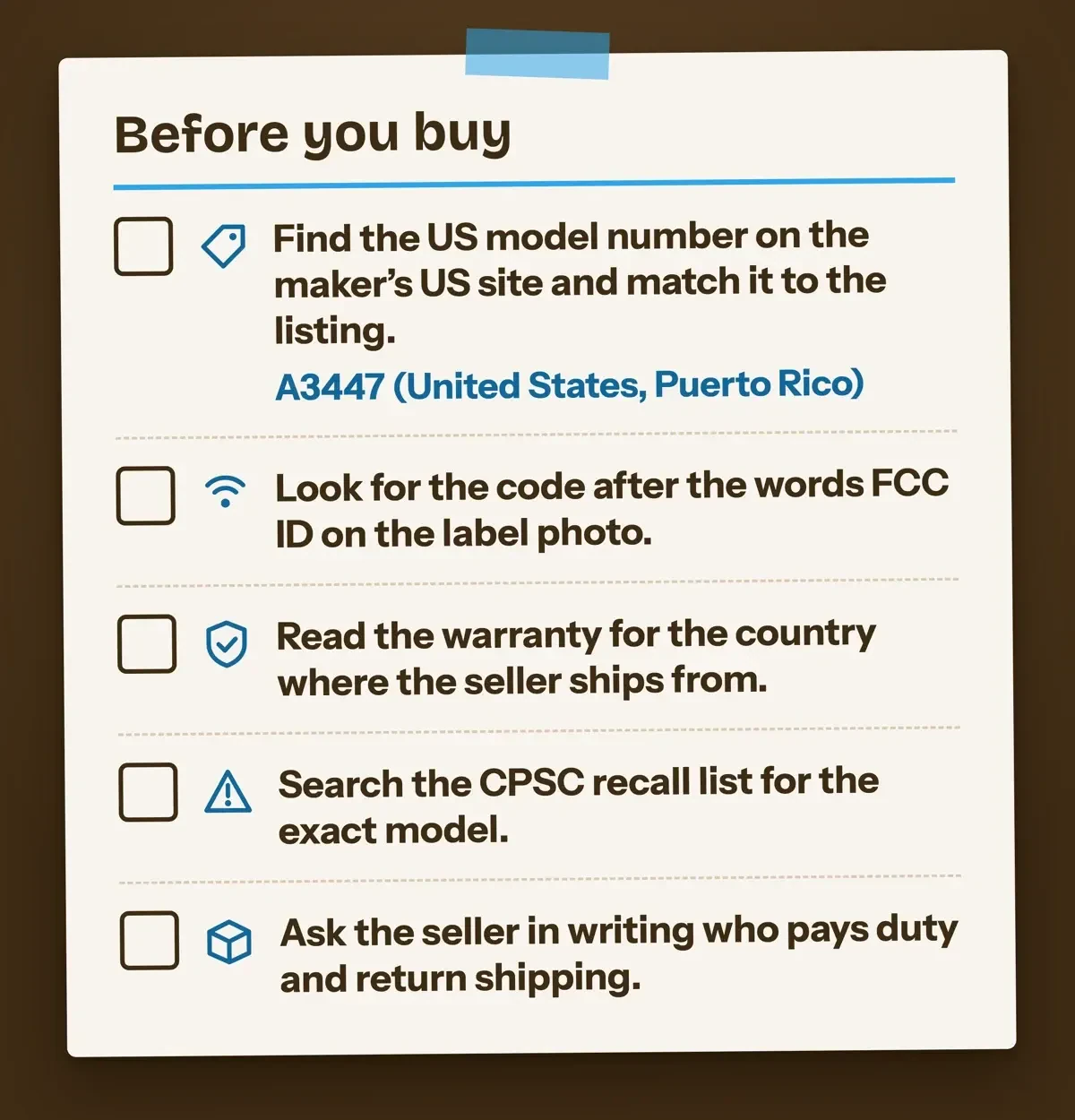 Drawn by us from Apple, FTC, CBP and CPSC pages and the FCC rules in 47 CFR, read November 12, 2026.
Frequently asked
Is technoexpress.com the same site as technoexpress.in?
Nothing we found links them. The Verisign record for technoexpress.com shows its own registration from December 22, 1999. Its home page served a Cloudflare bot check to our script, and we didn't try to get past it.
Who owns technoexpress.in?
The public record names a business in Karnataka, India, as registrant since July 28, 2026, with no person named. Per IANA, the .in registry itself is run by the National Internet Exchange of India.
Will a US warranty cover a phone bought from an overseas site?
Not always. Apple's US iPhone warranty says Apple "may restrict warranty service" for iPhone and iPad "to the country where Apple or its Authorized Distributors originally sold the device."
Where can I complain about an overseas website?
The FTC points to econsumer.gov, which it says "provides a platform to gather and share cross-border e-commerce complaints" and started in 2001. Its own page is built by script, so our checker didn't read it.
How we made this guide: Plain requests to technoexpress.in, its .in registry record and its Wayback Machine capture list. A script matched our old post's claims to saved pages, and a local trace ran on made-up buy links. Facts checked by the DigitalTreed team on November 12, 2026.
First published December 16, 2023 as a short review praising technoexpress.in. Rewritten November 12, 2026 after registry, archive and buy-link checks.
Sources
- NIXI RDAP: technoexpress.in registration record
- IANA Root Zone Database: .in
- IANA: RDAP bootstrap list for DNS
- Verisign RDAP: technoexpress.com registration record
- ICANN Lookup
- Internet Archive: Wayback Machine
- Google Search Central: Spam policies for Google web search
- Google Search Central Blog: March 2024 core update and new spam policies
- 16 CFR 255.5: Disclosure of material connections
- 16 CFR 255.1: General considerations
- FTC: FTC's Endorsement Guides, What People Are Asking
- FTC: Updated Advertising Guides to Combat Deceptive Reviews and Endorsements (June 29, 2023)
- 16 CFR 465.2: Fake or false consumer reviews and testimonials
- FBI IC3: Cyber Criminals Impersonating Brands Using Search Engine Advertisement Services
- FTC: Malware, How To Protect Against, Detect, and Remove It
- 47 CFR 2.803: Marketing of radio frequency devices
- 47 CFR 2.925: Identification of equipment
- FCC: FCC ID page
- Apple Support: Identify your iPhone model
- Apple: iPhone One (1) Year Limited Warranty (US)
- FTC: Warranties
- U.S. Customs and Border Protection: Internet Purchases
- CPSC: Recalls
- FTC: International Consumer Protection and Privacy
- econsumer.gov


Comments
No comments yet. Start the conversation below.