

Quick answer
There is no single best time to post on Facebook. Five vendor studies name five different slots, and 4 of them pick a Tuesday, Wednesday or Thursday. Start mid-week in your audience's local time, then check the recommended times Meta shows when you schedule a post.
Search "best time to post on Facebook" and you get a different answer on every page. Buffer says Thursday at 9 a.m., while Hootsuite says Tuesday at 5 a.m. Both are scheduling-tool companies reading their own customers' posts.
This guide puts those studies side by side, with how each one was made. Then it shows how to find your own best time in Meta's tools, convert it across US time zones and test it in 4 weeks.
Key takeaways
- No single best time exists; five vendor studies name five different slots.
- Four of the five studies pick a Tuesday, Wednesday or Thursday.
- Meta's scheduler shows recommended times based on when your followers are most active.
- Write post times as ET or PT, not EST or PST.
- Test two slots on your own Page for 4 weeks before deciding.
Key facts
- Every big study comes from a company that sells a scheduler, and 4 of the 5 measured their own users. Adobe Express read top creators.
- Sprout Social's study covers about 2 billion engagements on 307,000 profiles, from November 27, 2025 to February 27, 2026 (Sprout Social).
- Buffer analyzed 14 million+ Facebook posts and names Thursday at 9 a.m. as the best slot (Buffer).
- Hootsuite gives Tuesday at 5 a.m. on its Facebook page and Tuesday at 9 a.m. on its all-networks page, from the same study.
- Meta lets you schedule a Page post from 20 minutes to 29 days ahead (Facebook Help Center).
- Daylight saving time ends Sunday, November 1, 2026, under 15 U.S.C. 260a, so write "ET", not "EST", for summer posts.
What is the best time to post on Facebook?
The best time to post on Facebook is the hour your own followers are online, and no study can tell you that for your Page. Meta's scheduler shows it as recommended times, based on when your followers are most active. Studies give you a starting slot to test, not a rule.
Four of the 5 studies below put their top slot on a Tuesday, Wednesday or Thursday. Sprout Social found the strongest window from 12 to 8 p.m. local time. Buffer and Hootsuite pick early morning, and PostPlanify picks noon ET.
Our take: start with a weekday post between 9 a.m. and 1 p.m. in your customers' time zone. Then let your own numbers move it.
5 Facebook timing studies compared, with their methods
Here are the 5 studies we read on October 22, 2026, with how each one was made. All 5 are vendor data. None is a random sample of US small-business Pages.
| Study (vendor data) | What was measured | Data dates | Time basis | Best slot | Best day |
|---|---|---|---|---|---|
| Sprout Social, March 2026 | About 2 billion engagements, 307,000 profiles on 6 networks | Nov 27, 2025 to Feb 27, 2026 | Local time | Tue and Wed, 12 to 8 p.m. | Tuesday, Wednesday |
| Buffer, October 2026 | 14 million+ Facebook posts sent via Buffer | Not stated | Local time | Thursday, 9 a.m. | Wednesday |
| Hootsuite, November 2025 | 1 million+ posts on all networks | Not stated | Localized, 118 countries (chart files say Q4 2024 data) | Tuesday, 5 a.m. | Tuesday |
| Adobe Express, November 2025 | 40,000+ posts from the top 100 creators | Not stated | Not stated | 4 a.m. and 12 p.m. (views) | Saturday |
| PostPlanify, January 2026 | 11,000+ posts on its own platform | Trailing year | US Eastern | Noon ET | Tuesday |
The table shows each study's own headline. Adobe Express studied big creators, not businesses, so its Saturday result fits a different kind of Page. PostPlanify is the only one stated in US Eastern time.
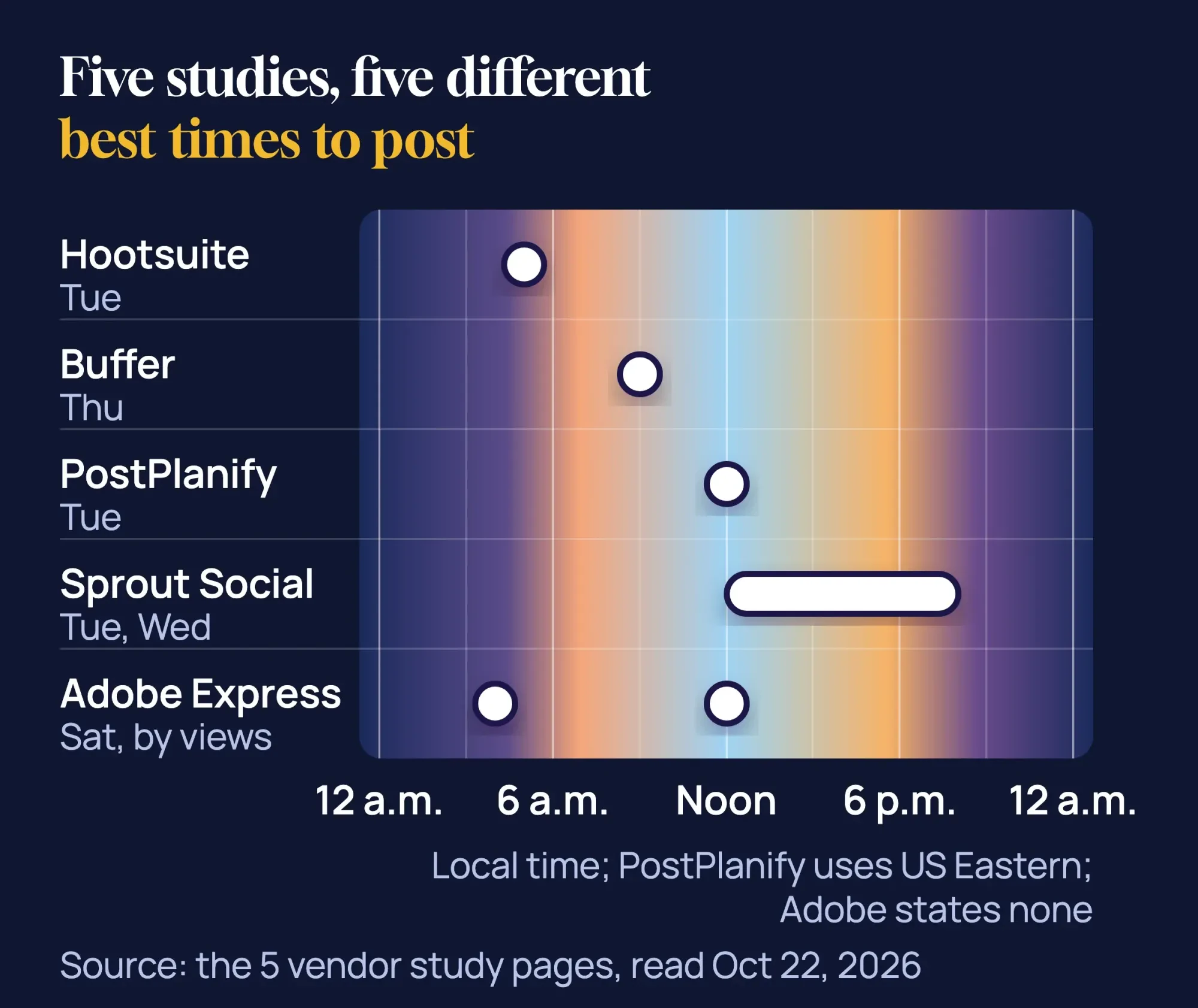 Source: Sprout Social, Buffer, Hootsuite, Adobe Express and PostPlanify study pages, October 2026. Chart by DigitalTreed.
Even one vendor can give two answers. Hootsuite's Facebook page says Tuesday at 5 a.m. Its all-networks page, published the same day from the same study, says Tuesday at 9 a.m.
Day by day, the gap is wider. Buffer's best Monday slot is 9 p.m., while Hootsuite's is 5 p.m. On Saturday, Buffer says 10 p.m. and Hootsuite says 6 a.m.
Best day and time to post on Facebook, day by day
Here is each study's best hour for each day, read on October 23, 2026. Buffer, Hootsuite and Sprout Social all give these in your audience's local time. All 3 are vendor data from their own users.
| Day | Buffer best (runner-up) | Hootsuite best | Sprout Social best |
|---|---|---|---|
| Monday | 9 p.m. (10 p.m.) | 5 p.m. | 12 to 1 p.m. |
| Tuesday | 8 a.m. (7 p.m.) | 5 a.m. | 12 to 8 p.m. |
| Wednesday | 8 a.m. (9 a.m.) | 6 a.m. | 12 to 8 p.m. |
| Thursday | 9 a.m. (8 a.m.) | 6 a.m. | 12 to 2 p.m. and 8 p.m. |
| Friday | 8 a.m. (7 a.m.) | 6 a.m. | Midday |
| Saturday | 10 p.m. (6 a.m.) | 6 a.m. | No peak |
| Sunday | 10 a.m. (9 a.m.) | 8 a.m. | Hard to define, low all day |
Buffer and Hootsuite lean toward mornings from Tuesday to Friday. Sprout leans toward lunch and the hours after. Weekends are weak in both Buffer and Sprout: Buffer calls Saturday the worst day, and Sprout says Sunday.
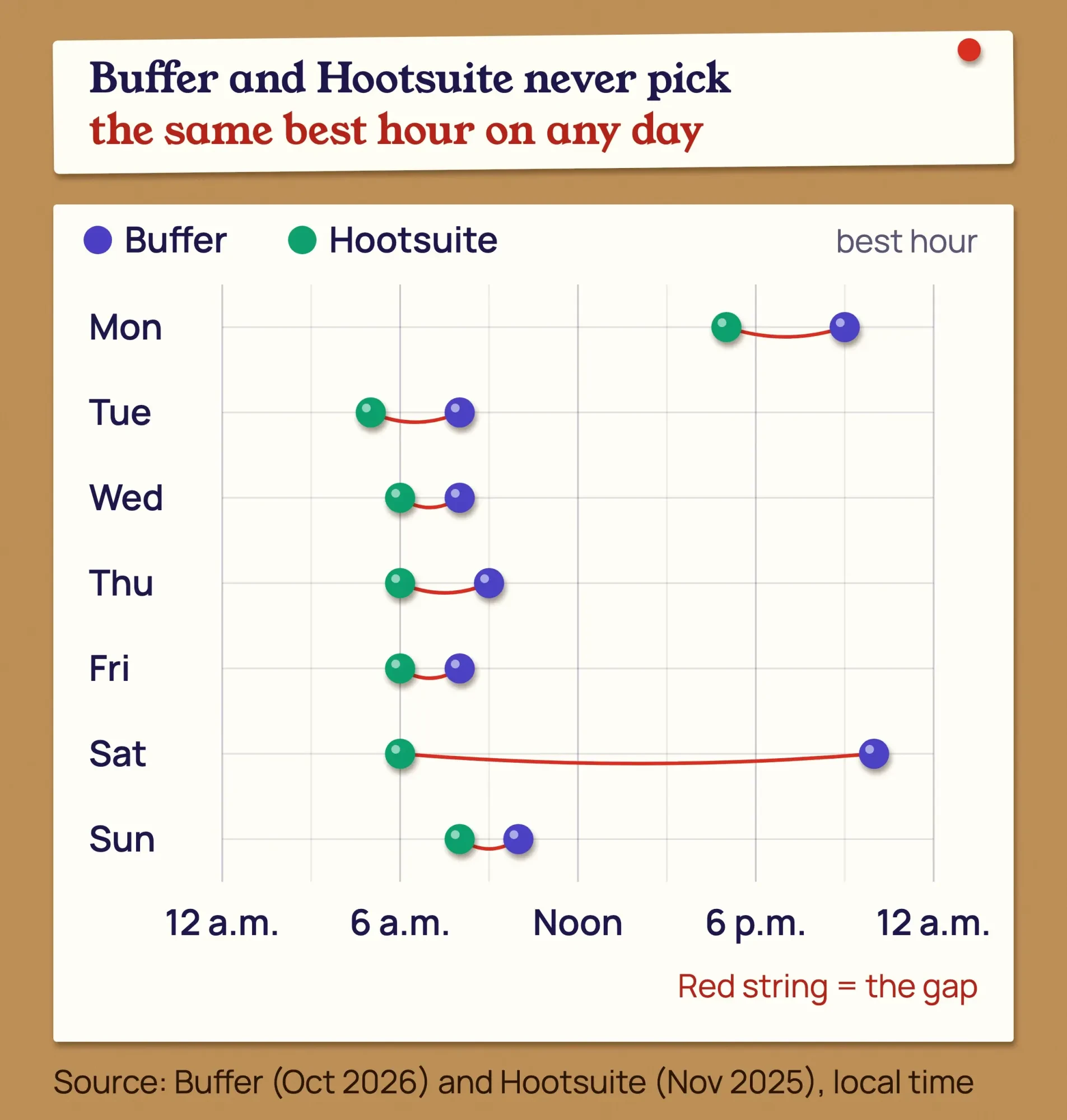 Source: Buffer best time to post on Facebook (October 2026) and Hootsuite (November 2025), local time. Chart by DigitalTreed.
Why do the studies disagree?
The studies disagree because each one measured a different crowd, in a different season, with a different method. None drew a random sample of US small-business Pages, so each headline time says most about that vendor's own users. Four reasons stand out:
- Who was measured. Four vendors read their own customers, and Adobe read top creators. Sprout's 307,000 profiles cover 6 networks, not Facebook alone.
- When. Only Sprout gives exact dates, and its window is November to February, which includes US holidays.
- How. Buffer charts median engagement. Adobe uses averages, which a few viral creator posts can pull up.
- Why. Each page ends with a pitch for the vendor's own scheduler.
The vendors even disagree on the weak hours. Buffer says afternoons from 12 to 5 p.m. "consistently show the lowest engagement." Sprout puts its best window right there.
Does your industry change the best time?
Yes, and the studies split here too. Sprout Social breaks its data into 9 industries, and Hootsuite into 13.
For food and beverage, Sprout's peak is Tuesday and Friday from 10 a.m. to 3 p.m., and weekends are the worst. Hootsuite's best for dining and hospitality is Sunday from 10 a.m. to noon.
Retail splits the same way. Sprout picks Monday to Wednesday from 9 a.m. to 1 p.m., and 10 a.m. to noon on Thursday and Friday. Hootsuite picks 5 to 6 p.m. on Tuesday and Thursday, and 8 to 10 a.m. from Wednesday to Saturday.
Does posting time matter if the Feed is not in time order?
A little, because Facebook's Feed is ranked, not shown in time order. Meta's Facebook Feed AI system card says it scores about 500 posts and orders them by predicted value to each person. So posting at the "right" minute does not guarantee reach.
Timing still decides which followers are online while your post is fresh. The card also says people can click "Following" to see posts from accounts they follow in reverse time order.
Shares and reactions still help a post travel. See our guide to how Facebook's share algorithm works, and our tips on increasing reach on Facebook. Planning a giveaway to lift engagement? Our guide to Facebook giveaway rules explains why share-to-enter breaks Meta's policy.
How to find your best time to post on Facebook in Meta's tools
Meta doesn't publish one best time. It points you to your own followers instead. Meta's mobile scheduling help page says you can "use the recommended times, which are based on when your followers are most active on Facebook."
These 5 steps find your Page's recommended posting times and your best past posts.
- Open the scheduler. From your Page, click Meta Business Suite in the left menu, then click Create post.
- Turn on scheduling. Next to Scheduling options, turn on the Set date and time toggle.
- Check Active times. Click Active times to see recommended publication times, then pick a date and time.
- Schedule it. Click Schedule. You can schedule a post between 20 minutes and 29 days ahead.
- Review your top posts. In Insights, note the day and hour of your 5 best posts by Views and Engagement.
The steps follow Meta's help page on scheduling posts. It also notes that "all times for scheduling correspond to your current time zone." So check your device's time zone before you trust a slot.
Step 5 uses Insights. Meta's Insights help page says Performance shows the last 7, 14 or 28 days. Audience data needs "at least 100 followers who are not also friends." A brand-new Page may not see it yet.
Insights for a single post are "available as soon as the post is published," per Meta's post insights page. For the full monthly review, see our social media marketing strategy for small businesses.
Facebook also has a "best time to post" answer page, but it is labelled "Summarized by Meta AI" from user posts. It is not Meta guidance. Even that AI summary page sends you back to your own Insights.
Which US time zone should you post in?
Post for the time zone where most of your customers live. Write the slot as ET or PT, not EST or PST, so it stays right all year. Sprout, Buffer and Hootsuite all say their times are the audience's local time.
For a local shop, that is your own time zone. For a national seller, check Top cities in Audience insights. The follower insights steps are on Meta's help site.
Watch the clock change. Under 15 U.S.C. 260a, daylight saving time runs from the second Sunday of March to the first Sunday of November. In 2026 it ends Sunday, November 1, and starts again Sunday, March 14, 2027.
So "9 a.m. EST" in July is wrong, because the East Coast is on EDT. Write "ET" all year. The US Department of Transportation notes that Hawaii and most of Arizona don't observe daylight saving time.
| Time zone | Example city | 9 a.m. ET, until Nov 1, 2026 | 9 a.m. ET, Nov 1 to Mar 14, 2027 |
|---|---|---|---|
| Eastern | New York | 9 a.m. EDT | 9 a.m. EST |
| Central | Chicago | 8 a.m. | 8 a.m. |
| Mountain | Denver | 7 a.m. | 7 a.m. |
| Arizona (no DST) | Phoenix | 6 a.m. | 7 a.m. |
| Pacific | Los Angeles | 6 a.m. | 6 a.m. |
| Alaska | Anchorage | 5 a.m. | 5 a.m. |
| Hawaii (no DST) | Honolulu | 3 a.m. | 4 a.m. |
We worked out the table from the federal rules above. Only Arizona and Hawaii shift against Eastern time when the clocks change.
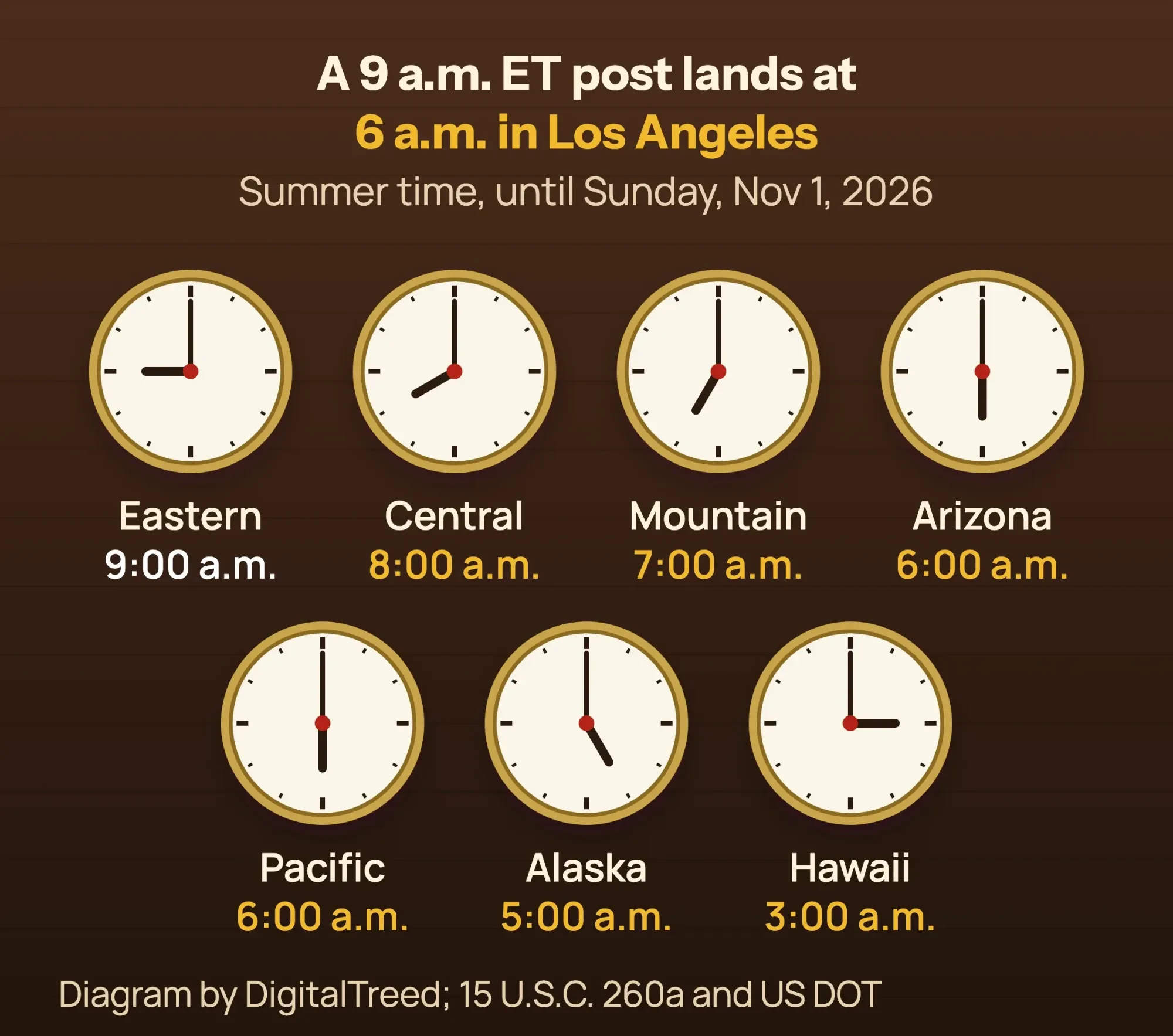 Diagram by DigitalTreed, based on 15 U.S.C. 260a and the US DOT, for summer 2026 time.
Our take for customers on both coasts: post at noon ET. That is 9 a.m. in Los Angeles, so neither coast gets an overnight post.
How to test the best time for your business in 4 weeks
A test on your own Page beats every study above. Here is a simple one that takes about 15 minutes a week.
- Pick 2 slots: your Active times pick and one study slot, such as Wednesday at 8 a.m.
- Post the same kind of content in both, 2 or 3 posts per slot over 4 weeks.
- Tag each slot's website link with its own utm_content value, such as wed-0800et and wed-1200et.
- Compare the median Views and Engagement per post, not the totals.
- Keep the winner, and test again each season, since daylight saving shifts habits.
Step 3 is quick: build your tagged links with our free UTM builder. Pick the Facebook page preset, paste your page URL, add the campaign name, then type the slot in Content. To match each post with the right button and wording, use our Facebook call to action button picker.
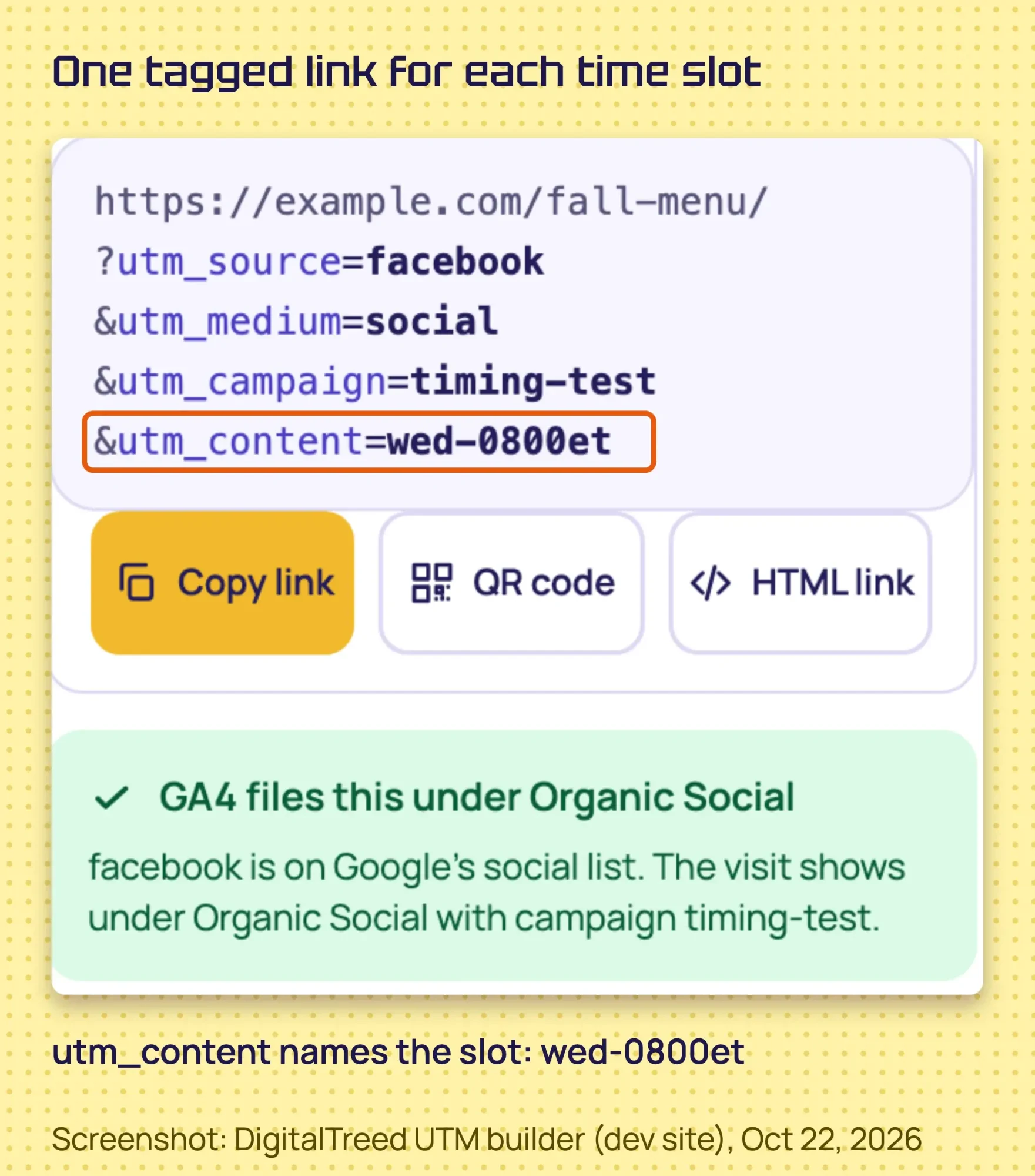 Screenshot: DigitalTreed UTM builder on our dev site, October 22, 2026.
Google Analytics then shows visits from each slot under its content value. Our Google Analytics 4 guide shows where to find that report.
Keeping this test going every week is the hard part. If you'd rather hand it off, our social media marketing team can plan, schedule and test your posts. (DigitalTreed sells this service.)
Example: a taco truck in Phoenix
Example: Rosa runs a made-up taco truck in Phoenix, Arizona, with 640 local followers. Phoenix stays on MST all year, so in July it is 3 hours behind New York.
Buffer's "Wednesday 8 a.m." means 8 a.m. in Phoenix for her, since it is local time. Meta's recommended time when she schedules a post is 11 a.m.
She posts at 8 a.m. on 2 Wednesdays and 11 a.m. on 2 others, with tagged menu links. She keeps the slot with the higher median views per post.
Want more ways to reach nearby customers? Read our guide to hyperlocal social media marketing.
Common timing mistakes
- Copying one vendor's exact minute as if it were a rule.
- Writing "EST" in summer, when the East Coast is on EDT.
- Posting for your own time zone when your customers live in another.
- Judging a slot on one post.
- Comparing total reach instead of results per post.
- Treating the Meta AI answer page as Meta policy.
If you're unsure which number to compare, our guide to engagement vs. reach on Facebook explains the difference.
Frequently asked
What is the best day to post on Facebook?
Buffer says Wednesday, Sprout says Tuesday and Wednesday, and Hootsuite says Tuesday. Adobe found Saturday for big creators. Start mid-week, then test.
What is the best time to post on Facebook today?
Find today in the day-by-day table above, then open your scheduler and check Active times. Meta's recommended time is based on your own followers.
What is the best time to post Reels on Facebook?
No big study separates Facebook Reels. Buffer says its analysis looks at Facebook posts as a whole. Test Reels in your own Insights.
Is it better to post on Facebook in the morning or evening?
The studies split. Buffer finds weekday mornings from 6 to 11 a.m. strong, while Sprout's Tuesday and Wednesday peak runs from noon to 8 p.m. Test one slot of each.
Should a business post on Facebook on weekends?
Two big studies say weekends are weak. Buffer calls Saturday the worst day, and Sprout says Sunday. But Hootsuite found Sunday late morning best for dining and hospitality.
What is the worst time to post on Facebook?
The studies disagree. Sprout names 4 to 7 a.m., Hootsuite's all-networks page names midnight to 4 a.m., and Buffer names afternoons from 12 to 5 p.m.
How often should a business post on Facebook?
Meta for Creators says posting consistently gives people a reason to return. For a weekly plan, see our social media marketing strategy for small businesses.
Your next step
This week, open Meta Business Suite, click Create post and check Active times. Write that slot down next to one study slot, and start the 4-week test. Running two Pages for one business? See how to merge or delete a duplicate Facebook Page.
If you want the testing and posting done for you, our social media marketing team can take it on.
How we made this guide: we read the 5 studies, Meta's help pages and Feed system card, and 15 U.S.C. 260a on October 22, 2026. We checked every number against the source named next to it that day. We built the UTM screenshot on our own tool the same day. Sources are linked inline.
First published July 2023. Rewritten October 2026: 5 studies compared with their methods, and Meta's recommended times. New: a US time-zone table, the November 1, 2026 clock change and a 4-week test. Updated October 23, 2026: added a day-by-day table, industry times and 2 FAQs. Updated October 25, 2026: added a sourced Key facts list, direct answers under the question headings and Meta's steps as a numbered list.
Sources
- Sprout Social: Best times to post on Facebook in 2026 (vendor)
- Buffer: Best time to post on Facebook (vendor)
- Hootsuite: The best time to post on Facebook (vendor)
- Hootsuite: Best time to post on social media (vendor)
- Adobe Express: Best time to post on Facebook (vendor)
- PostPlanify: Best times to post on Facebook (vendor)
- Facebook Help Center: Schedule a post for your Page
- Meta Business Help Center: Create and schedule Facebook posts
- Meta Business Help Center: Insights on your Facebook Page
- Facebook Help Center: See insights for your Page posts
- Facebook Help Center: See insights about your Page's followers
- Meta Transparency Center: Facebook Feed AI system
- Meta for Creators: Best practices for growing your Facebook presence
- 15 U.S.C. 260a, Advancement of time (Cornell LII)
- US Department of Transportation: Daylight Saving Time


Comments
No comments yet. Start the conversation below.