
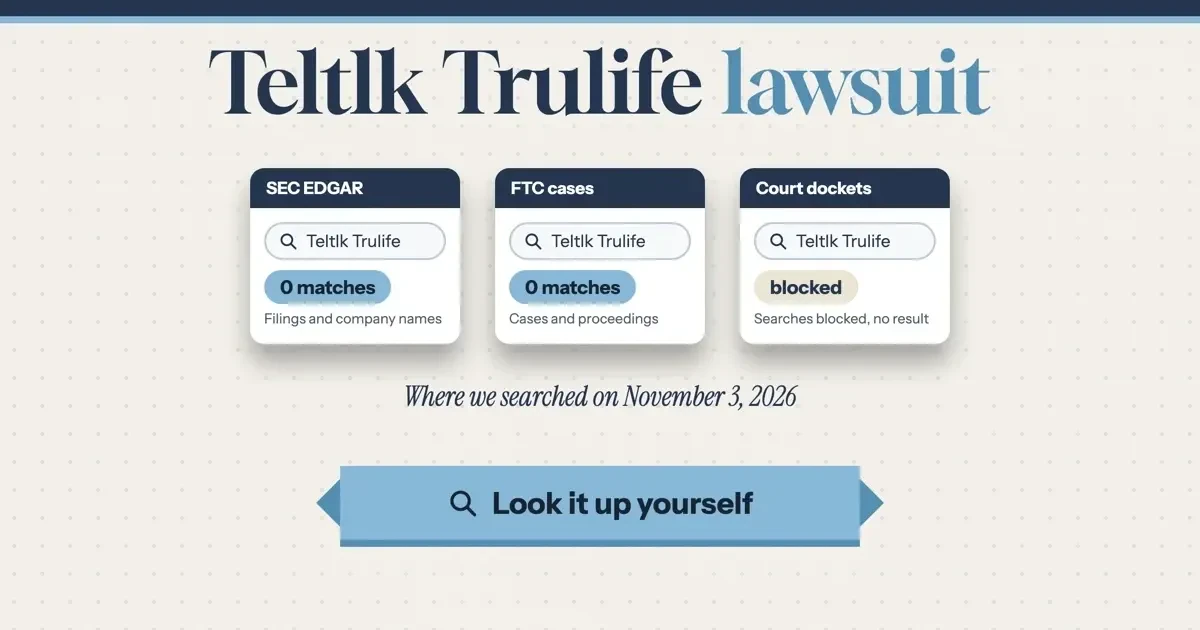
Quick answer
As of November 3, 2026, SEC EDGAR and the FTC case list showed 0 matches for Teltlk or Trulife Distribution. CourtListener and New York's court portals blocked our automated check, so those dockets are unsearched, not empty. Run them in a browser, or use the PACER Case Locator at $0.10 a page. Fees are waived if you spend $30 or less on court records in a quarter.
If you saw the Teltlk Trulife Distribution lawsuit named on a blog, you probably want to know whether a court ever heard it. A lawsuit is a case filed in a court, and a real one leaves a docket with a court name, a case number and a filing date. Before this rewrite, the page described the dispute with none of those details, so we dropped its claims and looked for the record.
Our view: a lawsuit claim with no court and no case number stays unconfirmed until a docket shows it. This one stays unconfirmed for now: the two record sites we could read came back empty, and the court sites blocked our checker.
Key takeaways
- SEC EDGAR and the FTC list showed 0 matches on November 3, 2026.
- CourtListener and New York courts blocked our automated check; we searched no dockets.
- PACER charges $0.10 per page, capped at $3 per document.
- PACER's per-page fee rises to 12 cents on January 1, 2027.
- A lawsuit claim with no court and case number stays unconfirmed.
What is the Teltlk Trulife Distribution lawsuit?
We couldn't confirm it. Neither Teltlk nor the phrase Trulife Distribution turned up in the records we could read, and the court searches were blocked for our automated check. The phrase names a dispute between a company called Teltlk and one called Trulife Distribution. The old page never said which court heard it, when it was filed or what its case number was, and it didn't link to a single filing or court notice. Without them, there's only a party-name search. The PACER FAQs say a name search in the Case Locator "will generate a listing of nationwide court locations and case numbers." A state case sits in that state's own court system instead.
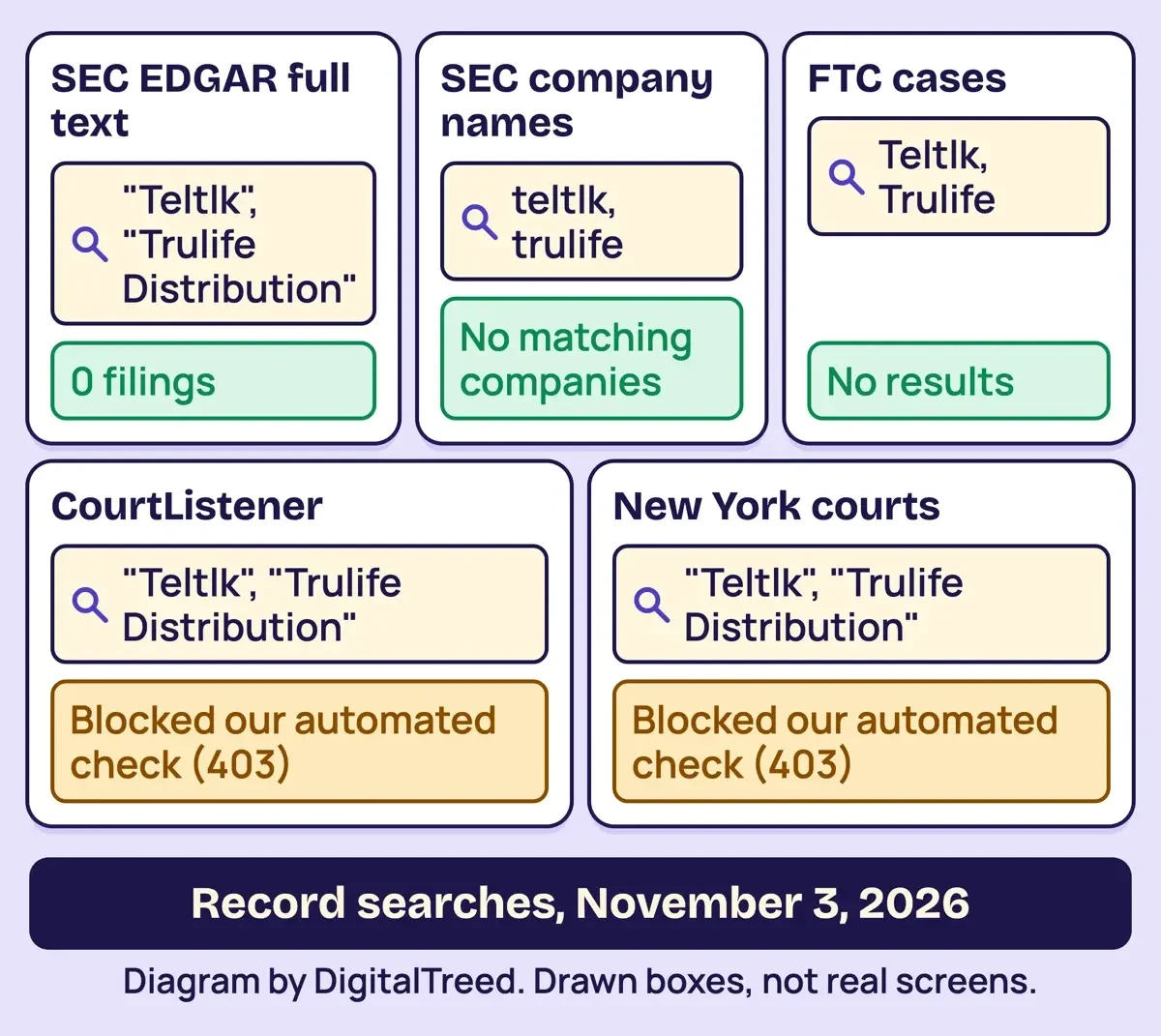 Diagram by DigitalTreed from our record searches of November 3, 2026 (test/run-log.txt). Drawn search boxes, not real site screens.
Where we searched and what came back
On November 3, 2026, we sent both names to SEC EDGAR and the FTC's case list, and tried CourtListener and New York's court and business pages. We spelled them as the old page did. Teltlk went in on its own, and Trulife Distribution as an exact phrase.
| Where we searched | Query | Result on November 3, 2026 |
|---|---|---|
| SEC EDGAR full-text search, filings since 2001 | "Teltlk" | 0 filings |
| SEC EDGAR full-text search, filings since 2001 | "Trulife Distribution" | 0 filings |
| SEC EDGAR full-text search, filings since 2001 | "Trulife" (one word) | 35 filings from 7 filers, none with Teltlk |
| SEC EDGAR company search | teltlk, then trulife | No matching companies (both) |
| FTC Cases and Proceedings | Teltlk, then Trulife | No results found for these filters (both) |
| FTC Cases and Proceedings (control) | Amazon | 26 cases |
| CourtListener case law and RECAP search | both names | 403 bot-block, opens in a browser |
| CourtListener search API | both names | 401, account token needed |
| New York WebCivil Supreme, NYSCEF, nycourts.gov | page load only | 403 bot-block, opens in a browser |
| New York Department of State entity search | page load only | No answer (connection reset) |
Eight of the 9 searches that ran returned 0 results, and none matched Teltlk or the phrase Trulife Distribution. As a control, the same FTC search box returned 26 cases for Amazon, so the name filter works. The single word Trulife does appear in 35 SEC filings from 7 filers, but none of them contains Teltlk or the exact phrase Trulife Distribution. We aren't naming those filers. Nothing ties them to this story.
CourtListener's search pages answered with a CloudFront 403 page that read "Request blocked," the same reply for case law and for RECAP. Its search API wanted an account token, which we don't have and didn't request, so all four API calls got a 401. New York's court pages blocked the checker before any search form loaded, so no party-name search reached a New York court. We didn't try to get around any of it. A second try about 20 minutes later got the same 403 and 401. In a browser, open CourtListener and search each name; Free Law Project says researchers "can search millions of federal filings in the RECAP Archive." Use the same two names and spellings we used.
What we tested
We sent 25 record requests on November 3, 2026, with the user agent DigitalTreed-check/1.0, 2 seconds apart. Nothing involved a sign-in, PACER payment or CAPTCHA. About 20 minutes later we repeated 7 of the blocked requests once, plus the SEC and FTC searches for both names, with the same results. A short script then counted the results from the saved pages, without sending anything new, and built the local log page shown below from those counts.
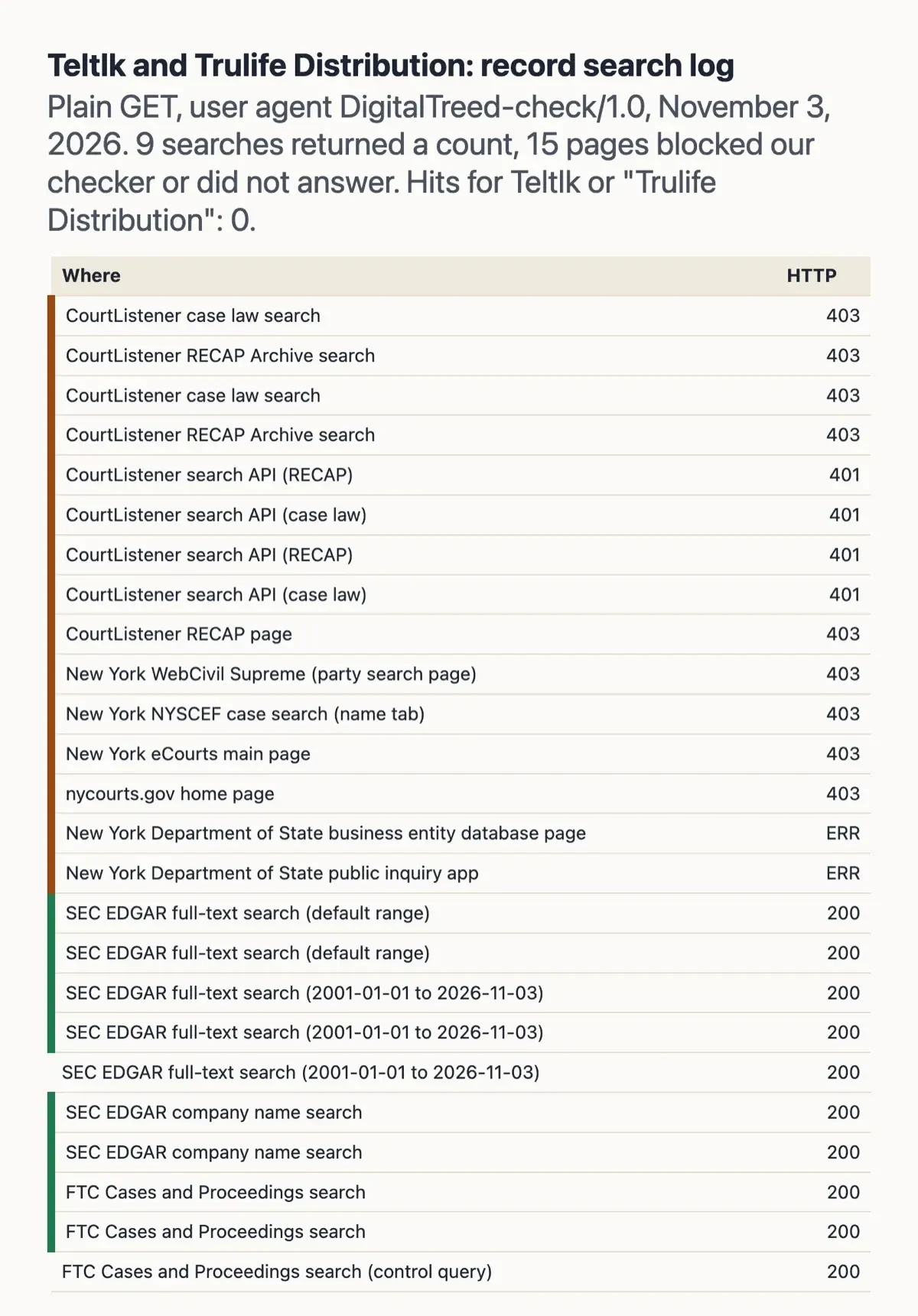 Screenshot: our record search log on 127.0.0.1, built from the saved responses, November 3, 2026.
How to look up a federal lawsuit in PACER
PACER is the federal judiciary's own record system, and CourtListener's RECAP Archive is built from PACER data. The federal courts say "PACER allows anyone with an account to search and locate appellate, district, and bankruptcy court case and docket information." The account costs nothing to open. The PACER Case Locator page says you "must first register for a free PACER account before searching for federal court records online."
Fees start when you search. As of November 2026, PACER pricing is $0.10 per page, and "You won't be charged more than $3 per document." The federal fee schedule waives the bill until an account "accrues charges of more than $30.00 in a quarterly billing cycle." Name searches are billed by the number of pages they return, even when the result screen finds nothing at all. The pricing page adds, "There is no maximum fee for these searches."
PACER's FAQ gives worked examples, and our example as of November 2026 is built from them. A name search returning 2 pages costs 2 x $0.10 = $0.20, and a 10-page docket costs 10 x $0.10 = $1, per the PACER FAQs. One 50-page complaint stops at the 30-page cap, so it costs $3. That example totals $0.20 + $1 + $3 = $4.20 for the quarter, and PACER waives fees when you spend $30 or less on court records in a quarter.
Step 2, the name search, has no fee cap.
- Register for a free PACER account; the sign-up page lists a Case Search Only type beside the filer accounts.
- Search the PACER Case Locator by party name, nationwide or narrowed to one state.
- Write down the court and the case number from the results list.
- Log in to that court's PACER site, search by case number with the Query option and run the Docket Report, with a date range if the case is long.
- Download only the documents you need; as of November 2026 each one stops at $3, though court transcripts have no cap.
PACER warns that searching by a party name "that is fairly common, that may yield a high number of pages." PACER's advice is to "Search by case number rather than by party name so you will go directly to the case without a charge." The Case Locator covers "district, bankruptcy, and appellate courts" in one index, so one search reaches every federal court.
The rates change soon. A PACER notice of June 26, 2026, says the per-page fee rises "from 10 cents to 12 cents" on January 1, 2027. The same notice says the automatic exemption for PACER fees will be "raised from $30 to $40 per quarter," and the federal judiciary news release gives the same two numbers. At 12 cents, our example's search and docket would cost $0.24 and $1.20, but neither page states the 2027 cap per document, so we don't guess one.
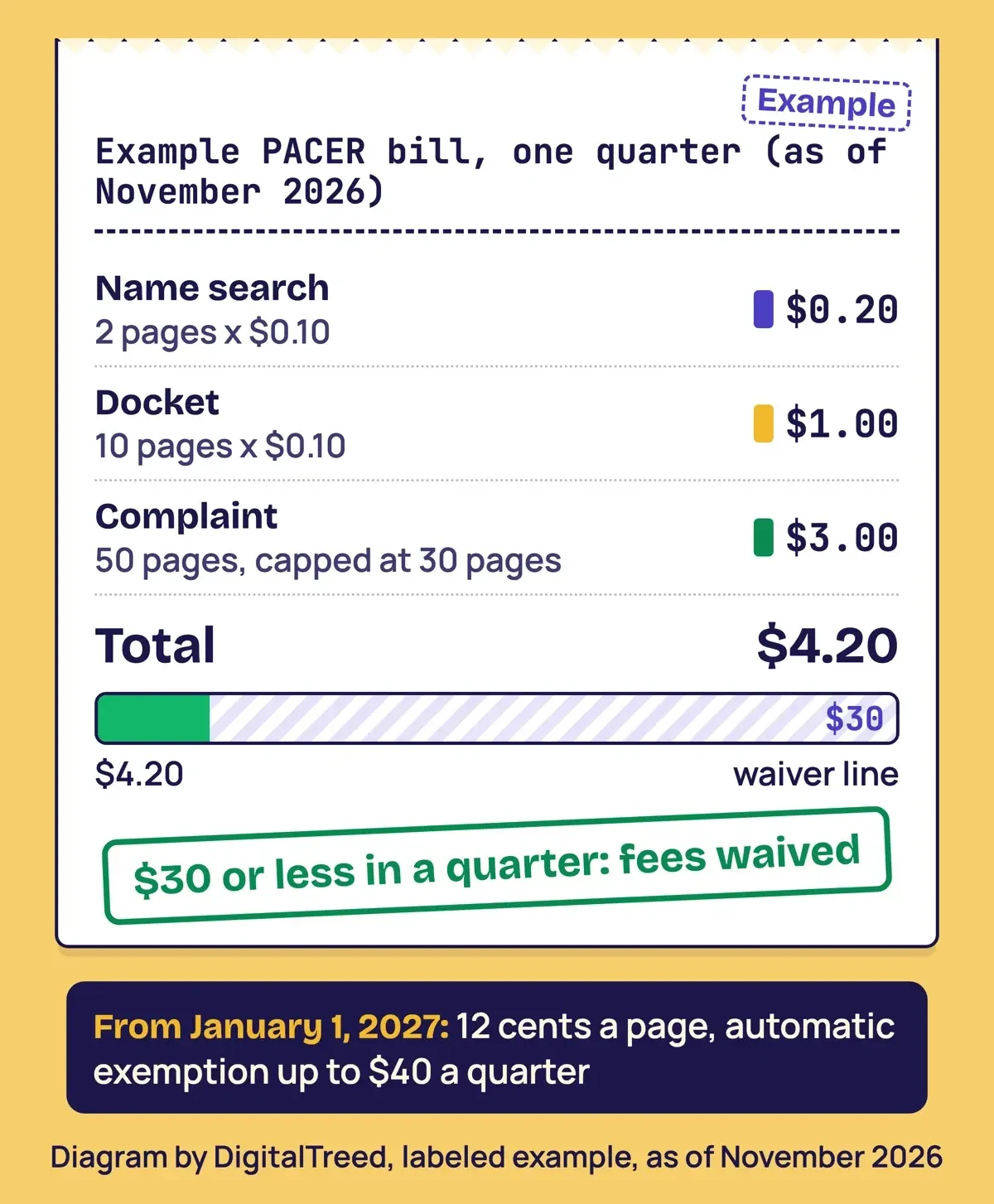 Diagram by DigitalTreed, example using PACER pricing and FAQ figures as of November 2026; 12 cents per page from January 1, 2027.
Free ways to read federal court records
A courthouse terminal is the no-cost way in. The fee schedule says "No fee is charged for viewing case information or documents at courthouse public access terminals." PACER's pricing page adds, "Court opinions are always free." The federal courts' find-a-case page lists a fee of 10 cents per page for printing from those terminals.
The other free route is the RECAP Archive from Free Law Project. Once the RECAP browser extension is installed, "your PACER purchases will be automatically added to the RECAP Archive." The RECAP page adds that anything others have added "will be available to you for free." Free Law Project's CourtListener page describes the archive as "consisting of nearly every federal case, hundreds of millions of docket entries." It also lists "Over 10 million opinions across hundreds of jurisdictions." The archive grows from what its users buy on PACER, plus every free opinion in PACER, so a gap there doesn't mean a gap in PACER.
If money is the barrier, PACER's fee-help page says people who can't pay "should directly contact each court from which you are requesting the exemption."
How to read a docket and its case number
Found a case? Read its docket. The federal courts glossary defines it as "A log containing the complete history of each case in the form of brief chronological entries summarizing the court proceedings." Each entry carries a date, an entry number and a short line about what was filed.
PACER's pricing page says a date range entered before you run the docket report "will display filings or entries within that range." Its own example sets the range from your last check to the present, so a return visit skips entries you already paid for.
A complaint starts the case. The glossary says it states "the wrongs allegedly committed by the defendant," so it's one side's account.
A judgment is "The official decision of a court finally resolving the dispute." Read the orders and any judgment before deciding what a case means.
The case number is the docket's address. It only works with the court name beside it. PACER's FAQ uses 01-10054 as a sample, and the Case Locator lists courts and case numbers side by side, so note both when you copy a result.
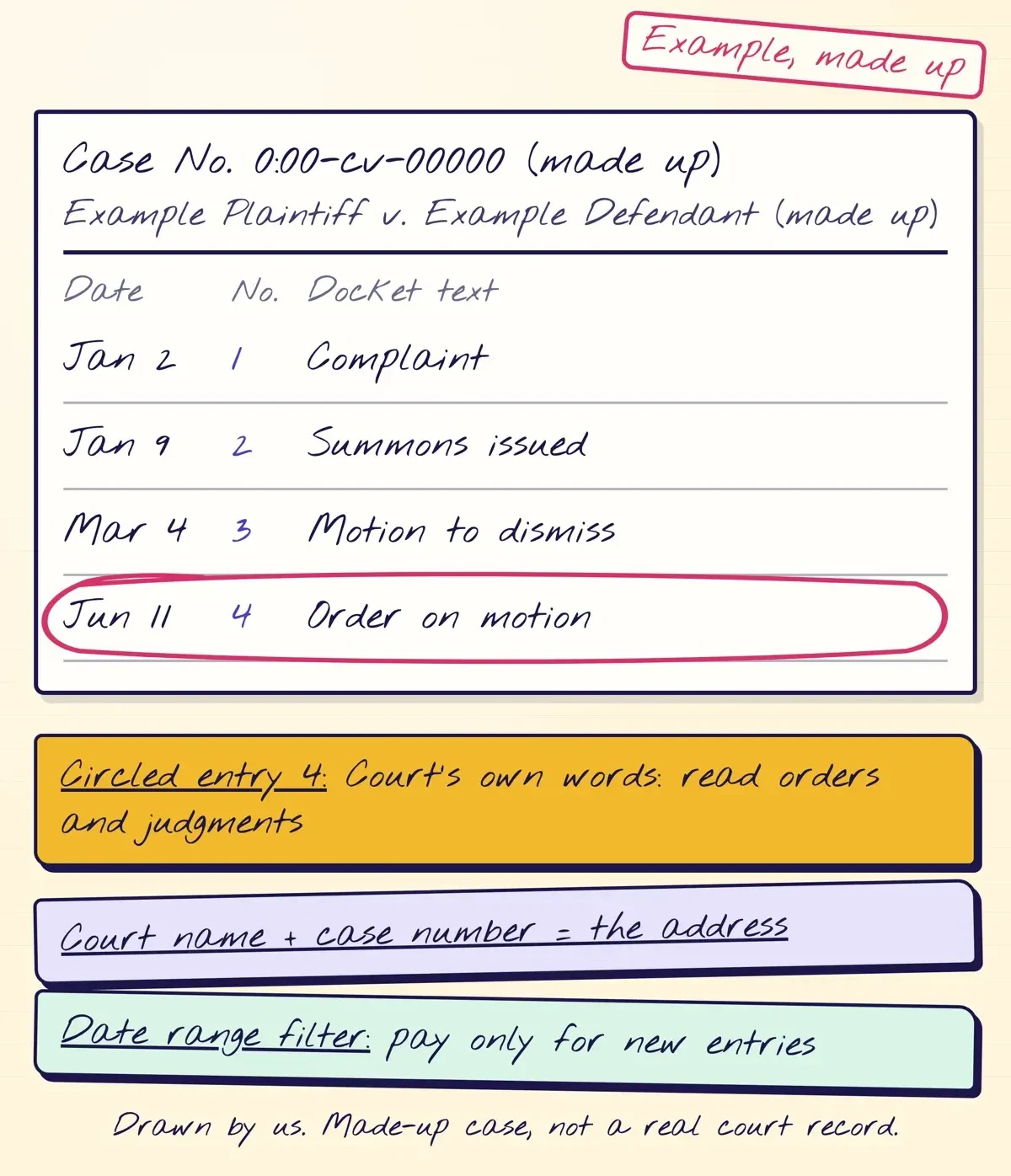 Drawn by us. Made-up case and entries for illustration; not a real court record.
State court cases: the New York example
The federal courts' comparison of federal and state courts says "The Constitution and laws of each state establish the state courts." The same page lists "Most contract cases" among the cases state courts hear. PACER indexes only federal district, bankruptcy and appellate courts, so a state case never shows up in a Case Locator search.
The old page mentioned only Long Island, so we tried New York's two court case search pages, WebCivil Supreme and NYSCEF. Both answered our checker with a 403 page signed "New York State Unified Court System." We can't describe their search screens from our own reading, and we haven't quoted anything from them. A second try about 20 minutes later got the same 403. To run the search yourself, open both links in a browser and search each name as a party.
For a claim that names another state, run the same two checks there: that state's court case search and its Secretary of State business search.
How to check a company in official records
Whether Teltlk or Trulife Distribution is a registered company is a separate question from the lawsuit. The SBA's register your business guide says "Most states require you to register with the Secretary of State's office, a Business Bureau, or a Business Agency." That state's business entity search is where a company's legal name and status live.
New York's Department of State business search reset the connection for our checker twice, so we couldn't confirm the page loads. Try it in a browser before you rely on it.
Each page below answered our checker with a normal page on November 3, 2026.
- SEC EDGAR full-text search: covers "all EDGAR filings submitted electronically since 2001"; put a name in quotes for an exact phrase.
- FTC Cases and Proceedings: type the company name in the search field and read any case in full.
- USA.gov state consumer protection offices: find the office for the state where the company operates.
- New York Attorney General complaint page: the New York example of a state complaint route.
A blank EDGAR result only means the name isn't in SEC filings since 2001. It says nothing about a company that never files with the SEC, which is why the Secretary of State search above comes before EDGAR. For reading what is there, our Oklo explainer built from SEC filings shows how we work through 10-K risk sections.
State consumer offices, in USA.gov's words, "can help with complaints against businesses, investigating scams and fraud, and more." The FTC asks anyone who thinks they saw a scam to tell it at ReportFraud.ftc.gov. Our business naming checklist covers the same state name search from the founder's side. If the company is a lender or a finance site, our GoMyFinance lookalike site check and Eloanwarehouse payday lender check cover that ground.
What to do with a lawsuit claim you can't confirm
Any lawsuit claim should come with a court, a case number and a filing date. Ask whoever repeats it for those three details before you change any plan, contract or payment because of it. With a number in hand, a PACER docket costs cents, and a state case can be searched on that state's court site.
If they can't supply them, treat the claim as unconfirmed and don't repeat it as fact in your own posts, reviews or sales pitches.
Our Palworld lawsuit explainer shows what a post looks like when a record exists: it works only from the companies' own notices and the court they named. For online payment problems, our guide on sellers stopping unpaid guest post orders adds the FBI's Internet Crime Complaint Center as a place to report. For this claim, we'd run one PACER Case Locator search for each name. That costs cents, likely within the $30 or less a quarter that PACER waives, and then we'd search both names on CourtListener and WebCivil Supreme in a browser. This guide isn't legal advice. If either business touches a contract, a debt or a dispute of yours, talk to a licensed attorney in your state first.
Teltlk Trulife Distribution lawsuit questions
Frequently asked
Is PACER free to use?
Opening an account is free, and opinions are always free. As of November 2026, audio files of some hearings cost $2.40 each, per PACER's pricing page.
Who can ask for a PACER fee exemption?
Courts may exempt groups "such as indigents, pro bono attorneys, academic researchers, and non-profit organizations" on request, per PACER pricing and the fee schedule.
How long will the 12-cent PACER fee last?
The PACER notice says it "will remain in place for a five-year period." The fee last rose in 2012, from 8 cents to 10 cents.
What if the PACER Case Locator finds nothing?
The PACER FAQs say to "contact the federal court where you think the case was filed for assistance." Then search the state courts.
How we made this guide: A script sent plain web requests to the record sites in the table and counted the results. PACER figures come from pacer.uscourts.gov and the federal fee schedule. Facts checked by the DigitalTreed team on November 3, 2026.
Sources
- PACER: Pricing, how fees work
- PACER: Temporary fee increase effective January 1, 2027
- U.S. Courts: Judiciary approves funding for case management and public access modernization
- U.S. Courts: Electronic public access fee schedule
- PACER: Frequently asked questions
- PACER Case Locator
- PACER: Options to access records if you cannot afford PACER fees
- U.S. Courts: Find a case (PACER)
- U.S. Courts: Glossary of legal terms
- U.S. Courts: Comparing federal and state courts
- Free Law Project: RECAP
- Free Law Project: CourtListener
- SEC: EDGAR full-text search
- SEC: EDGAR full-text search FAQ
- FTC: Cases and proceedings
- FTC: How to avoid a scam
- SBA: Launch your business, register your business
- USA.gov: State consumer protection offices
- New York Attorney General: File a complaint


Comments
No comments yet. Start the conversation below.