

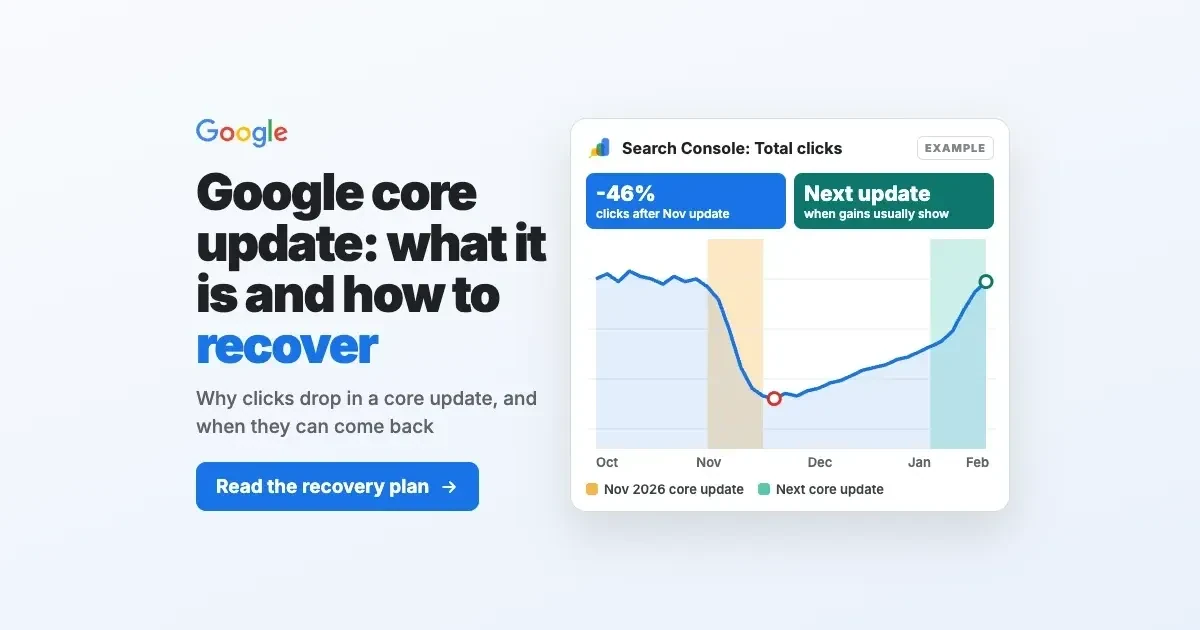
Quick answer
A Google core update is a broad change to how Google ranks all pages, not a penalty aimed at your site. The November 2026 core update ran from November 10 to 24, and Google has announced a December 2026 one with no start date yet. To recover, improve the whole site for readers, then expect most of the effect at a later core update.
A Google core update is a change to the main systems Google uses to rank search results, made several times a year. Google says on its core updates page that these changes are broad and "don't target specific sites or individual web pages." If your traffic fell during one, there's rarely one broken thing to fix.
Below: what a core update changes, the November and December 2026 updates, a quick cause check, and a dated recovery plan. Then how long recovery takes, based on our count of every core update since 2022, the new feedback route and how to prepare for December.
Key takeaways
- A core update re-ranks everything; it isn't a penalty.
- November 2026 ran November 10 to 24.
- December 2026 is announced, with no start date yet.
- Since 2022, core updates have usually come about three months apart.
- Improve the whole site, then wait for the next update.
What a Google core update actually changes
This is easiest to see the way Google explains it, with a list of restaurants. Say a friend asks for your top 20, and you wrote your list in 2019. New places have opened since, and some old favourites have slipped. The list changes, and the ones that move down "aren't necessarily 'bad'", as Google's core updates page puts it. Others simply earned a spot.
That's the difference.
Nothing is being punished.
A core update doesn't look for a rule you broke. Spam updates do something else: they improve Google's spam detection, including SpamBrain, which Google's spam updates page calls its "AI-based spam-prevention system." Google also runs smaller core updates it doesn't announce, so not every ranking change has a name.
| Update type | What it changes | What helps afterward |
|---|---|---|
| Core update | How all pages are ranked for relevance and usefulness | Improving the whole site for readers |
| Spam update | How Google detects pages that break its spam policies | Fixing the spam issue, then waiting months |
| Smaller core update | Small ranking changes Google doesn't announce | The same steady improvements |
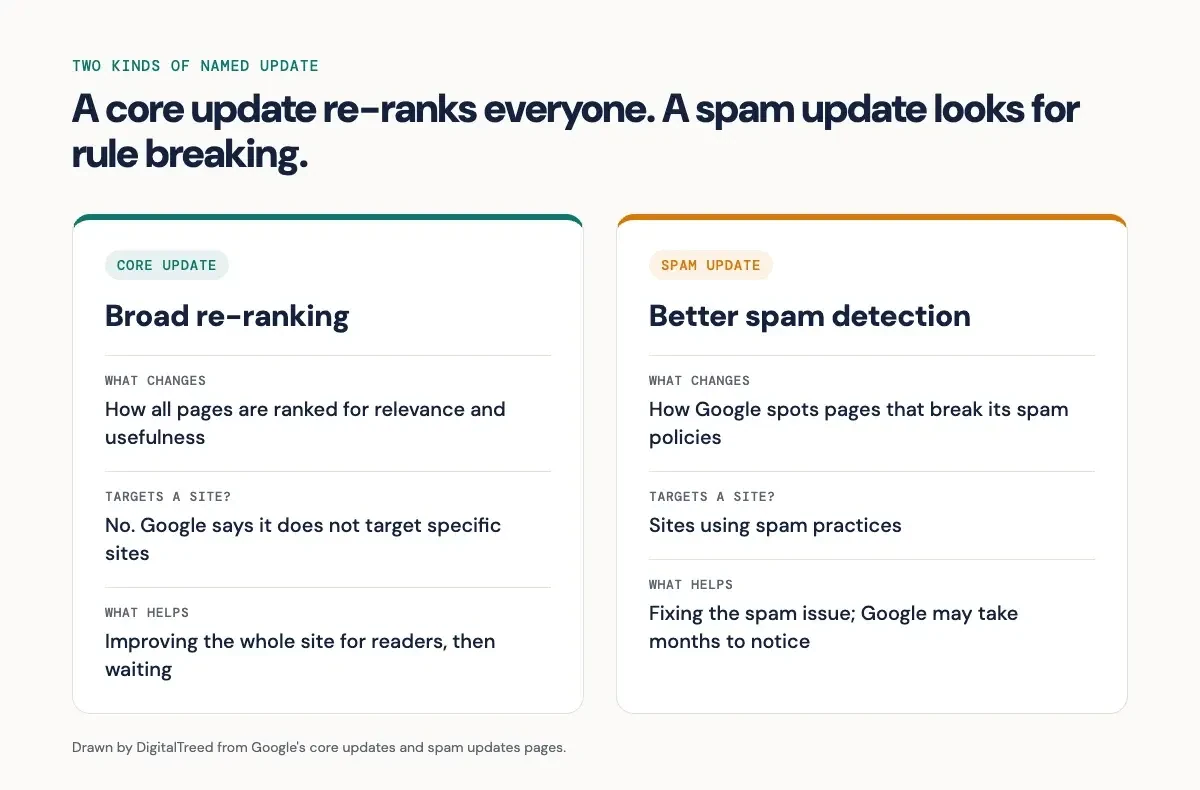 Drawn by us from Google's pages on core updates and spam updates.
If your drop lined up with a spam update instead, the fix is different, and our Advanced SEO chapter on spam policies and recovery covers it.
The latest core updates: November done, December announced
Those are the types. Now the dates: two core updates matter right now. The November 2026 core update started on November 10 and was complete on November 24, 2026, according to Google's Search Status Dashboard. The same day, Google posted a notice for the December 2026 core update, which hadn't started yet.
The December notice is unusually specific. Google says it "focuses on multiple improvements to how our systems understand and rank relevant content (including for longer and more complex questions)." It also mentions "improving personalized results for people who have personalization turned on." The notice says it's "scheduled to be released in December 2026" but gives no start date.
Why announce it early? Google's page on staying informed about ranking updates says it now gives advance notice of significant ranking changes, partly to meet the UK regulator's fair ranking requirements. For you, it means a few weeks to prepare instead of finding out from your traffic.
One more thing clears up a lot of searches. There was no core update in August, September or October 2026. The dashboard history lists spam updates on August 18 and September 24, and before November the last core update was May 2026. Our history of Google algorithm updates goes back further, and the algorithm cheat sheet lists every confirmed update in one table.
We made a short video on the November update, if you'd rather watch first.

Was it the core update or something else?
Before you plan a recovery around the November update, make sure that update caused your drop. Google's advice is to wait at least a full week after a rollout ends, then compare that week with the week before it began. For November 2026, that means comparing December 1 to 7 with November 3 to 9, so the rollout days, when rankings bounce around, don't muddy your numbers.
A drop that started on a different day, or hit one section only, often has another cause. Think of a redesign, a broken redirect, a noindex tag or a seasonal dip. Our step-by-step guide to why your Google rankings dropped walks through that check in Search Console, including the glitches that can fake a drop.
How do you recover from a Google core update?
Once you know the core update caused it, you recover by making the whole site more useful than the pages that outrank you. Then you give Google time. There's no switch to flip. Here's the plan we'd follow, by week, starting from the day a rollout ends.
- Day 0, the rollout ends: change nothing. Write down the start and end dates from the dashboard.
- Week 1: compare the week after the rollout with the week before it began, by page and by query.
- Weeks 2 to 3: read your biggest losers next to the pages that now rank above them, and note what those pages do better.
- Weeks 3 to 6: improve those pages and the site as a whole, one change at a time, with a dated note for each.
- After that: keep publishing and improving, and judge the result after the next core update.
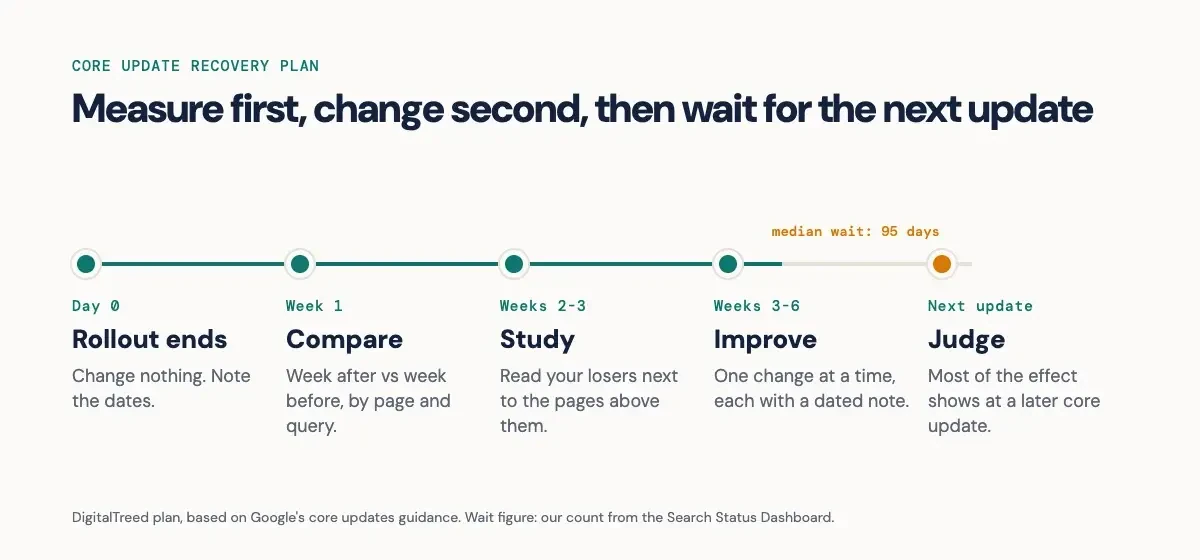 Our recovery plan, drawn by us from Google's core updates guidance.
The study step matters most, and it's the one people skip. Google suggests you judge the site against its helpful content questions, such as "Does the content provide original information, reporting, research, or analysis?" It also suggests asking "others you trust but who are unaffiliated with your site" for an honest view. A friend who doesn't work for you will spot thin pages faster than you will.
Ask them to be blunt.
What to compare on the pages that beat you
Open your biggest losing page next to the page that now ranks above it, and read both as a customer would. Start with who wrote it and why you'd trust them, because Google's helpful content guide asks whether a page shows "first-hand expertise and a depth of knowledge."
Then check whether it answers the question in the first few lines, or makes the reader scroll past a story first. Look at what it has that yours doesn't, such as real photos, prices, a worked example, a comparison or a date showing it was checked recently. Note whether it covers the follow-up questions people ask next. Finally, look at the page experience: a slow page covered in ads loses readers even when the words are good. Write each difference down in one line; that list becomes your to-do list.
You'll find the queries for each page in the Performance report, and filtering by page is covered in the Search Console guide on our site.
Most gaps are fixable. Few are quick.
When you change things, change them for readers. Google warns against "quick fix" changes and calls deleting content "a last resort." Rewriting a page so it answers the question faster, adding your own photos or test results, or merging three weak posts into one strong one all count. Our guide to refreshing content that is losing traffic shows how to do that without breaking URLs.
Here's what that can look like. Example: Cedar Hollow Furniture Repair, a made-up shop in Portland, lost about a third of its Search clicks in the November update. Its five "how to fix a wobbly chair" posts all said roughly the same thing. The owner merged them into one guide with photos from real repairs and a short video. They redirected the old URLs to the new guide and added the shop's prices and service area to the repair pages. Then they stopped changing things and waited, which was the hardest part, because every slow week tempted them to start rewriting the pages they'd just fixed.
Waiting is the plan, not a failure of it.
Rankings usually take months to come back
That waiting part is longer than most people expect: usually months, not weeks, and often longer than a small-business owner would like when the phone has gone quiet. Google says some changes take effect "in a few days." Others take "several months" while its systems confirm the site is helpful. Its core updates page adds that if a few months pass with no change, "that could mean waiting until the next core update."
So we counted. How long has that wait been? Using the Search Status Dashboard history, we looked at all 16 core updates from May 2022 to November 2026. From the end of one rollout to the start of the next, the median gap was 95 days, a little over three months. The shortest was 8 days, between the November and December 2024 updates. The longest was 170 days, between the September 2022 and March 2023 updates, which is a long time to wait on a fix you made in the fall.
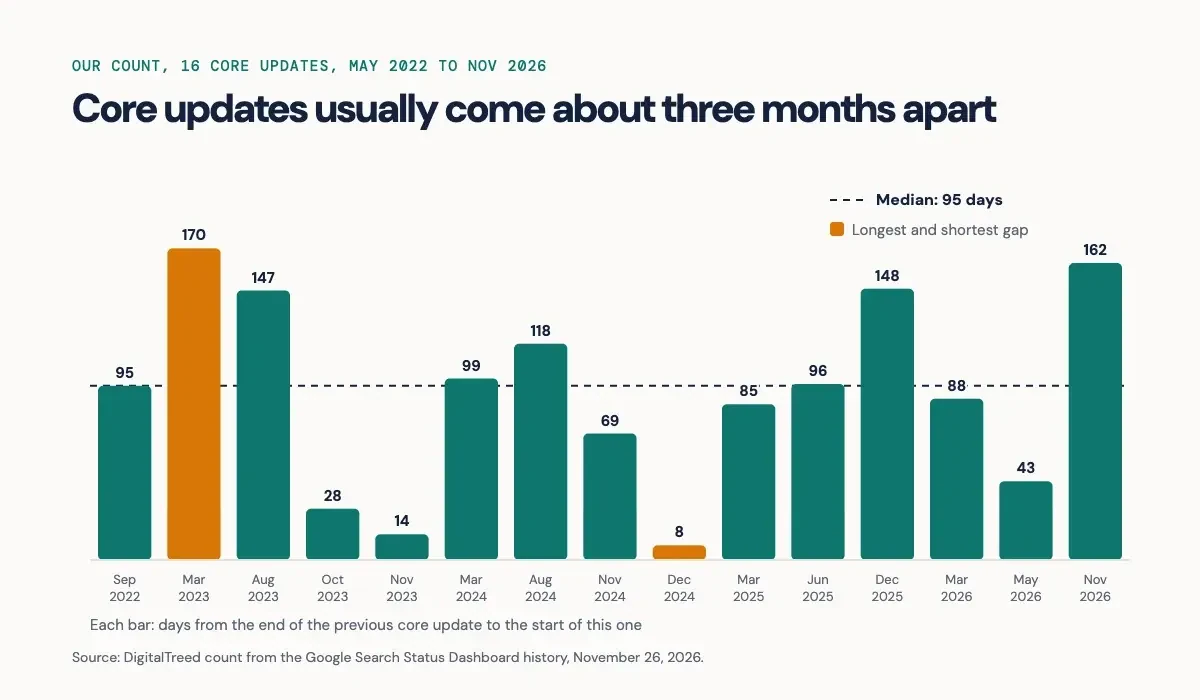 Source: our count from the Google Search Status Dashboard, November 26, 2026.
That's why a site that fixes its pages in December often sees the result around March, not next week. December 2026 may break the pattern, though, since it follows November so closely. If you've only just started improving your site, don't expect the December update to reward changes that are a few days old.
There's a smaller chance of earlier movement, too. Google says it makes smaller core updates it doesn't announce, and those can lift improved pages between the big ones. But it also says there's "no guarantee" your changes will show up as better rankings, because other pages keep improving as well.
Tell Google directly: the new feedback route
While you wait, there's now an official way to tell Google a core update got your results wrong. Google's new Search ranking hub links to a ranking feedback page. It says verified site owners can use the Submit feedback button in Search Console after a significant update. You add the update as a hashtag, such as #NovemberCoreUpdate2026.
We checked our own Search Console on November 26, 2026, and the Submit feedback item sits in the left-hand menu. We didn't send anything, since we had no example to report.
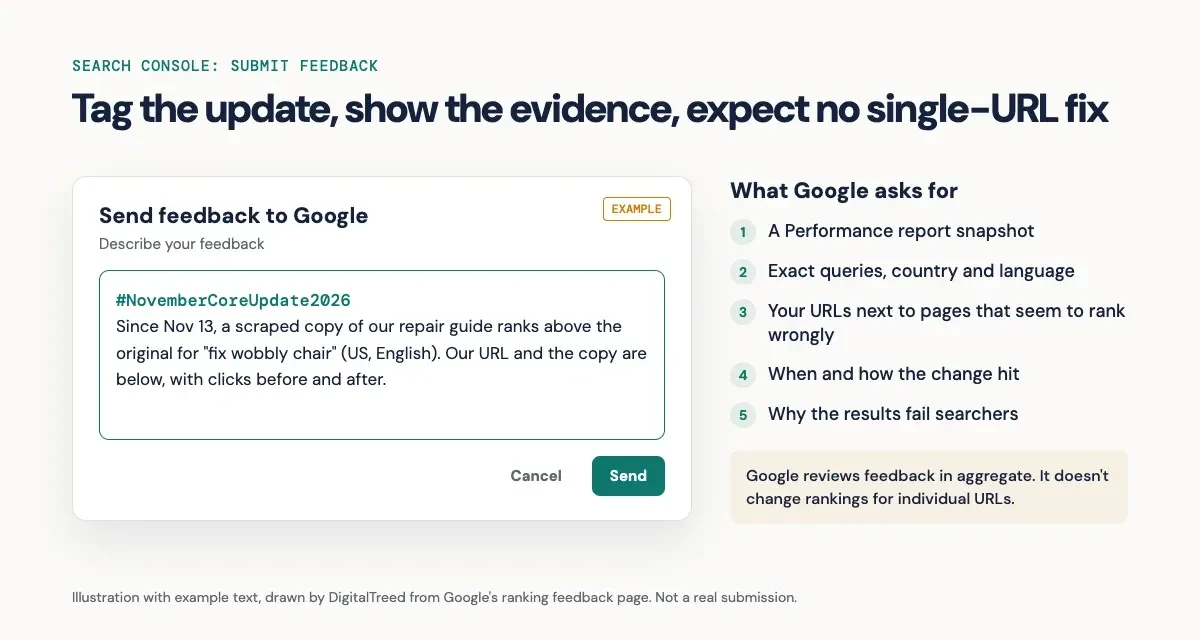 Illustration with example text, drawn by us from Google's ranking feedback page. Not a real submission.
Google asks for specifics. It wants a Performance report snapshot, the exact queries and country, your URLs next to the pages that seem to rank wrongly, and when it hit. A scraped copy of your article outranking the original is the kind of case it gives as an example.
Keep hopes modest. Google says engineers review these "in aggregate" and that feedback "doesn't result in manual ranking adjustments for individual URLs." It's a way to flag a pattern, not an appeal. A real reconsideration request only exists for manual actions, and you'll find it in Search Console's Manual actions report.
Get ready for the December update
Beyond feedback, the December notice gives you a hint about what Google wants: better results for longer, more complex questions. A Pew Research Center study found that 53% of searches with 10 or more words showed an AI summary, compared with 8% of one- or two-word searches. Long questions are where Google is putting its effort.
That trend favours specific answers.
In practice, that means answering the real questions customers ask, in full sentences, on the pages that matter. Think "how much does it cost to reupholster a dining chair in Portland," not just "furniture repair Portland." Our guide to getting cited in AI answers covers how to write those answers so they're easy to quote.
So don't rush.
Don't cram big changes into the next few weeks. If your pages are good, leave them alone; Google itself says to avoid changing content that's performing well.
Mistakes that slow recovery
Even with a good plan, a few habits make a core update drop last longer than it needs to. These come up again and again in Google's own guidance and in forum threads from owners.
The first is panic changes during the rollout, which muddy your data before you've even measured it. The second is mass deleting. Google calls deletion "a last resort" for content that can't be saved. The third is disavowing links because traffic fell. Google's disavow tool help page says "most sites will not need to use this tool." It's meant for a considerable number of spammy links tied to a manual action, or one that's likely.
The fourth is chasing rumours about which kind of site "got hit." Google's guidance asks whether content is helpful and original, not how it was produced. A page with nothing new to add won't be rescued by a new word count or a different tool.
If you'd like a second opinion on where your site stands, start by running your homepage through the website audit tool on our site. For a full review against Google's questions, our SEO services include a core update recovery plan, and DigitalTreed sells that service.
What we tested
On November 26, 2026 we counted the core updates on Google's dashboard since May 2022 and measured the gaps. We also found the Submit feedback button in Search Console without sending anything. Cedar Hollow is a made-up example.
Frequently asked
When is the next Google core update?
Google's dashboard notice says the December 2026 core update is "scheduled to be released in December 2026," with no start date.
Is a Google core update a penalty?
No. A penalty, called a manual action, shows up by name in Search Console's Manual actions report, per Google's appeals page.
Can I recover before the next core update?
Sometimes. Google says smaller, unannounced core updates can lift improved pages between the big ones, per its core updates page, but there's no guarantee.
How long does a Google core update take to roll out?
Under two weeks in 2026. On Google's ranking history dashboard, the March, May and November 2026 core updates each ran between 11 and 14 days.
Was there a Google core update in February 2026?
Not for Search. February 2026 brought a Discover core update, a change to the systems that surface "articles in Discover," released first to English-language users in the US.
How we made this guide: We read Google's core update, ranking hub and feedback pages and counted the core updates on its dashboard ourselves. Facts checked by the DigitalTreed team on November 26, 2026.
Sources
- Google Search Central: Google Search's core updates
- Google Search Status Dashboard: Ranking incident history
- Google Search Status Dashboard: November 2026 core update
- Google Search Status Dashboard: December 2026 core update
- Google Search Central: Search ranking hub
- Google Search Central: Submit feedback about ranking changes
- Google Search Central: How to stay informed on ranking updates
- Google Search Central: Spam updates
- Google Search Central: Creating helpful, reliable, people-first content
- Search Console Help: Disavow links to your site
- Google Search Central: Debugging drops in Google Search traffic
- Pew Research Center: Google users are less likely to click on links when an AI summary appears (July 22, 2025)
Comments
No comments yet. Start the conversation below.