

What Semrush is, who it's for, and when you don't need it
This is the Semrush guide in our "SEO tools explained" path. It's written for freelancers, agency staff and in-house marketers who already know the SEO basics and want to use Semrush properly, or decide not to buy it. If terms like keyword difficulty or referring domains are new, read Intermediate SEO first.
By the end you'll be able to set up a project on the India database and find the searches and links your competitors have and you don't. You'll turn a keyword list into a page plan, audit and track your own site, and judge what Semrush's AI visibility numbers mean. Five step-by-step tasks use Indian examples: a Delhi dental clinic, a Pune coaching centre, a Kanpur sweet shop and a D2C brand.
There are eight chapters, about 45 minutes in all. Chapters 1 and 2 cover what Semrush is and how to set it up. Chapters 3 to 7 go through the reports, and chapter 8 covers prices, pros and cons and the alternatives, starting with our own free tools. Every price was checked on Semrush's own pricing page on 16 October 2026, and every menu name and limit comes from its help centre. We have no affiliate deal with Semrush or any tool in this guide.
Quick answer
Semrush is a paid SEO suite that estimates any website's keywords, traffic and backlinks, audits your own site, tracks rankings and now measures AI visibility. It's built for agencies, freelancers and in-house teams researching competitors. Adobe bought it in April 2026. A small local site can usually start with free Google tools instead.
Most of what Semrush shows you is about other people's websites. That's the point of it. Search Console tells you what Google saw on your own site; Semrush tells you what it thinks is happening on your competitor's site, and on any site you type in.
That difference decides whether you need it. If your question is "why did my clicks drop?", Search Console answers it for free. If your question is "which searches bring traffic to the coaching centre down the road, and which sites link to them?", you need a tool with its own data. Semrush is one of the two best-known (the other is Ahrefs).
What's inside
Semrush sells its features as toolkits. The paid plans combine the SEO Toolkit with the AI Visibility Toolkit; Local, Content, Traffic & Market, Social, Advertising and AI PR are separate toolkits you add on.[1] This guide covers the SEO and AI visibility parts, because that's what most SEO work in India uses.
Here's how the main tools map to this guide, loosely following the workflows in Semrush's help centre:[2]
| Workflow | Main tools | Chapter |
|---|---|---|
| Competitor research | Domain Overview, Organic Rankings, Top Pages, Keyword Gap, Backlink Gap | 3 |
| Keyword research | Keyword Overview, Keyword Magic Tool, Keyword Strategy Builder | 4 |
| Links | Backlinks, Backlink Audit | 5 |
| On-page and technical | Site Audit, On Page SEO Checker, SEO Writing Assistant | 6 |
| Tracking | Position Tracking | 6 |
| AI search | AI Visibility Toolkit, AI checks in Site Audit | 7 |
One naming change to know before you read older tutorials: the report once called Organic Research is now called Organic Rankings.[3] Same report, new label.
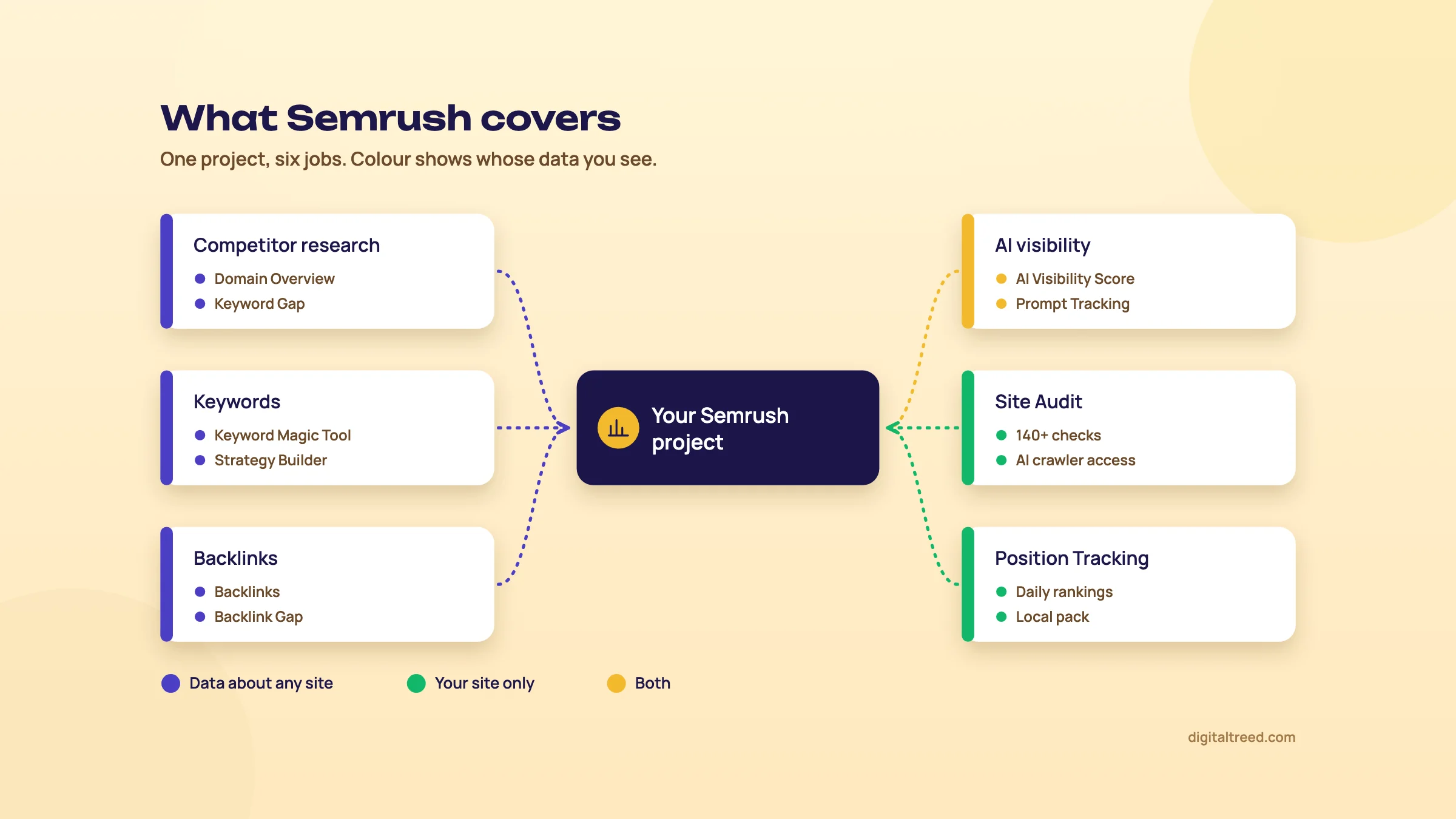 What Semrush covers, and whose data each part shows. Drawn by us.
Where the numbers come from
This matters more than any feature list. Semrush says it gets Google results pages for "hundreds of millions of the most popular keywords" through third-party data providers, and records the sites in the top 100 positions.[4] Traffic for a domain is then estimated from those rankings and search volumes. Its backlink crawler covers about 10 billion pages a day.
28.8B
keywords in the database, as of 2026, Semrush's own figure[4]
142
geographic databases, by Semrush's own count[4]
43T
backlinks in its index, also its own figure[4]
So every traffic figure for a competitor is an estimate built from estimates. Treat it as a direction, not a count. Google is blunt about this: "Third-party tools don't have access to our internal ranking data."[5] It also warns that some users misread third-party data as "somehow being from Google". Authority Score, KD% and traffic in Semrush are Semrush's own numbers, not Google's.
Tip
Check one site you own. Compare Semrush's estimated organic traffic with your real clicks in Search Console for the same month. The gap tells you how much to trust its estimates for sites like yours, in your niche.
Semrush is now part of Adobe
Adobe announced on 19 November 2025 that it would buy Semrush for $12 a share in cash, about $1.9 billion in total.[6] The deal closed on 28 April 2026, and Semrush now sits inside Adobe's customer experience business.[7]
For a customer, little changed on day one. Semrush's customer FAQ said there would be "no immediate changes to your current services, agreements, or points of contact".[8] The prices in chapter 8 are what the site showed on 16 October 2026, after the sale. Whether plans or prices change as the two companies merge their products, nobody outside Adobe knows yet.
Who it's for
- Agencies and freelancers who research several clients' competitors every week and need reports to send them.
- In-house SEO teams on sites with hundreds of pages, where Keyword Gap and Site Audit save days.
- Businesses that also run Google Ads, because Domain Overview gives a snapshot of competitors' paid keywords and ad copies (full ad research is the separate Advertising Toolkit).
- Teams asked about AI search, since the Starter plan and above include prompt tracking (chapter 7).
When you don't need it
We'd tell a Kanpur sweet shop, a single-clinic Delhi dentist or a Pune coaching centre with a 20-page site not to buy Semrush yet. Here's why. Your first problems are almost always on your own site: pages not indexed, slow mobile pages, weak titles, an unclaimed Business Profile. Free tools find all of those. Search Console shows the searches you already appear for. Keyword Planner gives volume ranges. Our Free Website Audit checks the technical basics.
Pay when you've fixed the basics and your next question is about competitors, or when a client's fee covers it. Guide 4, chapter 5 gives freelancers the same advice. And the free Semrush account (chapter 2) is enough for a quick look at a few competitors each day.
If you've decided Semrush is worth a try, chapter 2 sets up the account and your first project, starting with the setting most Indian users get wrong: the database.
Setting up: free account, trial, first project and the India database
Quick answer
Sign up for the free account first: no card needed, one demo project, 10 reports a day. Create a project for your own domain, then set every research report to the India database before you read a single number. Use the 7-day trial only when you have a week of real work planned, because exports are switched off during trials.
Setting up Semrush takes ten minutes. Setting it up so the numbers mean something for an Indian business takes one extra click that many people miss. This chapter covers both.
Free account, trial or paid plan
You have three ways in.
| Option | What you get | Card needed | Watch out for |
|---|---|---|---|
| Free account | 1 demo project, 10 reports a day across the main tools[9] | No | About 10 rows per report; no exports |
| 7-day free trial | A paid plan's tools for a week[1] | Yes | Exports disabled; converts to paid unless you cancel |
| Paid plan | Limits of your plan (chapter 8) | Yes | Monthly plans have no money-back guarantee |
The trial rules are worth reading twice. Semrush says exports are disabled during the trial period "even if exports are normally included in the paid version of the plan".[1] After seven days the trial turns into the plan you chose unless you cancel. And the 7-day money-back guarantee only covers a first subscription with a commitment of 12 months or longer, bought on Semrush.com by credit card.[10] A monthly plan isn't covered.
Semrush accepts Visa, Mastercard, Discover and American Express, and doesn't accept virtual cards.[11] If your Indian card blocks international payments, enable them in your bank's app before you start the trial.
Warning
Set a phone reminder for day six of any trial. If you forget, the trial converts to a monthly plan, and monthly plans aren't eligible for the standard refund.
Create your first project
A project is a workspace for one website. Click + Create Project on the Home page, give it a name and, optionally, add a domain.[12] You can rename a project later. But once you've added a domain and set up a tool with it, the domain can't be changed; you'd create a new project instead.
Projects themselves are unlimited. What's limited is "website monitoring". A slot is used as soon as you set up Site Audit, Position Tracking, Backlink Audit, On Page SEO Checker or Organic Traffic Insights for the project's site.[12] One project uses one slot however many of those tools you switch on. The free account gets one.
When you create your first project, Semrush sets up Site Audit[13] and Position Tracking for it automatically.[14] For later projects you configure each tool yourself.
The database: India or US
Every research report (Domain Overview, Organic Rankings, Keyword Overview, Keyword Magic Tool, Keyword Gap) shows data for one country database at a time. Search volume, keyword difficulty, CPC and a domain's estimated traffic are all for that country. India has its own database, with the code IN.[15]
Here's why it matters. Look up "coaching centre" in the US database and you'll get American volumes and American competitors, which tell a Pune institute nothing. Look up a D2C skincare brand's domain in the US database and its traffic will look tiny, because its customers search from India.
Our rule:
- Indian business selling in India: India database, always.
- Indian business selling abroad (an export manufacturer, an IT services firm): the database of each target country, one at a time.
- Comparing countries: Keyword Overview shows "Global Volume", the total across all of Semrush's country databases.[16]
The database selector sits beside the search bar in each report. Check it every time you open a new report, especially after following a link from a blog post or a shared report.
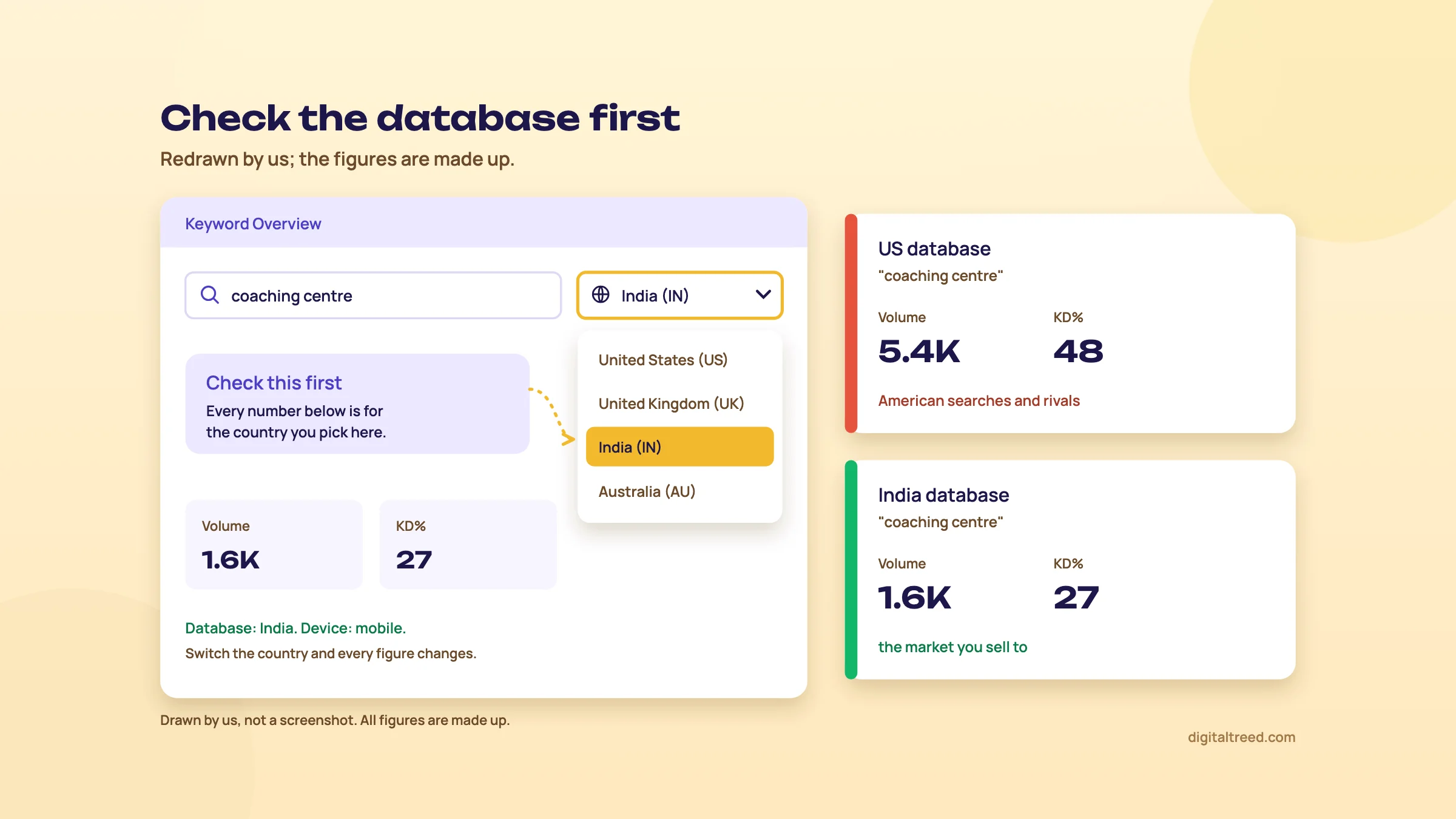 Check the database first: the same keyword gives different numbers in the US and India databases. Drawn by us; figures made up.
Mobile or desktop
Semrush keeps separate mobile databases as well as desktop ones, and India is one of them;[15] in Domain Overview and Organic Rankings a mobile database shows only the top 20 results.[17] Most Indian searches happen on phones, so when a report offers a device switch, choose mobile for consumer businesses. For B2B sites, look at both.
Day-one settings
- Profile: set your billing country to India before any purchase. Changing it later needs support and proof of residency.[11]
- Database: India in every research report you open.
- Site Audit: check the crawl scope and the page limit (chapter 6). The free account audits 100 pages a month.[18]
- Position Tracking: set the location to your city, not just "India" (chapter 6). Location and device can't be changed once a campaign starts.[14]
- Notifications: keep the weekly Position Tracking email on; it's the cheapest habit in SEO.
Set up a free Semrush project for a Delhi dental clinic
- Sign up at semrush.com with a work email. The free plan needs no card.
- Create the project Click + Create Project on Home, name it "Clinic main site" and add the clinic's domain.
- Check the audit Open Site Audit from the project. The first crawl starts on its own; on the free plan it covers up to 100 pages.
- Set up tracking In Position Tracking, choose Google, mobile, and the location New Delhi rather than India. Add the business name exactly as it appears on Google, so local pack rankings are picked up.
- Add 10 keywords The free limit is 10. Pick the clinic's money searches: "dentist in Lajpat Nagar", "root canal cost Delhi", "teeth whitening South Delhi" and so on. Tick the weekly email.
- Switch research to India Open Domain Overview, set the database to India and enter the clinic's domain, then two competitors' domains. Write down each one's estimated traffic and top keywords. That's your baseline.
Ten reports a day go quickly. Plan your free-account sessions: one Domain Overview per competitor, one Organic Rankings, one Keyword Magic search. Chapter 3 shows what to read in each of those competitor reports.
Competitor research: Domain Overview, Organic Rankings, Keyword Gap and Backlink Gap
Quick answer
Start with Domain Overview for a quick picture of any site, then open Organic Rankings to see which keywords and pages bring it traffic. Keyword Gap compares up to five domains and lists the searches your competitors rank for and you don't. Backlink Gap does the same for linking sites. Read every traffic number as an estimate.
Competitor research is the main reason people pay for Semrush. You can't see a rival's Search Console, but you can see an estimate of what they rank for, which pages earn it and who links to them. Four reports do most of the work.
Domain Overview: the one-page snapshot
Type any domain, subdomain, folder or URL. Domain Overview shows estimated organic traffic, paid traffic, backlinks and, since the AI features arrived, an AI Visibility Score with mentions and cited pages.[19] Every number is a link into the detailed report behind it.
| What you see | What it means | What to do with it |
|---|---|---|
| Organic traffic | Semrush's estimate of monthly visits from Google organic, in the chosen database | Compare competitors with each other, not with your own Search Console clicks |
| Organic keywords | Keywords the domain ranks for in the top 100, in that database | A rising count usually means new content is working |
| Authority Score | Semrush's 1 to 100 score of a domain's overall quality[20] | Use to compare sites, not as a target |
| Referring domains | Different sites linking to it | Opens the Backlinks report (chapter 5) |
| AI visibility | Mentions and citations in AI answers, from Semrush's prompt database | A first look; chapter 7 covers what it can and can't tell you |
Free users get 10 Domain Overview requests a day. Historical data and the Growth and Compare by Countries reports need the higher tiers.[19]
Organic Rankings: what brings a competitor traffic
Organic Rankings (called Organic Research until recently) lists a domain's keyword rankings, its position changes, its organic competitors and the SERP features it appears in.[3] The four views you'll use most (the last one is also a tool of its own, Top Pages):
- Positions: every keyword the domain ranks for, with position, volume, KD%, intent and the URL that ranks. It's sorted by traffic already, which shows what actually matters to them.[21]
- Position Changes: new, lost, improved and declined keywords. Useful after a Google update, or when a competitor suddenly overtakes you.
- Competitors: domains that rank for the same keywords. These are your real search competitors, which may not be the businesses you think of as rivals.
- Pages: which URLs bring the most estimated traffic.[22]
The Competitors report usually surprises small businesses. A Kanpur sweet shop thinks its competitor is the shop across the road. In search, it's often a food delivery app, a recipe site and a gifting marketplace. You can't beat a delivery app on "sweets near me", but you can beat a recipe site on "kaju katli price per kg in Kanpur" if you sell it.
Tip
The free plan shows about 10 rows per report. That's enough if you sort cleverly: sort Positions by traffic and you'll see the 10 keywords that matter most to a competitor.
Keyword Gap: what they rank for and you don't
Keyword Gap compares the keyword profiles of up to five domains side by side.[23] You put your domain first (Semrush labels it "You"), add up to four competitors, choose organic, paid or PLA keywords, choose the database, and click Compare.
The table at the bottom splits keywords into groups. These are the ones to learn:
- Missing
- Every competitor ranks; you don't. Usually your clearest content gaps.
- Weak
- You rank, but lower than all your competitors. Pages to improve.
- Untapped
- At least one competitor ranks; you don't. A longer list of ideas.
- Strong
- You rank above all of them. Protect these pages.
- Unique
- Only you rank. Often your brand and niche terms.
- Shared
- Every domain ranks. The core of your market.
Two filters make the lists usable. The Position filter finds keywords where you sit on page two (positions 11 to 20), which Semrush itself suggests as a starting list.[23] The intent filter splits informational from commercial and transactional searches, so a coaching centre can separate "what is JEE Main cut off" (a blog post) from "JEE coaching in Pune fees" (a service page).
Comparing specific folders or URLs, rather than whole domains, and looking at historical data need the higher tiers. On the free account, competitor research counts against the same 10 queries a day.[24]
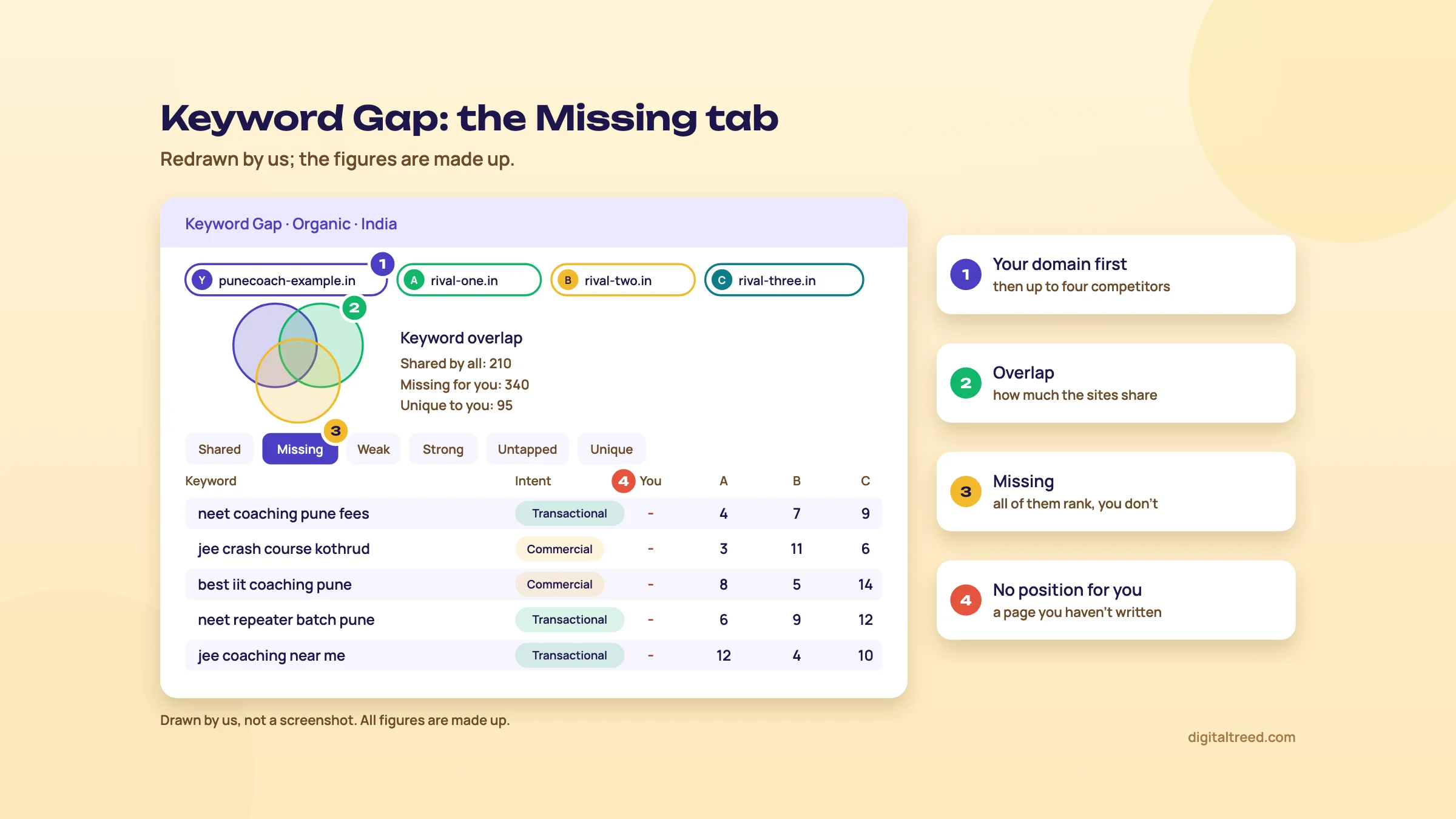 Keyword Gap: the Missing tab lists searches every competitor ranks for and you don't. Drawn by us; figures made up.
Backlink Gap: who links to them and not to you
Backlink Gap works the same way for links. Enter up to five domains and it lists the referring domains linking to each.[25] Select your domain in the drop-down above the table and filter by Best to see sites that link to all your competitors but not to you.
The Matches column counts how many of the compared domains each referring site links to. A site that links to all four competitors probably links to businesses like yours as a habit: a local directory, an industry association, a news site that writes round-ups. Those are your first outreach targets. Each one still needs a human check, because a site linking to everyone isn't always a site worth a link from.
Find content gaps for a Pune coaching centre
- Find real competitors In Organic Rankings, set the database to India, enter your domain and open Competitors. Note the top four domains that are other coaching institutes, not exam boards or news sites.
- Run Keyword Gap Enter your domain first and the four competitors after it. Choose Organic keywords and the India database, then click Compare.
- Open Missing Filter intent to Commercial and Transactional first. These searches ("NEET coaching Pune fees", "JEE crash course Kothrud") belong on service and course pages.
- Then Informational Switch the intent filter. Questions such as "how many attempts for JEE Main" belong in blog posts or a guide.
- Check page two Set Position for your domain to 11 to 20. These pages already rank; improving them is quicker than writing new ones.
- Make the list Copy the keywords into a sheet with the page each belongs to. Chapter 4 checks their difficulty before you write.
Keyword Gap gives you a list of searches. It doesn't tell you which ones you can realistically win. That's what KD% and the Keyword Magic Tool are for, in chapter 4. If you're doing this without any paid tool, Guide 2, chapter 1 shows the by-hand method with competitors' sitemaps.
Keyword research: Keyword Overview, Keyword Magic Tool and Keyword Strategy Builder
Quick answer
Use Keyword Overview to judge one keyword: volume, KD%, intent, CPC and who ranks. Use the Keyword Magic Tool to turn one seed into thousands of related searches, grouped by topic, with a questions filter. Keyword Strategy Builder, paid plans only, groups up to 10,000 keywords into pillar pages and subpages. Always check the database says India.
Semrush has three keyword tools that work as a funnel. Keyword Overview looks at one phrase closely. The Keyword Magic Tool finds the long list. Keyword Strategy Builder turns the list into a plan of pages. Here's what each number means and what to do about it.
Keyword Overview: is this one keyword worth it?
Enter a word or phrase and Keyword Overview shows its search volume, intent, number of results, CPC, competition level and a 12-month trend.[16]
| Metric | What Semrush means by it | How we read it |
|---|---|---|
| Volume | Average monthly searches on Google in the chosen database | An estimate. Compare keywords with each other; don't promise a client this many visits |
| Global Volume | Total across all Semrush country databases | Only useful if you sell abroad |
| KD% | 0 to 100 estimate of how hard it is to reach Google's top 10[26] | Compare inside Semrush only |
| Intent | Informational, navigational, commercial or transactional | Tells you which kind of page should target it |
| CPC | What advertisers pay per click on Google Ads | A rough signal of commercial value |
| Competitive Density | 0.00 to 1.00, how many advertisers bid on it | Paid search competition, not organic |
| Trend | Interest over the last 12 months, last bar is last month | Spot seasons: Diwali sweets, exam coaching, wedding wear |
Semrush groups KD% into six bands:[26]
KD% is Semrush's own model, so a 30 in Semrush and a 30 in Ahrefs aren't the same thing. Guide 2, chapter 1 explains why you compare difficulty only inside one tool. On paid plans, Keyword Overview also shows Personal Keyword Difficulty (PKD), which tailors the score to your domain.[16] For a young site, PKD is the more honest number. The free plan doesn't include PKD.[27]
Two more features of Keyword Overview are worth knowing. The Bulk Analysis tab checks up to 100 keywords at once.[16] Local metrics let you choose a city or region instead of the whole country, one keyword at a time, where Semrush has local data for it. Each new location uses one of your "keyword metrics updates".
Keyword Magic Tool: the long list
Enter a seed such as "eggless cake" and the Keyword Magic Tool returns related searches, split into topic subgroups down the left side, with total volume and average difficulty for the whole table.[27] The filters worth setting every time:
- Questions: only searches that ask something. Ready-made blog and FAQ topics.
- KD%: set a maximum. For a new site, start at "Easy" and below.
- Intent: keep commercial and transactional for service and product pages.
- Include keywords: add your city or area ("Kanpur", "Swaroop Nagar") to find local versions.
- Volume: set a minimum to hide noise, but don't set it high. In India, many profitable local searches show small volumes.
Free users see 10 results per report in the interface and can't export.[27] Paid users get thousands of rows and exports. That's the difference between a peek and a working list.
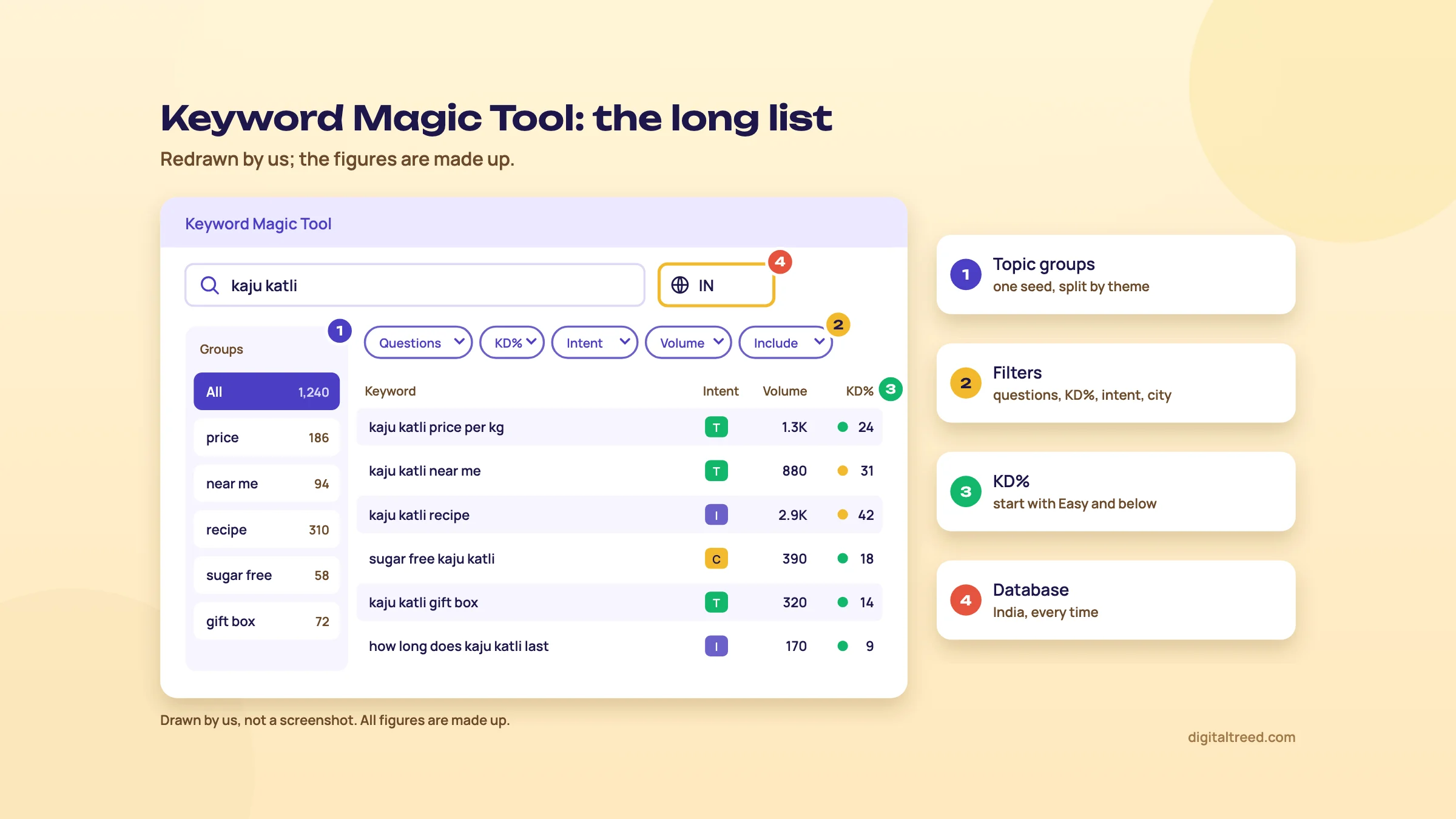 Keyword Magic Tool: topic groups on the left, filters on top, KD% on the right. Drawn by us; figures made up.
Note
From our work: a women's wear manufacturer's online store. Its product pages targeted short, competitive keywords. We moved them to long-tail keywords instead, and results started within a month. The lesson for this chapter: the long list matters more than the head term. Use the Keyword Magic Tool's filters to find the longer phrases, and don't chase the biggest volume.
Keyword Strategy Builder: from list to pages
Keyword Strategy Builder takes up to 5 seed keywords and builds a content plan. It analyses up to 10,000 keywords and groups them into topics, pillar pages and subpages.[28] It ranks pages by relevance to your seeds, search volume, keyword difficulty, domain diversity and SERP features. It's only on paid plans; free accounts get 0 structuring actions a month.
Four preset filters help you choose. Best for Strategy balances volume, difficulty and relevance. Quick Conversions keeps transactional and commercial keywords. More Potential Traffic shows the highest volumes. All Pages removes the filter.[28] From any page you can send its keywords to Position Tracking, export them, or generate an SEO brief.
One caution: a tool's cluster is a suggestion, not a site structure. Check two or three clusters by hand with the test in Guide 2, chapter 2: do the same pages rank for both keywords? If Google shows different results for two keywords, they probably need two pages, whatever the tool groups.
Build a keyword plan for a Kanpur sweet shop
- Set the database India, mobile. Most sweet shop searches happen on phones.
- Seed the Magic Tool Enter "sweets" and filter Include keywords to "Kanpur". Then repeat for the shop's top products: "kaju katli", "soan papdi", "sugar free sweets".
- Filter for buyers Intent: transactional and commercial. KD%: Easy and below. Save the keepers to a list.
- Add questions Switch on Questions for the same seeds. Keep the ones a shop can answer well, such as "how long does kaju katli last" or "which sweets for Diwali gift".
- Check the season Open Keyword Overview for the five biggest keywords and read the Trend bars. Plan festival pages two months before the spike.
- Group into pages Put up to five seeds into Keyword Strategy Builder and choose Quick Conversions. Check each suggested page against Google's results by hand before you write it.
Semrush's volumes are its own estimates. If you also run Google Ads, compare a few with Keyword Planner's ranges; the Keyword Planner guide explains why Google shows ranges to small accounts. Once you know which keywords you want, chapter 5 looks at the links you'll need to compete for them.
Backlinks: the Backlinks tool, Authority Score and Backlink Audit
Quick answer
The Backlinks tool shows any domain's links, referring domains, anchors and new or lost links. Authority Score is Semrush's own 1 to 100 grade, useful only for comparing sites. Backlink Audit flags suspicious links and builds a disavow file, but Google says most sites never need to disavow. Use the link data to find outreach targets, not to panic.
Links still matter, and Semrush is a decent place to study them. Just keep two things apart: finding links worth earning, which is most of the value, and cleaning up "toxic" links, which most sites don't need to do at all.
The Backlinks tool
Semrush's help pages call it Backlinks; older tutorials call it Backlink Analytics. Enter a domain or URL and you get its backlink profile, with these reports:[29]
- Overview: the profile at a glance, with totals and trends.
- Backlinks: each linking page, its anchor text and the page it links to.
- Anchors: the words used in links. A profile full of exact-match commercial anchors ("best digital marketing company Delhi") is a warning sign.
- Referring IPs, Indexed Pages, Outbound Domains and a Network Graph.
- Competitors: domains with similar backlink profiles.
- Bulk Backlink Analysis: compare the backlinks of up to 200 URLs at once.[25]
Semrush says new links reach its database within an hour of being published, and the interface refreshes every 15 minutes.[29] That's Semrush's claim about its own crawler. For your own site, Search Console's Links report is Google's view and is free; use both.
Free users get 10 requests a day with 10 results each, and only a basic Network Graph.[29]
Authority Score, read properly
Authority Score is Semrush's "compound metric that grades the overall quality of a website or a webpage", on a scale of 1 to 100.[20] It combines link power (the number and quality of referring domains), estimated organic traffic and six spam signals, such as a mismatch between links and traffic.
Semrush itself says the score is "best used for domain comparison, and not for determining good/bad on an absolute scale". It isn't a Google metric, and Semrush's own ranking factors study found only a weak link between Authority Score and position (Guide 2, chapter 9 has the numbers). Use it for one job: sorting a list of outreach targets so the stronger sites get contacted first.
Do not
- Promise a client an Authority Score of 40
- Buy links because a seller quotes a high score
- Compare Semrush's score with another tool's score
Do
- Compare your score with direct competitors' scores, in Semrush
- Watch referring domains grow over months
- Check each target site by hand before outreach
Backlink Audit and the disavow question
Backlink Audit analyses your own link profile, marks suspicious links with "toxic markers", lets you email site owners to remove links, and builds a disavow file for Google.[30] It can pull links from Search Console, Google Analytics and Majestic as well as Semrush. Without a paid SEO Toolkit you can re-run the audit once a week; paid plans re-run it as often as you like.
Here we disagree with how the tool is often used. Google's disavow help page says "most sites will not need to use this tool".[31] Google suggests disavowing only when you have a considerable number of spammy, artificial or low-quality links and those links have caused, or likely will cause, a manual action.
A tool's toxicity score is a guess about what Google might think. Disavowing from it tends to throw away good links along with bad ones. Our rule, the same as in Guide 3, chapter 10: no manual action and no history of buying links means no disavow file. Use Backlink Audit's Lost & Found report (paid plans) to notice when good links disappear, which is a far more common problem.
Note
From our work: a global sports platform and networking community. Its technical SEO was already good, but its posts linked to no outside sources, and earlier link building had used spammy tactics. We added sourced sports statistics to the posts, and collaboration requests then brought contextual links and brand mentions. Traffic rose 60%. The lesson: give sites a reason to link, then use a tool to find who might.
Build an outreach list for a D2C brand with Backlink Gap
- Pick four competitors Use Organic Rankings, Competitors, in the India database. For a D2C skincare brand, choose other brands, not marketplaces.
- Run Backlink Gap Enter your domain first and the four competitors. Select your domain in the drop-down above the table.
- Filter by Best These sites link to all your competitors but not to you. Sort by Matches, then by Authority Score.
- Open the top 30 by hand Keep magazines, review sites, gifting guides and bloggers who cover the category. Drop link farms, coupon sites and anything selling "guest posts".
- Find the reason For each keeper, open the page that links to a competitor. Was it a round-up, a review, a quote, a statistic? That tells you what to pitch.
- Track it Put the list in a sheet with the contact, the angle and the date. Export from Semrush works on paid plans, not during the trial.
The free way to watch your own links is Search Console's Links report. When a partner agrees to link, our Hyperlink Generator turns your URLs into HTML link code with your anchor text. Send them the exact snippet. Next, chapter 6 turns to your own site: Site Audit, Position Tracking and the on-page tools.
Your own site: Site Audit, Position Tracking and the on-page tools
Quick answer
Site Audit crawls your site with over 140 checks, now including AI crawler access; the free plan covers 100 pages a month. Position Tracking checks your daily rankings for chosen keywords, down to city or postal code, including the local pack. On Page SEO Checker and SEO Writing Assistant suggest page changes based on the current top 10.
Chapters 3 to 5 were about other sites. These tools work on yours, and they use your website monitoring slots (chapter 2).
Site Audit
Site Audit is a crawler with over 140 on-page and technical checks: duplicate content, broken links, HTTPS, hreflang, crawlability, indexability and more.[18] An AI Search category checks, among other things, whether you block AI crawlers such as OAI-SearchBot, PerplexityBot and Claude-SearchBot.[32] It can audit the desktop or mobile version of a site and re-crawl daily or weekly.
The settings that matter, from Semrush's configuration guide:[13]
- Scope: the whole domain, one subdomain or one folder. To audit only a blog, enter the blog's folder and clear "Crawl all subdomains".
- Limit per audit: how many pages each crawl takes.
- Pages to crawl: Website (follows links from the homepage), Robots.txt sitemap, Sitemap by URL, or Import URLs from file. Use a sitemap when you care about your important pages rather than the ones closest to the homepage.
- User agent: SiteAuditBot (Mobile) is the default; SiteAuditBot (Desktop) and OpenAI-Search are the alternatives. There's no Googlebot option.
- Crawl delay: switch to "1 URL per 2 seconds" if a shared hosting server struggles during the crawl.
- JS rendering: for JavaScript-heavy sites. Only on the higher tiers.
- Restrictions to bypass: for staging sites behind a password.
| Plan level | Pages a month | Pages per audit |
|---|---|---|
| Free account | 100 | 100 |
| Starter (Pro tier in the help pages) | 100,000 | 20,000 |
| Pro+ (Guru tier) | 300,000 | 20,000 |
| Advanced (Business tier) | 1,000,000 | 100,000 |
Semrush's help pages still use the older tier names Pro, Guru and Business; the same page says Semrush One Starter, Pro+ and Advanced inherit those tiers' limits.[18] Unused pages don't roll over; limits reset on the 1st of each month. The $139 SEO plan shows the same 5 websites and 500 tracked keywords as Starter on the pricing page.[9]
How to read the results: ignore the Site Health percentage at first and sort issues by Errors. Then ask of each one, "does this affect pages that earn money or traffic?" A missing alt text on an old event photo can wait. A noindex on the services page can't. Confirm anything serious in Search Console, which shows what Google actually did.
Note
From our work: when I taught SEO A to Z at a training institute, my students were already doing client work and saw results in two to three weeks. The hardest part for them was technical SEO, because most local business sites they handled ran on WordPress with shared hosting. The most common issue was site speed. The lesson for any audit tool: fix speed on the pages that earn money before you work down the rest of the list.
For a quick check without an account, our Free Website Audit runs 50+ checks across 25 pages, including speed and AI visibility, and, after a free sign-in, gives a points-ranked action plan with a PDF. Guide 3, chapter 11 covers a full audit step by step.
Position Tracking
Position Tracking checks where your site ranks for a fixed list of keywords, every day. It tracks Google, Bing, Baidu, ChatGPT Search and Google AI Mode, by device, and by location down to postal code.[33] It spots SERP features too, including AI Overviews and featured snippets.
Set-up decisions, in order:[14]
- What to track: root domain, subdomain, folder or URL. Start with the root domain.
- Search engine and device: Google and mobile for most Indian consumer businesses.
- Location: country, state or region, city, or postal code. A Delhi dentist should track New Delhi, or their area's PIN code if Semrush offers it, not India, because local results change across the city.
- Business name: enter it exactly as it appears on Google, so Semrush can find you in the local pack.
- Keywords: paste them, upload a file, or import from Keyword Strategy Builder, Google Analytics or Search Console. Tag them by service or page.
Two limits catch people out. Location and device can't be changed after the campaign starts. And tracking several locations or devices in one campaign (Multitargeting) needs Pro+ or above.[33]
| Plan level | Keywords tracked | Websites | Multitargeting |
|---|---|---|---|
| Free account | 10 | 1 | No |
| Starter (Pro tier) | 500 | 5 | No |
| Pro+ (Guru tier) | 1,500 | 15 | 10 targets per campaign |
| Advanced (Business tier) | 5,000 | 40 | 5,000 targets per campaign |
Data is daily for the first 60 days of a campaign, then weekly (Wednesdays by default) for 140 weeks.[33] Rankings in ChatGPT Search and Google AI Mode need an AI Visibility Toolkit or a Semrush One plan, which means Starter and up (chapter 7).[34]
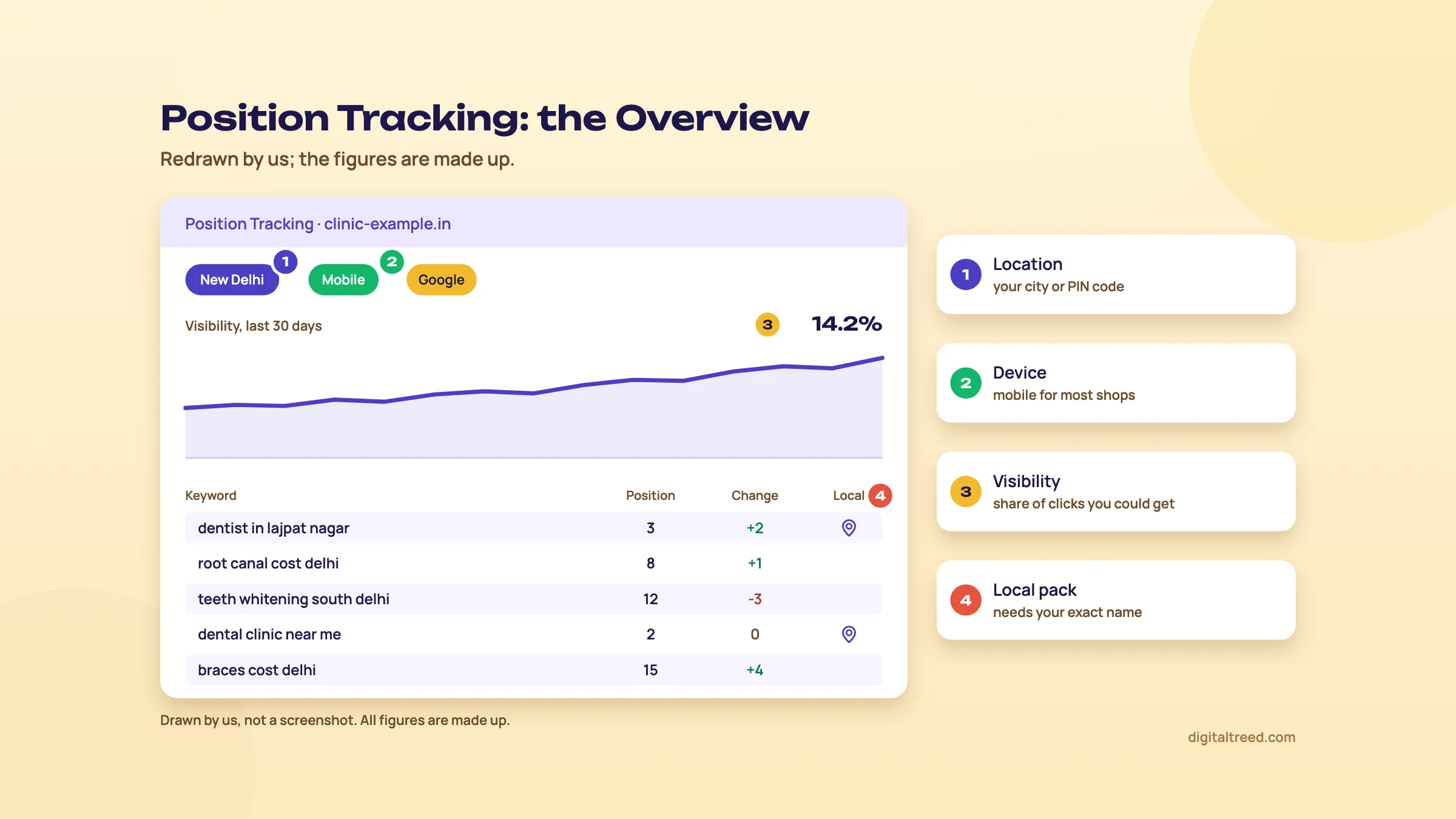 Position Tracking set to one city and mobile, with local pack results marked. Drawn by us; figures made up.
Why pay for rank tracking when Search Console shows average position? Because Search Console averages across every location and device, and only shows searches where you appeared. Position Tracking checks one place, one device, one keyword, every day, and shows competitors beside you. Guide 2, chapter 11 compares rank trackers and their prices.
On Page SEO Checker
On Page SEO Checker gives a list of changes for each page and target keyword, based on the top 10 results for that keyword.[35] Ideas come in groups: content, semantics, strategy, backlinks, user experience, SERP features and technical SEO. It can import pages and keywords from Search Console, Google Analytics, Organic Rankings or Position Tracking. Each keyword analysed uses one "SEO Idea unit"; the free account gets one campaign with up to 10 pages or keywords.[24]
It's good for spotting what the top pages have that yours lacks. Treat "add these semantically related words" as a reading list, not an order. Our Word Counter & Keyword Density Checker shows the top 1-, 2- and 3-word phrases on any page, from a URL or pasted text. Run it on your page and a competitor's to cover the same ground for free.
SEO Writing Assistant
SEO Writing Assistant is still offered, as part of the SEO Toolkit. It scores a draft on readability, SEO, originality and tone of voice, against your target keywords and the top-ranking pages.[36] It works inside Semrush and as a Google Docs add-on, a WordPress plugin and an MS Word add-in. Its readability score uses the Flesch reading ease formula.
The limits are tight below Pro+. Free and Starter-level users can create 2 documents per account; Pro+ and Advanced levels get unlimited documents.[36] The plagiarism checker allows 3 checks in total at the lowest paid tier.
A score of 10 out of 10 doesn't mean a page will rank. It means the page looks like the current top 10. Write something better than them first, then use the tool to catch what you missed. Guide 2, chapter 4 covers briefs and intent.
Audit and track a Delhi dental clinic's site
- Set the audit scope In Site Audit settings, choose the clinic's domain and "Robots.txt sitemap" as the source, so the 100 free pages are the ones in the sitemap.
- Run and sort Open the issues list and filter to Errors. Note anything on the homepage, treatment pages and contact page.
- Check AI access Open the AI Search issues. If OAI-SearchBot or PerplexityBot is blocked, read Guide 5, chapter 6 before changing robots.txt.
- Fix, then confirm Fix the errors with the developer. Use Search Console's URL Inspection on each fixed page.
- Track 10 keywords In Position Tracking, New Delhi, mobile, with the clinic's exact Google business name.
- Read weekly Each Monday, read the weekly email. Look for keywords that dropped more than five places, and check that page first.
Chapter 7 covers the part of Semrush that has grown fastest this year: AI visibility.
AI visibility in Semrush: what exists today and what it costs
Quick answer
Semrush tracks how brands appear in Google AI Overviews, AI Mode, ChatGPT, Perplexity and Gemini. Free accounts see a domain's AI mentions, citations and visibility score. Prompt tracking and Brand Performance need the AI Visibility Toolkit ($99 a month) or a Semrush One plan (Starter and up, from $199). The data comes from prompts Semrush runs, not from Google or OpenAI.
A year ago this chapter would have been a paragraph. Semrush has since built AI visibility into its plans, and its pricing page now leads with "SEO + AI Search". Here's what each feature does and which plan you need, from Semrush's own feature guide, dated 13 October 2026.[32]
The features, and who gets them
| Feature | What it shows | Data | Who gets it |
|---|---|---|---|
| Domain Overview, AI part | AI Visibility Score, mentions, cited pages for any domain | Semrush prompt database | Free, and Starter and up |
| Organic Rankings, AI Overviews | Which of a domain's keywords trigger AI Overviews, and whether it's cited | Keyword database | Free, and Starter and up |
| Site Audit, AI Search checks | Blocked AI crawlers and other technical blockers | Your crawl | Free (100 pages), and Starter and up |
| Visibility Overview | A brand's AI visibility across LLMs and AI Overviews | Prompt database | AI Visibility Toolkit or Semrush One |
| Competitor Research | Your AI visibility against up to four competitors | Prompt database | AI Visibility Toolkit or Semrush One |
| Prompt Research | Prompts and topics in your niche, like keyword research for AI | Prompt database | AI Visibility Toolkit or Semrush One |
| Brand Performance | Share of voice, sentiment and narratives, updated weekly | Synthetic prompts for your domain and location | AI Visibility Toolkit or Semrush One |
| Prompt Tracking, and AI in Position Tracking | Daily presence for your own prompts in ChatGPT and AI Mode | Daily checks | AI Visibility Toolkit or Semrush One |
Semrush says its AI data covers ChatGPT, Gemini, Perplexity, SearchGPT, Google AI Mode and Google AI Overviews, and that it refreshes more than 317 million prompts a month.[4] Not every report covers every platform. Prompt Tracking, for example, covers AI Overviews, AI Mode and ChatGPT.[32]
India is one of the regions covered by Visibility Overview, Competitor Research and Prompt Research. Prompt Tracking covers 220+ countries and territories.[37]
What it costs
$0
Free account: AI mentions, citations and visibility score; 100-page AI-readiness audit[32]
$99
AI Visibility Toolkit a month: 25 tracked prompts, 1 domain for Brand Performance, no free trial[37]
$199
Starter (SEO + AI Search) a month: 50 prompts a day plus the SEO Toolkit[9]
$299
Pro+ a month: 100 prompts a day, 15 websites[9]
Extra prompts for the AI Visibility Toolkit cost $60 a month for 50 more; another domain or location for Brand Performance costs $99 a month.[37] The $139 SEO plan is SEO only: its pricing card marks AI search tracking, AI sentiment, AI visibility reports and custom prompts as not included,[9] although one help page still lists some of them.[1] Chapter 8 converts these to rupees.
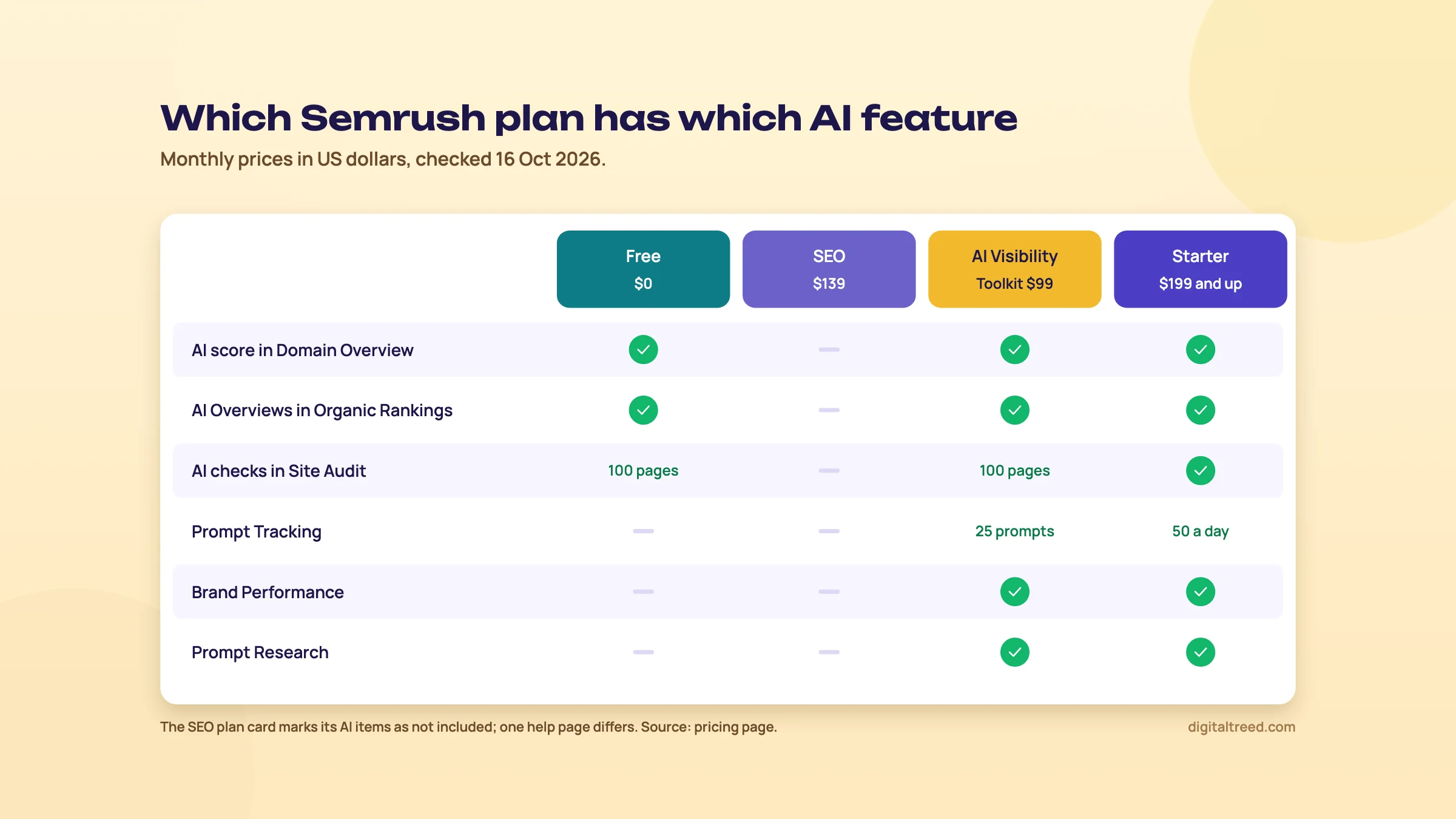 Which Semrush plan includes which AI feature, prices checked 16 October 2026. Drawn by us.
How much to trust it
Semrush's Brand Performance reports work by generating "synthetic prompts" for your domain and location, a mix of branded and non-branded questions, and analysing the answers.[32] So the data is Semrush asking AI tools questions on a schedule. That's useful. It's also not the same as what real people asked.
Google says it directly: "No third-party tool has access to our internal ranking or AI systems."[38] AI answers also change from one run to the next, so read trends over weeks, not single days. Guide 5, chapter 8 explains the free alternatives in detail. They are Search Console's generative AI report (impressions, not clicks), Bing Webmaster Tools' AI Performance report, GA4's AI Assistant channel and a monthly prompt log.
Who should pay for it
Our view: a single local business doesn't need paid AI tracking yet. The free Domain Overview score, the free Site Audit AI checks and a manual prompt log cover it. Pay when you report AI visibility to clients every month across dozens of prompts, or track several brands, and the manual log takes more than a day. For an agency already on the $139 SEO plan, moving to Starter at $199 adds 50 tracked prompts a day. That's cheaper than adding the $99 AI Visibility Toolkit, which has only 25.
Before trusting any AI visibility number, check that AI crawlers can reach your site at all. Our AI Crawler Checker checks whether GPTBot, ClaudeBot, PerplexityBot and more than 100 other bots can access your site, gives an AI readiness score and suggests a robots.txt fix.
Chapter 8 puts every plan and add-on in one table, with rupee figures, and compares Semrush with the alternatives.
Semrush pricing in India, pros and cons, and the alternatives
Quick answer
On 16 October 2026 Semrush's paid plans started at $139 a month (about ₹13,344) for SEO, $199 for Starter with AI search, and $299 for Pro+. Yearly billing saves up to 17%. The site shows US dollars, not rupees, even from India, and Semrush adds GST for Indian customers. Free Google tools and our own tools cover most small sites.
Prices below were checked on Semrush's pricing page on 16 October 2026, from an Indian connection. The page showed US dollars only.[9] Rupee figures are ours, at ₹96 to the US dollar (the October 2026 average up to the 16th), rounded, and before tax.[39] Semrush's tax page lists India among the countries where it collects GST, so expect GST on top at checkout.[40]
Plans
| Plan | Monthly | Billed yearly, per month | Websites | Keywords tracked daily | AI prompts tracked daily |
|---|---|---|---|---|---|
| Free | $0 | - | 1 demo project | 10 | - |
| SEO | $139 (about ₹13,344) | $117.33 (about ₹11,264) | 5 | 500 | None |
| Starter (SEO + AI Search) | $199 (about ₹19,104) | $165.17 (about ₹15,856) | 5 | 500 | 50 |
| Pro+ (SEO + AI Search) | $299 (about ₹28,704) | $248.17 (about ₹23,824) | 15 | 1,500 | 100 |
| Advanced | Custom | Custom | 40+ | 5,000+ | Custom |
| Enterprise | Custom | Custom | Unlimited projects, custom limits | Custom | Custom |
Source for the table: Semrush's pricing page and plans comparison article.[1] Our pick for most agencies is Starter, because it's the cheapest plan with every tool in this guide, though a few features (historical data, JS rendering, multi-location tracking) need Pro+. Pro+ adds historical data, content optimisation, keyword cannibalisation analysis and multi-location and device tracking. Billed yearly, you pay the whole year upfront.
Warning
Semrush's help pages still quote the old SEO Toolkit plans (Pro $139.95, Guru $249.95, Business $499.95) in places. Those names and prices don't match the current pricing page.[41] Go by the pricing page.
Add-ons and other toolkits
| Add-on | Price a month | About |
|---|---|---|
| Additional user | From $45 | ₹4,320 |
| AI Visibility Toolkit (on its own) | $99 | ₹9,504 |
| Base Report (My Reports, per report) | $10 | ₹960 |
| Pro Report (white-label, per report) | $20 | ₹1,920 |
| Lead Generation (Agency Partners listing) | $90 | ₹8,640 |
| Local Toolkit, Base | $30 per location | ₹2,880 |
| Content Toolkit | $60 | ₹5,760 |
Sources: users, reports and lead generation from the pricing page;[9] the AI Visibility Toolkit from its help page;[37] Local from the Local pricing article;[42] Content from the Content Toolkit article.[43]
Free account limits, in one place
- 1 demo project and 1 website to monitor; 10 reports a day across the main tools.[9]
- About 10 results per report, and no exports in the Keyword Magic Tool.[27]
- Site Audit: 100 pages a month. Position Tracking: 10 keywords.[24]
- On Page SEO Checker: one campaign, up to 10 pages or keywords.[24] SEO Writing Assistant: up to 2 documents.[36]
- Keyword Strategy Builder: not available.[28]
- AI: a domain's mentions, citations and visibility score, plus AI checks in a 100-page audit.[32]
Trials, refunds and paying from India
Paid plans have a 7-day free trial;[1] the AI Visibility Toolkit doesn't.[37] Exports are off during trials. The 7-day money-back guarantee only covers a first purchase with a 12-month commitment, or a first add-on, bought on Semrush.com by credit card. You must ask in writing within 7 days.[10] Semrush accepts Visa, Mastercard, Discover and American Express, but not virtual cards.[11] There's no student plan and no lifetime plan; colleges can apply to Semrush for Education, which gives 3 months' free access.[1]
Pros and cons
Pros
- Competitor research, keywords, links, audits, rank tracking and AI visibility in one account
- India has its own database, and Position Tracking goes down to city and postal code
- Keyword Gap and Backlink Gap compare five domains at once
- Shows a snapshot of competitors' Google Ads keywords and ad copies too
- A free account with no card, and a 7-day trial on paid plans
Cons
- Expensive for one person: about ₹13,344 a month before GST for the cheapest paid plan
- Prices in US dollars only, charged to an international card
- Traffic and volume figures are estimates; small Indian local searches are often thin
- Help pages and plan names don't always match after the recent restructuring
- Exports off during the trial, and no refund on monthly plans
- Extra users cost extra, from $45 a month each
Alternatives, starting with ours
Our own free tools cover parts of the job with no account:
- Free Website Audit: 50+ checks across 25 pages for SEO, speed, security and AI visibility, with a PDF action plan after a free sign-in. Instead of a first Site Audit on a small site.
- Meta Tag Analyzer: titles, descriptions, canonicals and Open Graph for up to 10 URLs, with Google and social previews.
- Word Counter & Keyword Density Checker: keyword percentages and top phrases from text or a URL. A free stand-in for parts of On Page SEO Checker.
- HTTP Status Checker: status codes, redirect chains and headers for up to 10 URLs.
- AI Crawler Checker: whether AI bots can reach your site, before you pay to track AI visibility.
We don't have a keyword volume, backlink or rank tracking tool yet. For those, use Google's free tools or another suite:
| Job | Free choice | Paid choice, entry price |
|---|---|---|
| Your own site's searches and clicks | Search Console | Not needed |
| Keyword volumes | Keyword Planner (ranges for small accounts) | Semrush SEO $139; Ahrefs Starter $29[44] |
| Competitor keywords | Semrush free account, 10 reports a day | Semrush SEO $139; Ahrefs Lite $129[44] |
| Your own backlinks | Search Console Links report; Ahrefs Free for your own site | Semrush or Ahrefs |
| Rank tracking | Search Console average position (not a true rank) | SE Ranking Core $129, 2,000 keywords daily[45] |
| Technical crawl | Our Free Website Audit; Screaming Frog free up to 500 URLs[46] | Semrush Site Audit; Screaming Frog paid |
| AI visibility | Search Console generative AI report; Bing AI Performance; a prompt log | Semrush Starter $199 or AI Visibility Toolkit $99 |
Which one when
- Local business with a small site: Search Console, Business Profile, Keyword Planner and our free tools. Semrush's free account for a monthly look at three competitors.
- Freelancer with two or three clients: the SEO plan, paid monthly until you're sure, then yearly. Or Ahrefs if links are most of your work.
- Agency reporting AI visibility: Starter or Pro+, plus the Pro Report add-on for white-label reports.
- In-house team on a large site: Pro+ for historical data, cannibalisation analysis and multi-location tracking, alongside a desktop crawler.
The comparison most people want next is Ahrefs vs Semrush, which puts the two side by side job by job. For a wider list of free options, see Best free SEO tools. If you'd rather have someone run the research and the fixes, that's our SEO service; ask for a quote.
Test yourself
Ten questions on the whole guide. Pick an answer, check it, and see your score at the end.
You got 0 of 10 right.
Frequently asked questions
Frequently asked
What is Semrush used for?
Semrush is used to research competitors' keywords, traffic and backlinks, find new keywords, audit your own site, track rankings every day and now measure how brands appear in AI answers. Most of its data is about other websites, which is what Search Console can't give you.
Is Semrush free?
There's a free account with no card needed: one demo project, 10 reports a day across the main tools, about 10 results per report, a 100-page Site Audit and 10 tracked keywords. It's enough for a quick look at a few competitors. Paid plans have a 7-day free trial, with exports switched off.
How much does Semrush cost in India?
On 16 October 2026 the paid plans were $139 a month for SEO (about ₹13,344), $199 for Starter and $299 for Pro+, or up to 17% less billed yearly. Semrush shows prices in US dollars, not rupees, and lists India among the countries where it collects GST.
Does Semrush show prices in rupees?
No. Seen from an Indian connection on 16 October 2026, the pricing page showed US dollars only. You pay with an international-enabled Visa, Mastercard, Discover or American Express card; virtual cards aren't accepted.
Who owns Semrush now?
Adobe. It announced the deal on 19 November 2025, at $12 a share in cash, about $1.9 billion, and completed it on 28 April 2026. Semrush told customers there would be no immediate changes to their services or agreements.
Which Semrush database should I use for India?
The India database (code IN) for any business selling to people in India. Volumes, keyword difficulty and competitors' traffic are all for the database you pick, so the US database gives misleading numbers for Indian searches. Choose mobile where the report offers it.
Is Semrush accurate?
Its traffic and volume numbers are estimates built from ranking data and search volumes, not Google's own figures. Google says third-party tools don't have access to its internal ranking data. Compare Semrush's estimate for your own site with your Search Console clicks to see how far off it is in your niche.
Does Semrush still have the SEO Writing Assistant and On Page SEO Checker?
Yes, both are still part of the SEO Toolkit. SEO Writing Assistant scores drafts for readability, SEO, originality and tone, and works in Google Docs, WordPress and Word. Free and entry-level accounts can create 2 documents; Pro+ and above get unlimited documents.
Can Semrush track AI Overviews and ChatGPT?
Yes. Position Tracking shows when AI Overviews appear for your tracked keywords. Tracking your own prompts in ChatGPT and Google AI Mode needs the AI Visibility Toolkit ($99 a month) or a Semrush One plan such as Starter ($199). The results come from prompts Semrush runs, not from OpenAI or Google.
Is Semrush better than Ahrefs?
Neither is better for everyone. Semrush covers more jobs in one account, including AI visibility, with Google Ads research and local SEO as add-on toolkits; Ahrefs has a cheaper Starter plan at $29 and is strong on links. Our Ahrefs vs Semrush guide compares them job by job.
Sources
References
- Subscriptions and Toolkits, Semrush Knowledge Base, accessed 16 Oct 2026
- SEO Toolkit, Semrush Knowledge Base, accessed 16 Oct 2026
- Organic Rankings, Semrush Knowledge Base, accessed 16 Oct 2026
- Data and Metrics, Semrush Knowledge Base, accessed 16 Oct 2026
- Guidance on third-party SEO tools and services, Google Search Central, updated 5 Jun 2026, accessed 16 Oct 2026
- Adobe to Acquire Semrush, Adobe, 19 Nov 2025, accessed 16 Oct 2026
- Adobe Completes Semrush Acquisition, Adobe, 28 Apr 2026, accessed 16 Oct 2026
- FAQ for customers: Adobe acquires Semrush, Semrush, 28 Apr 2026, accessed 16 Oct 2026
- Plans & Pricing, Semrush, prices seen 16 Oct 2026 from India, accessed 16 Oct 2026
- Canceling your subscription (refunds), Semrush Knowledge Base, accessed 16 Oct 2026
- Billing FAQ, Semrush Knowledge Base, accessed 16 Oct 2026
- Projects, Semrush Knowledge Base, accessed 16 Oct 2026
- Configuring Site Audit, Semrush Knowledge Base, accessed 16 Oct 2026
- Configuring Position Tracking, Semrush Knowledge Base, accessed 16 Oct 2026
- What countries does Semrush cover?, Semrush Knowledge Base, accessed 16 Oct 2026
- Keyword Overview, Semrush Knowledge Base, accessed 16 Oct 2026
- What mobile databases are available on Semrush?, Semrush Knowledge Base, accessed 16 Oct 2026
- Site Audit, Semrush Knowledge Base, accessed 16 Oct 2026
- Domain Overview, Semrush Knowledge Base, accessed 16 Oct 2026
- Authority Score, Semrush Knowledge Base, accessed 16 Oct 2026
- Organic Rankings Positions Report, Semrush Knowledge Base, accessed 16 Oct 2026
- Top Pages, Semrush Knowledge Base, accessed 16 Oct 2026
- Keyword Gap, Semrush Knowledge Base, accessed 16 Oct 2026
- What can you do with a free Semrush account?, Semrush blog, 10 Dec 2025, accessed 16 Oct 2026
- Backlink Gap, Semrush Knowledge Base, accessed 16 Oct 2026
- What is KD%?, Semrush Knowledge Base, accessed 16 Oct 2026
- Keyword Magic Tool, Semrush Knowledge Base, accessed 16 Oct 2026
- Keyword Strategy Builder, Semrush Knowledge Base, accessed 16 Oct 2026
- Backlinks, Semrush Knowledge Base, accessed 16 Oct 2026
- Backlink Audit, Semrush Knowledge Base, accessed 16 Oct 2026
- Disavow links to your site, Search Console Help, Google, accessed 16 Oct 2026
- Semrush Features for AI Visibility, Semrush Knowledge Base, 13 Oct 2026, accessed 16 Oct 2026
- Position Tracking, Semrush Knowledge Base, accessed 16 Oct 2026
- Semrush One, Semrush Knowledge Base, accessed 16 Oct 2026
- On Page SEO Checker, Semrush Knowledge Base, accessed 16 Oct 2026
- SEO Writing Assistant, Semrush Knowledge Base, accessed 16 Oct 2026
- AI Visibility Toolkit, Semrush Knowledge Base, accessed 16 Oct 2026
- Google's guide to optimizing for generative AI features on Google Search, Google Search Central, updated 10 Jul 2026, accessed 16 Oct 2026
- Monthly average USD to INR, 2026, X-Rates, accessed 16 Oct 2026
- Taxes, Semrush Knowledge Base, accessed 16 Oct 2026
- SEO Toolkit Pricing and Plans, Semrush Knowledge Base, accessed 16 Oct 2026
- Local Toolkit pricing and plans, Semrush Knowledge Base, accessed 16 Oct 2026
- Content Toolkit pricing and limits, Semrush Knowledge Base, accessed 16 Oct 2026
- Ahrefs pricing, Ahrefs, prices seen 16 Oct 2026, accessed 16 Oct 2026
- SE Ranking plans and pricing, SE Ranking, prices seen 16 Oct 2026, accessed 16 Oct 2026
- SEO Spider pricing, Screaming Frog, prices seen 16 Oct 2026, accessed 16 Oct 2026
Get the free checklist
Every step of this guide on one page, to print or tick off. We email you the PDF link.