

Quick answer
Empire Flippers prices the sites it sells at about 1.7x to 5x or more of their last 12 months of net profit, as of November 2026. On that marketplace a typical sale averaged 2.2x, while distressed sites, usually sold after a recent problem, averaged 1.1x. Add up 12 months of real profit before you trust any number.
How much is my website worth? That's the question when a stranger emails an offer for your content site or small store, and you'll want a figure you can defend. A website valuation is an estimate of what a buyer would pay for profit your site has already proven.
Visits alone don't set the price. In our test, two made-up sites had equal traffic but different profit. At Empire Flippers' 2.2x typical multiple they came out at $107,800 and $81,400 (example), while a traffic-only formula priced both at $60,000 (example). The closing section says which numbers we checked, and which we couldn't.
Key takeaways
- Buyers pay a multiple of the last 12 months of net profit.
- Empire Flippers' typical sale averaged 2.2x annual profit as of November 2026.
- A sharp profit jump usually means a lower multiple.
- A traffic-only formula gave both made-up sites $60,000 (example).
- Buyer and seller both report the price split on IRS Form 8594.
Profit times a multiple: the website valuation formula
Brokers don't start from traffic or potential. Empire Flippers says on its valuation calculator page that it prices listings as the last 12 months of net profit times a multiple. As of November 2026, it says that multiple typically runs from 1.7x to 5x or more across the 2,686 businesses it's sold. Its own example is $80,000 of yearly profit at 2.5x, about $200,000. Net profit here usually means seller discretionary earnings, or SDE, which is pre-tax profit with your own pay and any personal costs run through the business added back. Empire Flippers uses SDE up to about $5 million in yearly revenue and EBITDA above that, since bigger sites already pay managers to run the work.
Watch the unit, because brokers quote multiples two ways. FE International's October 16, 2026 post on content site multiples puts it plainly: a quote of "36x monthly profit" and one of "3x annual profit" describe the same price. To convert, multiply by 12. A 2.2x annual multiple equals 26.4x monthly profit, and 3.2x equals 38.4x. If a buyer quotes you 30x (an example figure), ask which one they mean before you do anything else. Thirty times monthly profit is 2.5x a year, while 30x annual profit sits far above both brokers' published ranges.
The window counts as well: Empire Flippers switches from 12 months to 6 when profit has jumped or dropped sharply, usually at a lower multiple. It calls a 3-month window "not a reliable base, especially for businesses above $100,000."
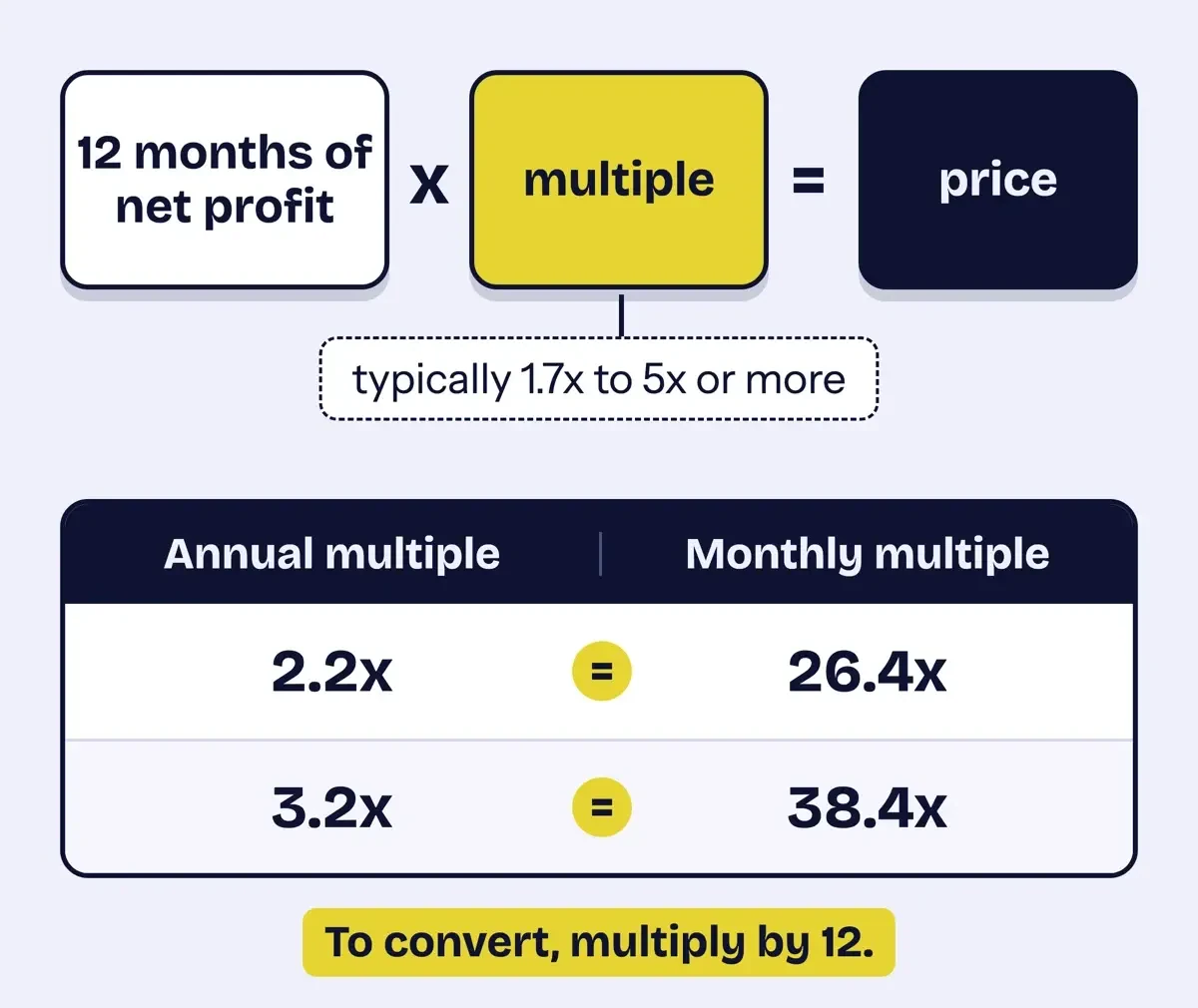 Diagram by DigitalTreed: the profit times multiple formula and the annual to monthly conversion, from the Empire Flippers and FE International pages cited here.
What moves the multiple up or down?
Two sites with the same profit can sell at very different multiples. Empire Flippers' valuation page lists what's behind the gap; six of its factors:
- Age and track record: a longer, steady history earns a higher multiple.
- Trend: flat or growing profit beats a recent spike or decline.
- Income sources: a single revenue source is a red flag to buyers.
- Traffic sources: heavy reliance on one channel, such as Google, lowers the multiple.
- Owner time: a site that runs on a few hours a week sells for more.
- Transferable assets: an email list, quality backlinks and a common platform such as WordPress widen the buyer pool.
FE International's October 16, 2026 post shows the spread in its own sales. It sold a travel blog at 3.5x while an inventory software business went for 10x. FE credits the gap to site age, financial trend, niche competition and the hours each one took. The same post quotes FE International's own wider band of roughly 3x to 10x annual earnings for private internet businesses. Content sites, blogs and newsletters sit in the lower-to-middle part, and FE adds that scale changes both the earnings basis and the number. If your traffic is mostly organic, read what Google confirms in our Google ranking factors explainer, since buyers price search dependence as risk.
A site that lives on one affiliate program carries that program's terms as risk. The Empire Flippers page says signed affiliate contracts or several income streams lower it. If most of your income comes through one program, compare it with others in our comparison of affiliate programs for beginners before a buyer asks about it.
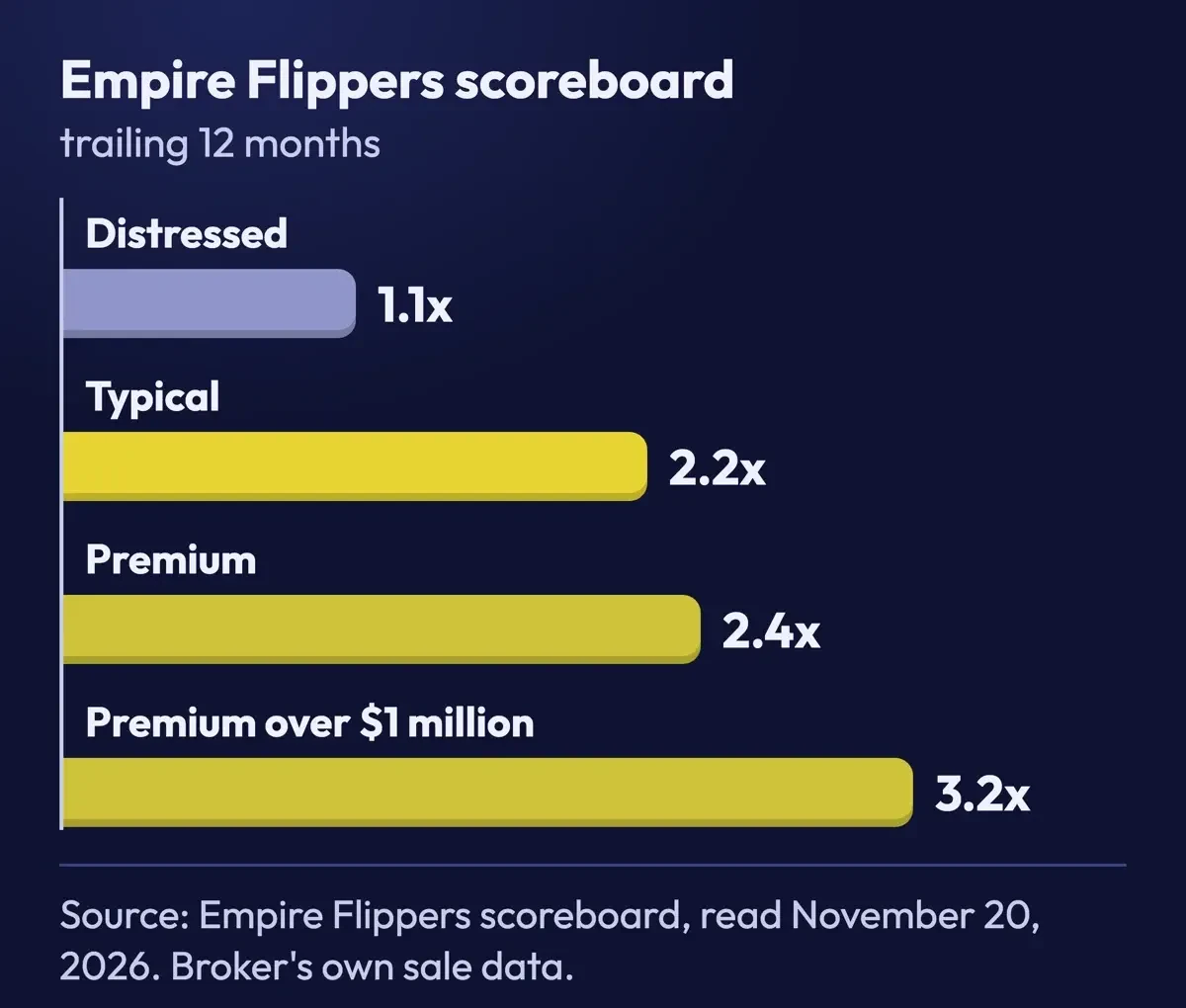 Source: Empire Flippers scoreboard, trailing 12 months, read November 20, 2026. Chart drawn by us; the figures are the broker's own sale data.
Where the multiples come from, and whose data they are
Every multiple in this section comes from a broker that's paid a commission when a site sells. Empire Flippers, for one, charges 15% on sales up to $700,000 as of November 2026. Don't read them as neutral statistics. They're sellers' own market data. They're from closed deals, though: the scoreboard divides the sale price, not the asking price, by profit.
The Empire Flippers scoreboard divides each sale price by the trailing 12 months of net profit. As of November 20, 2026, it showed 2.2x for typical businesses and 2.4x for premium ones. Premium sales over $1 million averaged 3.2x, and distressed sales averaged 1.1x. Distressed means a site sold at 1.5x or less, often after a recent problem. The page also counts $607,409,281 in total sales across 2,686 listings. Its website valuation guide, updated November 12, 2026, gives the same averages.
Why a website worth calculator can only guess
Empire Flippers says its own calculator "cannot judge traffic quality, backlinks or a recent change in trend".
Domain appraisal tools see even less. The Empire Flippers guide says they look at the name itself, such as its length, extension and words. They don't see your profit and loss statement, your traffic sources or how much work the site takes. The broker's FAQ adds that calculators valuing a site on traffic alone are less reliable. A domain authority score measures links, not price, and our domain authority checker walkthrough shows what a DA number does and doesn't tell you.
Outside traffic numbers are estimates too. Semrush's page on where its data comes from says its traffic figures start from a clickstream panel of over 200 million anonymized users. An algorithm then turns that panel into a traffic estimate, which a buyer can't treat as your real analytics. Our website analytics tools roundup covers the first-party tools that record actual visits.
Value my website: a worked example
To measure the gap between estimate and proof, we wrote a short calculator and fed it two made-up sites with the same example traffic of 30,000 monthly visits. Example site A's profit was a steady $49,000 over 12 months, while example site B's was $37,000 with its last 6 months up 181.4% on the first 6.
What we tested
On November 20, 2026, we ran test/value_calc.py locally, with no network access, and got these results.
| Result (example, made-up inputs) | Example site A (steady) | Example site B (recent spike) |
|---|---|---|
| 12-month net profit | $49,000 | $37,000 |
| At 1.7x to 5x (example) | $83,300 to $245,000 | $62,900 to $185,000 |
| At 2.2x typical (example) | $107,800 | $81,400 |
| Last 3 months x 4, at 2.2x (example) | $110,880 | $169,840 |
| Traffic only: 30,000 visits x $2.00 (example) | $60,000 | $60,000 |
Site A's last 6 months ran 4.6% above its first 6; site B's ran 181.4% above (example). Profit trend moves every row but the last.
What the two example sites show
A free website value estimator works like the traffic-only row. It gives both example sites $60,000 because it never sees profit, and the $2.00 per visit rate is one we made up for the example. The last-3-months row flatters site B most: annualizing its spike at 2.2x gives $169,840, against $81,400 on 12 months of profit (example). Empire Flippers calls three months an unreliable base for this reason. After a sharp jump, it uses a 6-month window, usually at a lower multiple. A buyer who sees site B's chart will ask what caused the spike, such as one viral post, one new affiliate deal or a Google update.
Run the same math on your own books: add 12 months of net profit, then multiply by 1.7 and by 5 for the outer range. Before you share numbers, run our website audit; it flags broken pages and slow templates a buyer's review would find.
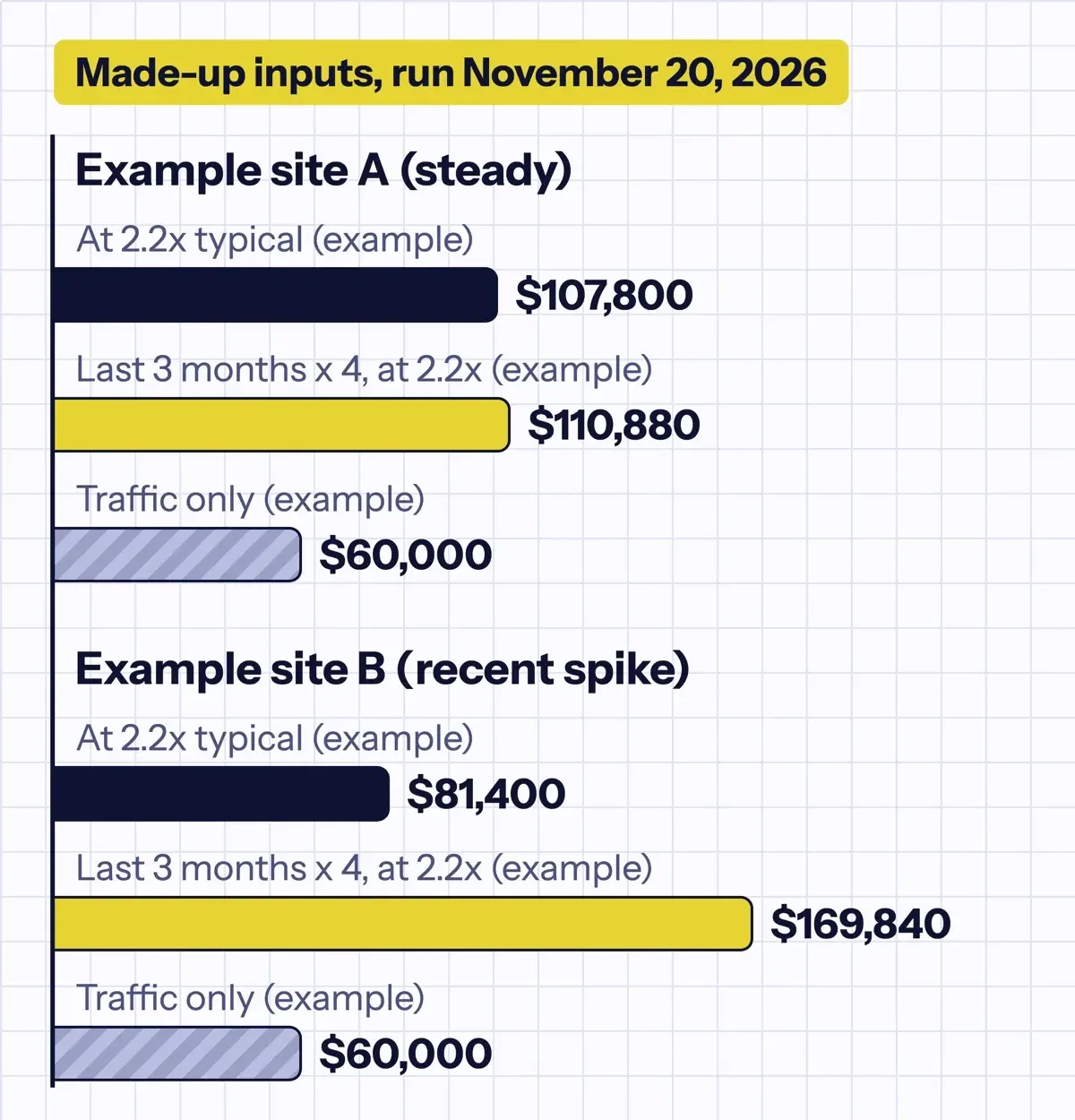 Drawn by us: results of our value calculator on two made-up example sites, from test/results.json (November 20, 2026).
What a buyer asks to see in due diligence
A buyer's review will reach your Search Console data too. FE International names exports around each 2026 update window, such as March 27 to April 8 and May 21 to June 2, as evidence buyers trust.
Don't hand over passwords. Share access instead. In Google Analytics, the Viewer role can see settings and data, and only an Administrator can assign roles. In Search Console, a Restricted user gets simple view rights on most data, while an Owner has full control. Add the buyer's own Google account with the lowest role that lets them check your claims, and remove it if the deal falls through. Buyers also look you up from the outside. Tools such as Semrush show a site's estimated traffic and its advertising data, so a buyer will compare those estimates with your analytics. If the two don't match, explain why before they ask.
Check your domain's transfer dates early. Under ICANN's Transfer Policy, a registrar may refuse a move within 60 days of a transfer, and a 60-day lock may follow an owner change unless you opted out.
An affiliate account may not move with the site unless the network agrees. Amazon's Associates Operating Agreement says: "You may not assign this Agreement, by operation of law or otherwise, without our express prior written approval."
Gather these records before you list. We've cited the page behind most of them above.
- Monthly profit and loss statement for the last 12 months, one row per month
- Add-back schedule with a receipt or record for each item
- Google Analytics Viewer access for the buyer's account
- Search Console Restricted user access, plus exports around core update dates
- Revenue proof: payout reports from each ad network and affiliate program
- List of income sources with each one's share of revenue
- Domain registrar, renewal date and any transfer lock dates
- Affiliate and ad accounts that can't be assigned, with a plan to replace them
- Hours you spend per week and which tasks are outsourced
- Content and email list counts, plus the platform and hosting plan
A hole in that list usually means a lower offer or an earnout. Empire Flippers says more than a quarter of the 168 businesses it sold in 2025 included one, and buyers typically paid 60% to 70% up front. Our GA4 and Search Console measurement walkthrough shows which reports to export, and the step-by-step technical SEO checklist covers the site checks buyers repeat.
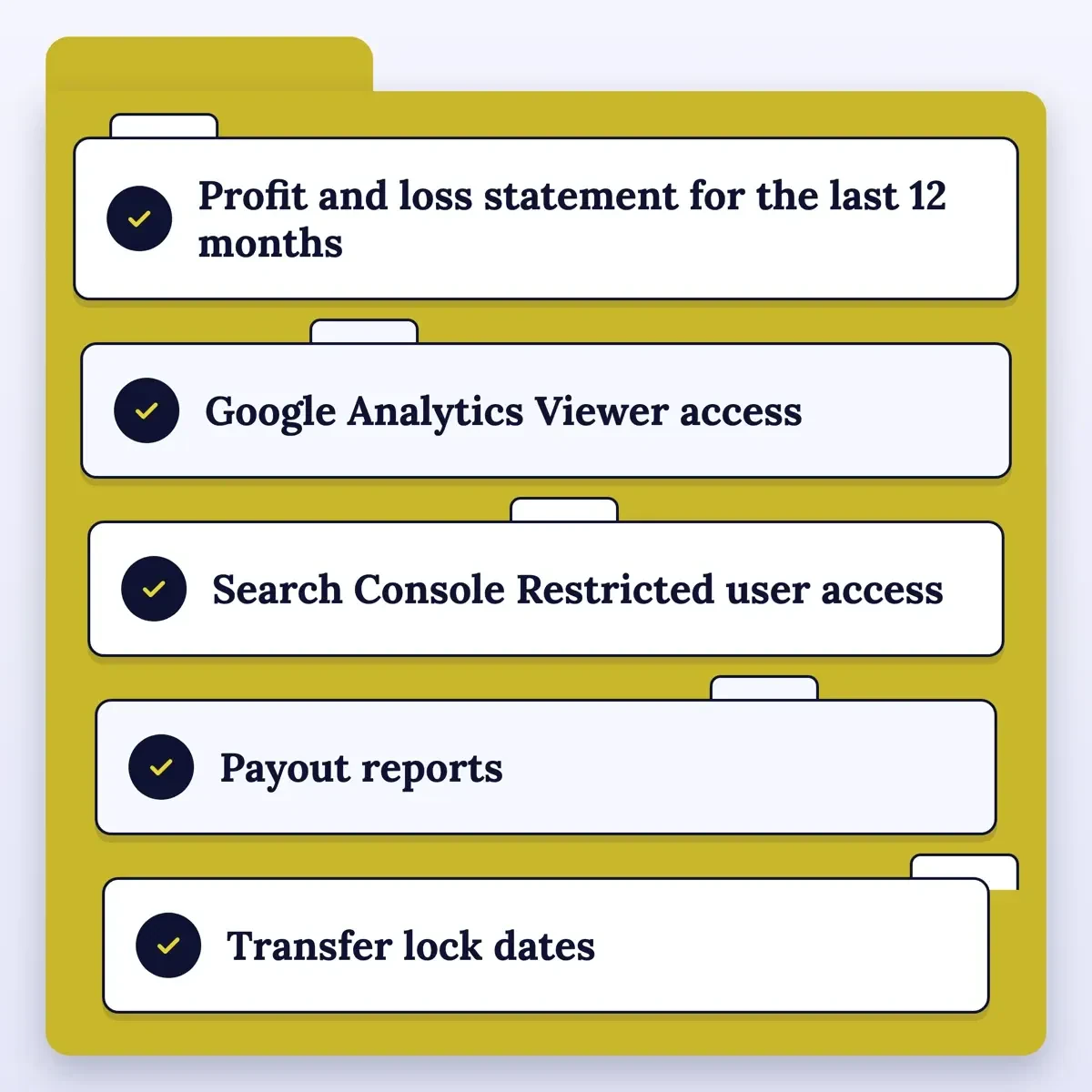 Diagram by DigitalTreed: the records buyers ask for, from the Google, ICANN, Amazon and broker pages cited in this section.
Taxes when the sale closes
Once those checks are done and the buyer signs, the IRS needs the price split by asset. We're working from official IRS pages, and this isn't tax advice. Check your own sale with a CPA. IRS Publication 544 says a lump-sum sale of a business counts as a sale of each asset, not one asset. Both sides use the residual method to divide the price among the assets, goodwill included. They then report that split on IRS Form 8594 with their federal returns for the year of the sale. Agree on the split in the contract, or the two forms won't match.
If you've owned the site for about a year, check the date. Under IRS Topic 409, a gain on an asset held more than one year is generally long-term, and one year or less is short-term.
Which numbers we checked, and which we couldn't
Those IRS pages, and every other figure above, came from pages we saved on November 20, 2026 with plain requests from our own script. We confirmed the Empire Flippers formula, scoreboard averages, listing rules and commission on its own pages, and the FE International range on its October 16, 2026 post.
Our script got HTTP 403 errors from Flippa's valuation pages and H1 2026 report, BizBuySell's website benchmarks and Quiet Light's valuation pages. None of their figures are used here. The Semrush link above now opens Semrush's AdClarity advertising page. When you compare multiples yourself, check the live scoreboard, whether a figure's monthly or annual and whether it's a sale or asking price.
Frequently asked
Can I sell a website that doesn't make money yet?
Not on a profit multiple. Empire Flippers lists sites with at least $24,000 yearly net profit and 12 months of revenue history, per its valuation page.
How many days does a website sale take?
Sales on Empire Flippers averaged 132 days, at 86% of list price, per its scoreboard as of November 2026.
What does a broker charge to sell my site?
Empire Flippers charges 15% on sales up to $700,000, with a $10,000 minimum, per its valuation page FAQ as of November 2026.
Do add-backs raise how much my site is worth?
Yes, if you keep records. Empire Flippers' valuation FAQ says, in its own example, $10,000 of valid add-backs at a 2.5x multiple adds $25,000 to the value.
How we made this guide: We read broker, Google, ICANN, Amazon and IRS pages as plain text and ran a local value calculator over two made-up sites. Facts checked by the DigitalTreed team on November 20, 2026. Nothing here is tax or legal advice.
First published October 2020 with valuation tools and another blog's income claims. Rewritten November 20, 2026 around the profit times multiple formula, dated broker data, a tested example and a due diligence checklist; the unsourced claims were cut.
Sources
- Empire Flippers: Business valuation calculator
- Empire Flippers: How to value a website (updated November 12, 2026)
- Empire Flippers: Scoreboard and average sale multiples
- FE International: Website and content business valuation multiples in 2026 (October 16, 2026)
- Semrush: AdClarity advertising intelligence
- Semrush: Where Semrush data comes from
- Google Analytics Help: Access and data restrictions
- Search Console Help: Manage users, owners and permissions
- ICANN: Transfer Policy
- Amazon Associates Program Operating Agreement
- IRS Publication 544: Sales and other dispositions of assets
- IRS: About Form 8594, Asset Acquisition Statement
- IRS Topic 409: Capital gains and losses


Comments
No comments yet. Start the conversation below.