

Quick answer
To become a freelance content writer in India, as of November 2026, you'll need three samples, a rupee price, a payment route and a GST plan for foreign clients. On our example $500 invoice, PayPal left 7.3% less than face value and Payoneer 2.2% to 5.0% less. Start with the five steps below, then ask a CA about GST registration and an LUT.
You can write a clean 1,500-word blog post, and a small business in Ohio or Leeds has just asked what you charge. Learning how to become a freelance content writer in India from there is mostly about pricing, payment and paperwork. A freelance content writer is a self-employed writer who sells articles, web pages and emails to several clients instead of drawing one salary. A client abroad adds a transfer fee, an e-FIRC for each payment and a GST export test that a salaried writer never meets.
The five steps come first, then what writing pays, where we found only two public salaries. How foreign clients pay changes what lands, and our example $500 invoice left ₹38,460 through PayPal and ₹40,592 at Payoneer's low end. Each payment carries an e-FIRC and a purpose code, which feed the GST export test. The last section says what we could verify.
Key takeaways
- On our example $500 invoice, PayPal left 7.3% less than face value.
- No Indian body we checked publishes freelance per-word rates for writers.
- ICICI Bank issues no physical FIRC for export payments settled after June 20, 2016.
- A GST Letter of Undertaking lapses when its financial year ends.
- A client based in India fails the export test, so normal GST rules apply.
Five steps from first sample to first foreign invoice
They're in the order a first job runs, and the last two decide what an example $500 invoice leaves in your bank.
- Pick two subjects you know from work or study, and publish three samples of 800 to 1,500 words under your name.
- Set a rupee floor per article before you quote in dollars, with the formula shown under rates below.
- Pitch where buyers already look: a marketplace profile, past employers, and businesses whose blogs went quiet.
- Choose how the client will pay, and ask that route or your bank how each e-FIRC reaches you.
- Before the first foreign invoice, ask a chartered accountant (CA) whether to register for GST and file an LUT.
Steps 1 to 3 are the familiar part. Our guide to branding yourself as a writer covers samples and a profile, while the tips for professional SEO writing cover the search side that blog clients ask about. Keeping a job while you start? Our page on freelancing while working full time walks through the employment-contract checks, and the Upwork tutorial for beginners shows a first proposal. Steps 4 and 5 are where you'll differ from the US freelancers in our starting-freelancing playbook, and they fill the rest of this page.
What writing pays: the public numbers we could find
Pricing is step 2, and it has the least public data behind it. We looked for an Indian ministry, survey or regulator that publishes freelance writing rates per word or per article and didn't find one. So both numbers below are salaries, not freelance rates.
The first anchor is American, for pitches to US clients. The Occupational Outlook Handbook from BLS, the US labor statistics agency, says "The median annual wage for writers and authors was $76,910 in May 2025." It gives that as $36.98 an hour. The figure doesn't include the self-employed, who held 65% of the 140,300 writer and author jobs BLS counted in 2025. BLS projects little or no change in the number of those jobs from 2025 to 2035. The same wage survey sits in its occupation profile for writers and authors. That's a staff writer's pay, so a US client weighs your quote against it rather than paying it.
The second anchor is Indian. On March 25, 2026 the National e-Governance Division, part of Digital India Corporation under MeitY, advertised a Content Writer cum Social Media post on contract. Its budget was 8 LPA (₹8 lakh a year), and it wanted 3 to 5 years' experience. That's ₹66,667 a month by our arithmetic (800,000 ÷ 12). An example floor works backward from what you need. Say you want ₹40,000 a month from four 1,500-word articles, so each one has to bring ₹10,000, or about ₹6.67 a word (40,000 ÷ 4 ÷ 1,500). At an example rate of ₹83 to $1, that's about $120.48 per article before fees, which push the dollar figure up by an amount the payment route sets.
How do foreign clients pay an Indian writer?
Four routes bring foreign money to an Indian writer: PayPal, Payoneer, Wise, or a SWIFT wire straight into an Indian bank account of your own. Each takes its cut at a different point: when the money arrives, when dollars become rupees, or both. On our example $500 invoice, the cut ran from $10.94 through Payoneer at its low end to $36.63 through PayPal.
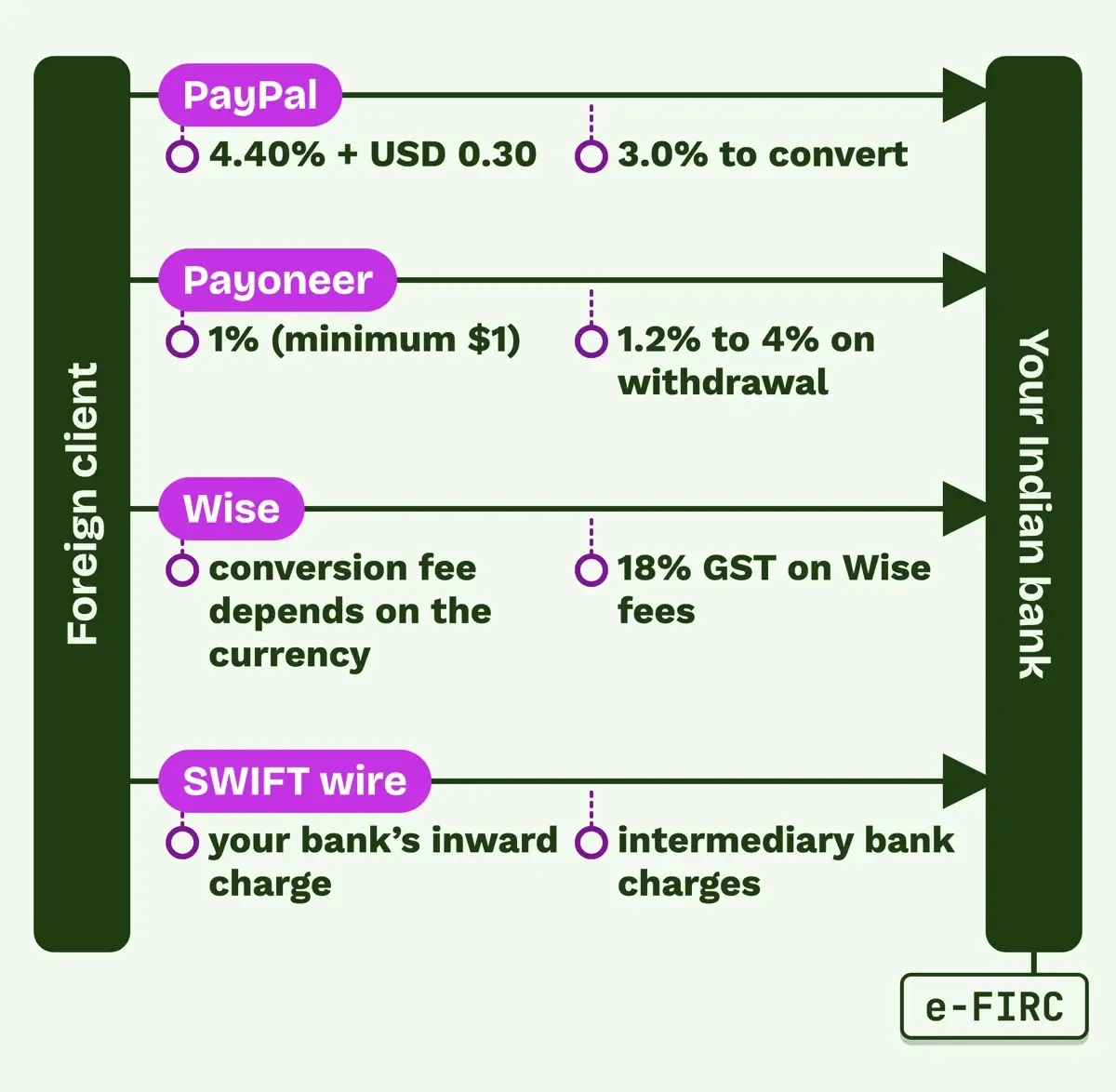 Diagram by DigitalTreed, from Payoneer, Wise, ICICI Bank and PayPal fee pages (all read November 13, 2026).
PayPal India's business fee page, as of November 2026, charges 4.40% plus a fixed USD 0.30 on commercial payments from outside India. Turning the balance into rupees costs 3.0% above its base exchange rate.
The page sent our checker a 403 on November 13, 2026, so we opened it in an ordinary browser that day and saw all three figures.
Payoneer's pricing page, as of November 2026, lists 1% (minimum $1) for money paid into a receiving account in a currency that isn't your local one. That's how USD reaches an Indian freelancer. A client who pays by card is charged up to 3.99% plus $0.49. Withdrawals to a bank account cost 1.2% to 4%, and there's a $29.95 annual fee if the account receives less than $6,000 or equivalent in any 12 consecutive months. In some countries, the page adds, a minimum withdrawal fee of up to $20 may apply.
Payoneer's India home page doesn't show a separate fee table, though its menu lists a digital FIRC service.
Wise works only for businesses here. Its India receive page says "Receiving money feature is currently available only for business customers." As of November 2026, the conversion fee depends on the currency, and "We charge GST of 18% on the Wise fees." The Wise Business receive page promises "a free eFIRC for every transfer." Yet Wise's help article for Indian businesses says Wise charges "an equivalent of 2 USD" on the transfer to your INR bank account "to issue e-FIRC automatically."
We couldn't settle which one applies from the pages alone, so check the fee screen in your Wise Business account before you accept the first transfer.
Wise's help article also puts each incoming transaction between a minimum of 5 USD and a maximum of 2.5M INR or its equivalent. It says money reaches your INR bank account within 1-2 days, while an international Swift transfer takes 2-6 working days.
A direct SWIFT wire into your Indian bank skips the middle company. You'll pay your bank's inward charge and its exchange margin, plus whatever an intermediary bank takes on the way. None of those is one published national figure, so the table below shows the bank row as a blank you fill in. Ask your branch for its schedule.
| Route | Receiving fee | Converting to INR | Other costs | Where we read it |
|---|---|---|---|---|
| PayPal India | 4.40% + USD 0.30 on international commercial payments | 3.0% above the base rate | Blocked our checker; confirmed by hand | Fee page in a browser, November 13, 2026 |
| Payoneer | 1% (minimum $1) into a non-local-currency receiving account; card payer up to 3.99% + $0.49 | 1.2% to 4% on withdrawal to a bank | $29.95 a year if under $6,000 received in 12 months | Pricing page, November 13, 2026 |
| Wise Business (India) | No separate receiving fee shown | Depends on the currency; no single figure shown | 18% GST on Wise fees; e-FIRC free or $2 (two pages differ) | India pricing and help pages, November 13, 2026 |
| Bank wire (SWIFT) | Your bank's inward charge | Your bank's exchange margin | Intermediary bank charges, unknown in advance | Your bank's schedule of charges |
To see what lands, we priced three example invoices with each page's fees as of November 2026. At an example rate of ₹83 to $1, the PayPal formula was 4.40% of the invoice plus $0.30, then 3.0% of what was left. For Payoneer we took 1% (minimum $1) on receipt, then 1.2% or 4% of the rest on withdrawal, the two ends of the range its pricing page shows.
| Invoice | At the example ₹83 to $1 | PayPal India | Payoneer (1.2% to 4% withdrawal) |
|---|---|---|---|
| $150 | ₹12,450 | ₹11,521 (7.5% less) | ₹12,178 to ₹11,832 (2.2% to 5.0% less) |
| $500 | ₹41,500 | ₹38,460 (7.3% less) | ₹40,592 to ₹39,442 (2.2% to 5.0% less) |
| $1,500 | ₹124,500 | ₹115,427 (7.3% less) | ₹121,776 to ₹118,325 (2.2% to 5.0% less) |
Wise isn't in the table, since neither of its India pages shows one conversion fee.
On the example $500 invoice, PayPal took $36.63 in all and left ₹38,460. Payoneer left ₹40,592 at the low end of its range and ₹39,442 at the high end. PayPal cost the most in all three. Worked backward in the same example, getting ₹40,000 into the bank needs a $520.01 invoice through PayPal, $492.71 to $507.08 through Payoneer, and $481.93 with no fees at all. Our Foreign Payment Fee Calculator runs your own invoice through each route at the rate you type in. The getting-paid-from-abroad chapter of our SEO career guide works the same $500 PayPal case by hand and lands on the same 7.3% loss.
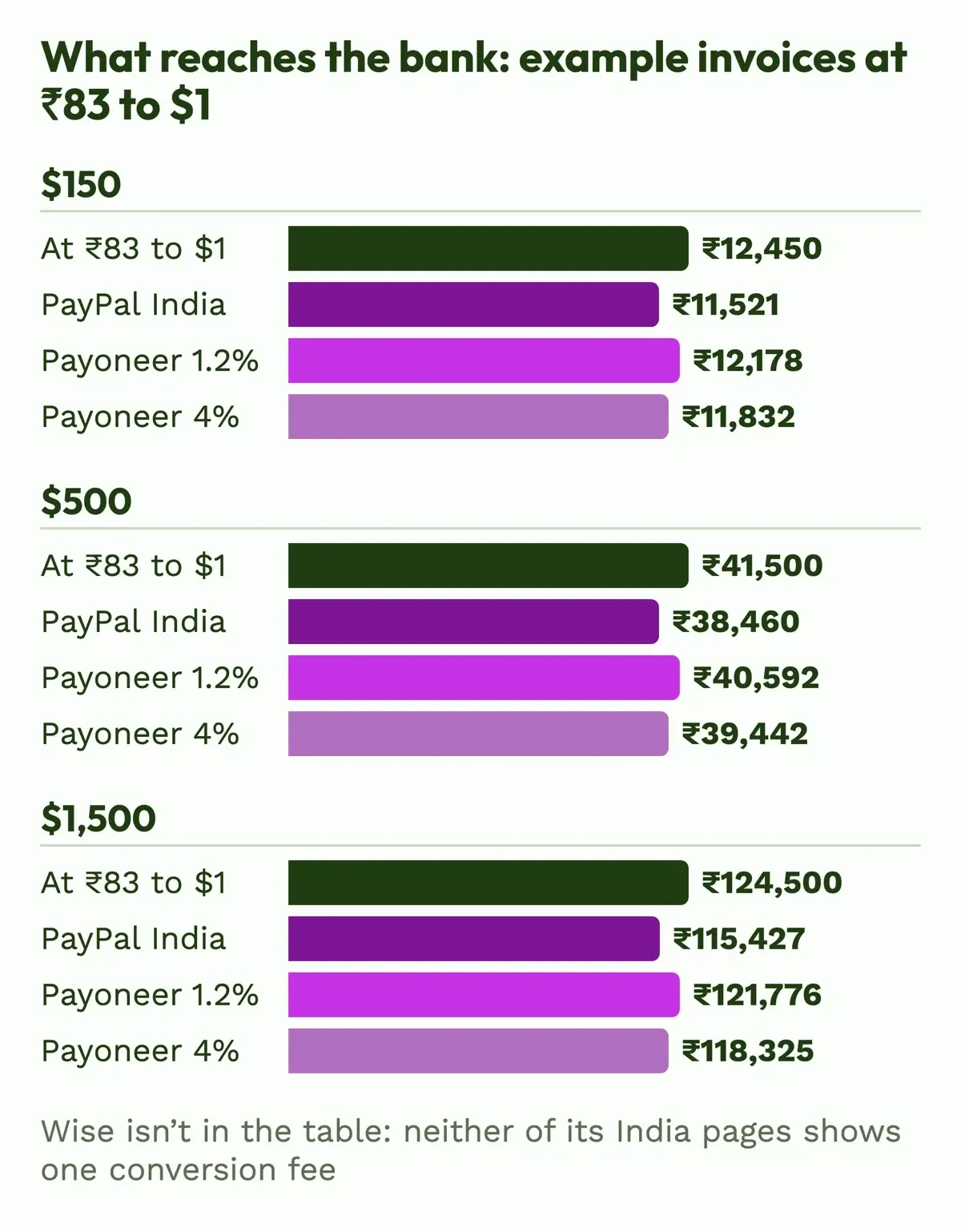 Drawn by us from our example fee test of November 13, 2026 (test/results.json).
e-FIRC and purpose codes: the paper trail for each payment
Condition (iv) of the GST export test below asks how you were paid, so keep proof that each payment came from abroad in foreign exchange. Banks don't issue that proof on paper anymore. ICICI Bank's FIRC FAQ says "For all export related remittances settled after June 20, 2016, banks will not issue a physical FIRC." It describes an e-FIRC as an FIRC "issued by a bank in EDPMS," the Export Data Processing and Monitoring System. An FIRS, it adds, is a note on bank letterhead with the same remittance details. Wise's help article says its e-FIRC arrives by email within 3 working days, and Payoneer lists an automated e-FIRA.
Your bank also tags every inward payment with an RBI purpose code. The lists don't agree. RBI's annex of receipt purpose codes starts each code with P, but there's no line for content writing. DBS Bank India's inward purpose code list has P1007 for advertising, P1017 for publishing and printing, and P1099 for "Other services not included elsewhere". The RBI annex we read puts that catch-all at P1019, which DBS uses for commission agent services.
Ask your bank which code it'll use. Keep its answer, in writing, with your invoices, since the code travels with every payment it reports.
GST on export of services and the LUT
Section 2(6) of the IGST Act treats a service as an export only when five conditions all hold, and the fourth is the payment your e-FIRC records. CBIC's Circular 202/14/2023-GST quotes them in their current wording, and its earlier Circular 161/17/2021-GST sets out the older text.
- The supplier of the service is located in India.
- The recipient of the service is located outside India.
- The place of supply of the service is outside India.
- Payment arrives in convertible foreign exchange, or in Indian rupees wherever the RBI permits it.
- Supplier and recipient are not merely two establishments of one distinct person.
An export that meets all five is zero-rated. The GST Council's zero-rating flyer gives a registered exporter two ways to claim the refund. You can supply "under bond or Letter of Undertaking" with no integrated tax and claim back unused input tax credit, or pay the tax and claim that back.
Registration starts once turnover passes ₹20 lakh in a financial year, under section 22 of the CGST Act. That turnover includes "exports of goods or services or both." CBIC's 2019 GST update sets ₹10 lakh for services in Manipur, Mizoram, Nagaland and Tripura.
No page we read says in so many words whether an export-only writer under ₹20 lakh must register, which makes it the first question to put to a CA.
If you're registered, the LUT is filed online. The GST portal's LUT user manual gives the path: Services, then User Services, then Furnish Letter of Undertaking (LUT). That opens Form GST RFD-11, where you pick the financial year, name two independent witnesses with their addresses and occupations, and sign with DSC or EVC. The portal's LUT FAQ says it's furnished before the export supply. Its status turns to Expired when that financial year closes on March 31, so you'll need a new LUT each year.
A client in Bengaluru or Mumbai fails conditions (ii) and (iii), so normal GST applies once you're registered. That client may also deduct TDS before paying you, at the rate in the FAQ below. For the income tax side, our guide to ways to make money online in India covers advance tax and the return form.
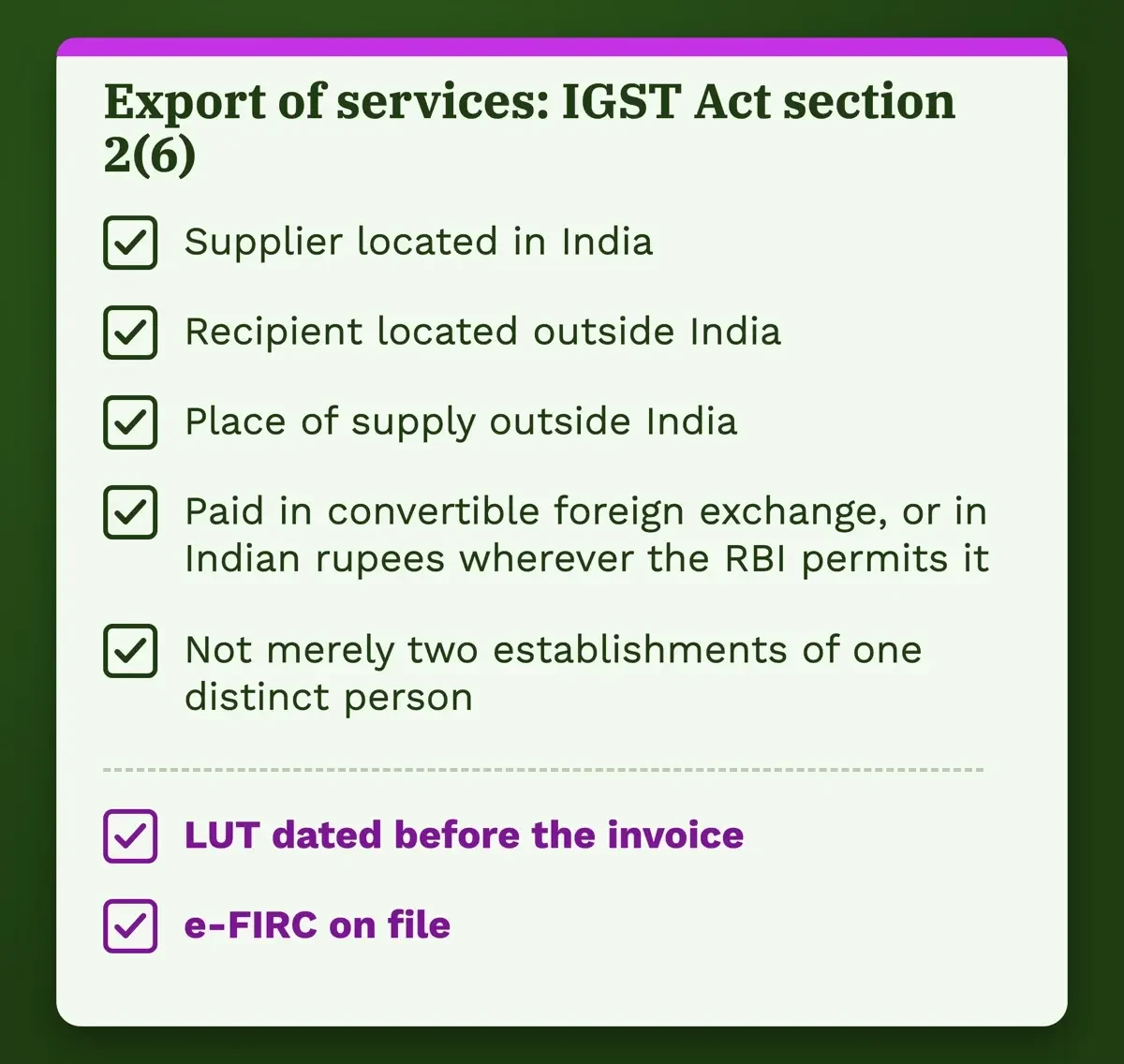 Drawn by us from CBIC Circular 202/14/2023-GST and the GST portal LUT FAQ, read November 13, 2026.
We ran six made-up invoices from a made-up writer, Inkpada Writes, through the five conditions plus two checks for an LUT dated before the invoice and an e-FIRC on file. Our example LUT date was April 2, 2026. Two invoices passed cleanly: a US client paying in USD through Wise, and a UK client paying in GBP by SWIFT.
Two met the five conditions but carried a flag. A March 28, 2026 invoice fell in the earlier financial year, before the LUT. A Canadian client's Payoneer payment had no e-FIRC on file yet. The last two weren't shown to be exports. A Bengaluru client paying rupees by NEFT failed conditions (ii), (iii) and (iv), and a Dubai client whose relative in Pune paid by UPI failed (iv) as we coded it.
What we tested
Both checks ran on November 13, 2026 in one Python script with example data only, and we served its report on 127.0.0.1. Across three example invoices at an example ₹83 to $1, PayPal India left 7.3% to 7.5% less and Payoneer 2.2% to 5.0% less. Wise wasn't priced.
The invoice check found two clean exports, two flagged exports and two invoices that weren't shown to be exports.
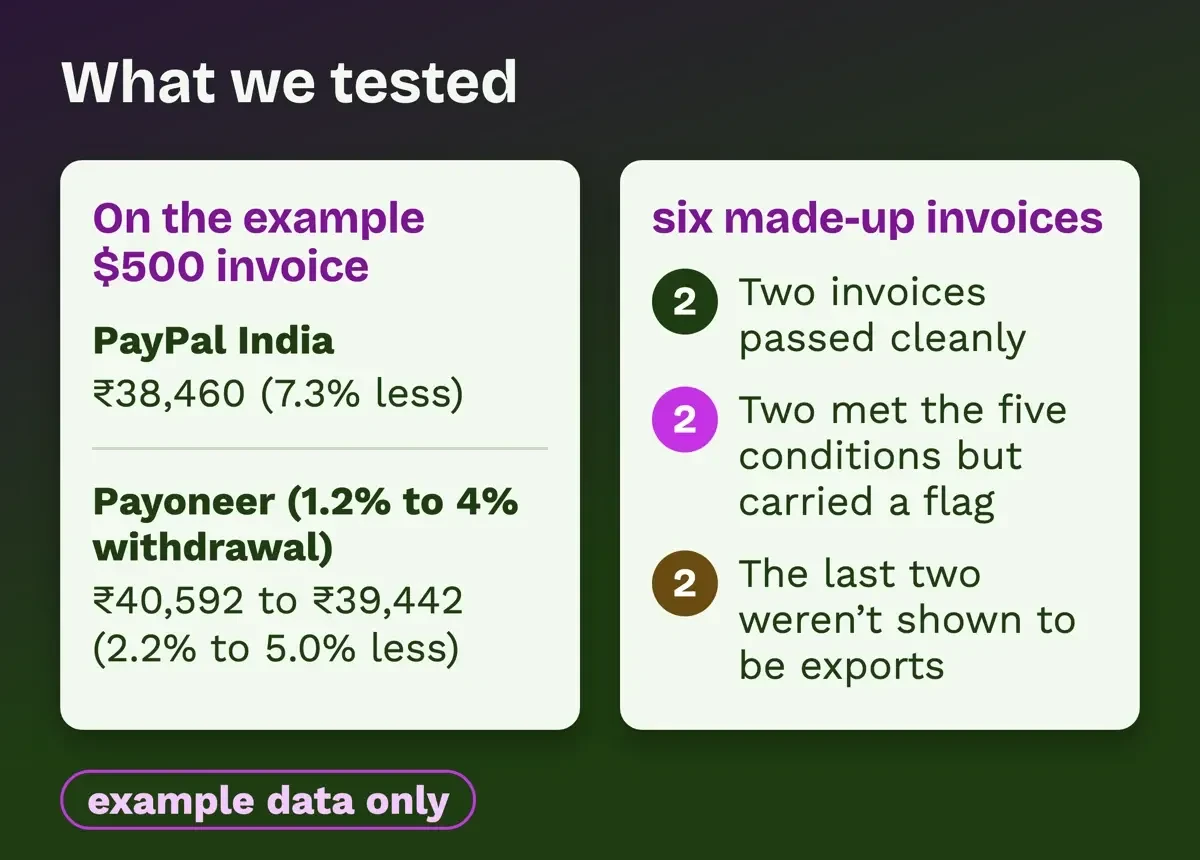 Drawn by us from our test report at http://127.0.0.1:8765/report.html, November 13, 2026, example and made-up data.
What we could verify on November 13, 2026
Our checker named itself and didn't sign in, and when the PayPal India fee page refused it, we read that page in an ordinary browser.
| Fact | Where we looked | Status |
|---|---|---|
| Payoneer receiving, withdrawal and annual fees | Payoneer pricing page | Confirmed; the page shows no India-only figures |
| Wise: business-only receiving, 18% GST, e-FIRC | Wise India pricing pages and help article | Confirmed, but the e-FIRC charge differs between two Wise pages |
| PayPal India 4.40% + USD 0.30 and 3.0% to convert | PayPal India fee page | Confirmed in an ordinary browser; our checker got a 403 |
| No physical FIRC for export payments since June 20, 2016 | ICICI Bank FIRC FAQ | Confirmed for ICICI Bank; other banks not checked |
| Purpose codes for writing work | RBI receipt-code annex, DBS Bank India list | Lists differ; no code named for content writing |
| Five export conditions, LUT steps and validity | CBIC circulars 161 and 202, GST portal manual and FAQ | Confirmed |
| Freelance per-word rates in India | Ministries, surveys, regulators | Not published anywhere we looked |
There's one gap you'll want to check yourself: the Wise e-FIRC charge, where Wise's own pages disagree. Fee pages change, so recheck PayPal, Payoneer and Wise before each new invoice. If we were starting today, we'd hold the first invoice until the CA call on GST, the bank's purpose code in writing and the e-FIRC route were all settled. Our Free Invoice Generator lets you add your CA's export wording to the invoice notes.
Frequently asked
Do Indian clients deduct TDS from a content writer's fee?
Often, yes. The Income-tax Act, 2025 sets the rates in a table under section 393(1), shown on incometaxindia.gov.in. Serial number 6(iii) there covers fees for professional services at 10%, with a ₹50,000 threshold. Your CA can say which line fits writing.
Can a foreign client pay me in rupees and still count as an export?
Only where the RBI permits it. CBIC's Circular 202/14/2023-GST points to Special Rupee Vostro Accounts that Indian banks may open for partner-country banks, under an RBI circular of July 11, 2022.
When is a GST LUT treated as approved?
The GST portal's LUT FAQ says it shows as Deemed Approved if the tax official takes no action within 3 working days. You can also save a half-filled application for 15 days.
How we made this guide: Our files hold text copies of the BLS, NeGD, CBIC, GST Council, GST portal and RBI pages. The Payoneer, Wise, ICICI Bank and DBS Bank India fee pages are saved there too. The test used only example and made-up data. PayPal India's fee page turned our checker away, so a person opened it. Facts checked by the DigitalTreed team on November 13, 2026. It's general information, not tax advice, so have a CA check your own case.
First published July 2020. Rewritten November 13, 2026 with rates from public data, foreign payment routes, e-FIRC and GST export steps.
Sources
- US Bureau of Labor Statistics: Writers and Authors, Occupational Outlook Handbook
- US Bureau of Labor Statistics: OEWS profile, writers and authors (27-3043)
- National e-Governance Division: Content Writer cum Social Media advertisement, March 25, 2026
- PayPal India: business fees
- Payoneer: pricing
- Payoneer India: home page
- Wise India: fees for receiving money
- Wise India: business fees for receiving money
- Wise Help: receiving payments for Indian businesses
- ICICI Bank: Foreign Inward Remittance Certificate FAQ
- Reserve Bank of India: purpose codes for reporting forex transactions (receipts)
- DBS Bank India: inward remittance purpose code list
- CBIC: Circular 161/17/2021-GST, export of services
- CBIC: Circular 202/14/2023-GST, export of services and rupee payments
- GST portal: furnishing a Letter of Undertaking (user manual)
- GST portal: Letter of Undertaking FAQ
- CBIC: Central Goods and Services Tax Act, 2017 (updated text)
- CBIC: GST, An Update (May 2019)
- GST Council: Zero rating of supplies (flyer)
- Income Tax Department: incometaxindia.gov.in

Comments
No comments yet. Start the conversation below.