
Quick answer
As of November 2026, five ways to make money online in India we could check on official pages are freelancing, YouTube, affiliate links, marketplace selling and tutoring. Everything you earn from April 1, 2026 falls under the Income-tax Act, 2025. For most service earners, GST registration starts once yearly turnover passes ₹20 lakh, exports included. Start a money-in log today, then take it to a CA.
Maybe you already use one of the ways to make money online in India: a foreign design client, a small channel, a few affiliate links. Now there's a new tax law, and you're not sure what it changes. Tax deducted at source (TDS) is the part of a payment that the payer keeps back and deposits in your name. Some of your money arrives with TDS taken out and some arrives whole, and that split decides what you'll owe later.
The five ways below don't share one tax line. An Indian client's fee falls under a row of the section 393(1) TDS table. A marketplace sale pulls you into GST registration early, and YouTube adds US withholding on top. These are steps, not tax advice, so take your numbers to a chartered accountant (CA) before you file.
Key takeaways
- Income with no Indian TDS, like our example foreign fees, needs advance tax.
- Income earned from April 1, 2026 falls under the Income-tax Act, 2025.
- GST registration starts above ₹20 lakh, and exports count toward it.
- Advance tax applies once your yearly tax after TDS reaches ₹10,000.
- Any online job that asks you to pay first matches an I4C red flag.
Which tax law covers money you earn online from April 2026
The e-filing portal's home page now takes payments "under the Income-tax Act, 2025 for Tax Year 2026-27 onwards," while dues up to FY 2025-26 still go under the 1961 Act. So money that reached you between April 1, 2026 and March 31, 2027 belongs to tax year 2026-27, under the new Act. The new Act mostly renames and regroups. PRS Legislative Research's bill summary says the first draft kept "most of the provisions of the 1961 Act" and proposed April 1, 2026 as its start date. The department's TDS compliance FAQ is blunt about rates. "The TDS rates and monetary thresholds for all categories of payments have been retained," it says.
What did change is the paperwork. Section numbers like 194J and 194H are gone for payments made after March 2026. The department's tax payments FAQ says TDS on most non-salary payments now sits in section 393, and salary TDS in section 392. From tax year 2026-27, the Annual Information Statement "will stand replaced by Form No. 168," per the same FAQ. That's the form you'll use to see every rupee of TDS that payers reported against your PAN, so it's worth learning early. You'll find it in your e-filing login once the department publishes it for the year. Income up to March 2026 still shows in the old AIS, where the TDS FAQ says the old section numbers appear.
When a payer says it deducted TDS, find that line in Form 168 and match it against your own record.
A missing line usually means the payer's quoted an old section number, and the TDS FAQ says that can cause processing errors, which the payer fixes with a correction statement.
| Way | TDS from the payer | GST angle | Advance tax |
|---|---|---|---|
| Freelancing, Indian business client | Yes, 10% on professional fees (serial number 6(iii)) | Counts toward ₹20 lakh | Yes, on the rest |
| Freelancing, foreign client | None in our example log | Export, counts toward ₹20 lakh | Yes, on all of it |
| YouTube (AdSense for YouTube) | US withholding on US-viewer earnings | Ask a CA how it's treated | Yes |
| Amazon Associates India | Yes, per the agreement | Fee is GST-inclusive | Yes, on the rest |
| Marketplace sales of goods | Operator deducts 0.1% TDS and collects GST TCS | Section 24(ix) registration | Yes, on the rest |
| Tutoring paid by parents on UPI | No | Counts toward ₹20 lakh | Yes, on all of it |
In our example log, three rows reached the bank with no Indian TDS: the foreign client, YouTube and UPI tutoring. The tax on that money's yours to pay through advance tax.
For the other rows, a payer's TDS note and your Form 168 entry show what was actually deducted. Those two beat any row here when you're sitting with a CA.
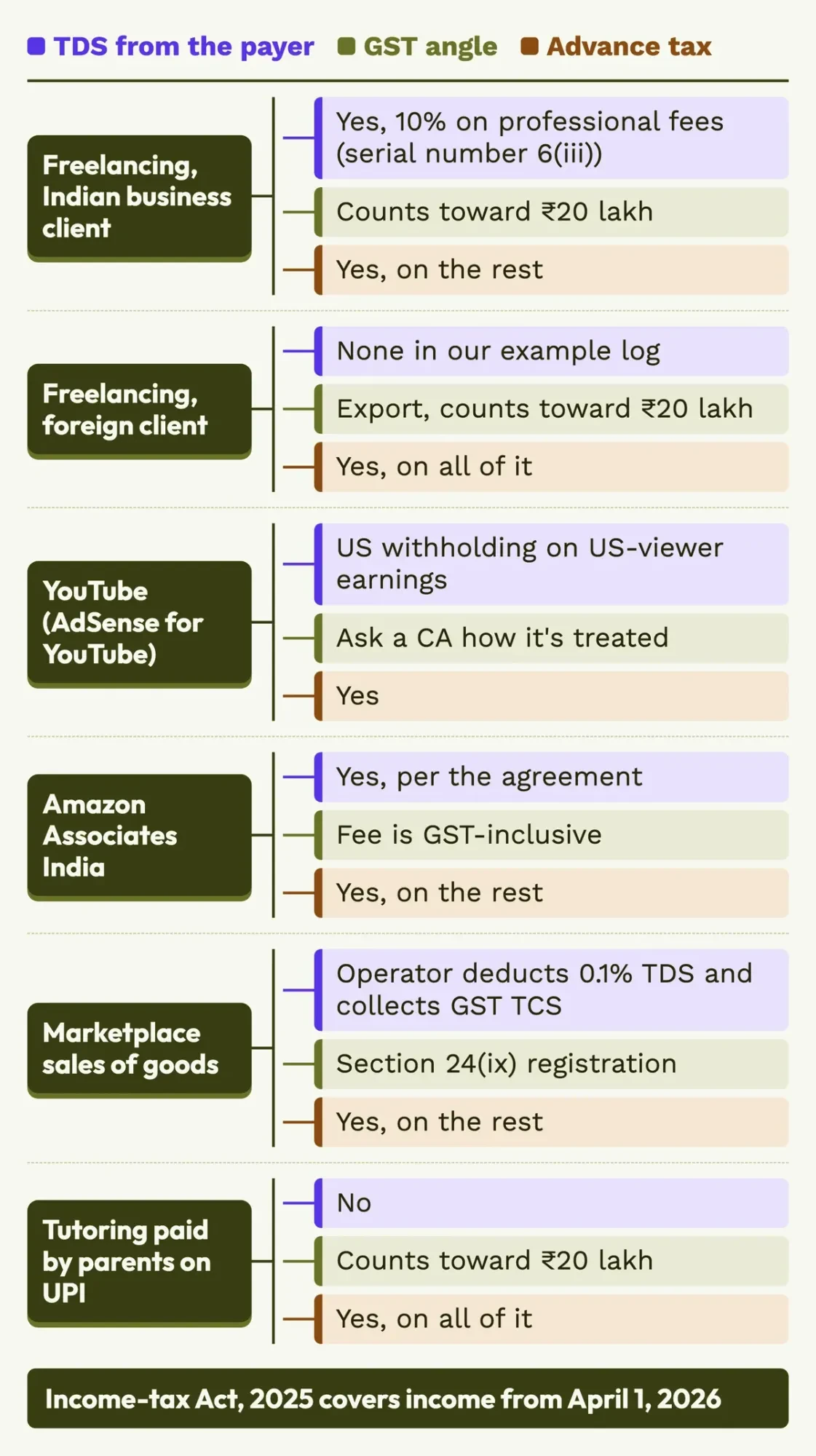 Diagram by DigitalTreed, from incometax.gov.in, CBIC and platform pages read November 13, 2026.
Way 1: freelancing for clients in India and abroad
Freelancing pays for a skill you can show in a portfolio today instead of an audience you'd have to build first. Design, code, editing and writing all work, and there's no stock to buy. The tax side depends almost entirely on who's paying: an Indian company that hires you will usually deduct TDS before it pays. Since April 2026 it's got to quote the right line of the section 393 table, and that line is what you'll later see beside its name in Form 168.
The rates an Indian client deducts sit in the section 393(1) table of the Income-tax Act, 2025. Our checker got a 403 there, so we opened the table by hand on incometaxindia.gov.in on November 13, 2026. For "fees for professional services," serial number 6(iii) lists 10%. Fees for technical services that aren't professional services are at 2%, and the threshold limit for both is ₹50,000. Your payer's TDS note and the Form 168 entry will show the exact amount taken, and a CA can confirm which line of the table it falls under.
In our example log, a $600 job from a client abroad lands as ₹49,800 (at an example rate of ₹83 to $1). No Indian TDS came off it. The tax on that ₹49,800 is then yours to pay through advance tax during the year, and it's your CA who can confirm how a foreign payer's fees are treated. Payers outside India, the foreign clients plus YouTube, made up 52.1% of our example log (₹530,370 of ₹1,018,170), and none of that money had Indian TDS on it.
Transfer fees eat into that money before tax does, so compare routes before you send your first invoice, not after the first payout lands short. Our Foreign Payment Fee Calculator compares what reaches your bank after PayPal, Wise, Payoneer or a bank wire. New to global platforms? Our Upwork tutorial for beginners walks through a first proposal, and writers get rates and client tips in the freelance content writer guide for India.
On GST, exports aren't treated like local sales. A GST Council flyer on zero rating of supplies says "As per the GST Law exports are meant to be zero rated." A registered supplier can export "under bond or Letter of Undertaking" without paying integrated tax.
That Letter of Undertaking is the LUT you'll hear about, though it isn't something you file until you've registered for GST.
Way 2: YouTube and creator income
YouTube doesn't pay a channel anything until it's joined the Partner Program. Its Partner Program page for India lists two ways in. One is "1,000 subscribers with 4,000 qualified watch hours in the past 12 months." The other is 1,000 subscribers with 10 million qualified Shorts views in 90 days, so a channel that grows on Shorts still needs the same 1,000 subscribers.
The same page asks for two-step verification, no active Community Guidelines strikes, and one AdSense for YouTube account, either already linked or set up later in YouTube Studio. Reaching 1,000 subscribers is the hard part. Our YouTube audience growth guide covers what tends to move that number.
Then there's US tax, which applies even though you live in India. Google's US tax requirements page for YouTube earnings works an example for a creator in India who earned $1,000, with $100 from US viewers. With tax info and a treaty claim, Google holds $15. The reason, per Google: "India and the U.S. have a tax treaty relationship that reduces the tax rate to 15% of earnings from viewers in the U.S."
Without a tax form, Google's same example deducts $240, because without tax info the rate's "up to 24% of total earnings worldwide," not just the US part. The page asks for tax info by December 10 each year.
We ran that formula on our example channel. It earned $1,190 over seven months, $370 of it from US viewers, so the treaty rate takes $55.50 (370 x 15%). With no tax info on file, it could hold up to $285.60 (24% of $1,190). Whatever Google holds, ask your CA how to claim credit in India for that US tax.
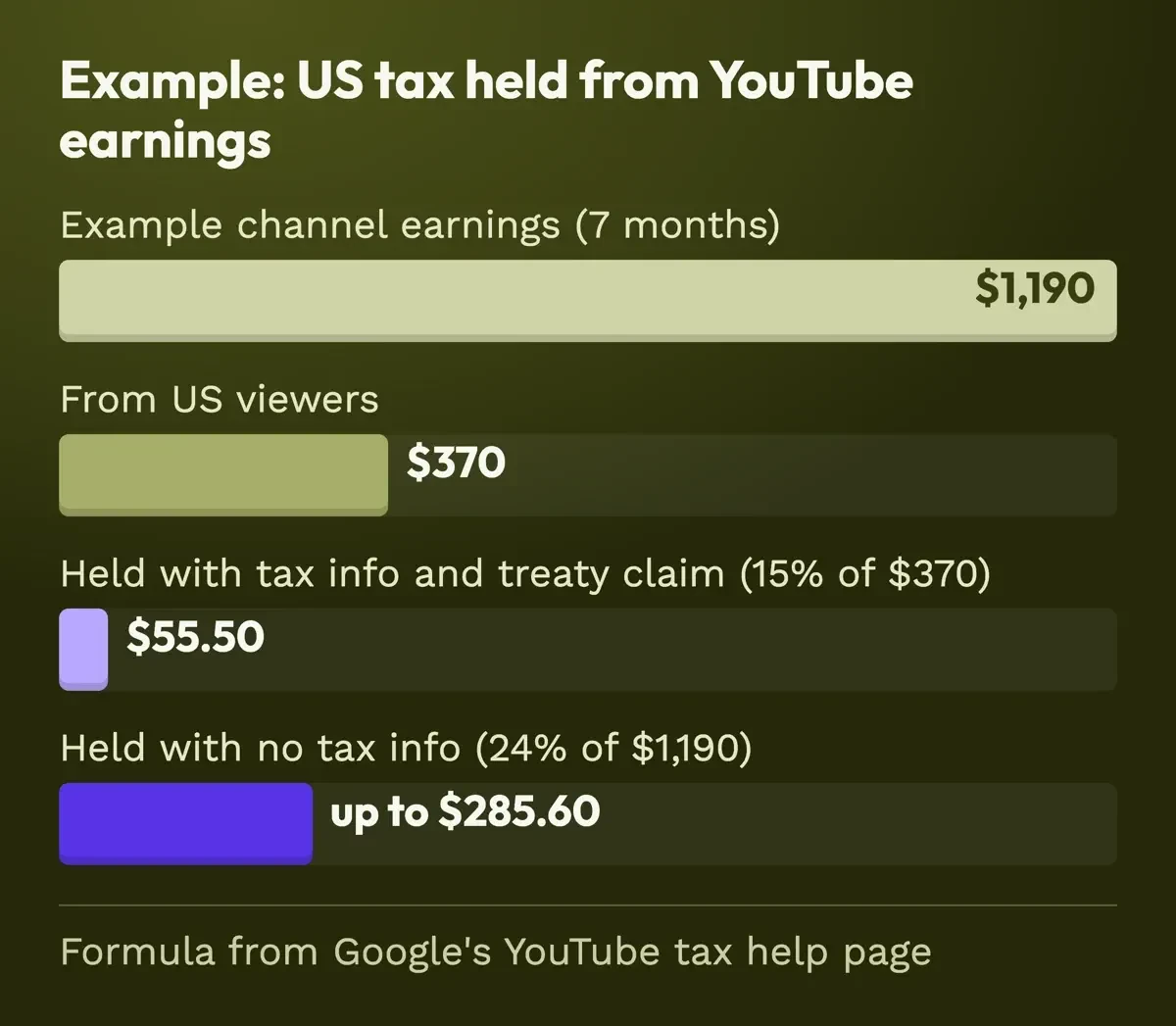 Drawn by us from our example log and the formula on Google's YouTube tax help page, November 13, 2026. Example figures.
Brand deals add a disclosure duty, and it applies to a free product sent for review just as much as to a fee paid into your account. The Advertising Standards Council of India (ASCI) brought in guidelines for influencer advertising in May 2021. Its page asks brands and influencers to "disclose such material connections" so ads aren't dressed up as content, so label a paid video up front. A free product isn't tax-free either. Serial number 8(iv) of the table lists 10% on "Any benefit or perquisite, whether convertible into money or not" from a business or profession, above ₹20,000.
Way 3: affiliate links with Amazon Associates India
Affiliate links carry the same disclosure duty as brand deals, and you earn a fee when a reader buys through your link. On a new site, it's the payout rules that shape your cash flow more than the rate. Amazon's Associates Program Operating Agreement for India says it pays about 60 days after each month ends. So April fees arrive around the end of June.
It can also hold your fees until they reach "at least INR1000 in case of NEFT transfers." Our example site earned ₹600 in April and ₹700 in May. May's the first month its running balance cleared the ₹1,000 floor, and that ₹1,300 gets paid about 60 days after May ends. The next two balances cleared in August (₹1,100) and October (₹1,400).
Two tax lines sit in the same clause. The fee is "inclusive of all taxes including applicable service tax or goods and services tax." Indian residents' fees are also "subject to income tax withholding at the rate stipulated under applicable law." The section 393(1) table's commission line, serial number 1(ii), lists 2% above a threshold limit of ₹20,000. It's your CA who can confirm whether Amazon withholds under that line. Look for that TDS in Form 168, and don't add GST on top of what Amazon pays, because the fee already includes it.
The agreement wants one line on your site, too: "As an Amazon Associate I earn from qualifying purchases."
We can't quote category rates. Amazon's India fee schedule page showed our plain request a robot test instead of the table. For joining and earning, see our Amazon affiliate program guide and the Amazon affiliate commission rate guide.
Way 4: selling products through marketplaces
Unlike affiliate links, a marketplace shop means you're the one who owns the stock, and GST also arrives earlier here than anywhere else in this list. Section 24 of the CGST Act names people who must register whatever their turnover. Item (ix) covers anyone supplying through an e-commerce operator that has to collect tax at source under section 52. Section 52 lets that operator collect up to 1% of the net value of taxable supplies made through it. The rate actually in force is set by notification, and later notifications may have changed who must register, which we didn't check. So talk to a CA before you list your first product, not after.
Income tax runs through the operator too. So a payout statement can show two deductions, GST collected at source and income tax TDS, that you'll keep apart in your log. The section 393(1) table's serial number 8(v) has any e-commerce operator deduct 0.1% of the gross amount of sales it facilitates, with a threshold limit of nil. Our example cushion-cover shop sold ₹225,000 of goods over seven months, so its payouts show ₹225 of TDS (225,000 x 0.1%). Every rupee of those sales counts toward GST turnover.
Selling in bulk to other businesses is a different game, and the main portals for that are compared in our B2B marketplaces in India roundup.
Way 5: online tutoring paid by parents
When parents pay you directly on UPI for tutoring, nobody deducts TDS, so the money's easy to leave out of a return. Parents aren't businesses. The table's individual-payer line, serial number 6(ii), doesn't start until fifty lakh rupees. Our example tutor earned ₹12,000 a month for two students, then ₹18,000 after a third joined in June, a mid-year jump that pushes the yearly total past an April guess. That ₹114,000 over seven months reached the bank whole. It still counts toward GST turnover, and the full tax on it falls into advance tax. Teach through a coaching platform instead, and the platform may deduct TDS like any business client would. Check Form 168 for its name.
Keep the receipts boring. Write down the date, student, amount and UPI reference the day the money lands, because a bank statement alone won't tell a CA who paid for what.
When do you need GST registration?
GST doesn't look at tutoring fees or any other receipts one way at a time. It adds the money from all five ways into your aggregate turnover for the financial year. Section 22(1) of the CGST Act requires registration "if his aggregate turnover in a financial year exceeds twenty lakh rupees." It's ₹10 lakh in special category states. The Act's definition also counts "exports of goods or services or both" in that turnover, so foreign income doesn't sit outside the limit.
The ₹40 lakh limit doesn't cover as many people as its fame suggests. States can raise the limit to ₹40 lakh only for a supplier "engaged exclusively in the supply of goods." CBIC's 2019 GST update confirms that goods limit from April 1, 2019 for most states. Mixed earners like our example, selling services and goods, don't qualify and stay at ₹20 lakh.
The same CBIC update exempts "Suppliers of services, having turnover up to Rs. 20 lakh, making inter State supplies." It also exempts those selling services through e-commerce platforms. That's why a freelancer with clients in other states doesn't register early, while a goods seller on a marketplace may have to.
After seven months our example log had ₹1,018,170 of turnover, which is 50.9% of the ₹20 lakh line with five months of the financial year still to run. Projected over 12 months, the year ends near ₹1,745,434 (1,018,170 / 7 x 12).
That's ₹254,566 under the line (2,000,000 - 1,745,434), so one extra example contract of about $3,070 at ₹83 to $1 would push it over.
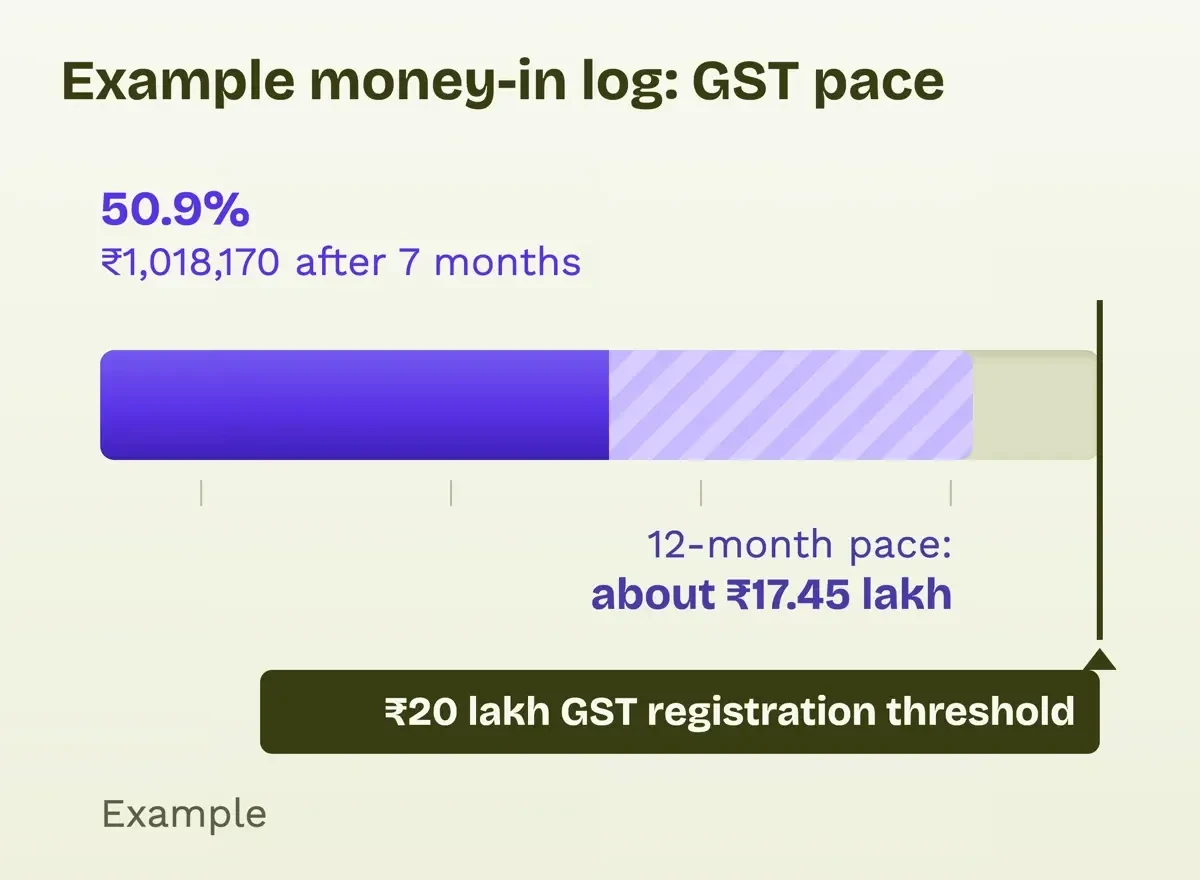 Drawn by us from our example money-in log (made-up receipts), November 13, 2026.
Check your pace every quarter, and if it's close, talk to a CA about registering before you cross the line, since your invoices change with a GSTIN.
Advance tax and the ITR form for online income
Advance tax is where money that's had no TDS taken catches up with you, and in our example more than half of it arrived that way.
The tax payments FAQ cites section 404 of the 2025 Act. Under it, "advance tax is payable if the amount of tax payable during the year, computed under the advance tax provisions, is Rs. 10,000 or more."
The same FAQ puts the first instalment for tax year 2026-27 on June 15, 2026, but if you use the presumptive scheme in section 58, it's one payment instead. You "must discharge their entire advance tax liability in a single instalment on or before 15 March," which means March 15, 2027 this year. Paying late costs interest at 1% a month under section 424.
Our example shows why freelancers hit this rule fast. Say a CA estimates ₹52,000 of tax for the year (an example input, not a calculation). TDS on statements was only ₹14,725, so ₹37,275 is left (52,000 - 14,725), far over ₹10,000. Nearly all of that gap comes from the foreign client money and the UPI tutoring fees, where nobody along the way deducted anything at source.
The return form isn't as settled. For last year's income (FY 2025-26, filed as AY 2026-27), the portal's business and profession page points to ITR-3. ITR-4 (Sugam) covers presumptive income up to ₹50 lakh. But ITR-4 isn't open to anyone who "has income from any source outside India." Ask your CA whether foreign-client fees count as income from a source outside India before you pick ITR-4. The ITR-4 user manual lists the same presumptive sections. Forms for tax year 2026-27 weren't on the portal yet when we looked, because those returns get filed in 2027. Bring your Form 168 printout and money-in log when you do.
What we tested
On November 13, 2026 we made a money-in log of 38 made-up receipts from April to October 2026, across all five ways, plus 6 made-up job offers. A Python script totaled each way, checked the GST pace, applied YouTube's formula and Amazon's ₹1,000 payout floor, then served the report on 127.0.0.1. It found ₹1,018,170 of example income, ₹14,725 of TDS shown, and 52.1% from abroad with no Indian TDS. It also flagged 4 of the 6 offers. Everything in the log is made up, so treat the totals as a worked example of the checks, not as a picture of what anyone actually earns.
How do you spot a fake online job?
Those flagged offers matter because fake jobs copy the five ways above, borrowing words like freelancing, YouTube tasks or tutoring to look like ordinary online work from home. An I4C advisory on fake CAPTCHA-filling jobs, dated April 8, 2025, names four warning signs. "The Red Flags in such scams are upfront payment, unrealistic earning promises, delayed or denied withdrawals, and overemphasis on referral programs."
I4C, the Indian Cybercrime Coordination Centre, is the Ministry of Home Affairs' nodal body for cybercrime. We checked our 6 made-up offers against its four flags with a short keyword script, and we've listed every match, not just the ones that make a point. Offer 1 wanted a ₹499 registration fee and promised ₹3,000 a day for liking videos, and offer 2 asked for an "18% tax" before a withdrawal. Offer 3 pushed a team bonus for bringing 5 friends and promised guaranteed 30% returns. Offer 5 charged a ₹1,200 training fee for CAPTCHA work it called minimal effort. Offers 1, 3 and 5 each hit two flags, and offer 2 hit one.
The two clean ones were ordinary jobs. One was a ₹15,000 brochure paid by bank transfer after delivery, and the other was a ₹6,000-a-month maths tutoring slot paid by a parent on UPI.
Both paid after the work. Offer 4 also asked for a PAN for the invoice, but that isn't one of the four I4C flags, so our script didn't mark it.
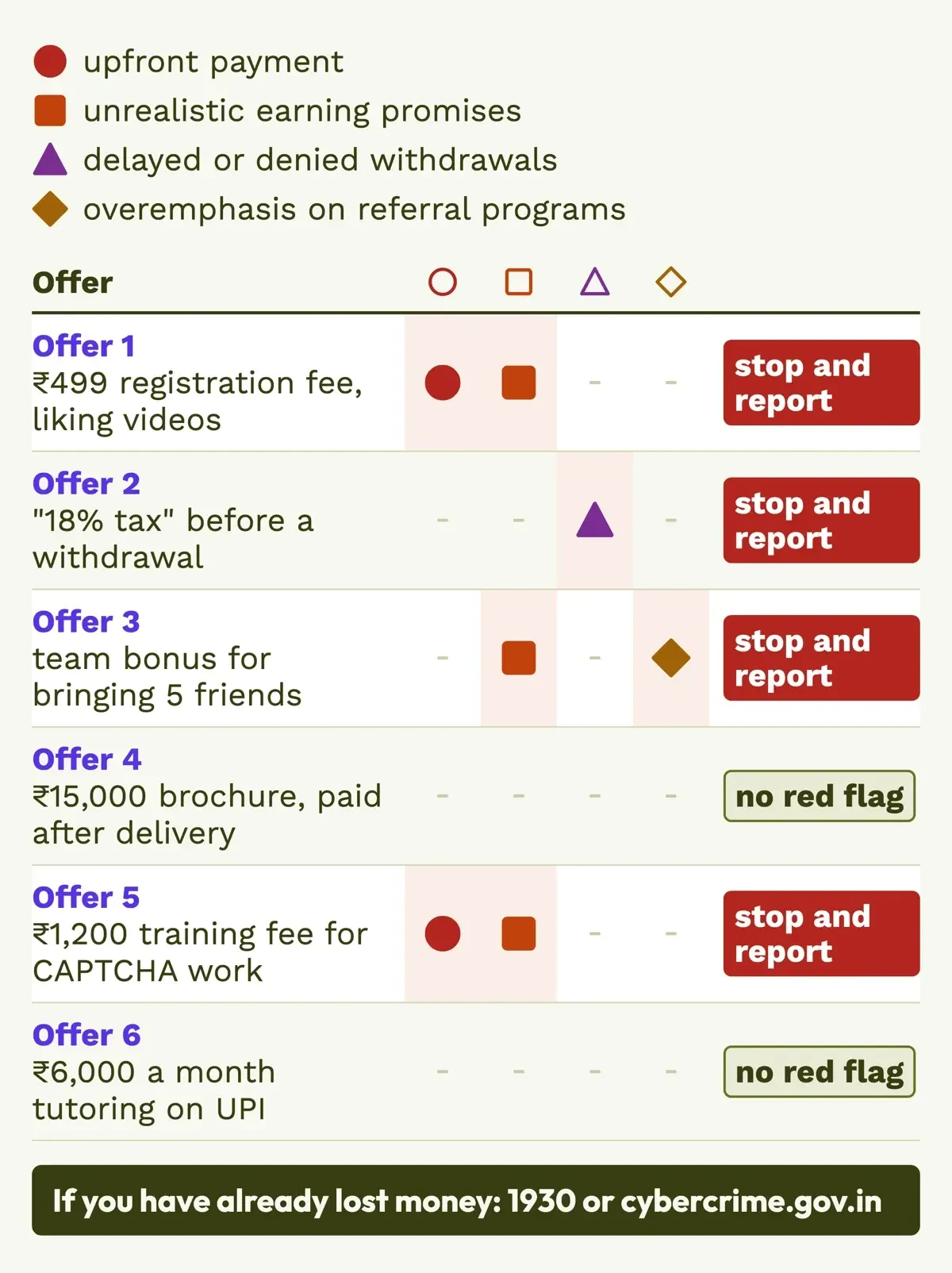 Drawn by us from our check of six made-up offers against I4C advisory TAU/ADV/004, November 13, 2026.
If money's already gone, act the same day. The Department of Telecommunications' Chakshu reporting page is direct: "If you have already lost money, please report at cyber crime helpline 1930 or cybercrime.gov.in."
The National Cybercrime Reporting Portal takes the complaint online. Chakshu itself takes reports of the fraud call, SMS or WhatsApp message, and it asks for them within 30 days so action can still be taken.
If an offer promises fast money, our realistic guide to building wealth runs the math on why slow income wins.
What we could and couldn't confirm on November 13, 2026
Each page got one plain request that named us, with no sign-in and no attempt around a block. Where incometaxindia.gov.in blocked it, the section 393(1) table was opened once in an ordinary browser that day.
| Fact | Where we looked | Status |
|---|---|---|
| Income-tax Act, 2025 covers income from April 1, 2026 | incometax.gov.in home page and two FAQs | Confirmed |
| TDS rates and thresholds kept, now in section 393 | e-filing TDS FAQ | Confirmed; five lines of the section 393(1) table opened by hand (our checker got a 403) |
| Slabs for tax year 2026-27 | incometaxindia.gov.in, indiabudget.gov.in | Not checked: both returned 403 |
| ITR forms for tax year 2026-27 | e-filing home page | Not on the portal yet; only AY 2026-27 forms listed |
| GST ₹20 lakh threshold and exports in turnover | CGST Act (CBIC copy to 2020), CBIC 2019 update | Confirmed; later notifications not checked |
| YouTube Partner Program and US withholding | YouTube Help pages | Confirmed |
| Amazon Associates India payout and disclosure | Associates Operating Agreement | Confirmed; fee rates page hit a bot check |
| Consumer Affairs influencer guide | consumeraffairs.nic.in | Not reachable from our checker |
There's one rate gap left: the slabs for tax year 2026-27, because both incometaxindia.gov.in and indiabudget.gov.in sent our checker a 403. The TDS lines here come from one browser read of the section 393(1) table on November 13, 2026. Confirm the current rate there or with your CA before filing, and match Form 168 against your log.
Starting from zero, pick the way that pays for a skill you've already got. Log the first rupee the day it lands, and see a CA before the first advance tax instalment's due on June 15. If writing suits you, our guide to starting a blog and earning from it is a slower sixth path.
Frequently asked
Do I pay tax on YouTube income in India?
Yes, it's taxable income here. Google can also hold back US tax, and its YouTube tax help page says tax forms expire after the third full calendar year, so recheck yours in AdSense for YouTube.
Which section replaced 194J for TDS from April 2026?
Section 393 of the Income-tax Act, 2025 holds the TDS tables for payments other than salary, and professional fees sit at serial number 6(iii) of its 393(1) table. The tax payments FAQ says salary TDS moved to section 392.
How do I report a fake online job offer?
Call 1930 or file at cybercrime.gov.in. I4C's CAPTCHA job advisory also tells readers to follow @cyberdost on social media for prevention tips.
How we made this guide: Official pages from incometax.gov.in, CBIC, the GST Council, YouTube, Amazon, ASCI, I4C and DoT were saved as text. A made-up money-in log ran locally. Blocked pages were listed, and the section 393(1) table on incometaxindia.gov.in was read once in a browser. Facts checked by the DigitalTreed team on November 13, 2026. It's general information, not tax advice, so have a CA check your own figures.
First published April 2020. Rewritten November 13, 2026 as five ways to earn online with the tax steps for tax year 2026-27.
Sources
- Income Tax Department e-Filing portal: home page
- Income Tax Department e-Filing portal: latest news
- Income Tax Department: TDS Compliance FAQs
- Income Tax Department: Tax Payments FAQ
- Income Tax Department: Individual having income from business or profession, AY 2026-27
- Income Tax Department: File ITR-4 (Sugam) online user manual
- PRS Legislative Research: The Income-Tax Bill, 2025
- CBIC: Central Goods and Services Tax Act, 2017 (updated text)
- CBIC: GST, An Update (May 2019)
- GST Council: Zero rating of supplies (flyer)
- YouTube Help: YouTube Partner Programme overview and eligibility
- YouTube Help: US tax requirements for YouTube earnings
- Amazon.in Associates: Associates Program Operating Agreement
- ASCI: Influencer resource
- I4C: Advisory TAU/ADV/004, fake CAPTCHA filling jobs
- Indian Cybercrime Coordination Centre (I4C)
- Department of Telecommunications: Sanchar Saathi Chakshu
- National Cybercrime Reporting Portal


Comments
No comments yet. Start the conversation below.