
Quick answer
Editing an 80,000-word novel costs about $7,100 to $9,400 for all four rounds, as of October 2026. That's the median range US editors reported to the Editorial Freelancers Association: 1.2 to 3.5 cents a word for fiction, depending on the edit. Most authors don't buy all four, so your real bill is usually one or two of those lines.
Book editing cost depends on three things: which of the four edits you buy, your genre and your word count. Book editing itself is paid work by a freelance editor on your manuscript before you publish.
That's it. The editor's website, the font on their invoice and how busy they sound matter far less.
We ran every number in this guide through the Editorial Freelancers Association's 2026 Rate Chart, the largest set of US editing rates we could find with a stated method, and priced out real book lengths. You'll also see how to read three quotes for the same job and how not to pay the wrong person.
Key takeaways
- EFA 2026 medians put fiction editing at 1.2 to 3.5 cents a word.
- All four edits on an 80,000-word novel cost $7,120 to $9,360.
- A copyedit plus a proofread on that novel runs $2,560 to $3,760.
- Nonfiction costs more per word than fiction at every editing stage.
- Buy editing as its own service, and keep the rights to your book.
Book editing rates by type: the 2026 EFA numbers
Start with the chart. The EFA surveyed its members from November 2025 to mid-January 2026, and over 1,100 of them reported what they charged in 2025.
These are medians, so half the editors who answered charge more and half charge less. And the EFA says plainly that it doesn't set rates. Here's what the chart shows as of October 2026:
| Edit type | Fiction, per word | Nonfiction, per word | Memoir, per word | Fiction, per hour |
|---|---|---|---|---|
| Developmental | 3.0 to 3.5¢ | 4.0 to 5.0¢ | 3.5 to 4.5¢ | $52.50 to $70 |
| Line editing | 2.7 to 3.5¢ | 3.5 to 5.0¢ | 3.0 to 4.0¢ | $50 to $60 |
| Copyediting | 2.0 to 2.7¢ | 3.0 to 4.0¢ | 2.7 to 3.5¢ | $40 to $50 |
| Proofreading | 1.2 to 2.0¢ | 2.0 to 3.0¢ | 1.7 to 2.0¢ | $35 to $45 |
Two patterns jump out. Nonfiction costs more per word than fiction at every stage, mostly because facts, sources and structure take checking.
And the price drops as the edit gets closer to the page. A proofread costs roughly half of a developmental edit per word.
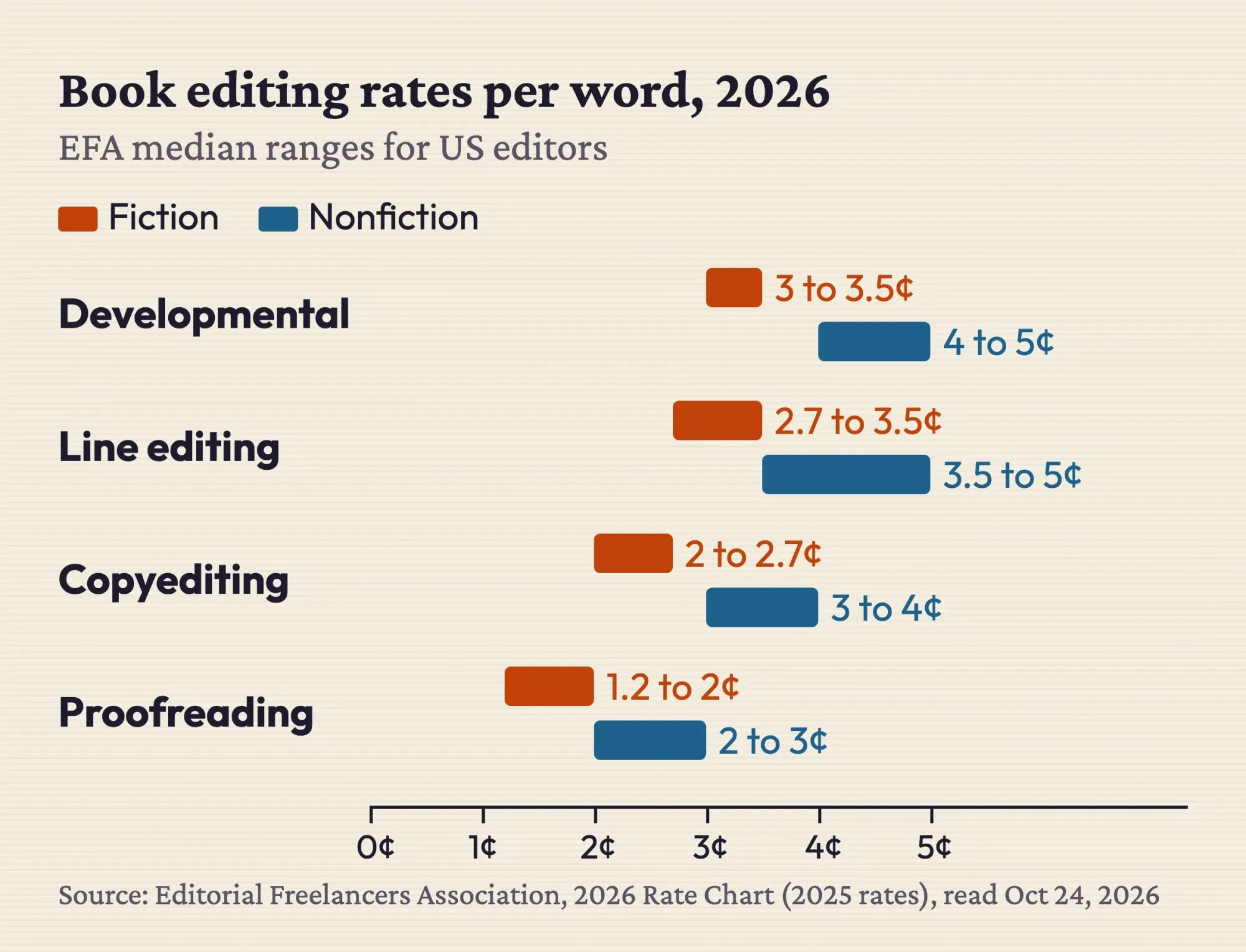 Diagram by DigitalTreed, from the EFA 2026 Rate Chart (median ranges, 2025 rates), October 2026.
For a sense of scale, editors on a payroll in the US earned a median $77,920 a year in May 2025, according to the Bureau of Labor Statistics. That's a salary figure, though, and most book editors you'll hire are freelancers who set their own rates.
What does each type of book editing fix?
Before you compare prices, match the edit to the problem. The EFA's service definitions are the clearest we've found. A proofread won't save a plot that sags in the middle, and the next rewrite would undo it anyway.
Here's where the lines fall. A developmental editor works on content, structure and genre fit, often through a long "edit letter." A line editor works sentence by sentence on language and style. A copyeditor fixes spelling, grammar, usage and punctuation and keeps a style sheet for consistency. A proofreader checks the final layout for typos and formatting mistakes.
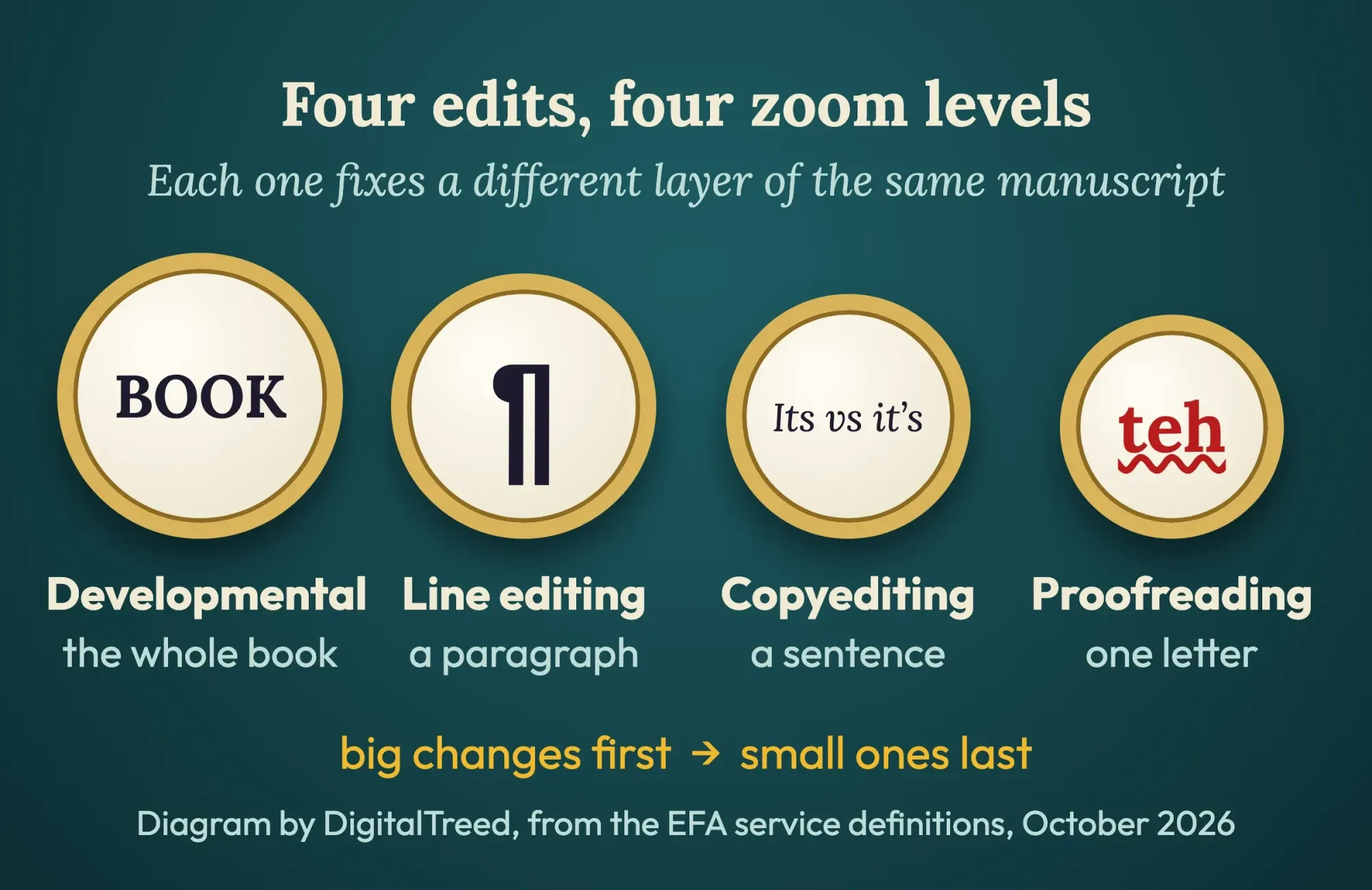 Diagram by DigitalTreed, based on the EFA editorial services definitions, October 2026.
Order matters as much as choice.
Big changes come first, small ones last, and each round assumes the one before it is done.
If you only buy one edit, make it a copyedit. Amazon's own help pages say typos are among the most common quality issues Kindle customers report, so it's the edit readers notice.
Not every book needs all four. Plenty of authors use beta readers for the big-picture pass, then pay for a copyedit and a proofread. Our older guide to book editing best practices covers what you can tighten yourself before an editor ever sees the file.
An 80,000-word novel, priced edit by edit
So here's what the EFA medians mean in dollars. We multiplied each fiction range by 80,000 words, a common length for an adult novel, and added the rows up.
| Edit | Rate (fiction) | 80,000 words |
|---|---|---|
| Developmental | 3.0 to 3.5¢ | $2,400 to $2,800 |
| Line editing | 2.7 to 3.5¢ | $2,160 to $2,800 |
| Copyediting | 2.0 to 2.7¢ | $1,600 to $2,160 |
| Proofreading | 1.2 to 2.0¢ | $960 to $1,600 |
| All four | $7,120 to $9,360 |
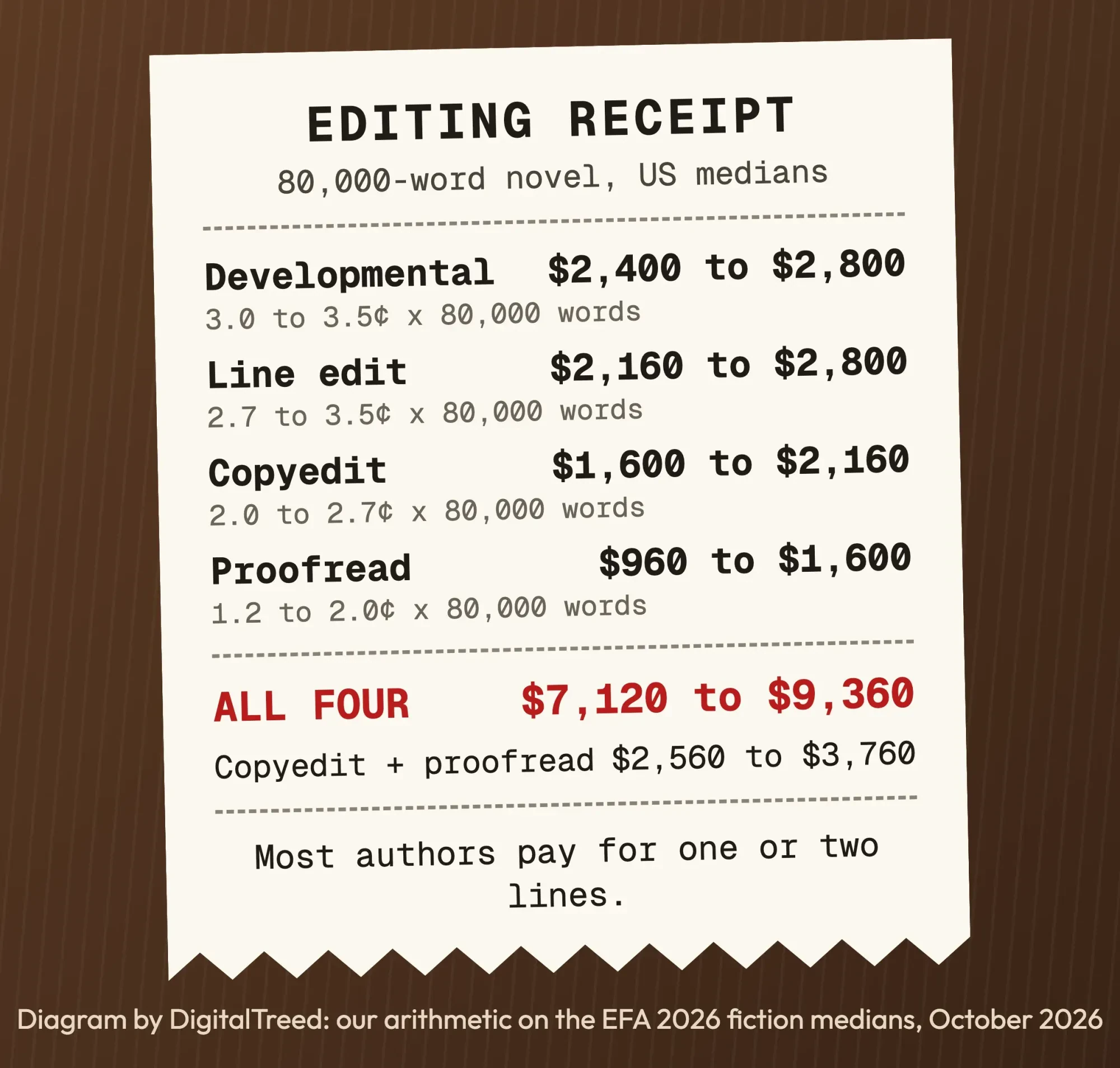 Diagram by DigitalTreed: our arithmetic on the EFA 2026 fiction medians, October 2026.
Most authors don't pay that total. A copyedit plus a proofread on the same novel runs $2,560 to $3,760 as of October 2026.
That's the budget we'd plan around for a first self-published book that's already had honest beta readers.
Example: Prairie Lane Bakery, a made-up bakery in Wichita, Kansas, writes a 45,000-word guide to home sourdough to sell at the counter and on Amazon. Friends who bake have already tested the recipes and the order of chapters, so the owners skip the developmental edit. At the nonfiction medians as of October 2026, a copyedit costs $1,350 to $1,800 and a proofread $900 to $1,350. Together, that's $2,250 to $3,150 for a book that reads like it came from a publisher.
Short stories follow the same math at a smaller scale. As of October 2026, a 6,000-word story at the fiction copyediting median costs $120 to $162, which matters if you're planning to sell short stories on Amazon or publish an eBook for royalties.
Per word, per hour or per page: three quotes for one job
Those totals assume a per-word quote, but editors quote in different units, and that's where most confusion starts.
The EFA chart reports all three, and it counts a page as 250 words.
Take the same 80,000-word novel and ask for a copyedit. Per word, the median range gives $1,600 to $2,160. Per page, it's 320 pages at $5.00 to $6.75: the same $1,600 to $2,160.
Per hour is the odd one out. At the 2026 median pace of 6 to 10 pages an hour the job takes 32 to 53 hours, and at $40 to $50 an hour that's $1,280 to $2,667.
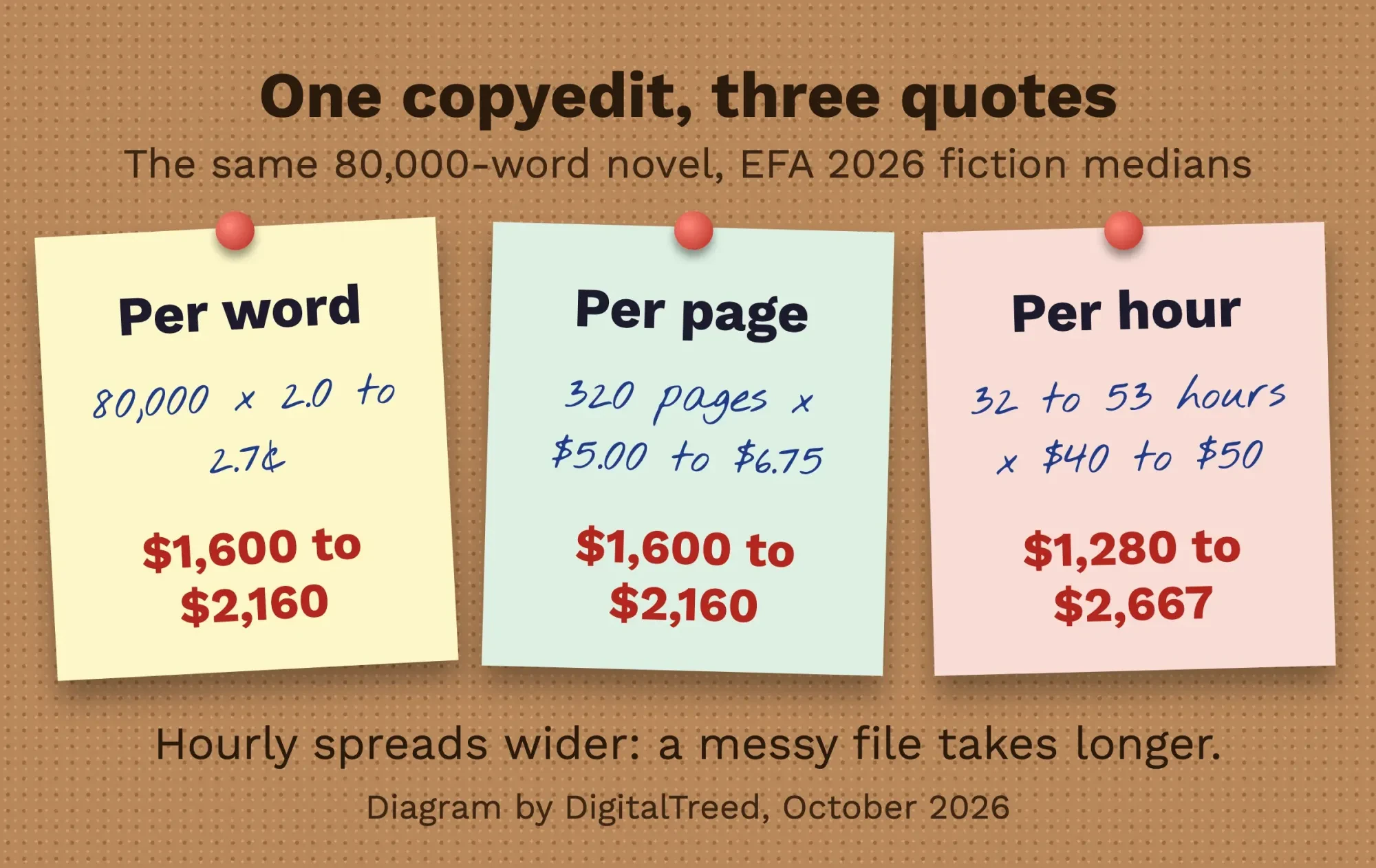 Diagram by DigitalTreed: one copyedit priced three ways from the EFA 2026 fiction medians, October 2026.
The hourly range is wider because it depends on how clean your file is.
A messy manuscript slows the editor down, and you pay for every extra hour.
Our take: ask for a per-word or per-project price with a cap, or an hourly quote with a written estimate of hours.
Either way, you know the most you'll pay before the work starts.
What pushes a quote above or below the median
Beyond the unit, the EFA lists the reasons rates vary: the kind of work, turnaround time, expertise, local cost of living, training and years of experience. For a book, these four move the quote most.
- Genre and subject. Medical and academic manuscripts sit higher in the chart than general fiction, and technical work usually does too.
- Speed. A rush deadline usually costs extra, so ask before you promise a launch date.
- How clean the draft is. Run a spellcheck and a read-aloud pass first, and the editor can spend the time on what you can't catch.
- Rounds. One pass and a second pass are different jobs, so the contract should say which you're buying.
Cleaning up the draft yourself is the cheapest saving on this page. Paste a chapter at a time into our free readability checker, which highlights long, passive and hard sentences.
While you're there, learn the which vs that rule. It's one of the most common fixes copyeditors bill you for.
How to vet a book editor before you pay
Even a fair price isn't the only risk.
Writer Beware, the watchdog run by the Science Fiction and Fantasy Writers Association, has tracked editing scams for years, including one firm that ran a kickback scheme with agents and publishers. Its advice comes down to a short list.
- Look for a real web presence: a site, a client list or a marketplace profile you can check.
- Check credentials and the books the editor has worked on, and read a few pages of them.
- Be wary of a referral from an agent or publisher who might take a cut.
- Ask for a sample critique or a short sample edit, and agree on its price first.
- Never work on a handshake. Get a written contract with the scope, rounds, deadline and fee.
Watch for one more trap.
A company that edits, designs and "publishes" your book for a fee may be what Writer Beware calls a vanity publisher, which charges you to produce a book and takes rights on an exclusive basis.
Buy editing as its own service, and keep your rights. Still drafting? Our roundup of book writing software covers where to write before an editor sees the file.
A cover is usually the next bill after editing. Our guide to what a graphic designer costs covers the same questions for that hire.
Contracts, 1099s and copyright when you pay an editor
Once you've picked an editor, three paperwork points come up with almost every job.
First, if you pay a US freelance editor through your business, for payments made in 2026 and later, the IRS reporting threshold for Form 1099-NEC is $2,000. Ask for a Form W-9 before the first payment so you have their tax ID on file.
Second, editing doesn't change who owns your book. Copyright exists automatically once a work is fixed, and editing suggestions alone don't usually make an editor a co-author.
Say so in the contract anyway.
Third, if you want to register the finished book, the Copyright Office's online fee is $45 for a single author filing one work that isn't for hire, or $65 on the standard application.
This section explains common rules as of October 24, 2026, not your own tax or legal position. For a business book with co-authors or a big advance, a short call with a CPA or a publishing attorney costs far less than fixing a bad contract later.
Writing a book to support your business, not just publishing one? If you'd like help with the launch page, the cover or the marketing around it, our quote form gets you a fixed price. It's our own paid work, and you should know that before you click.
Once the book is edited, the launch work starts. A media kit helps when you pitch podcasts and blogs, and our plan for promoting a business blog works for a book launch too.
Frequently asked
How much does it cost to edit a 300-page book?
At 250 words a page, 300 pages is 75,000 words. At the EFA 2026 fiction medians, that's about $1,500 to $2,025 for a copyedit and $900 to $1,500 for a proofread. Nonfiction runs higher: $2,250 to $3,000 for the copyedit.
Is $2,000 a lot for a book edit?
It depends on the edit and the length. For an 80,000-word novel, $2,000 sits inside the median range for a copyedit and below it for a developmental edit. For a 40,000-word book, it's above the median for a copyedit.
Can I skip the developmental edit?
Often, yes, if beta readers or a writing group have already tested the structure. You can't skip a final proofread of the formatted file, though: that's where the typos Amazon readers report get caught.
How we made this guide: Our content team pulled every rate from the Editorial Freelancers Association's 2026 Rate Chart, the day this rewrite went in for review (October 24, 2026). That day we also read the EFA's definitions, the BLS page on editors, Writer Beware, Amazon KDP's quality guide, the Copyright Office and the IRS. The worked totals are our own arithmetic on the EFA medians, and Prairie Lane Bakery is made up. Sources are linked where each fact appears. Eram N. reads and approves this rewrite before it goes live.
First published March 2023. Rewritten October 24, 2026: replaced general hiring tips with dated 2026 US rates by edit type, worked costs for real book lengths, three ways to read a quote, scam checks and the paperwork.
Sources
- Editorial Freelancers Association: Editorial Rates, 2026 Rate Chart (survey of 2025 rates)
- Editorial Freelancers Association: Editorial services definitions
- U.S. Bureau of Labor Statistics: Occupational Outlook Handbook, Editors (May 2025 pay)
- SFWA Writer Beware: Editors and editing services
- SFWA Writer Beware: Vanity, subsidy and hybrid publishers
- Amazon Kindle Direct Publishing: eBook content quality guide
- U.S. Copyright Office: What is copyright?
- U.S. Copyright Office: Fees
- IRS: Instructions for Forms 1099-MISC and 1099-NEC
- IRS: About Form W-9


Comments
No comments yet. Start the conversation below.