

Quick answer
A full stack developer costs about $16 to $80 an hour on worldwide freelance platforms as of October 2026. US staff developers earn a median $44.54 to $65.38 an hour (BLS, May 2025). A fair US freelance rate usually sits above that wage, not below it. If a quote is far lower, ask who writes the code.
If you're working out how to hire a full stack developer, the price is usually the first shock. Quotes for the same app can differ by thousands of dollars, and the cheapest one isn't always the bad one.
This guide takes the buyer's side. It covers what the numbers mean, how to test someone when you can't read code, and the paperwork that decides who owns the result.
Key takeaways
- Wages made up 68.5% of employer costs for full-time private-industry workers.
- A paid trial task and a second developer's review test skill for non-coders.
- Paying for code doesn't make it yours without a signed written transfer.
- Create the code repository in your own GitHub organization on day one.
- Paying a US freelancer $2,000 or more in 2026 likely means a 1099-NEC.
Rates run from $16 to about $80 an hour, and location explains most of it
Those rates come from marketplaces and agency directories, and they're worldwide. Upwork's full stack cost page puts its median band at "$16–$35/hr", based on past contracts "worldwide". Arc's rate page says "$61-80 per hour (on average)" with the filter set to all around the world (both as of October 2026).
BLS, the federal labor statistics agency, doesn't track a "full stack developer" job.
Full stack work spans two of its occupations, so we show both. Web developers earned a median $92,650 a year in May 2025, according to the BLS handbook page for web developers. Software developers earned $135,980, per the software developers page. As hourly wages, that's $44.54 for web developers and $65.38 for software developers in the BLS May 2025 wage profiles.
Those are wages, and they're not prices.
An employee doesn't pay their own health insurance, software or the weeks between clients. A US freelancer does, so their rate should land above the wage line.
When a quote lands far under it, the work is probably being done somewhere cheaper, or by someone junior.
Neither is wrong. You just need to know which one you're buying.
One developer covers both ends of the site
That's the whole definition. The BLS describes two kinds of web developer. Front-end developers "create the technical features for a website's look", and back-end developers are "responsible for the overall technical construction of the website." A full stack developer does both jobs, plus the database and usually the hosting setup.
So when is one person enough?
For a first custom project, often. Think of a booking portal, a customer login area, a quoting tool or a small internal app. One generalist can build it without hand-offs between people, and that's a real saving on a small budget. If a website builder can do the job, you may not need a developer yet; our no-code vs custom development guide helps you decide.
Specialists win when one layer is hard. Heavy data work, payments at scale or a complex interface each deserve someone who does only that. And a single developer is a single point of failure: if they get sick or take a full-time job, your project stops.
We'll come back to that risk, because it's the one most hiring guides skip.
As for the job titles, "web developer" can mean front-end only or back-end only. "Software engineer" is broader and isn't limited to websites. If your project is a plain marketing site or a store, you may not need custom code at all. Our ecommerce development guide and WordPress build tutorial cover the do-it-yourself routes.
Scope, seniority and the hiring route set your price
Once you know you need custom work, four things move the number. Scope is the biggest, since a customer login area with online payments and a link to your scheduling software is several times the work of a simple contact form. If the job includes checkout, read our payment gateway integration guide before you write the brief. Seniority comes next. A senior developer costs more an hour and often fewer hours in total.
Location is the third, and the rate pages above show how wide that gap runs.
Fourth comes the route you hire through. A freelancer suits one defined project of one to three months with a clear scope. A small agency costs more but adds design, testing, project management and someone to replace a developer who leaves. Clutch's software development pricing guide says "most software development companies listed on Clutch charge between $24–$49/hour", a worldwide figure that includes offshore firms (as of October 2026).
A W-2 employee makes sense only when software is core to your business and there's steady work for a year or more.
Below that, you're paying a salary for idle weeks.
Offshore and nearshore developers can be excellent and far cheaper.
The cost shows up in time zones and handoffs, so ask for at least two or three working hours a day that overlap with yours, and one named person who answers.
Our take: for most small businesses, the first custom project fits one full stack freelancer on a fixed scope, plus a second developer paid for a short code review. Hire an employee later, once you know the software will keep growing.
Where do you find them? Referrals from other owners who've had software built come first, then freelance marketplaces, then small local studios you can meet in person before you sign anything. We won't rank platforms here. The tests below matter more than where the name came from.
The rate table, as of October 2026
Put those sources side by side and the spread makes more sense. Every vendor row below is that company's own data, and none of them says it's US-only.
| Source | What it measures | Scope | Rate |
|---|---|---|---|
| BLS, web developers (May 2025) | median employee wage | US | $44.54 an hour ($92,650 a year) |
| BLS, software developers (May 2025) | median employee wage | US | $65.38 an hour ($135,980 a year) |
| Upwork (vendor data) | typical band on past contracts | worldwide | $16 to $35 an hour |
| Clutch, software firms (vendor data) | what most listed firms charge | worldwide | $24 to $49 an hour |
| Clutch, web agencies (vendor data) | what most listed agencies charge | worldwide | $25 to $49 an hour |
| Arc (vendor data) | average freelance rate | worldwide, all levels | $61 to $80 an hour |
We checked the three vendor pages one after another on the morning of October 24, 2026. Upwork's band came from historical contracts worldwide, and its page carries no date. Arc's figure used an "All around the world" filter. Clutch's web development pricing guide said "most agencies charge between $25–$49/hour" and was first published in 2024. One ranking hiring guide we read that day gave two different rate bands for US junior developers on the same page.
That's why we don't trust any single number.
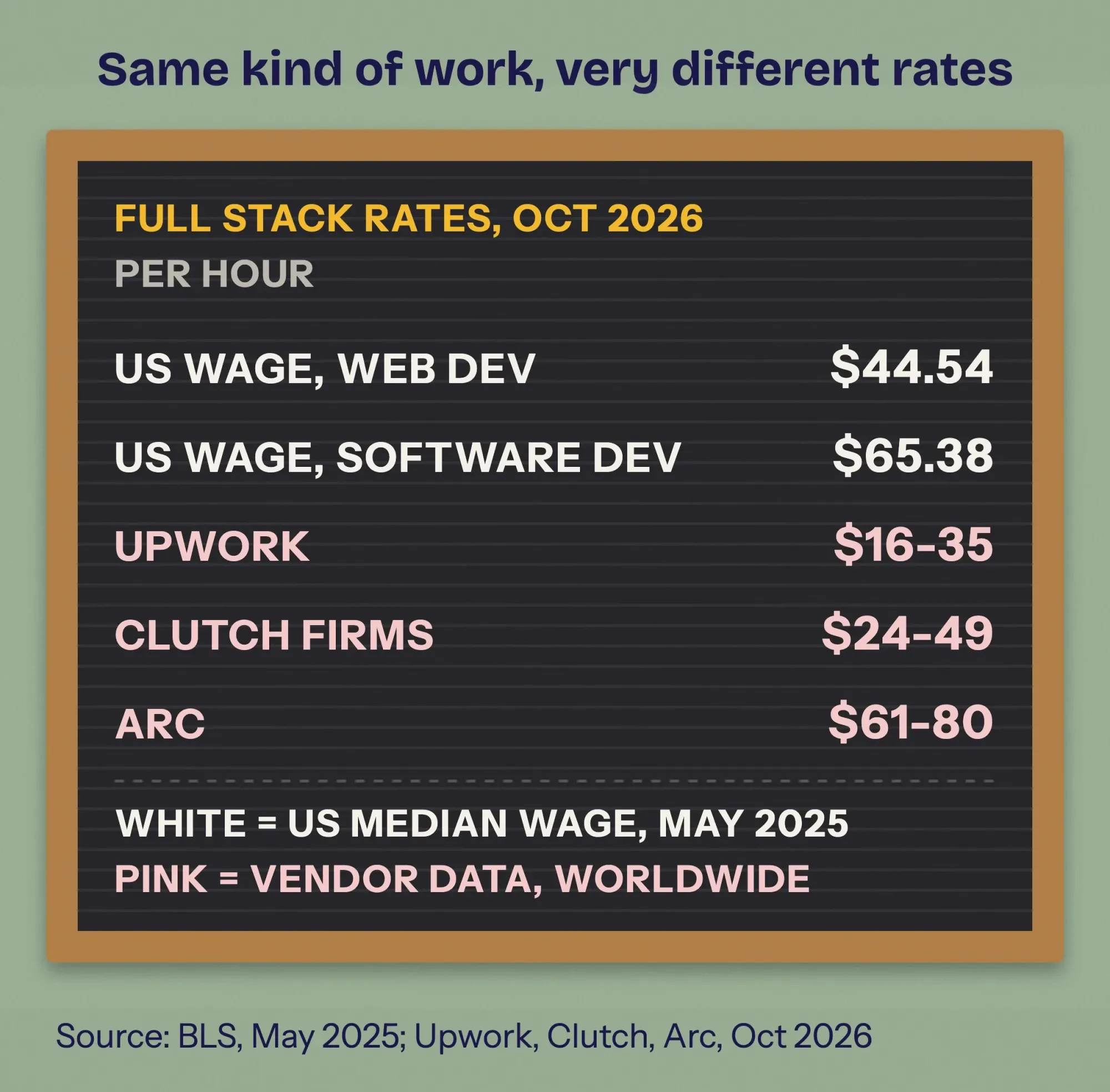 Source: U.S. Bureau of Labor Statistics, May 2025; Upwork, Clutch and Arc rate pages, October 2026. Diagram by DigitalTreed.
Example: a Boise HVAC company prices a customer portal
Numbers are easier to judge with a real-looking brief behind them. So here's one worked through, with a made-up business.
Example: Summit Ridge Heating & Air is a fictional 9-person HVAC company in Boise, Idaho. It wants a customer portal where homeowners book a seasonal tune-up, pay a deposit and see past service visits. The portal has to talk to the scheduling software and card processor the company already uses.
Its one-page brief says what the business does and the one action that matters (a booked tune-up). It lists who uses the portal. Each must-have feature is one plain sentence, such as: a customer can book a tune-up and pay a deposit. It names every system to connect, with links to their API docs; our guide to third-party integrations explains why that list drives cost. It notes the data stored, says card numbers never touch Summit Ridge's own servers, and sets the deadline, budget range and monthly support hours.
Two more items make the quotes sharper. The brief attaches a report on the current site from our website audit tool, which is free, and the logo and brand files from the company's designer. If you don't have clean brand files yet, our guide to hiring a graphic designer covers what to ask for.
For budgeting, we assumed 160 hours of build work. That's our planning figure for a portal this size, not a quote.
| Basis (as of October 2026) | Hourly rate | 160 hours |
|---|---|---|
| Upwork band, worldwide (vendor) | $16 to $35 | $2,560 to $5,600 |
| Clutch software firms, worldwide (vendor) | $24 to $49 | $3,840 to $7,840 |
| BLS web developer median wage (May 2025) | $44.54 | $7,126 (a wage, not a price) |
| Arc average, worldwide (vendor) | $61 to $80 | $9,760 to $12,800 |
| BLS software developer median wage (May 2025) | $65.38 | $10,461 (a wage, not a price) |
Summit Ridge would read that spread like this. Quotes near the bottom almost certainly come from outside the US or from junior developers, and it'd ask who writes the code. A US freelancer whose rate sits above the $65.38 wage line (BLS, May 2025) isn't gouging. That's where a self-employed US developer's rate should sit.
The example stops at the hiring decision.
We haven't built this portal, and we won't claim results for it.
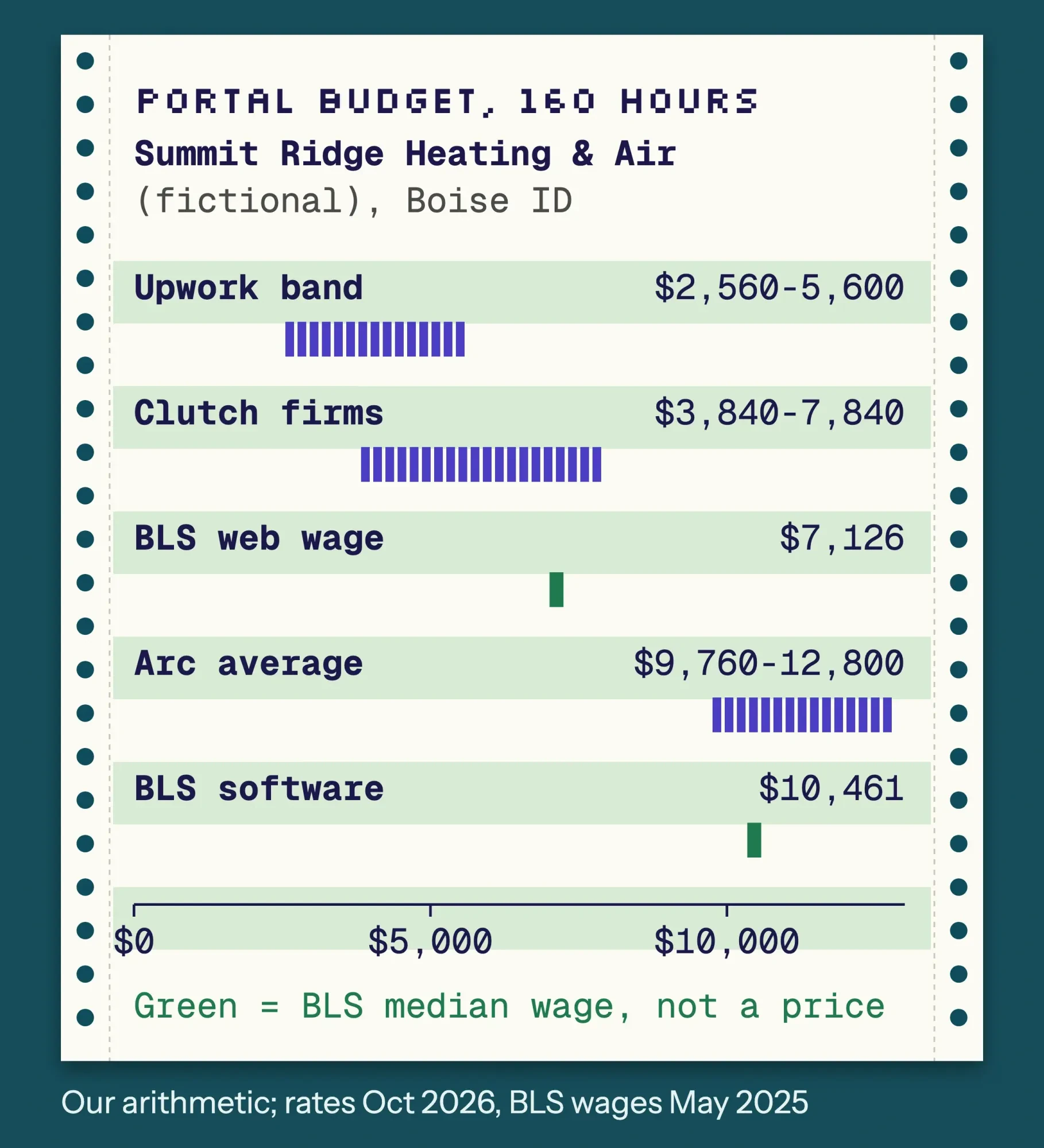 Diagram by DigitalTreed. Our arithmetic on Upwork, Clutch and Arc rates (October 2026) and BLS May 2025 wages. Summit Ridge is a fictional example.
Want one team to scope and build a job like this? Our web development service does custom portals and integrations. We'd earn from a job like this, so read our advice knowing we have a stake in it.
A salary costs more than the salary
That budget covers the build. The bills that follow it are easier to miss, and the biggest is the gap between a wage and an employee's real cost.
Wages and salaries made up 68.5% of employer costs for full-time private-industry workers in June 2026, per the BLS employer costs release. Benefits were the other 31.5%. Divide a salary by 0.685 and you get a rough all-in figure: about $198,500 a year for a software developer at the $135,980 median. A web developer at $92,650 comes to about $135,300.
That's our rough math with an all-industry average, not a quote for tech jobs.
Contractors don't carry that overhead for you, but they bring costs of their own, starting with a paid trial task before the main contract and a second developer's code review. Then add hosting each month, a support retainer for bugs and updates, and time for changes once real customers use the thing. If you're hiring to rescue an older app, our AngularJS end-of-life guide lists what to have ready before the first call.
Leave room for an acceptance check, too. Before the last payment, run the new pages through our website speed test on a phone connection, and click through every feature in the brief yourself.
How to test a developer when you can't read code
All of that only pays off if the person is good.
The top hiring guides we read assume you can run a technical interview, and most owners can't. Here's a plan that doesn't need you to.
- Ask for 2 or 3 live projects like yours, and what they personally built in each. Open them on your phone.
- Ask for a code sample or a public repository. A clear README, tests and recent work are good signs.
- Pay for a small trial task, a real slice of your project that fits in about one working day.
- Pay a second developer 1 or 2 hours to review the trial.
- Ask the candidate to explain the trial code to you in plain words on a call.
- Call two past small-business clients and ask what happened after launch.
That review step is how a non-coder gets an expert opinion without learning to code. Google's code review guide says the most important thing in a review "is the overall design" of the change. It also asks reviewers to check: "Will the tests actually fail when the code is broken?" Hand your reviewer those two lines.
Security deserves one direct question. The OWASP Top 10:2025 is the standard list of the worst web app risks, led by "Broken Access Control" and including "Injection". A good developer will tell you how they handle both. Ask how they'd fix a common setup error, such as "Cannot use import statement outside a module"; a good answer starts with package.json. A blank look tells you plenty.
Don't skip the explain-back call.
Someone who can explain their own code clearly will also send you clear updates.
Which red flags should rule out a developer?
Most of those tests are about skill. These signs are about trust, and any one of them is reason to walk.
- They want the code repository, hosting or domain in their own account.
- There's no written contract, or only a "work for hire" line with no assignment of copyright.
- They won't do a paid trial or share any code sample.
- They don't write tests and have no plan to.
- They want 100% up front, with no milestones tied to working software.
- They ask for your passwords by email instead of their own limited user accounts.
- They promise Google rankings. Our guide to hiring an SEO freelancer shows why that's a warning sign.
A rate far below the wage line isn't a red flag on its own.
Not knowing who will write the code is.
Who owns the code is settled on paper
The ownership question is the one owners rarely think to ask.
Paying for code doesn't make it yours.
Under 17 U.S.C. 201(a), copyright belongs first to the author, usually the person who writes the work. A "work made for hire" is the exception, and the definition in 17 U.S.C. 101 covers two cases. One is work by an employee within the scope of the job. The other is a commissioned work that fits one of nine listed kinds, such as a translation, a compilation or an atlas, and only "if the parties expressly agree in a written instrument signed by them."
A computer program isn't one of the nine.
So a contract that only says "work for hire" may not move a contractor's code to you. The fix is a written transfer. Under 17 U.S.C. 204(a), a transfer of copyright "is not valid unless" it's in writing and signed by the owner of the rights. The Copyright Office's Circular 30 sets out the same two routes. Ask for a signed assignment of the custom code, effective when you pay.
Two practical steps make that assignment work. Create the code repository in your own company's GitHub organization on day one, and add the developer as a collaborator. GitHub's transfer guide says only someone with admin access can move a repository later, so start where you'll end up. Then ask for a list of every open-source library and its license. GitHub's licensing page notes that code without a license stays fully under its author's copyright.
Our guide to hiring a web designer explains the assignment clause and domain ownership in more detail. The contract should also cover scope, milestones, a change-request rate, confidentiality, a bug warranty window, support terms and what you get if the work stops halfway.
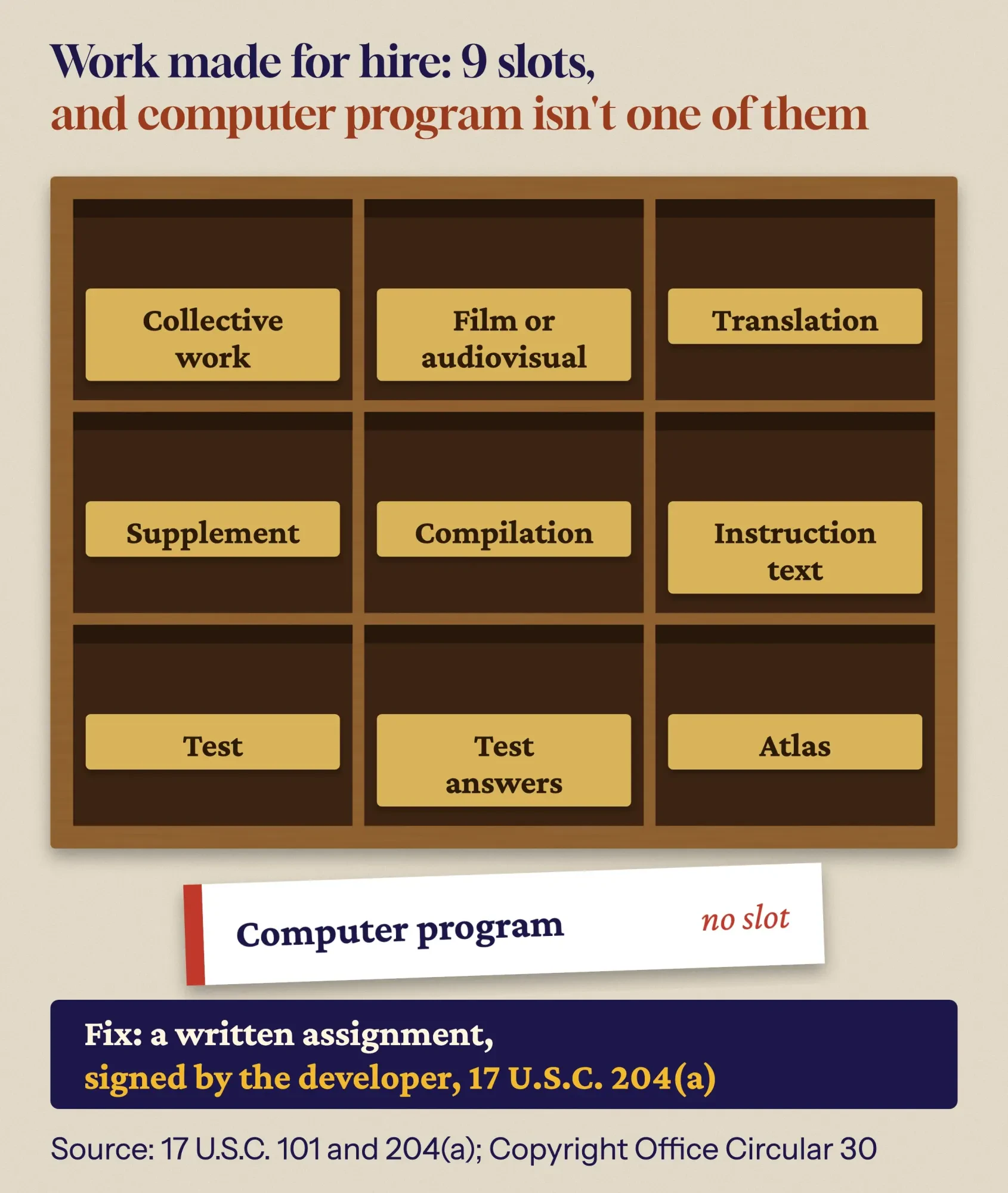 Diagram by DigitalTreed, based on 17 U.S.C. 101 and 204(a) and Copyright Office Circular 30.
Contractor or employee, and the $2,000 1099 line
The contract also has to match how you actually work together, because the label on it doesn't decide worker status.
The IRS contractor or employee page looks at three kinds of evidence: behavioral control, financial control and the type of relationship. It adds that a remote worker is your employee "if you can control what will be done and how it will be done," even if they choose to work remotely. Its short definition puts it simply: with a contractor, you control "only the result of the work."
Wage law runs a separate test under the Fair Labor Standards Act.
The Department of Labor calls misclassification "a serious problem" on its misclassification page, since misclassified workers can miss minimum wage and overtime. On February 26, 2026, it proposed a new rule built on an "economic reality" test. As of October 2026 that rule is still a proposal, not a final rule, and your state may use a stricter test of its own.
Run Summit Ridge through it. A fixed project, a developer who sets their own hours, has other clients and invoices per milestone looks like a contractor. If the company later wants 40 set hours a week from that person, under its direction, with no end date, it should look again.
Taxes come next. The IRS 1099-NEC instructions set the reporting line at $2,000 for tax years beginning after 2025. Pay an unincorporated US freelancer $2,000 or more in 2026 for services, and you'll likely file a 1099-NEC by January 31, 2027. Card and payment-platform payments are reported on a 1099-K by the processor instead.
Collect a Form W-9 before the first payment.
We write software for a living; we aren't your lawyer or your accountant. This section and the one on code ownership aren't legal or tax advice. They map the federal rules as we read them in October 2026, and an attorney or CPA should check how they fit your setup. Foreign contractors use different forms, which we didn't cover.
Plan the handover before the first line of code
All that paperwork protects you on paper.
The handover protects you in practice, when the one developer who knows the system moves on. Our website development process guide lists what to receive at launch: every login, in your name.
The BLS lists it as part of a developer's job to "document every aspect of an application or system as a reference for future maintenance and upgrades." Write that into the contract as a deliverable, with this list:
- admin rights on the repository, in your organization
- a README with setup steps another developer can follow
- a list of settings and secret keys, shared through a password manager
- hosting, database and backups in your account, with restore steps
- domain, DNS and third-party API accounts in your name
- a recorded 30-minute walkthrough of the code
Then keep an eye on it after launch. A portal that goes down on a Saturday costs bookings, and our guide to uptime monitoring shows how to get an alert before customers call.
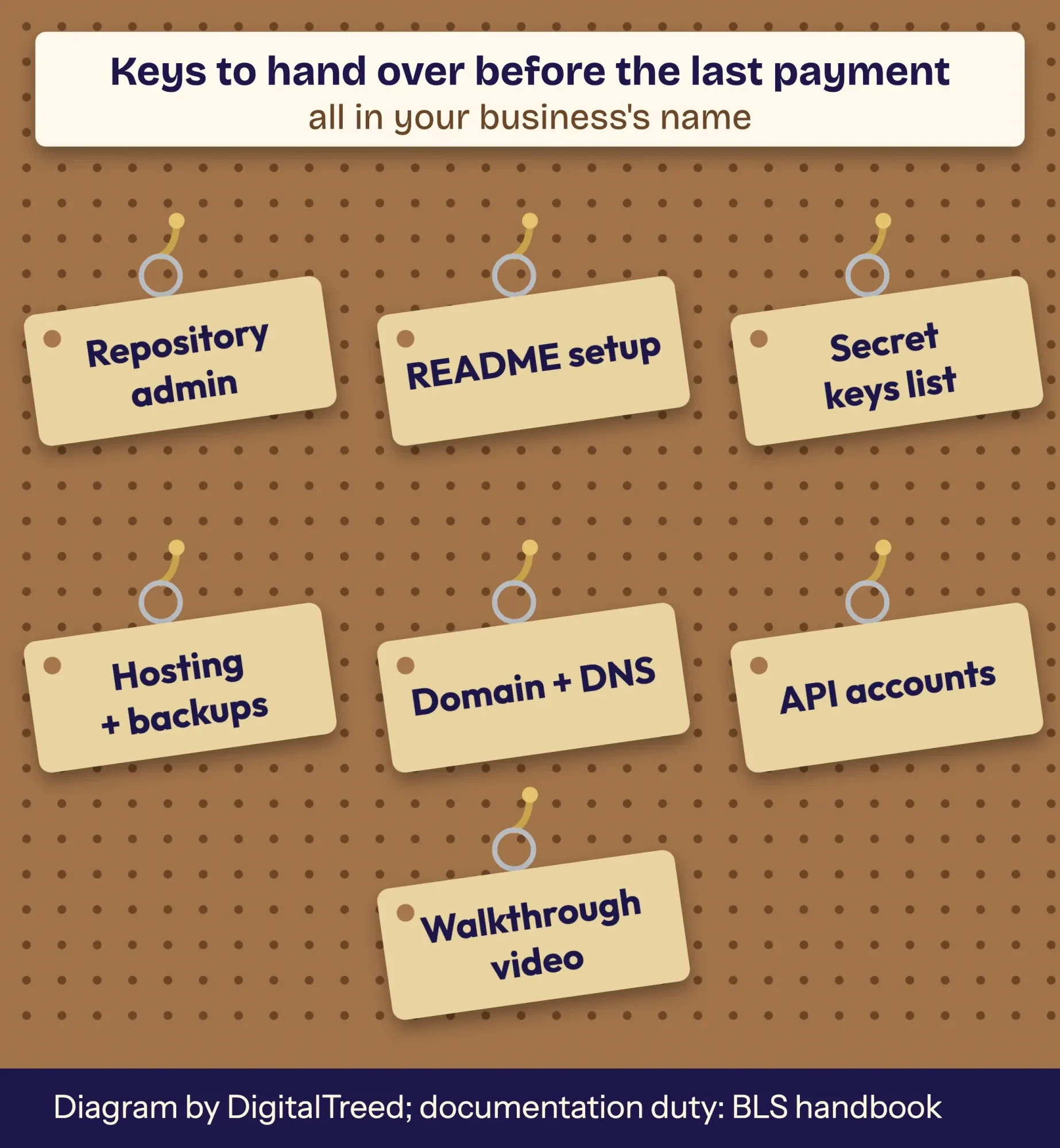 Diagram by DigitalTreed. Handover items from our checklist; the documentation duty is from the BLS Occupational Outlook Handbook.
Frequently asked
What form do I need from a developer outside the US?
Usually Form W-8BEN. The IRS Form W-8BEN page says a foreign person gives it to the withholding agent or payer when asked. That's the reverse of the W-9 you collect from a US freelancer. Ask a CPA whether any withholding applies to your payments.
Who owns code a developer writes with AI tools?
AI help doesn't rule out copyright, but prompts alone don't count. The Copyright Office's January 29, 2025 announcement says AI output is protected only where a human author determined sufficient expressive elements. So ask candidates how much of the code they write and shape themselves. Your written assignment can only transfer what's protectable.
Are web developers hard to find in the US?
Demand is steady rather than extreme. The BLS web developers handbook page projects 5 percent growth from 2025 to 2035. It expects about 13,600 openings each year, mostly to replace people who leave the job.
Ten questions to ask before you sign
Then come the questions. Ask every candidate the same ten, so the answers line up as neatly as the quotes.
- Which past project is closest to mine, and what exactly did you build?
- Which stack would you use, and why that one for a company our size?
- Will the code live in a repository my business owns from day one?
- Will you assign copyright in the custom code to us in writing, and list each open-source license?
- How do you test your code, and will the tests be in the repository?
- How do you guard against broken access control and injection?
- Where will it be hosted, in whose account, and at what monthly cost?
- How often will I see working software, and what happens when scope changes?
- Do you use AI coding tools, and how do you check what they write?
- After launch, what's your bug response time, monthly support price and notice period?
Good developers like these questions.
They're the ones they wish more clients asked.
When you've got your brief and your shortlist, compare quotes line by line. To add ours to the comparison, send that same brief through our quote form and we'll price each item.
How we made this guide: Our web development team checked each wage, rate, rule and quote against its source, finishing on October 24, 2026. We pulled BLS wage data for both developer occupations and read the Upwork, Arc and Clutch rate pages side by side that morning. We also read the IRS, Department of Labor and Copyright Office pages, the U.S. Code, GitHub's docs, Google's review guide and OWASP. The Summit Ridge brief and budget are our own arithmetic on a made-up company. Every source is linked inline where its fact appears.
First published July 2023. Rewritten October 24, 2026: replaced the six-benefits pitch with a buyer's guide to rates, skill tests, red flags, code ownership, worker status and handover.
Sources
- U.S. Bureau of Labor Statistics: Occupational Outlook Handbook, Software Developers (May 2025 pay)
- U.S. Bureau of Labor Statistics: Occupational Outlook Handbook, Web Developers and Digital Designers (May 2025 pay)
- U.S. Bureau of Labor Statistics: May 2025 OEWS profile, software developers
- U.S. Bureau of Labor Statistics: May 2025 OEWS profile, web developers
- U.S. Bureau of Labor Statistics: Employer Costs for Employee Compensation, June 2026
- Upwork: Full stack developer cost (vendor data, read October 24, 2026)
- Arc: Full-stack developer hourly rates (vendor data, read October 24, 2026)
- Clutch: Software Development Company Pricing Guide (vendor data, read October 24, 2026)
- Clutch: Web Development Company Pricing Guide (vendor data, read October 24, 2026)
- U.S. Copyright Office: 17 U.S.C. 201(a), Ownership of copyright
- 17 U.S.C. 101, Definitions (Cornell LII)
- 17 U.S.C. 204, Execution of transfers of copyright ownership (Cornell LII)
- U.S. Copyright Office: Circular 30, Works Made for Hire
- GitHub Docs: Transferring a repository
- GitHub Docs: Licensing a repository
- IRS: Independent contractor (self-employed) or employee?
- IRS: Independent contractor defined
- U.S. Department of Labor: Misclassification of employees as independent contractors
- U.S. Department of Labor: 2026 proposed rule on employee or independent contractor status
- IRS: Instructions for Forms 1099-MISC and 1099-NEC (12/2026)
- IRS: About Form W-9
- Google Engineering Practices: What to look for in a code review
- OWASP Top 10:2025

Comments
No comments yet. Start the conversation below.