
Quick answer
For most US beginners, the scope of blogging is a side income that grows slowly for two years or more. As of November 2026, AdSense pays out once your balance reaches $100. Our example blog, with made-up inputs and 15% monthly growth, earned $614.50 to $1,545.50 in year two at a $5 or $15 page RPM. The example sheet below shows every input and formula.
The scope of blogging for a US beginner with a few free evenings a week comes down to what the posts can pay and what work they lead to. A blog is a website where you publish dated posts on one topic.
We built an example 24-month income sheet, and even its good case paid under $3 an hour in year two. That's why we'd give a blog two years before leaning on its income. Below come ad payouts and the traffic they need, then FTC disclosure, Google spam rules, writing jobs, taxes and the sheet.
Key takeaways
- Our example blog earned under $3 an hour in its second year.
- As of November 2026, AdSense publishers keep about 68% of Google Ads spend.
- As of November 2026, Mediavine asks for $5,000 a year in ad revenue.
- The FTC says readers may not understand a bare affiliate link label.
- BLS calls blogging useful experience for writer jobs paying a $76,910 median.
What the scope of blogging covers in money terms
Blog income comes from three places. Ads run beside your posts, affiliate links pay when a reader buys, and brands pay for sponsored posts. For ads, a new blog can apply to Google's AdSense program, where you paste one piece of code and Google finds the advertisers. You'll need to be 18 or older, according to its eligibility page. That page also sends Blogger users to a hosted AdSense account set up inside Blogger, while self-hosted WordPress blogs apply directly. Our AdSense approval guide covers why sites get turned down, and Blogger vs WordPress compares the two platforms on cost.
Google takes two cuts. Its revenue share page says "publishers receive 80% of the revenue, after the advertiser platform takes its fee." If the advertiser bought the ad through Google Ads, you keep about 68%, as of November 2026, so $100 of advertiser spend leaves about $68 for you.
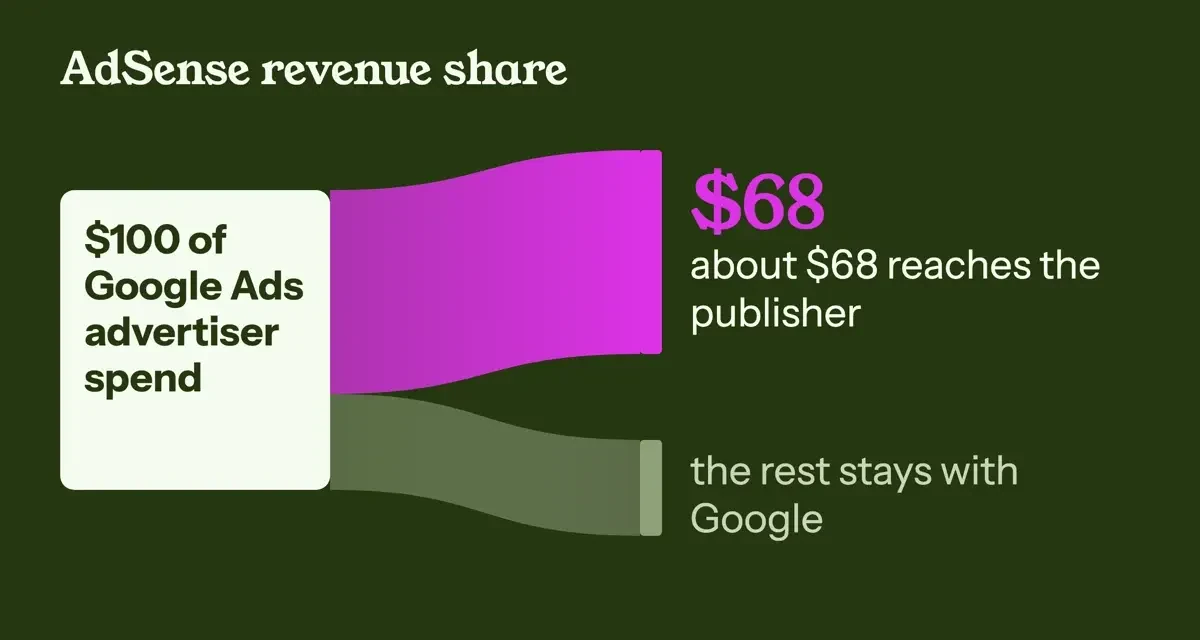 Diagram by DigitalTreed, from the AdSense revenue share page read November 20, 2026.
Affiliate income works differently, since you're paid only when someone buys. Amazon's Associates home page promises, as of November 2026, "up to 10% in associate commissions" on qualifying purchases, and the rate depends on the product category. Our Amazon Associates commission rates post lists them. Sponsored posts are a direct deal with a brand at a price you'll negotiate, and pitching sponsored posts has its own guide. Memberships, digital products and client work are covered in how bloggers make money.
How much traffic does a blog need to make money?
Ad earnings are counted per thousand page views, and Google's RPM help page gives the formula: estimated earnings divided by page views, times 1,000. Its own example is $0.15 from 25 page views. That's a $6.00 page RPM.
Your RPM moves with your topic, your readers' countries and the season, and Google doesn't publish a typical figure to plan with. Even the earnings estimator on the AdSense start page begins at 50,000 monthly page views and warns "There's no guarantee or commitment that you'll earn this amount."
Payouts also have a floor. As of November 2026, the AdSense payment thresholds table lists $100 for US dollar accounts. Once you pass it, the payment timelines page says "you'll be issued a payment between the 21st and the 26th of the month."
Take an example blog earning $20 a month in ads. It reaches $100 in month five and is paid in that window a month later.
Bigger ad networks set a higher bar. As of November 2026, Mediavine's requirements page asks for "a minimum of $5,000 in annual ad revenue." Its smaller Journey program wants 5,000 sessions a month from the US or six other listed countries.
At an example $5 page RPM, Mediavine's $5,000 a year takes about 83,333 page views a month ($5,000 / $5 x 1,000 / 12). At an example $15 RPM, it's about 27,778, still nearly double the 14,935 our example blog reaches in month 24.
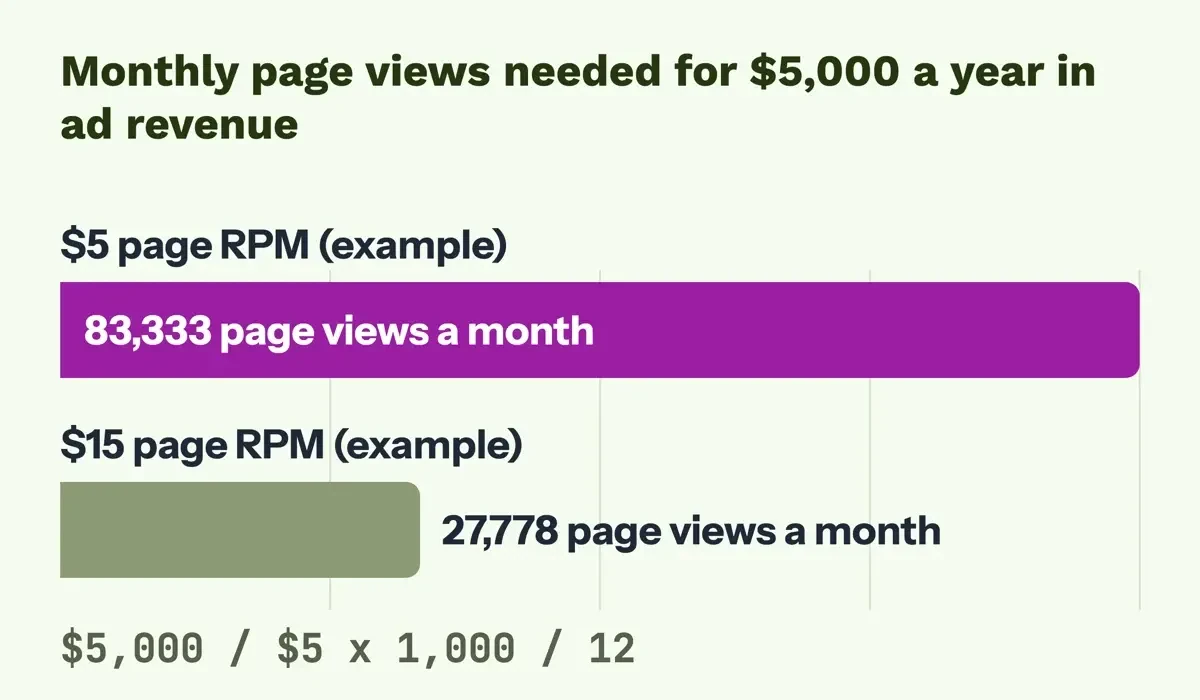 Drawn by us: example RPMs are made up; the $5,000 bar is from the Mediavine requirements page read November 20, 2026.
Our example sheet below never reaches Mediavine's bar in 24 months, so we'd add affiliate links or a service you sell rather than wait on ads.
Disclosure rules for affiliate links and sponsored posts
Once a brand pays you or sends you something, federal advertising rules apply to the post. The FTC's FAQ on endorsements names bloggers directly. If a brand sends you free products expecting a mention, it says "the FTC Act applies to you." Its Disclosures 101 page counts "a financial relationship" as a material connection, so a free blender creates the same duty to disclose as a check. Placement matters too. The page says "Disclosures are likely to be missed if they appear only on an ABOUT ME or profile page," below a post, or behind a click. It also counts tags and likes as possible endorsements, which matters if you promote your posts on social media.
The FTC also cares about the label itself, and the same FAQ warns that readers might not understand that the words affiliate link mean you're paid. A "buy now" button "would not be adequate" either. Its sample line is "I get commissions for purchases made through links in this post," placed where readers see it next to the link.
Google has separate rules for paid links in search. Its outbound link guide asks you to mark ads and paid placements with the rel value sponsored. Its spam policies also name thin affiliation, where product descriptions are "copied directly from the original merchant without any original content or added value." A blender review built from the maker's pasted spec sheet fits that description.
What Google's helpful content and spam policies changed
If your readers come from search, Google's guidance on helpful content matters too. Its helpful content guide lists questions to test a post against. One question settles a common myth by asking whether you write to a word count because you heard Google prefers one. Google's answer: "(No, we don't.)"
The spam policies define scaled content abuse as cases where "many pages are generated for the primary purpose of manipulating search rankings and not helping users." Google's page on AI-generated content adds that mass-producing pages with AI and no added value "may violate Google's spam policy on scaled content abuse." That page also reminds writers that "generative models don't retrieve facts, but predict a likely sequence of words," so every AI-drafted number needs a source check. Back on the spam policies page, Google warns that sites breaking these rules "may rank lower in results or not appear in results at all."
Rankings also move when you've done nothing wrong. Google's core updates page says that "several times a year, Google makes significant, broad changes to our search algorithms and systems." So we'd never budget rent around one good month of search traffic. Our SEO and blogging guide for beginners covers the on-page work that keeps a post useful through those changes.
Writing and editing jobs a blog can lead to
Beyond ad and affiliate money, a blog is a public portfolio you can send to an employer. The Labor Department's BLS writers and authors profile says experience from "any writing that improves skill, such as blogging, is beneficial."
BLS puts the median annual wage for writers at $76,910 in May 2025. That's $36.98 an hour, across 140,300 jobs. The outlook is flat. BLS projects little or no change in writer jobs from 2025 to 2035, with about 11,900 openings a year, mostly to replace people who leave. The BLS wage profile for writers breaks that pay down by state and industry.
Editing looks much the same. The editors profile shows a $77,920 median in May 2025, a 1% projected decline and about 7,900 openings a year.
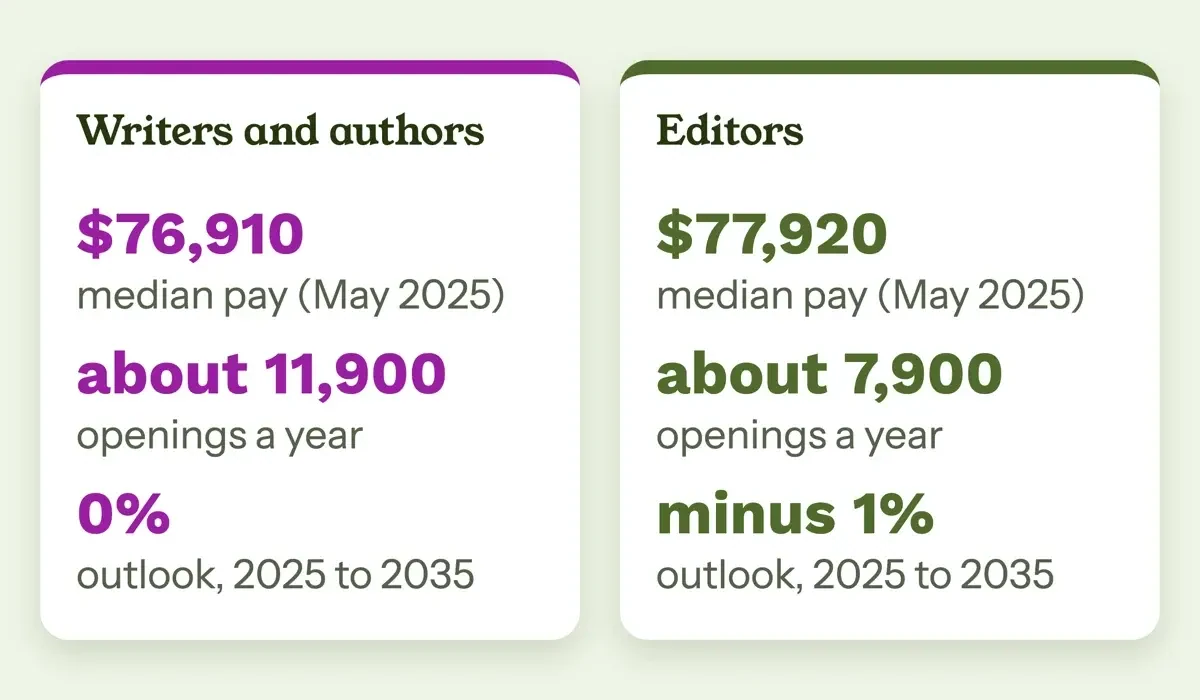 Source: BLS Occupational Outlook Handbook (May 2025 pay, 2025 to 2035 outlook), read November 20, 2026. Diagram by DigitalTreed.
BLS also notes that "Many writers and authors are self-employed," and a blog gives a new freelancer samples to send on day one. Our freelancing starter guide covers first clients, rates and a one-page contract.
Taxes on blog income in the US
Small blog earnings still count at tax time. The IRS self-employment tax page says you file Schedule SE when your net earnings from self-employment "were $400 or more." The rate is 15.3%. That's 12.4% for Social Security and 2.9% for Medicare.
In our example below, the blog stays under $400 in year one at either RPM. It passes $400 in year two, the first year it'd owe self-employment tax, though a real blog would subtract hosting and tools that our example leaves out. If you're blogging as a sole proprietor, the IRS page says you generally use Schedule C to figure those net earnings from self-employment. As of November 2026, AdSense's threshold table lists a $0 tax information threshold for US dollar accounts, so Google asks for tax details before you earn anything. Talk to a CPA before your first filing, because state rules and your other income change the bill.
An example blog income sheet
To see those payout, traffic and tax rules work together, we built a 24-month example sheet for a made-up US blog. Every input is an example. It starts at 600 page views in month one and grows 15% a month, with a page RPM of $5 or $15 and 10 hours of work a week. Affiliate sales add $1.60 per 1,000 page views (1,000 x 2% click x 5% buy x $40 order x 4% commission).
| Result (example, made-up inputs) | At $5 page RPM | At $15 page RPM |
|---|---|---|
| Page views in year 1 | 17,400 | 17,400 |
| Page views in year 2 | 93,100 | 93,100 |
| Month the AdSense balance first reaches $100 | Month 13 | Month 8 |
| Ads plus affiliate, year 1 | $114.88 | $288.88 |
| Ads plus affiliate, year 2 | $614.50 | $1,545.50 |
| Pay per hour in year 2 (520 hours) | $1.18 | $2.97 |
| Journey by Mediavine (5,000 sessions a month) | Month 20 | Month 20 |
| Mediavine ($5,000 a year in ad revenue) | Not within 24 months | Not within 24 months |
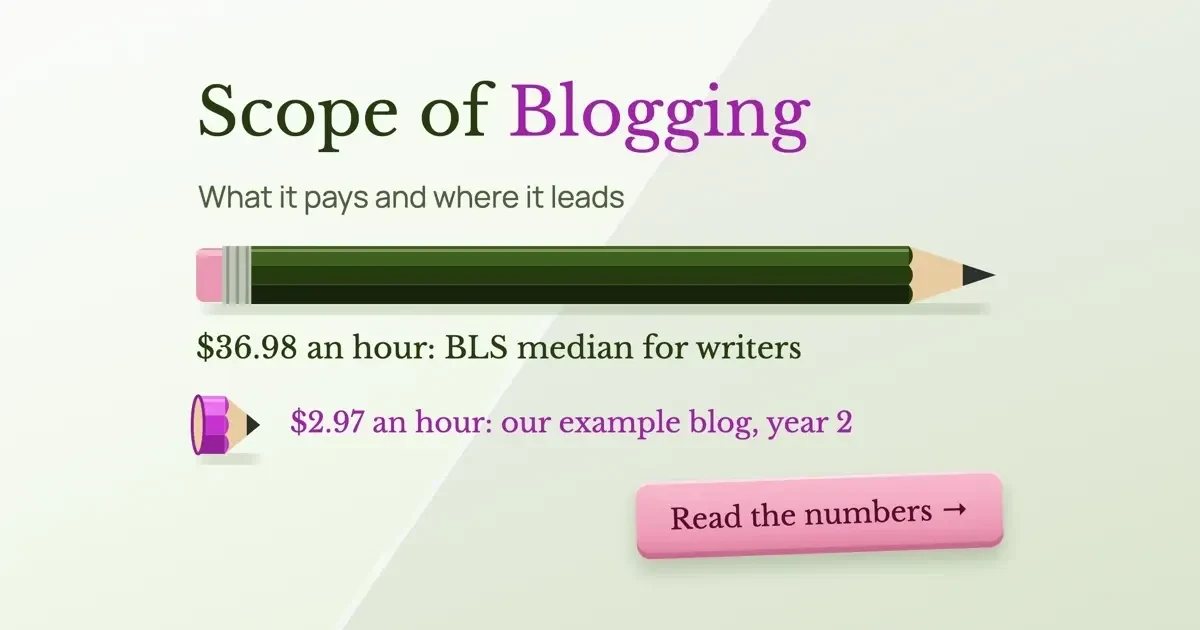
The pay-per-hour row is the one we'd show a friend asking about blogging as a career. At 520 hours a year, even the high example case earns $2.97 an hour in year two. The BLS median for writers is $36.98, more than 12 times as much. At the low example RPM, the AdSense balance doesn't reach the $100 payout line until month 13, so more than a year of posting passes before Google pays anything. The last months do climb fast. Month 24 alone brings an example $98.58 at the low RPM and $247.93 at the high one, and both depend on 15% growth every month for two years.
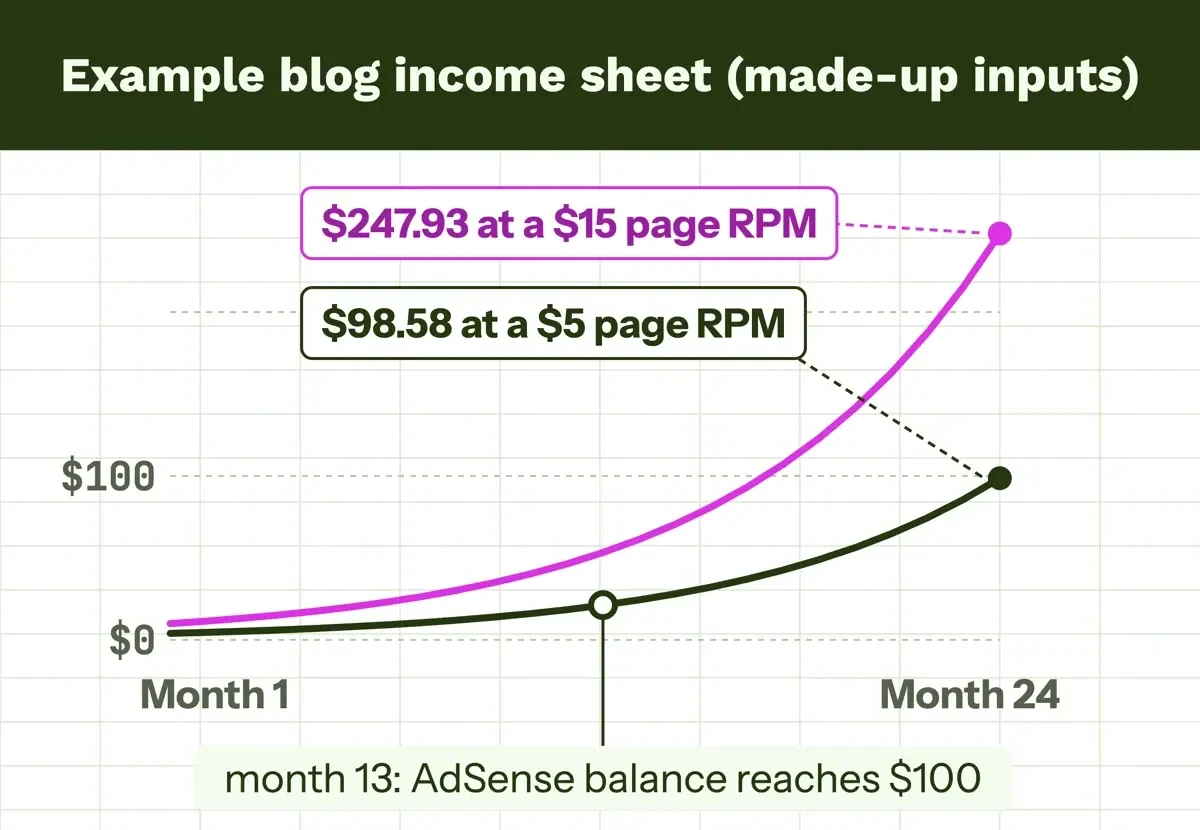 Drawn by us: the example sheet from our local script, made-up inputs, November 20, 2026.
What we tested
Our Python script found all 14 rule lines it checks on the official pages we saved. It then built the sheet as CSV, JSON and an HTML report, which we opened on 127.0.0.1. Journey's month assumes 1.5 page views per session, all from the US.
Which blog income facts we could confirm
We read every source on November 20, 2026 with plain requests, no sign-in and no forms.
- Confirmed: AdSense's 80% share and the about 68% Google Ads figure, on one Google page.
- Confirmed: the $100 US payout threshold and the 21st to 26th payment window.
- Confirmed: Mediavine's $5,000 rule and Journey's 5,000 sessions, on one Mediavine page.
- Changed: our student blogger guide recorded 1,000 Tier 1 sessions for Journey.
- Not confirmed: your own AdSense share, which shows only inside a signed-in account.
- Not checked: the eCFR text of the FTC guides, which sent our request to a bot check.
- Not published: any typical page RPM; the AdSense estimator offers an estimate only.
Two numbers deserve your own check. AdSense's revenue share page says your share appears under Account, then Settings, then Account information. Mediavine's page can change between reads, as Journey's did.
Frequently asked
How do I start a blog and make money if I am under 18?
AdSense takes applicants 18 or older. A parent or guardian can apply instead, and "all payments will be made to the adult responsible for the site." Setup steps are in how to start a blog.
When could a new blog get its first AdSense payout?
In our example, the balance first reached $100 in month 8 at a $15 RPM and month 13 at $5. As of November 2026, Mediavine adds another clock for Journey: your domain must be "at least 4 months old."
Is a platform's paid-partnership label enough disclosure?
Not on its own. The FTC FAQ says it's "always best to add your own disclosure" even when a platform has a built-in tool.
Do I owe tax on blog income if no company sends me a 1099?
Yes. The IRS gig economy page says "Gig economy income is taxable," and you report it even without a Form 1099-K, 1099-MISC or 1099-NEC.
How we made this guide: We saved each official page as text, checked our sheet's rules against those copies with a script, and labeled every made-up input. Facts checked by the DigitalTreed team on November 20, 2026.
First published July 3, 2020. Rewritten November 20, 2026 for US readers, with sourced payout, disclosure, job and tax figures.
Sources
- Google AdSense: Start earning
- AdSense Help: AdSense revenue share
- AdSense Help: Eligibility requirements for AdSense
- AdSense Help: Payment thresholds
- AdSense Help: Payment timelines
- AdSense Help: Revenue per thousand impressions (RPM)
- Mediavine: Mediavine and Journey by Mediavine requirements
- Amazon Associates: Program home page
- FTC: FTC's Endorsement Guides, What People Are Asking
- FTC: Disclosures 101 for Social Media Influencers
- Google Search Central: Qualify your outbound links
- Google Search Central: Spam policies for Google web search
- Google Search Central: Creating helpful, reliable, people-first content
- Google Search Central: Google Search's guidance on using generative AI content
- Google Search Central: Google Search's core updates and your website
- BLS Occupational Outlook Handbook: Writers and Authors
- BLS Occupational Outlook Handbook: Editors
- BLS: Occupational Employment and Wage Statistics profile, writers and authors
- IRS: Self-employment tax (Social Security and Medicare taxes)
- IRS: Gig economy tax center

Comments
No comments yet. Start the conversation below.