
Quick answer
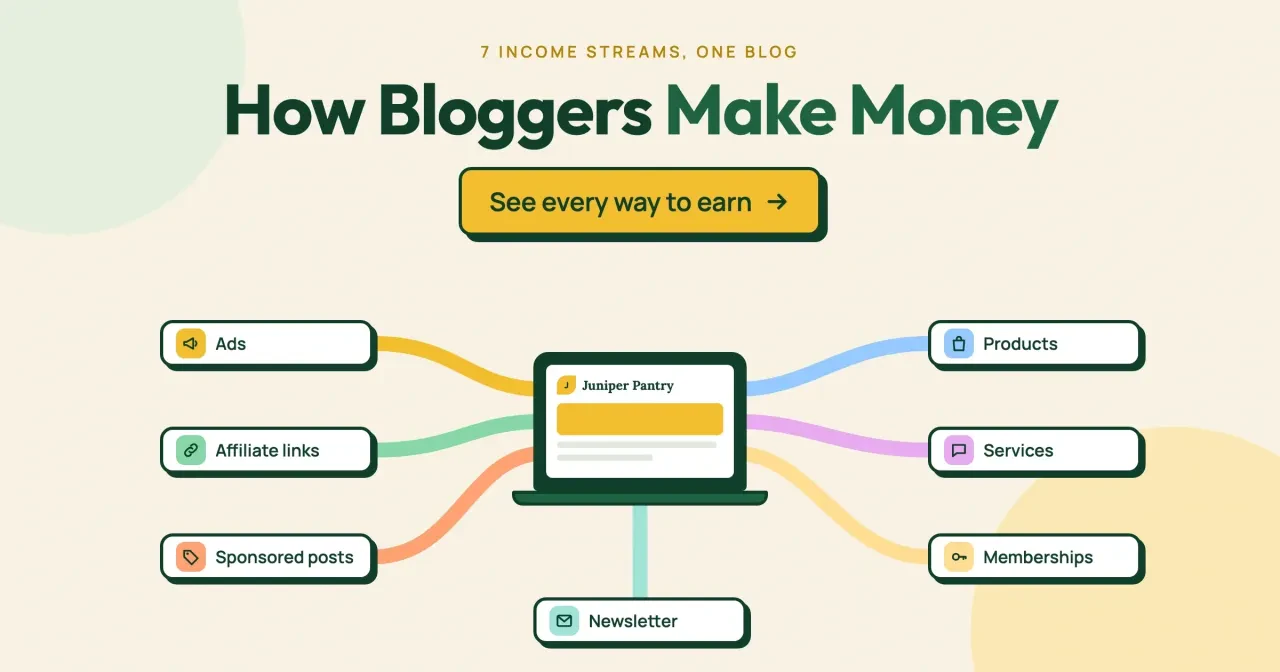
As of October 2026, bloggers earn from 7 income streams; AdSense ads, for one, pass publishers 80% of ad revenue after the buyer's fee. What you keep depends on the stream: Gumroad takes 10% plus $0.50 a sale on your own link, but 30% via its marketplace. Start with the map below, then pick one stream.
You've kept a blog going for a while, and someone's income report made you wonder which streams are real at your size. A blog income stream is a single way a blog turns readers into money. So how do bloggers make money? They stack a few of the seven below. We quote no one's earnings here, only published fees and the math on them.
We start with the 7 income streams on one map, then the streams where companies pay you and those where readers and clients pay. Next is how much of $1,000 you keep, the FTC's disclosure guides and what the IRS expects. We end with which stream to start with.
Key takeaways
- On $1,000 in Gumroad sales, you keep $880 by direct link, $700 via Discover.
- AdSense passes publishers 80% of ad revenue and pays out at $100.
- A business paying $2,000+ by check or bank, not card, files a 1099-NEC.
- Affiliate and sponsored income both need a clear disclosure under 16 CFR 255.5.
- Self-employment tax of 15.3% applies once net blog earnings reach $400.
The 7 income streams on one map
We group blog income into 7 streams, and the quickest way to sort them is by who sends the money. Three are paid by companies that want your readers' attention, while the other four are paid by readers or clients themselves, which changes how much traffic you'll need first.
Here's the map, with the fee or rule each payer publishes as of October 2026. Start with the last column, because it's the cut taken before anything lands in your account.
| Stream | Who pays you | Fee or rule, October 2026 |
| Ads | Advertisers, through a network | AdSense: you get 80% after the buyer fee |
| Affiliate links | Merchants, per sale | Set by each program; disclose it |
| Sponsored posts | Brands, per post | Disclose; mark paid links |
| Products | Readers who buy | Gumroad: 10% + $0.50 a sale |
| Services | Clients | 1099-NEC at $2,000+ from one business, not by card |
| Memberships | Paying members | Patreon: 10% plus processing fees |
| Newsletter | Paid subscribers | Ghost: 0% transaction fee |
The top three rows need traffic before they pay much, because an advertiser or merchant pays for views, clicks or sales. The bottom four can pay from your first customer. So audience size, more than niche, decides which stream to switch on first.
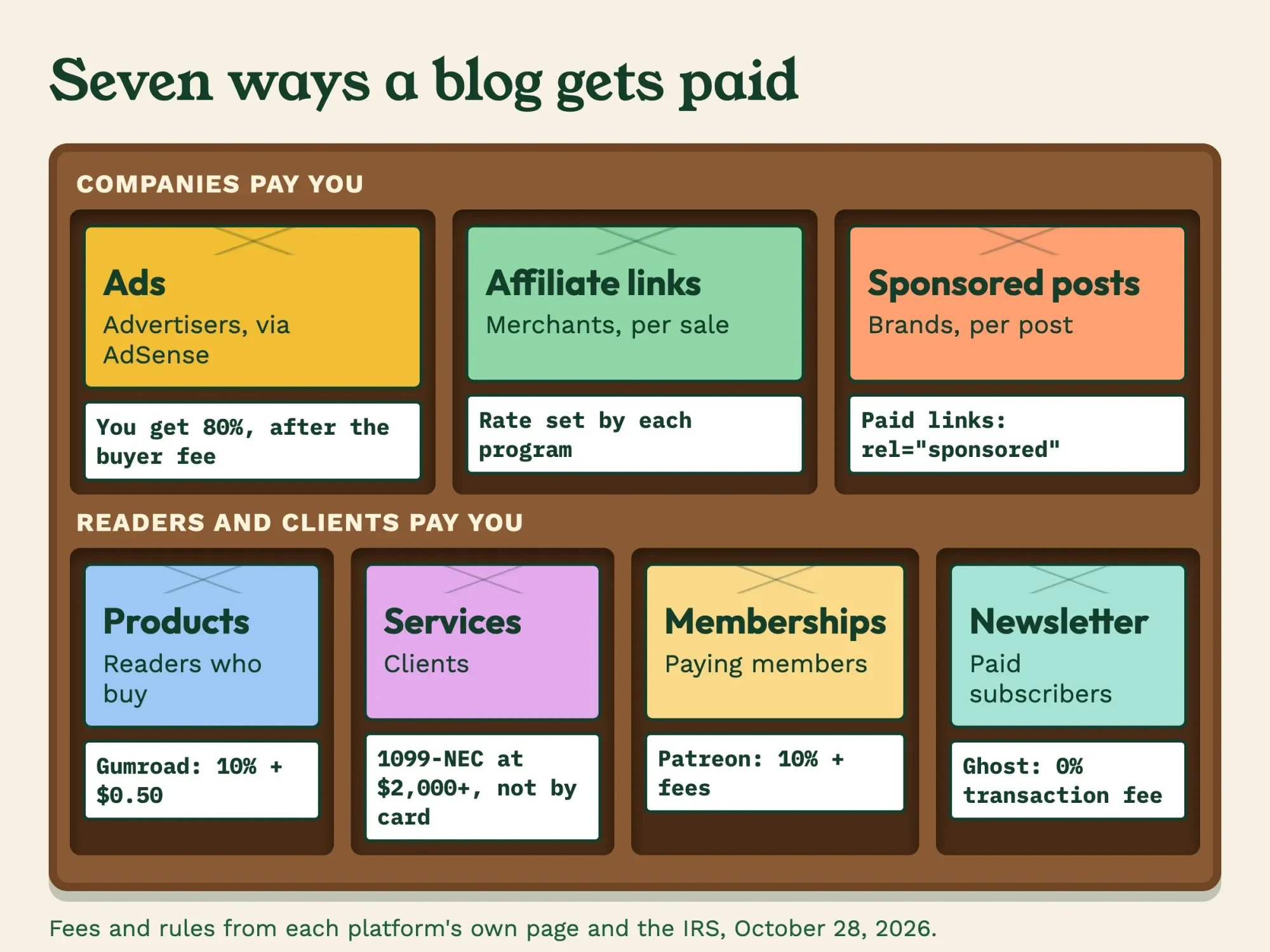 Diagram by DigitalTreed. Fees from each platform's own page and the IRS, October 28, 2026.
The company-paid half comes first, because all three of its streams wait on traffic.
Streams where companies pay you: ads, affiliate links and sponsored posts
The first three streams share one trait: a company pays you to reach your readers, so the money rises and falls with your traffic from one month to the next. They're easy to switch on and slow to grow.
Display ads ask the least of you, since there's nothing to sell or pitch. Google's AdSense revenue share page says publishers get "80% of the revenue, after the advertiser platform takes its fee." When the buyer uses Google Ads, that's about 68%. AdSense's payment thresholds table lists a $100 payout threshold for US dollar accounts, so a blog earning, say, $5 a month waits $100 / $5 = 20 months to get paid. Getting approved is its own job, covered in our AdSense approval guide.
Ad networks gate entry. Journey by Mediavine asks for "a minimum of 1,000 sessions from Tier 1 countries" within 30 days. Mediavine's main program wants "a minimum of $5,000 in annual ad revenue." If neither bar is in reach yet, you can still sell banner slots straight to local advertisers, as the guide to finding advertisers for your website explains.
Affiliate links pay per sale, not per view.
You get a cut of what a reader buys through your link, and the merchant sets the rate. Google won't reward a page that only repeats the seller, though. Its spam policies call it thin affiliation when product descriptions and reviews "are copied directly from the original merchant without any original content or added value." The click, cookie and commission are explained in our affiliate marketing explainer.
Sponsored posts are the third: a brand pays a flat fee for a post or a mention. Google's outbound link guide says to mark "advertisements or paid placements" with rel="sponsored". Finding brands and pricing a post is covered in how to get sponsors for your blog. The other four streams can pay before the traffic arrives, because the reader is the one paying.
Streams where readers and clients pay you
Here the reader is the customer. These streams can work with a few hundred loyal readers, but you'll have to make something people want to buy, and that's real work before any money shows up.
Products are things you make once and sell many times, like a template, a printable or an ebook, and once one's made, it needs no new hours per sale. Gumroad's pricing page lists "10% + $0.50" per sale through your own links. It charges 30% when "new customers find and buy from you through our discover marketplace." So on a $25 sale, a buyer from your own blog costs $2.50 + $0.50 = $3 in fees, while a Discover buyer costs $25 x 30% = $7.50.
Services trade your hours for money: writing, design or setup help for readers who'd rather pay than learn. There's no platform fee when a client pays your invoice directly, and our free invoice generator makes one in a minute. The catch is that services stop the week you stop working, and they bring a tax form once one client's payments pass a line we'll get to below.
Memberships charge a monthly fee for extras, like bonus posts or a community. Patreon takes "10% of the income you earn on Patreon." On top of that come "payment processing, currency conversion, and payout fees," which that page doesn't price.
A paid newsletter is a membership delivered by email. Ghost doesn't take a cut: its paid plans run "without any additional transaction fees from Ghost," though "Payment processor fees still apply." You pay a plan fee instead. Publisher, the first plan listing paid subscriptions, is $29 a month on yearly billing as of October 2026. That's $29 x 12 = $348 a year, which weighs more on a small list than a big one. Say your newsletter had 100 paying readers at $5 a month: that's 100 x $5 = $500, so the $29 fee is under 6% of it.
Flat fees and percentage cuts are hard to compare in your head, so we put them on one sum.
How much of $1,000 do you keep?
To compare the fees fairly, we ran the same $1,000 through each one. The formula is simple: what you keep equals the gross minus the platform's published cut, before card processing and income tax.
For Gumroad's own-link fee at $25 a sale, $1,000 is 40 sales. The cut is $1,000 x 10% + 40 x $0.50 = $100 + $20 = $120, so you keep $880. Through Discover it's $1,000 x 30% = $300, leaving $700. Patreon's 10% leaves $900 before its other fees. For ads, $1,000 of Google Ads spend leaves about $1,000 x 68% = $680. A sponsor or client who pays you directly leaves the full $1,000. Those are list fees as published today, and they'll change, so check each page again before you price anything.
Now look at the flat $0.50.
Gumroad's $0.50 part grows with the number of sales, not the price. At $5 a sale, $1,000 is 200 sales. The flat part alone is then 200 x $0.50 = $100, five times the $20 at $25. Cheap products lose more to per-sale fees, so set the price after you've done that math.
What we tested
On October 28, 2026, we put those fee rules into a small calculator page on 127.0.0.1. It used $1,000 per stream and a $25 price as example inputs, and its output matched the hand math.
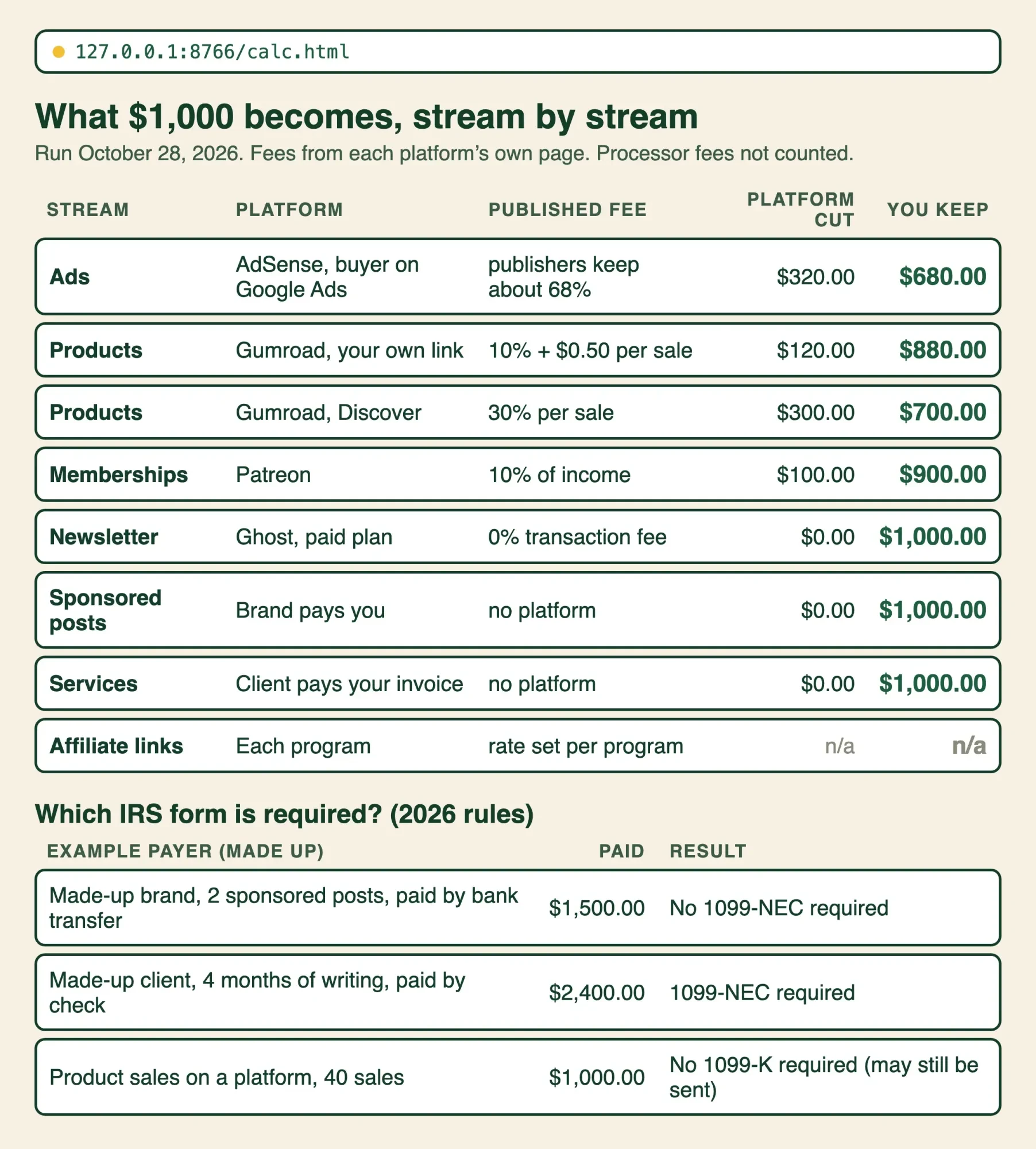 Screenshot: our calculator on 127.0.0.1, October 28, 2026.
The FTC's disclosure guides cover affiliate links and sponsored posts
Once money or free products change hands, disclosure guidance from the FTC applies. Its Endorsement Guides at 16 CFR 255.5 say a connection the audience wouldn't expect "must be disclosed clearly and conspicuously." The same section counts "monetary payment or the provision of free or discounted products" as a connection.
The Guides even use a blogger as Example 11: "A coffee lover creates a blog that reviews coffee makers." That blogger earns through affiliate links, so "the reviews should clearly and conspicuously disclose the compensation." In plain words, say it near the top, before the first link; our guide to using affiliate links covers labels beside each link.
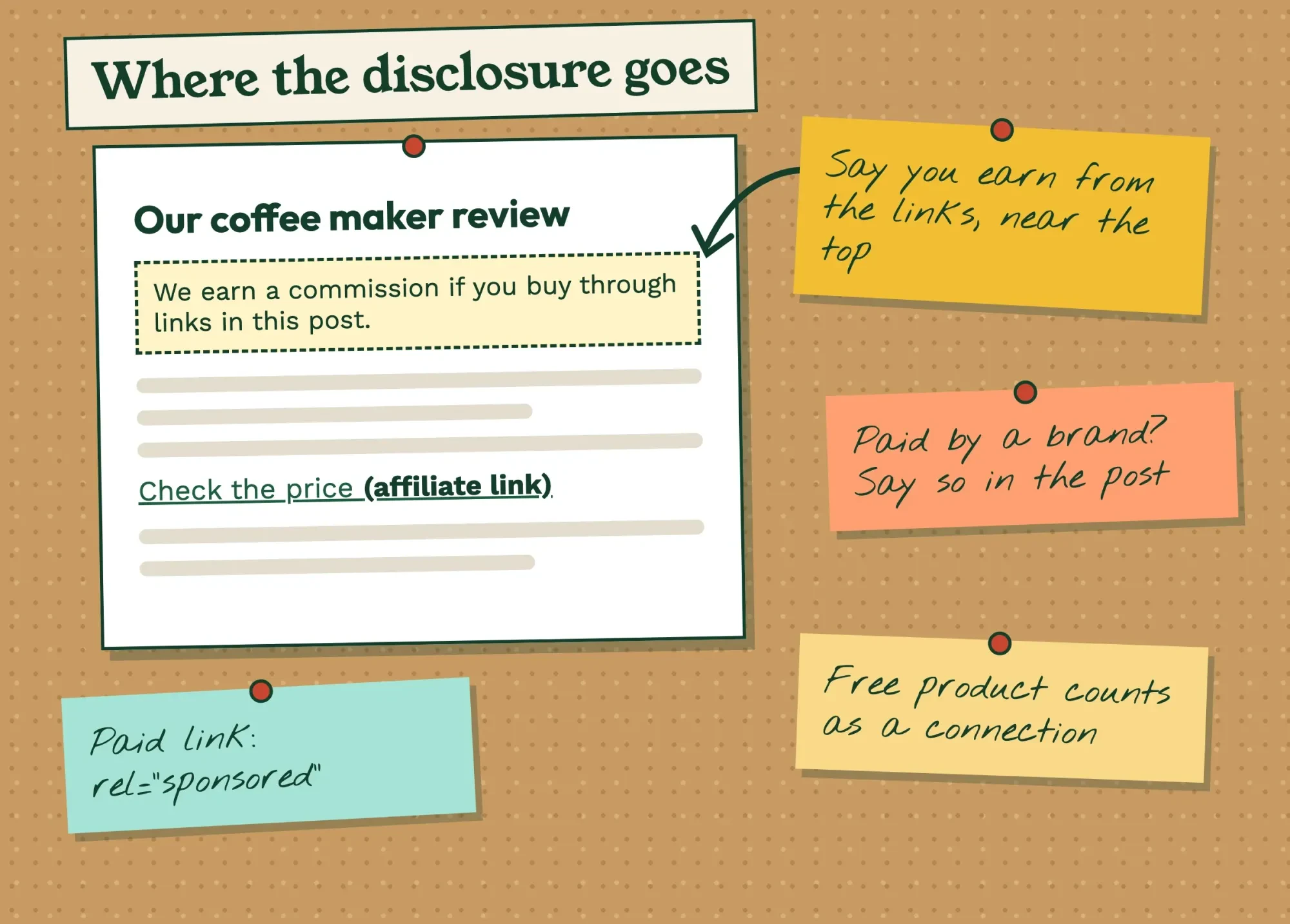 Drawn by us. Based on 16 CFR 255.5 and Google's rel="sponsored" guidance.
Sponsored posts fall under the same section, and the paid link also gets marked for Google. Full disclosure wording, with examples, is in our sponsored blog post rules. If a brand contract sets your wording, have an attorney read it before you sign.
What does the IRS expect from blog income?
If you blog for profit, the IRS treats the income like any other small-business income, whether it's an AdSense payout, a sponsor's transfer or a Gumroad sale. Below are the thresholds from its own pages. They aren't tax advice, so talk to a CPA before you file.
The form you get depends on how you were paid. The instructions for Forms 1099-MISC and 1099-NEC say the threshold for tax years after 2025 "increased to $2,000." So a business files a 1099-NEC when it pays you at least $2,000 for services in a year, but card and payment-app payments go on a 1099-K instead.
The 1099-K line sits higher. The IRS 1099-K page says a platform sends one when payments "total over $20,000 in more than 200 transactions." Smaller totals may get one. In our calculator, a made-up brand paying $1,500 by bank transfer needs no 1099-NEC. A made-up client paying $2,400 by check for writing work does.
Both still count as income.
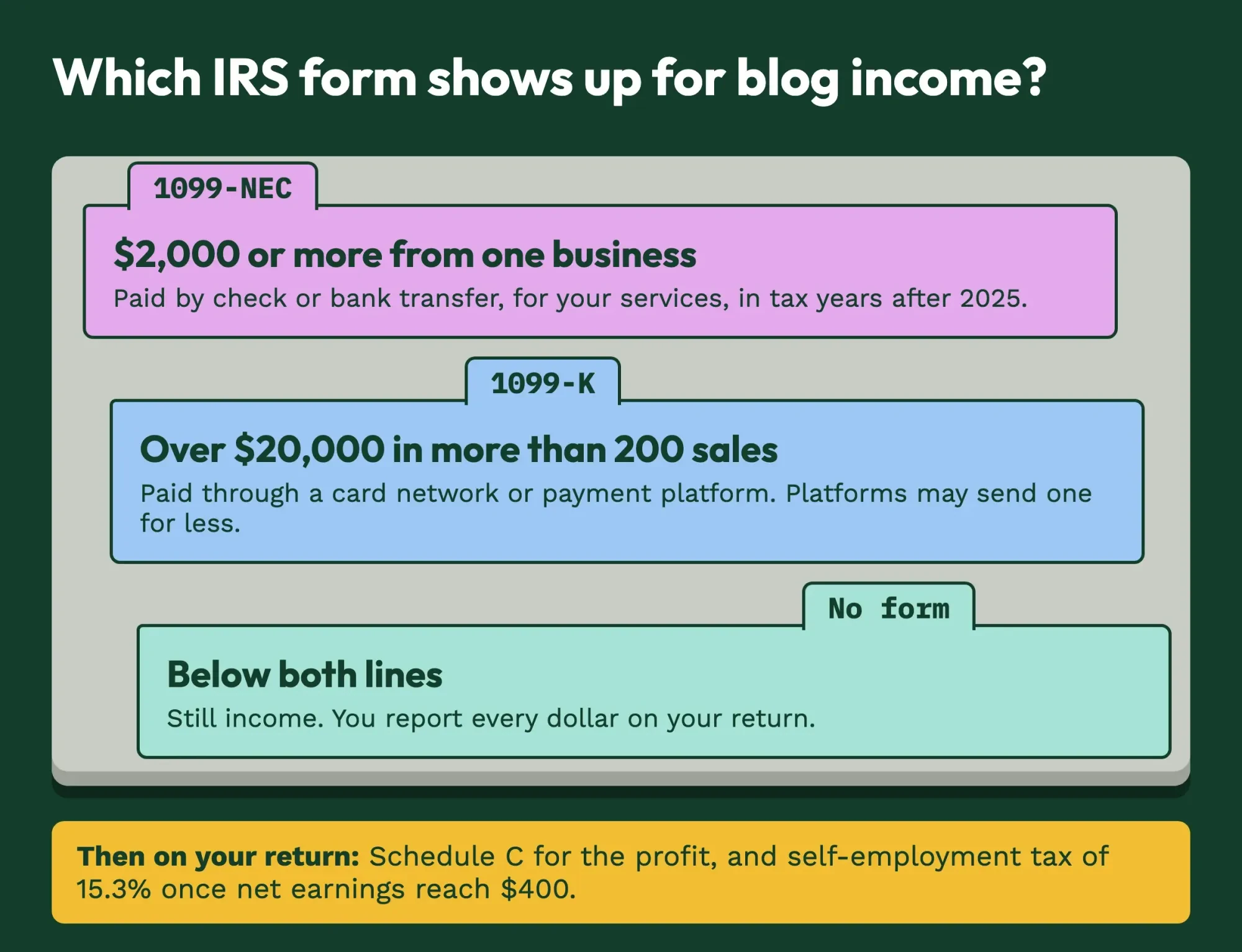 Diagram by DigitalTreed. Thresholds from IRS pages read October 28, 2026.
Then comes the return itself. Schedule C is for a business, and the IRS counts an activity as one when your "primary purpose" is "income or profit" and you do it "with continuity and regularity." If your blog doesn't meet that test yet, because you post now and then just for fun, ask a CPA how the income should be reported on your return.
For a business, the IRS self-employment tax page puts self-employment tax at 15.3%: 12.4% for Social Security and 2.9% for Medicare. It kicks in once your net self-employment earnings reach $400. That's why we'd log every payment from the first dollar, form or no form. Note the date, payer, amount and stream for each payment you get, because the same log later tells you which of your streams is actually worth the hours.
Which stream to start with, by audience size
So where to begin? Our take: go where your readers already are, not where the biggest income reports are.
Under the 1,000 Tier 1 sessions a month that Journey asks for, ads pay slowly, and affiliate links pay only when a reader actually goes on to buy. A reader-paid stream doesn't need that traffic. Look at the questions readers already email or comment about, and sell the answer as a one-hour service or a $25 guide that saves them the search. Ten buyers of a $25 guide bring in 10 x $25 = $250 before fees.
Traffic-paid streams can wait their turn.
Once traffic clears the ad-network bar, add ads and affiliate links to posts that already rank. Keep the product running too. Unsure it's worth it? Our look at whether blogging is worth it works through the time cost. If the blog doesn't exist yet, how to start a personal blog comes first.
Want posts written to earn their keep? DigitalTreed's content marketing service does that work. We sell that service, so we'd benefit if you hire us; everything above works without us.
Frequently asked questions
Frequently asked
Do I pay tax on blog income under $2,000?
You still report it. The IRS gig economy tax center says to report it "even if the income is" not on a 1099.
Do bloggers pay estimated taxes?
Often. The IRS estimated taxes page applies if you "expect to owe tax of $1,000 or more."
Can I click my own AdSense ads?
No. AdSense program policies say "Publishers may not click their own ads."
Does Gumroad collect sales tax for me?
Where it has tax obligations. Its pricing page says it collects taxes "in regions where we have tax obligations as a merchant of record," a role it took on January 1, 2025.
How we made this guide: We read each platform's fee page, 16 CFR 255.5 and the IRS pages, then ran our calculator locally. Facts checked by the DigitalTreed team on October 28, 2026.
First published July 2020. Rewritten October 28, 2026: now a map of 7 streams with fees, a local test, the FTC's guides and IRS forms.
Sources
- Google AdSense Help: AdSense revenue share
- Google AdSense Help: Payment thresholds
- Google AdSense Help: AdSense Program policies
- Mediavine: Mediavine and Journey by Mediavine requirements
- Google Search Central: Spam policies
- Google Search Central: Qualify your outbound links
- Gumroad: Pricing
- Patreon: Pricing
- Ghost: Pricing
- eCFR: 16 CFR 255.5, Disclosure of material connections
- IRS: Instructions for Forms 1099-MISC and 1099-NEC
- IRS: Understanding your Form 1099-K
- IRS: About Schedule C (Form 1040)
- IRS: Self-employment tax (Social Security and Medicare taxes)
- IRS: Estimated taxes
- IRS: Gig economy tax center


Comments
No comments yet. Start the conversation below.