
Quick answer
Digital marketing trends 2026 mostly come down to one habit: about half of US adults now use AI chatbots, and 42% of adults use them to look things up, per Pew Research Center. So act on the free basics those tools read first. Most of the flashy stuff can wait.
Most trend lists are written for big brands with a marketing team.
You've got a business to run.
So we sorted this year's ideas into three piles: things to act on this month, things to try over the year, and things you can ignore without feeling one bit behind.
Each idea names the free tool or setting to use. We also ran our own crawler checker against the sites that rank for this exact topic, and the result is further down.
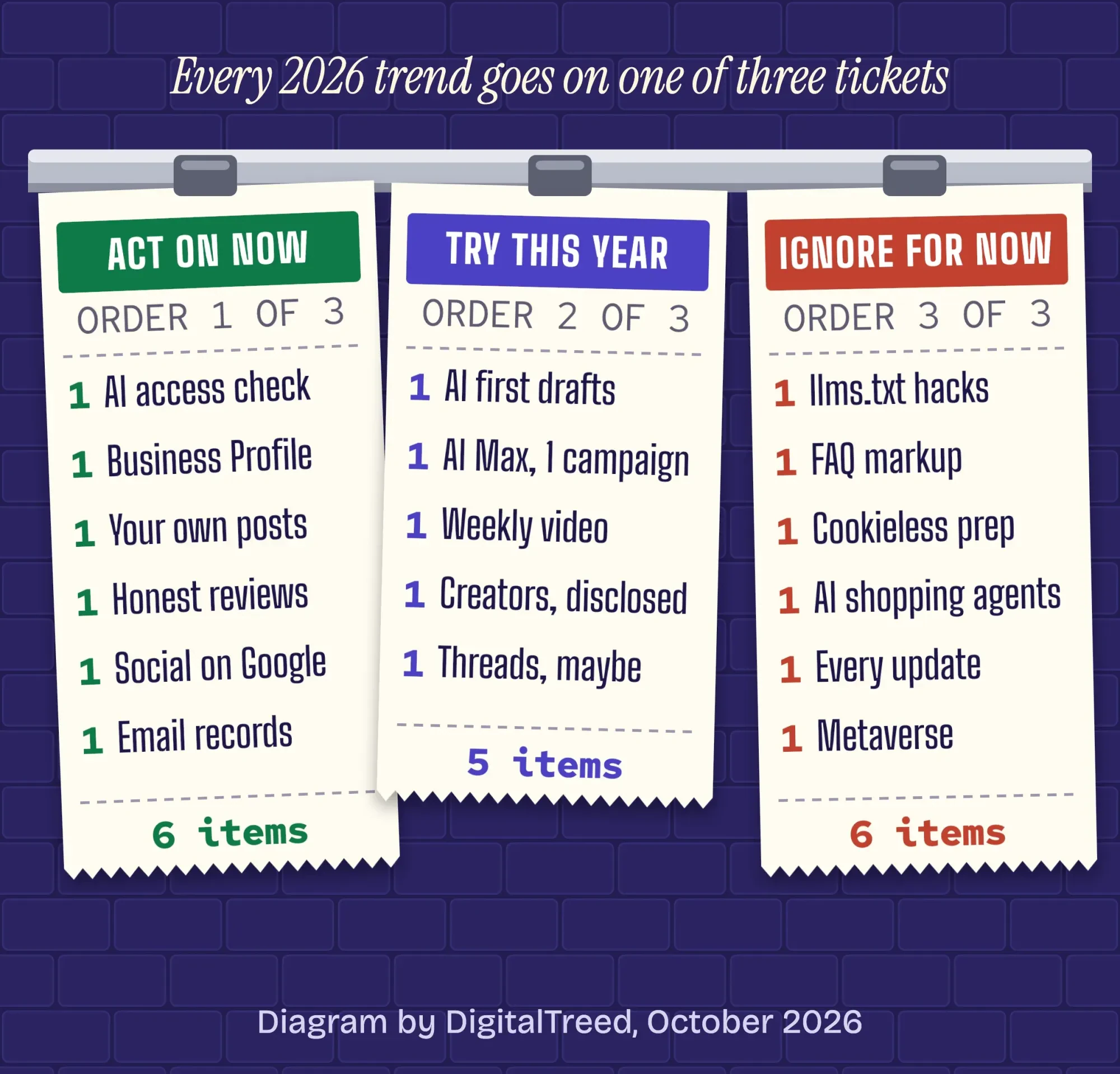 Diagram by DigitalTreed, based on the groups used in this guide, October 2026.
Key takeaways
- Pew found 49% of US adults use AI chatbots, and 42% search with them.
- Google lists no extra requirements for AI Overviews beyond normal indexing.
- Finish your Business Profile, since Google says it feeds AI answers.
- Skip llms.txt and FAQ markup, which Google says won't help in Search.
- Fake reviews and rewards for positive reviews break the FTC review rule.
Most of this year's trends trace back to one habit: asking AI
That habit is new, and it's big. In Pew’s February 2026 survey of 5,119 US adults, 49% said they use AI chatbots, and roughly one in four use them every day.
The most common use? Searching for information, at 42% of all US adults.
Google's own AI answers changed clicking, too. In a Pew study of 900 US adults’ browsing in March 2025, people clicked a regular result on 8% of visits when an AI summary showed up, and on 15% when it didn't.
Clicks on a link inside the summary itself? Just 1% of those visits.
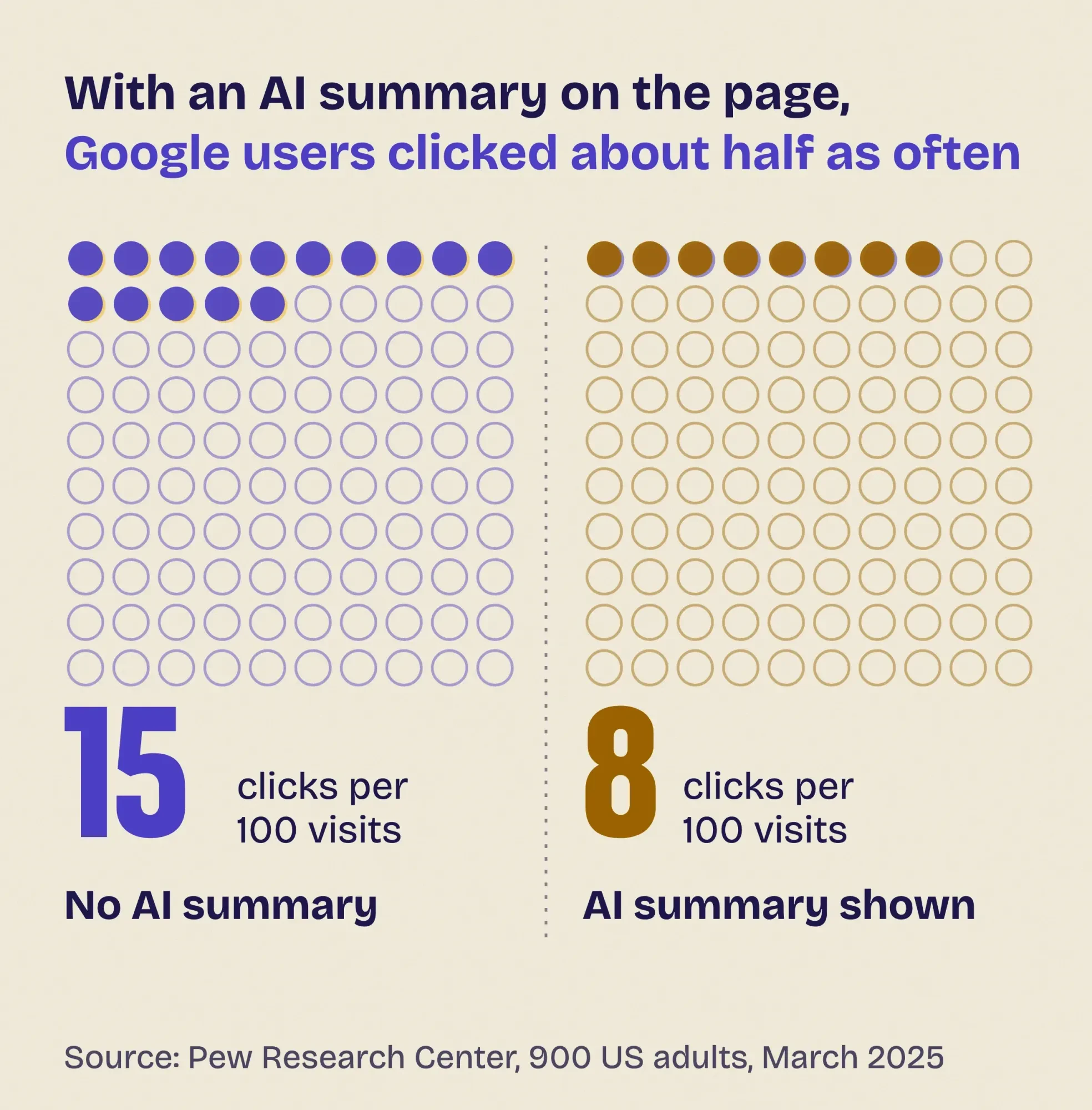 Source: Pew Research Center, browsing data of 900 US adults in March 2025, published July 2025.
Google tells the other side. Its AI features guide says clicks from results pages with AI Overviews "are higher quality," though it doesn't publish numbers for that.
Both can be true. Fewer clicks, and better ones.
Here's the part that matters for you.
Google lists "no additional requirements" for AI Overviews or AI Mode, beyond a page being indexed and eligible to show a snippet in regular results. Its May 2026 guide to generative AI search answers the big worry head-on: "Is SEO still relevant for generative AI search? In short, yes!"
Our take: the AI shift rewards the same things good local marketing always did, only faster. A complete profile, honest reviews, and pages that say something nobody else can.
Act on these this month (most are free)
That's the theory. These six turn it into an afternoon or two of work, and none of them needs an ad budget.
Check that AI search can actually read your site
Start with Search Console, Google's free dashboard for your site. Under Settings, the Search generative AI control should say "Include," which is the default.
Switch it to Exclude and Google says you won't get traffic from those features at all.
Then open the Generative AI performance report to see which pages showed up in AI answers. Small sites may see no data yet, which Google says usually means too few impressions.
Last, run your domain through our free AI Crawler Checker. It reads your robots.txt and flags a blocked bot like OAI-SearchBot, the one OpenAI uses to show sites in ChatGPT search.
Say you run a pet-sitting business in Denver and blocked "all bots" years ago to stop spam. This is where you'd catch it.
Twenty minutes, tops.
Fill in every field of your Business Profile
None of the top trend pages we read mentions this one.
Yet Google's AI optimization guide says Business Profiles can help your services show up "in both AI responses and other Google Search results."
Add real photos, list every service, and fix your hours before each holiday. Our Google Business Profile optimization guide walks through each section.
Picture a Charlotte locksmith that lists "car key programming" as its own service, apart from "house lockouts." That gives Google two clear answers instead of one vague one.
Write the post only you could write
Google now says this out loud. Its guide calls "7 Tips for First-Time Homebuyers" commodity content, which "typically adds little unique insight for readers."
A roofer's post on what one hailstorm did to three roofs on the same street isn't commodity, and neither is a bakery's honest cost breakdown of a three-tier wedding cake.
One of those a month beats ten generic tips posts.
Ask every customer for a review, and pay for none
Reviews feed your profile, and your profile feeds the map and those AI answers.
Ask everyone, every time, with one short link.
Think of a pool cleaner in Phoenix who texts that link from the truck before pulling out of the driveway. That's the whole system.
Keep it honest, though. The rules got sharper, and we cover them in the FTC section below.
See which Google searches find your social posts
This one's brand new.
Search Console's platform properties let you add your Instagram, TikTok, X or YouTube account and see how people find those posts on Google.
Google says it's rolling out gradually, so you may not have it yet.
Once you have it, a Nashville hair salon might find its before-and-after Reels showing up for Google searches, not just inside Instagram.
Fix your email setup if you send a newsletter
Gmail counts you as a bulk sender if you send 5,000 or more messages a day to personal Gmail accounts. Bulk senders need SPF, DKIM and DMARC records, plus one-click unsubscribe.
Most small lists never get near that. The records still help you land in the inbox, and our business email setup guide shows them.
Even a Portland yoga studio with 800 subscribers, nowhere near the limit, should set up the records.
Try these this year, one at a time
Those six were the sure things.
The next ones can pay off or flop, depending on your customers. So test them one at a time, and tag every link you share with our UTM builder so you'll know which one worked.
Use AI as a drafting helper, not a ghostwriter
AI in marketing is the loudest trend of the year, but most US businesses haven't adopted it. The Census Bureau’s business survey found overall AI use "hovered between 17% and 20%" from December 2025 to May 2026.
For the smallest firms, it's even lower: under 20% of businesses with four or fewer employees.
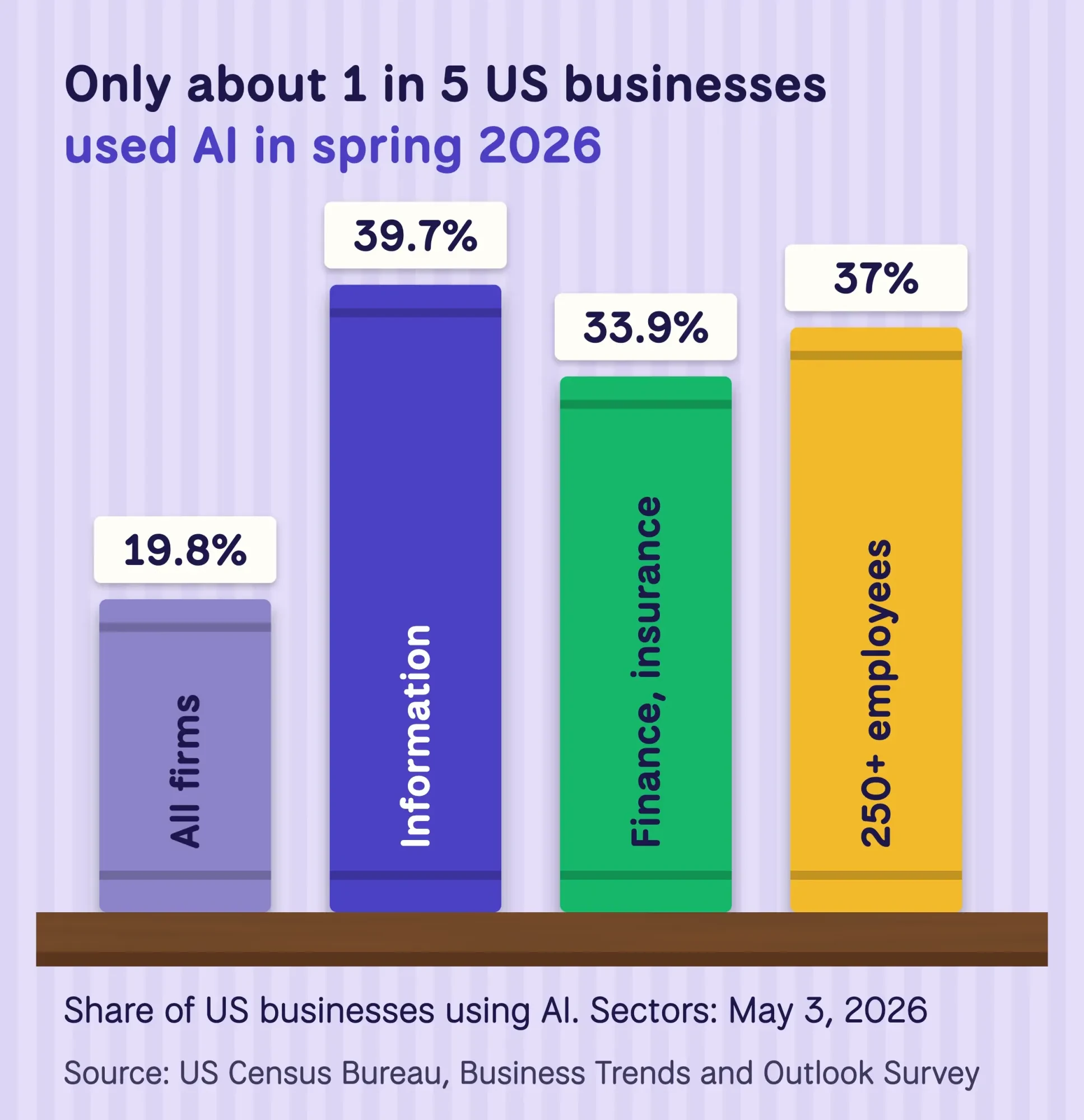 Source: US Census Bureau, Business Trends and Outlook Survey, published May 2026.
A vendor survey paints a busier picture. In LocaliQ’s 2026 report of 300-plus small business owners, nearly 60% said they use AI for some part of their marketing.
That's a different question asked of a different group of owners, and LocaliQ sells marketing services, so we'd read it as the top of the range rather than the middle.
Use it for first drafts, ad variations and replies to common questions. A website chat assistant counts, too, and our guide to AI chatbots for small business websites compares them.
Then check every fact yourself.
A Minneapolis bookkeeper might let AI draft a January deadline email in two minutes, then fix the dates and the tone herself.
One hard line: never let AI write a review or a customer quote.
Turn on AI Max for one Google Ads campaign
AI Max for Search lets Google match more search terms, rewrite parts of your ads and send people to the page it thinks fits best.
On the same page, Google says advertisers who turn it on "will typically see 14% more conversions or conversion value at a similar CPA/ROAS."
That's Google's claim about Google's product, based on its own 2025 data for non-retail advertisers.
Test it on one campaign for a month, keep the daily budget where it is, and compare cost per lead.
For a garage door company in San Diego, that might mean trying it on the repair campaign only and leaving new-door sales alone.
Rather have someone watch the numbers for you? Our Google Ads management team runs tests like this. (Full disclosure: that's a paid service of ours.)
Short video on a single channel
84% of US adults say they use YouTube and 70% use Facebook, per Pew’s 2026 social media fact sheet. In LocaliQ's vendor survey, 53% of small businesses planned to spend more on video.
Pick one channel and post one useful clip a week for three months.
A plumber filming a 40-second "how to shut off your water" is plenty. Our YouTube channel setup guide gets you started, and our social media strategy guide helps you choose the platform.
Creators and customer posts, with the disclosure built in
Paying a local creator or gifting a product can work well.
A Raleigh coffee shop that gives a local food creator a month of free lattes needs that creator to say so in the post.
Just put the disclosure rules in writing first, which we cover below.
Threads, but only if your customers post there
Meta says Threads "crossed 500 million monthly actives" in its second-quarter 2026 remarks. That's a global number, so look at your own customers before you add another app.
Got a vintage clothing shop in Brooklyn whose buyers already chat in Instagram comments? Cross-post to Threads for a month and count the replies.
Which digital marketing trends can small businesses ignore?
Now the fun part.
These show up on plenty of 2026 lists, and for a five-person shop they mostly burn time.
llms.txt files and other "GEO hacks" for Google
Google's own generative AI guide says many AEO and GEO hacks "aren't effective or supported by how Google Search actually works." It names llms.txt, chunking your content and rewriting pages just for AI.
In a June 15, 2026 changelog note, Google added that these files aren't needed for Google Search and won't help or hurt your rankings.
Other AI tools are a separate story, and our generative engine optimization guide covers them honestly.
FAQ markup for rich results
The same changelog says Google stopped showing FAQ rich results in May 2026.
Keep FAQs on the page if your readers like them. Skip the markup.
Getting ready for a cookieless Chrome
It didn't happen.
In an October 2025 update, Google confirmed Chrome is keeping its current approach of giving users a third-party cookie choice. It also retired several Privacy Sandbox tools "in light of their low levels of adoption."
Tagged links and your own email list matter more than any cookie plan.
AI shopping agents
The same AI guide suggests looking at agentic experiences only "if this is something that's relevant to your business and you have extra time." If you sell online, our ecommerce trends list covers where they stand.
Chasing every Google update
The Search Status Dashboard lists two core updates and four spam updates in 2026, as of October 24.
Our history of Google algorithm updates explains why reacting to each one rarely pays.
Metaverse stores and VR ads
Next.
We tested the top trend sites: none blocks AI training bots
Those ideas are our opinion. So we also checked what the people writing about AI search actually do on their own sites.
On the afternoon of October 24, 2026, India time, we ran the code behind our AI Crawler Checker on our own laptop rather than through the public tool page, which has a human check.
We pointed it at the eight sites near the top of a US-region search for "digital marketing trends 2026" whose pages we could read. It read each site's public robots.txt, plus its home page and llms.txt, with a pause of a few seconds between sites. Then it checked 120 crawler names, 43 of them AI bots.
Every one of the eight lets all 43 AI bots read its home page.
None blocks the training bots either, like OpenAI's GPTBot, Common Crawl's CCBot or Google-Extended.
The only blocks we found were aimed at SEO crawlers, an archive bot and one data crawler, Omgilibot, which Search Engine Journal shuts out.
| Site (October 24, 2026) | AI bots allowed | What stood out |
|---|---|---|
| Digital Marketing Institute | 43 of 43 | No robots.txt at all (404), so every bot is allowed |
| Google (business.google.com) | 43 of 43 | Allows only listed paths, but the US trend pages are open |
| Neil Patel | 43 of 43 | Blocks one SEO crawler; has an llms.txt file |
| Smart Insights | 43 of 43 | Our checker found no structured data on its home page |
| American Marketing Association | 43 of 43 | Nothing blocked |
| WebFX | 43 of 43 | Blocks one old archive crawler; has an llms.txt file |
| Search Engine Journal | 43 of 43 | Blocks two SEO crawlers and one data crawler; has an llms.txt file |
| LocaliQ | 43 of 43 | Names Claude and OpenAI bots to allow; has an llms.txt file |
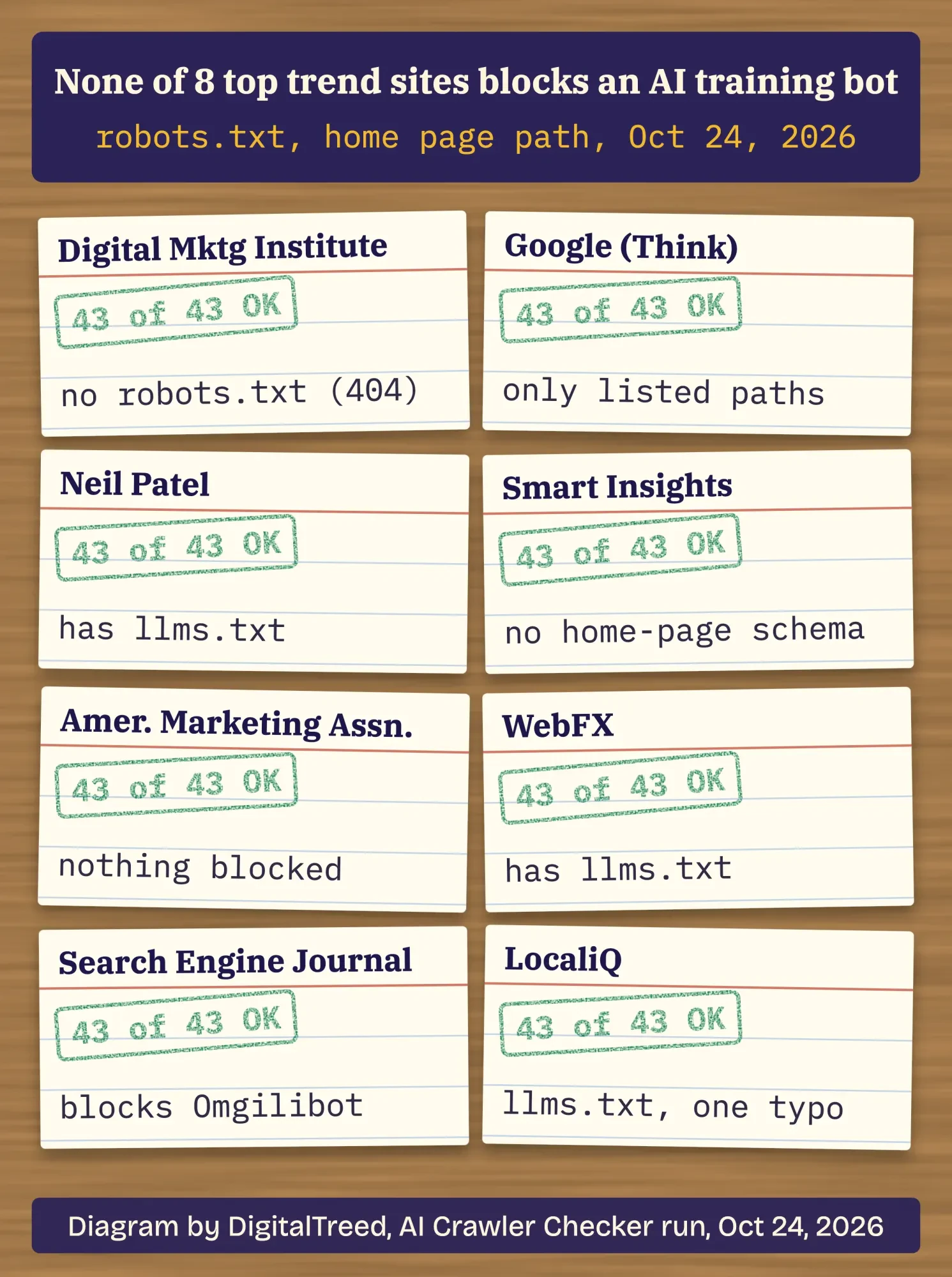 Diagram by DigitalTreed from our AI Crawler Checker run on 8 public robots.txt files, October 24, 2026.
One small surprise.
LocaliQ's file lists AI bots it wants to welcome, but its first rule reads "ser-agent: Claude-SearchBot," missing its U. Our checker couldn't match that line to any bot, so Claude-SearchBot fell back to the catch-all rule, which lets everyone in.
No harm done, but it's an easy typo to make in your own file.
We cross-checked five sites by opening their robots.txt directly (DMI's still returned a 404), and they matched. Search Engine Journal's server refused our plain request, though the tool's own fetch worked. Our checker tests the home page path, so for Google's site we also tested the trend article's own path, and it's open too.
So what's the lesson for you?
Blocking AI training is a fair choice. OpenAI says GPTBot and OAI-SearchBot are set separately, and Google says Google-Extended doesn't affect Google Search. But a stray rule that blocks a search bot keeps you out of the answers your customers read.
Three FTC rules sit under the review, creator and AI trends
Three of the ideas above touch federal law, and none of the trend pages we read mentions it.
Reviews come first. The FTC's rule on consumer reviews and testimonials (16 CFR 465) bans fake reviews, including ones that misrepresent whether the reviewer exists. It also bans rewards tied to a review "expressing a particular sentiment," and it requires disclosure on reviews from staff or family.
In December 2025, FTC staff sent warning letters to 10 companies about the rule. The FTC says violations can bring civil penalties of up to $53,088 each, still the cap in the FTC's penalty table (16 CFR 1.98) as of October 2026.
Asking every customer for honest feedback is fine, and our free Google review link generator turns the ask into one tap.
Google also tightened its review snippet rules in July 2026 against fake and undisclosed incentivized reviews.
Creators come second. Under the Endorsement Guides (16 CFR 255), tags in social media posts can count as endorsements. If you pay or gift someone, they disclose it, and you're expected to guide and monitor them.
AI is third. When the FTC announced Operation AI Comply in 2024, then-Chair Lina Khan said "there is no AI exemption from the laws on the books."
An AI-written testimonial is still a fake testimonial.
Read this section as a summary of the rules, not legal advice. It reflects the rules in force when we checked them (October 24, 2026), and a lawyer who knows your state and industry should look at anything you're unsure about.
Example: Kettle Creek Auto Detail's first month
Here's how one made-up business could use this list.
Kettle Creek Auto Detail is a fictional two-person mobile detailing crew in Lexington, Kentucky, with a small website and an Instagram account.
- Week 1: confirm the Search generative AI control says Include, and run the AI crawler check.
- Week 2: finish the Business Profile with service areas, prices and before-and-after photos.
- Week 3: text every customer a review link after each job, with no discount tied to stars.
- Week 4: post "what a clay bar does to paint," with their own photos, and tag the link they share on Instagram.
What they skip: llms.txt, FAQ markup and the metaverse. Nobody in Lexington will notice.
Frequently asked
Which social media platforms do most US adults use in 2026?
YouTube and Facebook lead, and Instagram comes third at 51% of US adults. That's from Pew's 2026 social media fact sheet. Smaller shares use TikTok, Reddit, Snapchat and X, so pick the one your own customers already use.
Can I opt out of ads in AI Overviews?
No. As of October 2026, Google's ads and AI Overviews help page says you can't opt out or target that spot directly. Text and Shopping ads from existing Search, Shopping and Performance Max campaigns can show there in the US. Google Ads also has no separate report for those placements yet.
How much do small businesses spend on marketing?
Most spend little. In LocaliQ's 2026 small business marketing report, 52% of owners had monthly budgets under $1,000. Half had no employees dedicated to marketing, and 83% named referrals as their best source of customers. LocaliQ sells marketing services, so treat it as one vendor's survey.
Keep up with two free pages, not 30 trend lists
That plan will stay current longer than any list, this one included. When something changes, Google's Search Central changelog and its Search Status Dashboard usually say so first.
Bookmark both, and check them once a month.
Want someone else to handle the search side? Our SEO team can take the first-month list off your plate. (It's a paid service, and we'll tell you if you don't need it.)
How we made this guide: the DigitalTreed team checked each number, quote and rule against its source, with every check done October 24, 2026. That meant Google's help pages, Pew, the Census Bureau, the eCFR and the FTC, each linked where it's used, with vendor figures labelled as vendor figures. The robots.txt test was our own, run with our crawler checker's code.
First published July 2020. Rewritten in full, October 24, 2026: a new act, try and ignore list with Pew and Census data, Google's 2026 AI search guidance, the FTC rules and our own robots.txt test.
Sources
- Pew Research Center: Americans and AI 2026 (June 17, 2026)
- Pew Research Center: Google users are less likely to click on links when an AI summary appears (July 22, 2025)
- Pew Research Center: Social media fact sheet (2026)
- US Census Bureau: AI use by businesses, Business Trends and Outlook Survey (May 26, 2026)
- Google Search Central: AI features and your website
- Google Search Central: Guide to optimizing for generative AI features on Google Search (May 2026)
- Search Console Help: Search generative AI control
- Search Console Help: Generative AI performance report
- Search Console Help: Platform properties
- Google Search Central: What's new (changelog)
- Google Search Central: Review snippet structured data
- Google Search Status Dashboard: ranking updates
- Privacy Sandbox: Update on plans for Privacy Sandbox technologies (October 17, 2025)
- Google Ads Help: AI Max for Search campaigns
- Google Workspace Admin Help: Email sender guidelines
- Google Search Central: Google's common crawlers (Google-Extended)
- eCFR: 16 CFR part 465, Use of Consumer Reviews and Testimonials
- eCFR: 16 CFR part 255, Guides Concerning the Use of Endorsements and Testimonials in Advertising
- FTC: FTC warns 10 companies about possible violations of the Consumer Review Rule (December 22, 2025)
- FTC: FTC announces crackdown on deceptive AI claims and schemes (September 25, 2024)
- OpenAI: Overview of OpenAI crawlers
- Meta: Second quarter 2026 prepared remarks (July 29, 2026)
- LocaliQ: Small business marketing trends report 2026 (vendor survey)
Comments
No comments yet. Start the conversation below.