
Quick answer
Ecommerce trends 2026, the short version: the ones worth a small US store's money are the unglamorous ones. Show the full price early, shorten checkout, give Google and AI shopping tools clean product data, and collect honest reviews. US online sales grew 12.2% in a year, per the Census Bureau. AR try-on and voice shopping can wait.
Most trend lists come from companies that sell the trend. A review-widget maker says reviews matter most, and a shipping company says it's all about delivery.
Fair enough. But you've got a small store and maybe four spare hours a week.
So we sorted this year's ideas with one question: does it fix a real reason US shoppers leave, or does Google, your platform or the law already ask for it? A yes puts it in the first group. A "maybe, for some products" puts it in the second. If it mostly makes a good conference talk, it lands in the third.
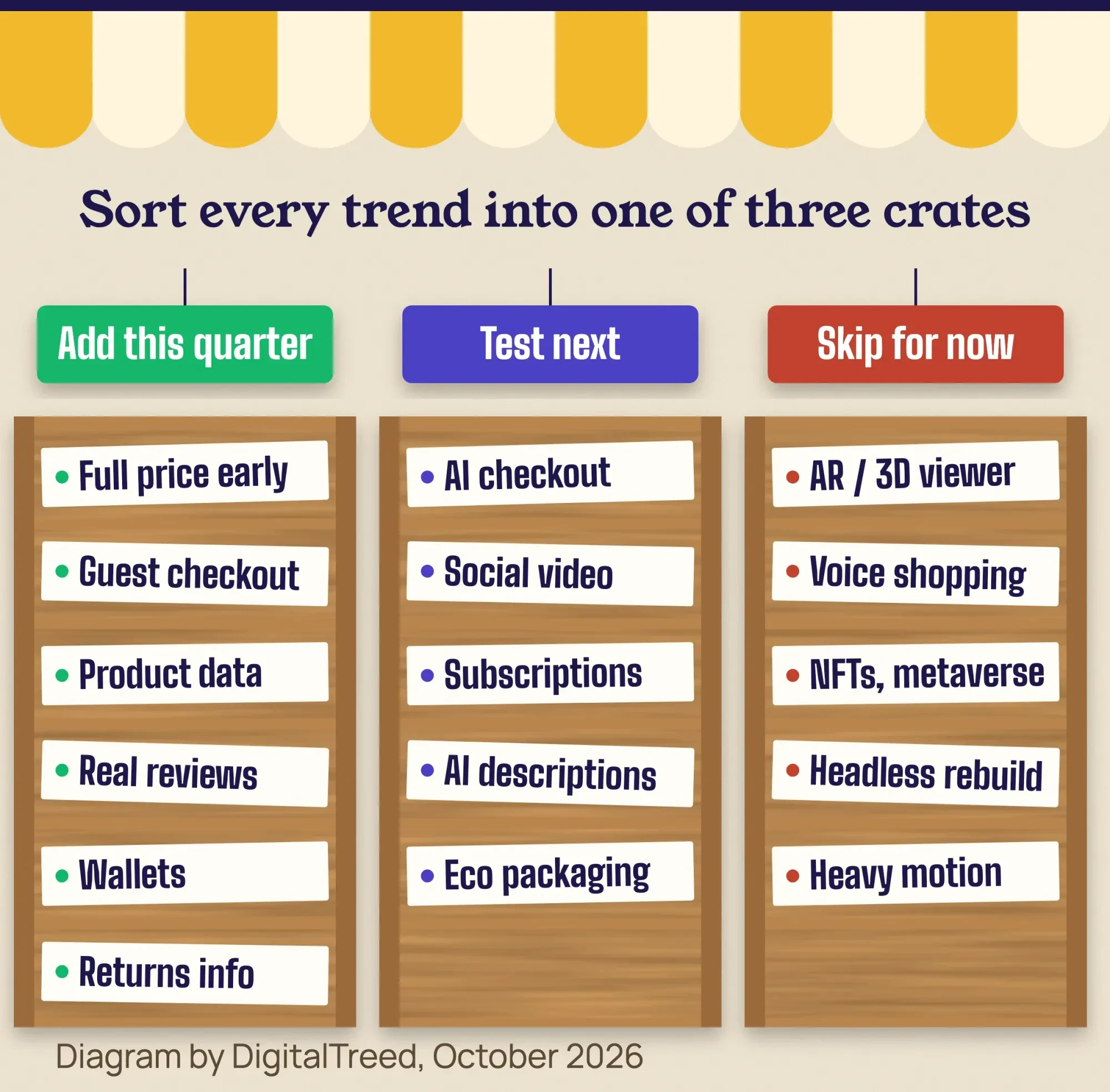 Diagram by DigitalTreed, based on the sorting used in this guide, October 2026.
We also built a fake product page for a made-up hot sauce shop and tried two of these trends on it. One result surprised us.
Key takeaways
- US online sales grew 12.2% in a year, against 6.7% for all retail.
- Show your shipping rate or free-shipping threshold on the product page.
- Make account sign-up optional, and cut every field you don't need.
- A clean Merchant Center feed and product markup come before any agentic commerce.
- Never reward reviews for a particular sentiment, positive or negative.
Online sales still grow faster than retail as a whole
That shop would be selling into a market that's still growing. US retail e-commerce sales were $340.2 billion in the second quarter of 2026, seasonally adjusted, according to the Census Bureau’s quarterly e-commerce report.
That's 12.2% more than a year earlier, while total retail grew 6.7%.
Online is now 17.1% of all US retail sales, per the same report.
A note on dates: these are the current published figures, from the August 18, 2026 release. Since September 28, 2026, the Census Bureau has flagged them as no longer its most up-to-date estimates.
The Census Bureau says revised estimates come with the third-quarter report on November 19, 2026, so it's worth checking the page if you're reading after that.
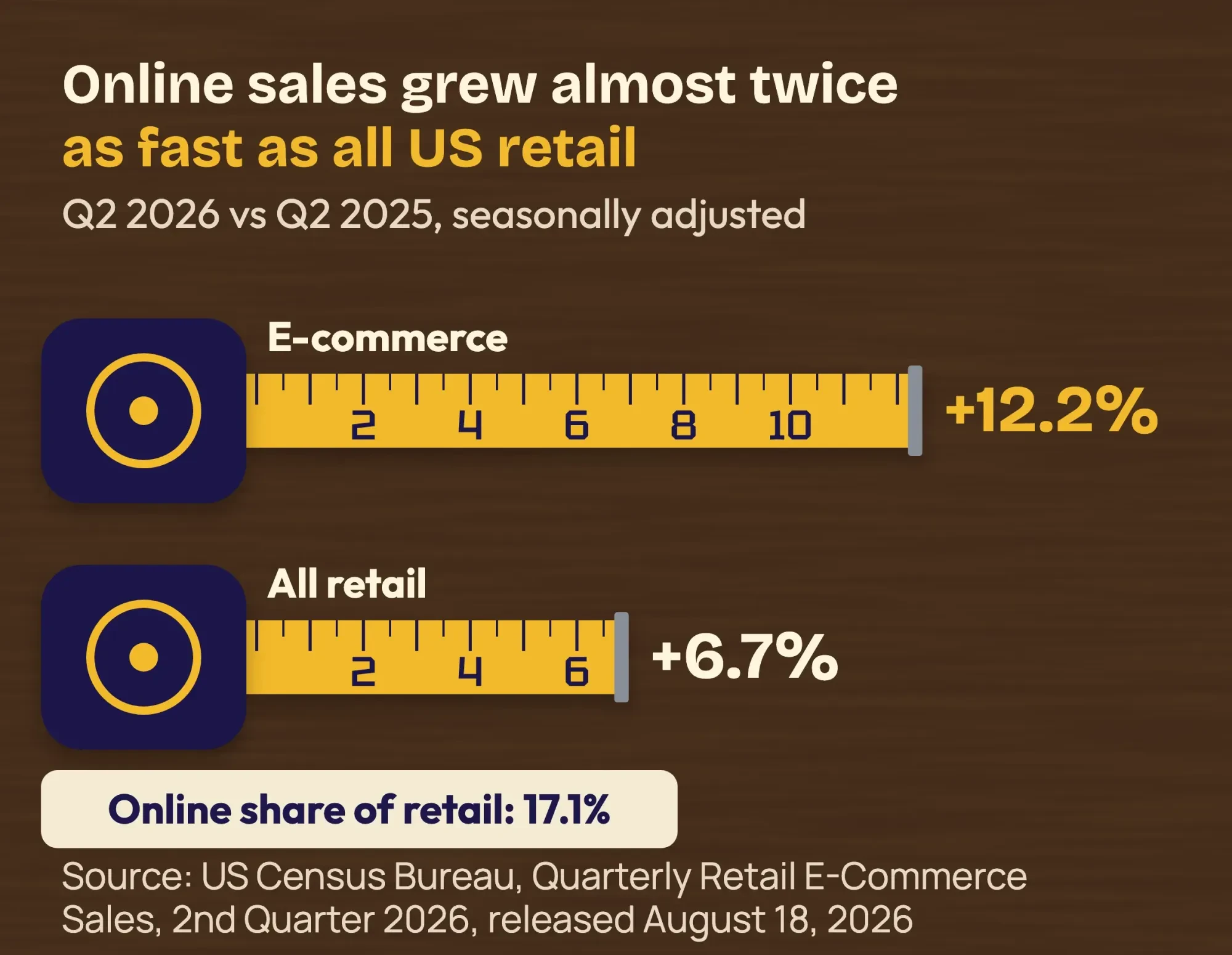 Source: US Census Bureau, Quarterly Retail E-Commerce Sales, 2nd Quarter 2026, released August 2026.
With growth like that, every platform has a new feature to sell you. You don't need all of them.
Add these this quarter
That's where the sorting comes in. These six cost little or nothing, and each one answers a reason people leave a cart in Baymard Institute’s 2026 survey of 1,083 US online shoppers. Baymard's reasons leave out the 42% who were "just browsing."
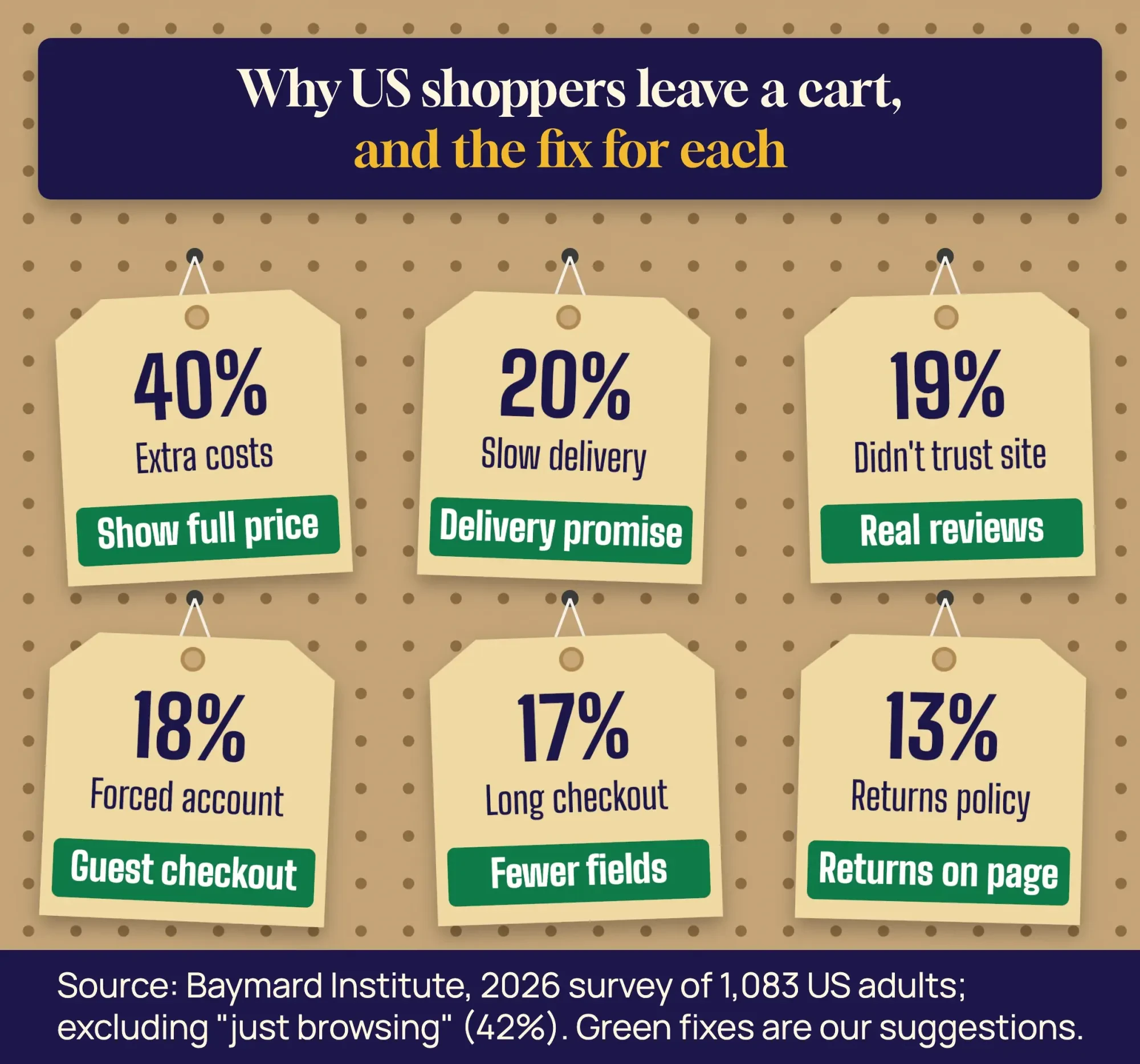 Source: Baymard Institute, 2026 survey of 1,083 US adults who shop online (reasons excluding "just browsing").
Show the full price before checkout
Surprise costs top Baymard's list: 40% of shoppers who quit a cart did so because shipping, tax or fees were too high, and 12% couldn't see the total up front.
So put your shipping rate or free-shipping threshold on the product page, not only on the last step.
California makes it a legal point, too. Its Honest Pricing Law, SB 478, in force since July 1, 2024, makes it illegal for most businesses to list a price that leaves out required fees. Certain government taxes and shipping costs are the exceptions.
A checkout-only "handling fee" for a California buyer is asking for trouble.
The federal FTC fee rule is narrower than its nickname. It covers live-event tickets and short-term lodging, not a typical product store.
Example: Marsh Light Hot Sauce, a made-up two-person shop in Savannah, Georgia, prints "$6.95 flat shipping in the US" under every price as of October 2026. It's one line in the product template.
Let people check out as guests
Forcing an account cost 18% of shoppers in Baymard's survey, and another 17% quit because checkout felt too long or complicated.
Baymard says a good checkout can get by with 12 to 14 form elements. The average US checkout it benchmarked shows 23.48.
Make sign-up optional, and cut every field you don't need to ship the order.
On WooCommerce, the Cart and Checkout blocks are the default for stores started after version 8.3 in November 2023, per the WooCommerce docs, and older stores can switch.
Company name, a second phone number, "how did you hear about us"? Gone.
Give Google and AI tools clean product data
Only have time for one idea on this list? Make it this one.
Google's free listings let your products appear "at no cost on Google Search, Google Maps, Gemini, YouTube, the Shopping tab, Google Images, and Google Lens." You upload the catalog through Merchant Center.
Then add product markup to every product page. Google calls the version for pages where people can buy merchant listings, and it lists shipping and return details as recommended properties. Our free schema markup generator writes the Product code for you.
Running a loyalty program? Google can show it in US results through loyalty program markup.
Shopify stores get one more switch. Its agentic storefronts feature puts products in AI channels such as ChatGPT, Google AI Mode and Gemini, Microsoft Copilot and Meta.
Shopify says it "is active by default for eligible stores," so check your sales channel settings to see if yours qualifies.
Still picking a platform? Our WordPress vs Shopify comparison covers that choice.
Ask every buyer for a review, and fake none
Reviews still sell, and the FTC now has a rule just for them. Its Rule on the Use of Consumer Reviews and Testimonials has been in force since October 21, 2024, and it bans fake reviews, including ones that misrepresent whether the reviewer exists.
It also bans rewarding people for reviews that express a particular sentiment, positive or negative.
A discount for "a 5-star review" is out. Asking every buyer for honest feedback is fine.
Reviews written by your officers or managers need a clear disclosure, and threatening a customer to get a review taken down counts as suppression. We explain how to ask at scale without crossing those lines in our post on honest, automated review requests.
Turn on the wallets people already use
Payment trouble is a smaller reason, but it's cheap to fix.
In Baymard's survey, 10% left after a declined card and 9% wanted more payment methods.
Wallets like Apple Pay and Google Pay usually come through the processor you've already got, so look at its settings before you shop for a new one. What each extra payment method costs per order is in our payment gateway integration guide. For scale, Stripe charges 2.9% + 30¢ per successful domestic card payment as of October 2026.
Promise delivery and returns on the product page
Slow delivery cost 20% of shoppers, and a weak returns policy cost 13%.
Say how long shipping takes and how returns work, right next to the Add to cart button.
Then describe the policy with Google's return policy markup, which can sit once at the business level and cover most products.
The FTC's shipping-time rule is in our ecommerce website build guide, so we won't repeat it here.
What is agentic commerce, and does a small store need it?
Clean product data also happens to be the entry ticket for the loudest trend of the year.
Agentic commerce is when an AI assistant, such as ChatGPT or Google's AI Mode, finds products and completes some or all of the purchase for the shopper.
It's real, and it's early.
Google's Universal Commerce Protocol lets stores sell through AI Mode in Search and Gemini while staying the merchant of record, but it starts with a waitlist. Stripe’s agentic commerce docs say availability and launch stage "vary by integration." And Shopify, as above, switches its version on by default for eligible stores.
For most small stores, that means the same work as the first group: a clean Merchant Center feed and correct product markup.
Our take: don't pay anyone to "get you into ChatGPT" this year. For the non-shopping side of this year's changes, see our digital marketing trends for 2026. Fix the feed, mark up your product pages and watch where orders come from. Shopify shows AI-channel orders with "channel or referrer attribution," and you can tag the rest with the GA4 setup in our analytics guide.
Test these over the next 6 to 12 months
Those were the sure things. These next ones can pay off, depending on what you sell.
Try one at a time, so you'll know which one worked.
Social and live shopping, on one channel
Five of the six top trend pages we read list social commerce.
But we couldn't find a primary US figure for how much small stores actually sell this way.
So test it small. Pick the one app your buyers already use, connect your catalog through your platform's sales channel for it, and post one shoppable video a week for a month. Our social media strategy guide helps you pick the app.
Marsh Light could cook with its sauce on camera for 10 minutes every Friday. Cheap, and easy to count.
Subscriptions for things people reorder
Hot sauce runs out.
So do coffee, soap and dog treats, which makes a refill plan a natural test.
Read the rules first, though. The Restore Online Shoppers’ Confidence Act requires clear terms before you take billing details, the buyer's express informed consent, and "simple mechanisms" to stop recurring charges.
And the FTC's 2024 click-to-cancel rule? It's gone for now.
The Eighth Circuit vacated it on July 8, 2025. The FTC then restored the older negative option rule, effective February 12, 2026, and in March 2026 it asked for public comment on whether the rule needs new amendments.
Either way, make canceling as easy as signing up, whatever the rule of the month.
AI help with product descriptions
AI drafts are fine as a first pass on a whole catalog.
Just check every fact, though: sizes, ingredients, materials, care instructions.
One hard line: never let a tool invent a review or a customer quote. Under § 465.2, that's a fake review no matter who typed it.
Greener packaging, said plainly
Packaging is the one part of your store people hold in their hands.
But "eco-friendly" on a mailer is a general environmental claim, and the FTC's Green Guides say marketers "should not make unqualified" claims like that. Name the specific change instead, such as a mailer made from recycled paper, and only if it's true.
Skip these for now
Now the fun part.
These show up on nearly every trend list. For a store with a few people, they're mostly cost.
AR try-on and 3D viewers on every product
We've tested this one, and the full numbers are in our test below. Short version: a 3D viewer made our test page over 1,000 times heavier.
If you sell sofas or eyeglasses, it might earn that. For hot sauce, a sharp photo does the job. Our free photo editor test shrank a 2.6 MB product photo to a 39 KB WebP.
Adding one anyway? Load it only when someone taps "View in 3D." That version added about half a kilobyte until the tap. Run your own page through our website speed test before and after.
Voice shopping
We couldn't find a current primary US source showing small stores selling by voice. Old smart-speaker forecasts don't count.
Skip it.
Blockchain, NFTs and the metaverse
There's nothing here a small store needs in 2026. Next.
A headless rebuild
Headless means splitting your storefront from the store's back end, usually with custom code and a bigger budget. Consultant Neal Schaffer puts it bluntly: for a brand under $20 million, it's "almost always a solution looking for a problem."
We'd agree.
Animation-heavy design
Scroll effects and page transitions look great in a design file.
On a cheap phone, they can make every tap feel sticky.
Google's Core Web Vitals aim for an INP of 200 milliseconds or less, an LCP within 2.5 seconds and a CLS of 0.1 or less.
New design features also have to work for people with disabilities. The Justice Department’s ADA web guidance covers businesses open to the public, and our build guide has the checks.
Our test: one made-up hot sauce shop, two trends
Those calls are opinions until you measure them, so we measured two.
For our October 23, 2026 test, we built one product page for Marsh Light Hot Sauce, our fictional store, and served it locally from a Mac mini. No real store, customer or account was involved.
First, product markup. We wrote Product code with a $12.00 price, stock status, a $6.95 shipping rate and a 30-day free returns policy, then ran it through our schema markup validator on a local copy of our site. It passed. We deleted the shipping and returns parts and ran it again, and it still passed.
That's the lesson.
A validator checks the required fields, and Google lists shipping and returns as recommended, not required.
"Valid" is the floor, so add those details anyway. They answer two of the top reasons people leave.
Second, a 3D viewer, which is the AR trend in practice. We ran Lighthouse 13.5.0 five times on each of three versions of the page, with mobile settings, on an Apple Mac in India. Version one was plain. Version two loaded Google's open-source model-viewer with a public Khronos sample bottle as the page opened. Version three loaded the same viewer only after a tap.
| Test page (median of 5 runs) | Page weight | Blocking time | Performance score |
|---|---|---|---|
| Plain product page | 8.5 KiB | 0 ms | 100 |
| 3D viewer on page load | 9,018 KiB (about 9 MB) | 162 ms (118 to 2,523) | 98 (71 to 99) |
| 3D viewer on tap | 9.0 KiB | 0 ms | 100 |
The median score barely moved. The weight did.
The page went from under 9 KB to about 9 MB, nearly all of it the 3D model. A shopper on a phone plan downloads that whether or not they spin the bottle. And in 2 of 5 runs, the page was blocked for 1.3 to 2.5 seconds and the score fell into the 70s.
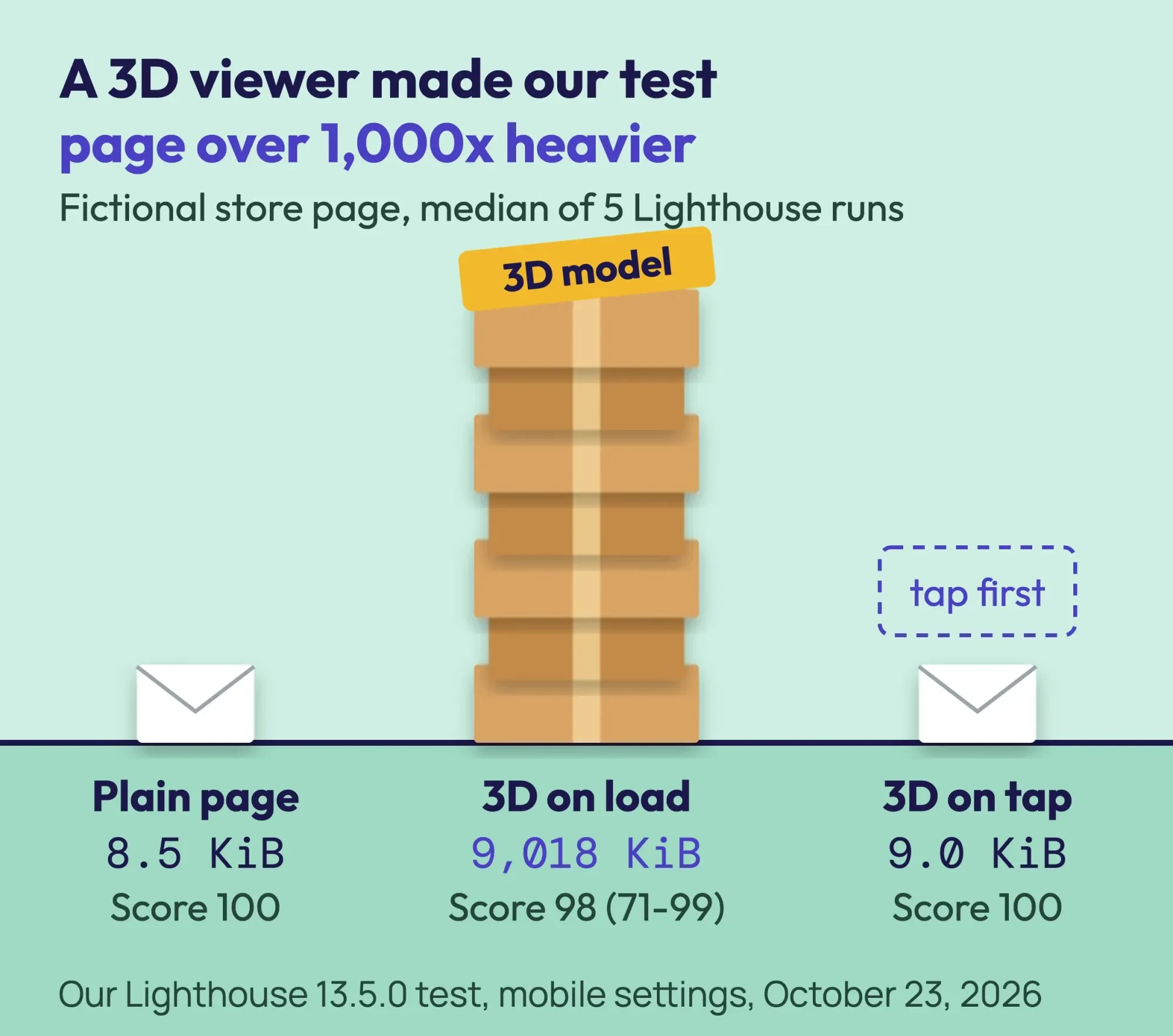 Diagram by DigitalTreed from our Lighthouse 13.5.0 test on a fictional store page, October 23, 2026.
Our sample model was a heavy one, and a 3D file built for the web can be far smaller. Still, tap-to-load is the safe default. We measured video, map and payment embeds the same way in our guide to third-party integrations.
Example: Marsh Light's first month
Here's how the made-up Savannah shop, two people and about 40 products on Shopify, could spend its first month.
- Week 1: add the shipping line under every price, and make account sign-up optional at checkout.
- Week 2: send the catalog to Merchant Center, add product markup with shipping and returns, and check the agentic storefronts setting.
- Week 3: email every buyer a Google review link, with no reward tied to stars.
- Week 4: start a 3-month refill subscription test, with a cancel button in the customer account.
What it skips: AR, voice, NFTs and a rebuild. Nobody will miss them.
Rather not take on the product data or checkout work yourself? Our ecommerce web development team can set it up. (Full disclosure: that's a paid service of ours.)
Frequently asked
What is the average cart abandonment rate?
About 70%. Baymard Institute averages 50 studies to a documented rate of 70.22%, per its cart abandonment statistics page, last updated September 22, 2025. So most carts never become orders, and small checkout fixes can still move real money.
Do other states besides California ban hidden fees?
Yes. Minnesota's deceptive trade practices law makes it unlawful to show a price that leaves out mandatory fees or surcharges, as of October 2026. Per Minnesota Statutes 325D.44, government taxes are excluded, and a reasonable shipping fee actually incurred is allowed. This is general information, not legal advice.
Where do I manage Shopify's agentic storefronts?
In your Shopify admin, go to Sales channels, then Agentic, to choose which AI channels you sell on. The Shopify agentic storefronts help page also says buying inside Google AI Mode, Gemini, Copilot or Meta needs direct checkout turned on, as of October 2026.
Start with your best seller
Open your best-selling product on your phone. Can you see the full cost, shipping included, before checkout?
No? That's your first fix, and it won't cost a cent.
For the rest of the list, you're welcome to ask us for a fixed quote.
The law notes above are general information as of October 23, 2026, not legal advice. States can add their own rules, as California's fee law shows, so check your own store with a lawyer or your state attorney general's office.
How we made this guide: the DigitalTreed team checked every number and rule against its primary source on the day of this rewrite, October 23, 2026. That means the Census report, the eCFR, the Federal Register, the Eighth Circuit's opinion and the platforms' own docs, each linked where it's used. The schema check and the speed test were ours, run that day on a fictional store page.
First published April 2020. Rewritten October 23, 2026: a new list sorted into add, test and skip, Census figures for the second quarter of 2026, the FTC review, fee and subscription rules, and our own schema and 3D-viewer test.
Sources
- US Census Bureau: Quarterly Retail E-Commerce Sales, 2nd Quarter 2026 (August 18, 2026)
- Baymard Institute: Cart abandonment rate statistics and 2026 reasons survey
- California Attorney General: Hidden fees (SB 478)
- Federal Register: Trade Regulation Rule on Unfair or Deceptive Fees (January 10, 2025)
- eCFR: 16 CFR part 465, Use of Consumer Reviews and Testimonials
- Federal Register: Consumer reviews and testimonials final rule (August 22, 2024)
- 15 U.S.C. 8403, Restore Online Shoppers' Confidence Act
- Eighth Circuit: Custom Communications, Inc. v. FTC (filed July 8, 2025)
- Federal Register: Revision of the Negative Option Rule (February 12, 2026)
- Federal Register: Prenotification Negative Option Plans, advance notice (March 13, 2026)
- eCFR: 16 CFR 260.4, Green Guides, general environmental benefit claims
- US Department of Justice: Guidance on Web Accessibility and the ADA
- Google Merchant Center Help: Free listings for products
- Google Search Central: Merchant listing structured data
- Google Search Central: Intro to product structured data
- Google Search Central: Merchant return policy structured data
- Google Search Central: Loyalty program structured data
- Google for Developers: Universal Commerce Protocol
- web.dev: Web Vitals
- Chrome for Developers: Lighthouse overview
- Shopify Help Center: Agentic storefronts (vendor)
- WooCommerce: Cart and Checkout blocks status (vendor)
- Stripe: Pricing (vendor)
- Stripe Docs: Agentic commerce (vendor)
- Neal Schaffer: Ecommerce trends in 2026 (consultant opinion)
- model-viewer (Google open-source project)
- Khronos Group: glTF sample assets, WaterBottle
Comments
No comments yet. Start the conversation below.