

Quick answer
Start marketing a food product with a page you own. As of October 2026, an example $9.00 bottle sold there through Stripe keeps $6.04: $9.00 minus a $0.56 Stripe fee and an example $2.40 cost. On Amazon's Individual plan it keeps $4.89 ($9.00 - $0.72 - $0.99 - $2.40), and an example $4.50 wholesale sale keeps $2.10. Build the page first.
You make a hot sauce, a snack or a small-batch coffee, and the people who've tasted it keep buying, so now you want buyers who've never met you. How to market a food product is a question of order as much as tactics, since each channel has its own rules and takes its own cut of every sale.
We start with the label and permit questions, then build a product page and work out what each sales channel leaves per bottle. After that come Amazon Grocery rules, Faire for shop owners, a sell sheet for grocery buyers, sampling at farmers markets, and social posts with creators.
Key takeaways
- An example $9.00 bottle nets $6.04 on your page: $9.00 - $0.56 - $2.40.
- Amazon Grocery needs no category approval but wants a UPC on every listing.
- Amazon's Professional plan costs less than Individual above 40 sales a month.
- A bundle priced over $15.00 moves Amazon's grocery referral fee from 8% to 15%.
- Leave star ratings out of your markup until real reviews show on the page.
Check the label and the permit before you sell
Two answers decide where your food can legally go: what your printed label says, and what your health department lets a kitchen like yours sell. The first is the label. FDA's How to Start a Food Business page says labeling of FDA-regulated food "must be truthful and not misleading". Every claim on your product page, sell sheet and posts should match that label word for word. That means the product name, net amount and ingredient order on the page come straight off the printed label, not from an older design file. If the bottle says "5 fl oz", the page says 5 fl oz too, not "5 oz".
The second question is where you cook. The same FDA page tells home cooks to "learn the regulations of FDA and your state and local health department". Those rules, often called cottage food laws, decide what a home kitchen may sell, and a kitchen cleared for a market may still fall short of Amazon's license rule. Before you plan channels, ask your local health department three things. Can you sell online, can you ship to another state, and can a store resell your food? Write the answers down. This guide's steps aren't legal advice, so have a food lawyer read your label before you print labels in bulk.
Build a product page that sells the bottle
Once the label text is final, the product page is where the sauce's name, size and ingredients first appear online. A grocery buyer looks the page up, a creator links to it, and a sampling card opens it. Our made-up brand for this guide, Hearthstone Pepper Co., sells one item, Smoky Red Hot Sauce. Its page carries six things:
- A bottle photo on a plain background, compressed so it loads fast on a phone.
- The product name as the only H1 on the page.
- The price and size, here an example $9.00 for an example 5 fl oz bottle.
- The ingredients line, copied from the label: red chiles, vinegar, garlic, smoked salt.
- An Add to cart button wide enough for a thumb.
- A reviews row that says "No reviews yet" until real buyers write some.
The ingredients line keeps the page and the bottle from drifting apart, so change both on the day the recipe changes.
The empty reviews row isn't an accident. Google's structured data guidelines say "Don't mark up irrelevant or misleading content, such as fake reviews". So a new sauce shows five empty stars, not five gold ones.
Under the visible page sits structured data, code that tells Google what's for sale, and Google's product snippet documentation requires a name plus offers, review or aggregateRating. On the currency field, it says "It is therefore best to always provide this property". Paste your page into our free schema markup validator after each edit. Hearthstone's markup gives the price as 9.00 and the currency as USD. Once the page passes, Google's Merchant Center help says "One specific way to show your products at no cost is with a free listing". That puts the same page in front of shoppers on Google without an ad budget, which is a sensible first step before you pay for any marketplace.
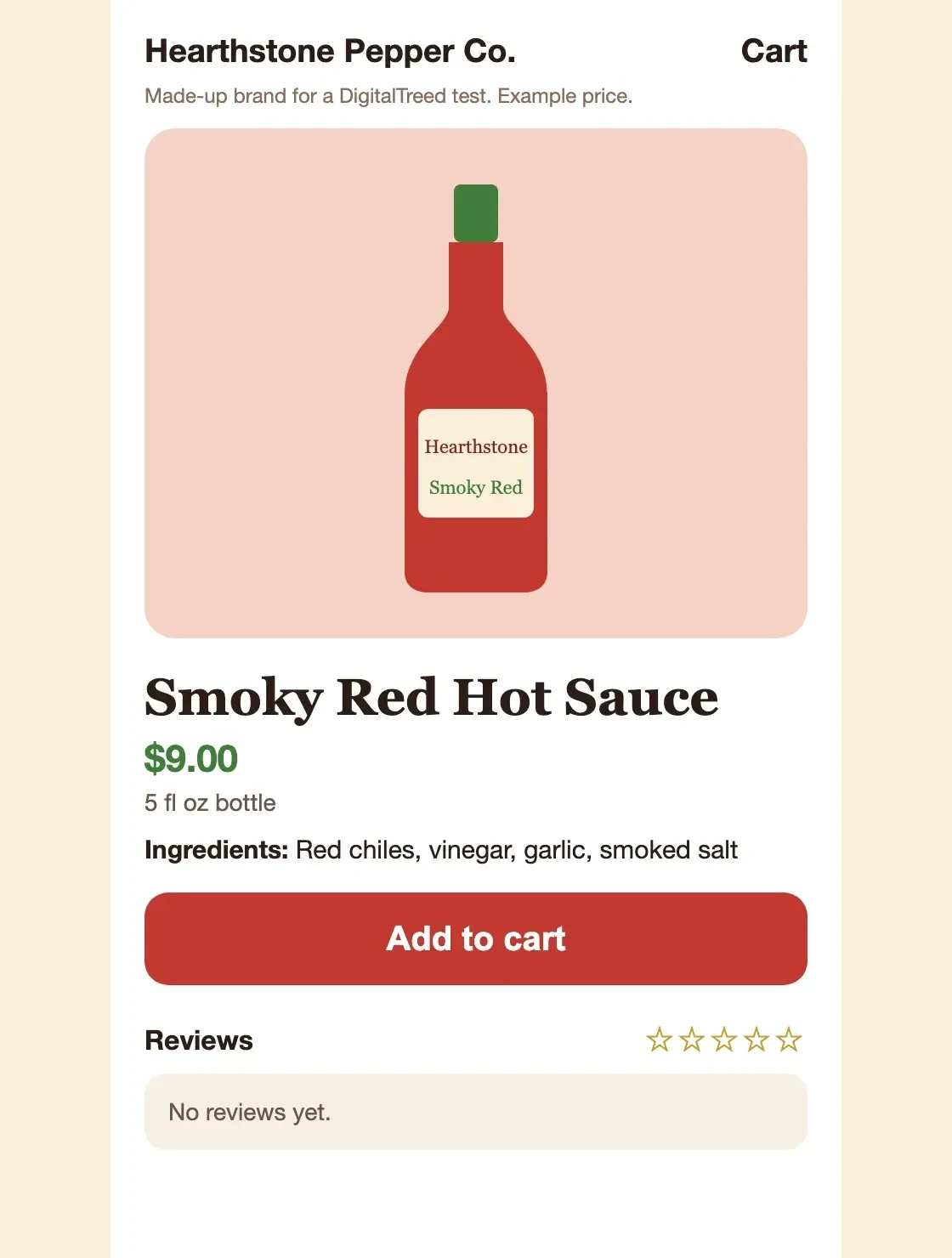 Screenshot: page.html for Hearthstone Pepper Co. (made up), built by test/make_pages.py and opened on 127.0.0.1, October 29, 2026. Example price.
What we tested
On October 29, 2026, we served two versions of the Hearthstone page on 127.0.0.1 and ran 10 checks on each with a Python script. Eight came from Google's two pages above; one checked the photo alt text, and one checked the ingredients line and the Add to cart button. The draft held four planted mistakes: "$9.00" with a dollar sign, no priceCurrency, a rating block beside "No reviews yet", and an empty photo alt.
The draft passed 5 of 10, failing the price format, the currency, the rating, the alt, and the page-to-markup price match. The dollar sign caused that fifth failure. The fixed page passed 10 of 10. A local script isn't Google's Rich Results Test, so this can't promise a rich result.
What does each sales channel leave you per bottle?
That page tells shoppers what the bottle is. It doesn't tell you what one sale is worth after Stripe or Amazon take their cut, so we priced that next.
We ran one example bottle through four routes, with fees read on October 28, 2026. The inputs are examples, not anyone's sales: a $9.00 retail price, a $2.40 cost per bottle and a $4.50 wholesale price. Shipping, ads and your store's plan aren't counted. It isn't a forecast. Swap in your own cost and prices before you trust any row, because the cost per bottle moves every result in the table by the same amount.
| Route (fees as of October 28, 2026) | Formula, example inputs | Left per bottle (example) |
| Own website, Stripe card payment | $9.00 - (2.9% x $9.00 + $0.30 = $0.56) - $2.40 | $6.04 |
| Amazon, Individual plan, you ship | $9.00 - (8% x $9.00 = $0.72) - $0.99 - $2.40 | $4.89 |
| Amazon, Professional plan, 100 sales a month (example), you ship | $9.00 - $0.72 - ($39.99 / 100 = $0.40) - $2.40 | $5.48 |
| Wholesale to a store at $4.50 (example) | $4.50 - $2.40 | $2.10 |
As of October 28, 2026, Stripe's US pricing page lists 2.9% + 30¢ per successful domestic card charge, with no monthly fee. That's why your own site keeps the most here. On a $9.00 card sale through your own site, the fixed 30¢ is more than half of the $0.56 fee, so a small order loses a bigger share. Amazon's selling fees page, read the same day, puts the Grocery and Gourmet referral fee at 8% up to a $15.00 sale price and 15% above it. On top of that comes $0.99 per item on the Individual plan, or $39.99 a month on Professional. Wholesale keeps the least per bottle, but one store order moves a whole case.
The 15% tier, as of October 28, 2026, matters when you bundle. An example 3-pack at $16.00 crosses $15.00, so Amazon charges 15% on the whole $16.00. That's $2.40, against $1.28 at 8%. Plug your real numbers into our Stripe fee calculator. If you haven't picked a store platform, the WordPress vs Shopify cost breakdown covers the plan fees we left out.
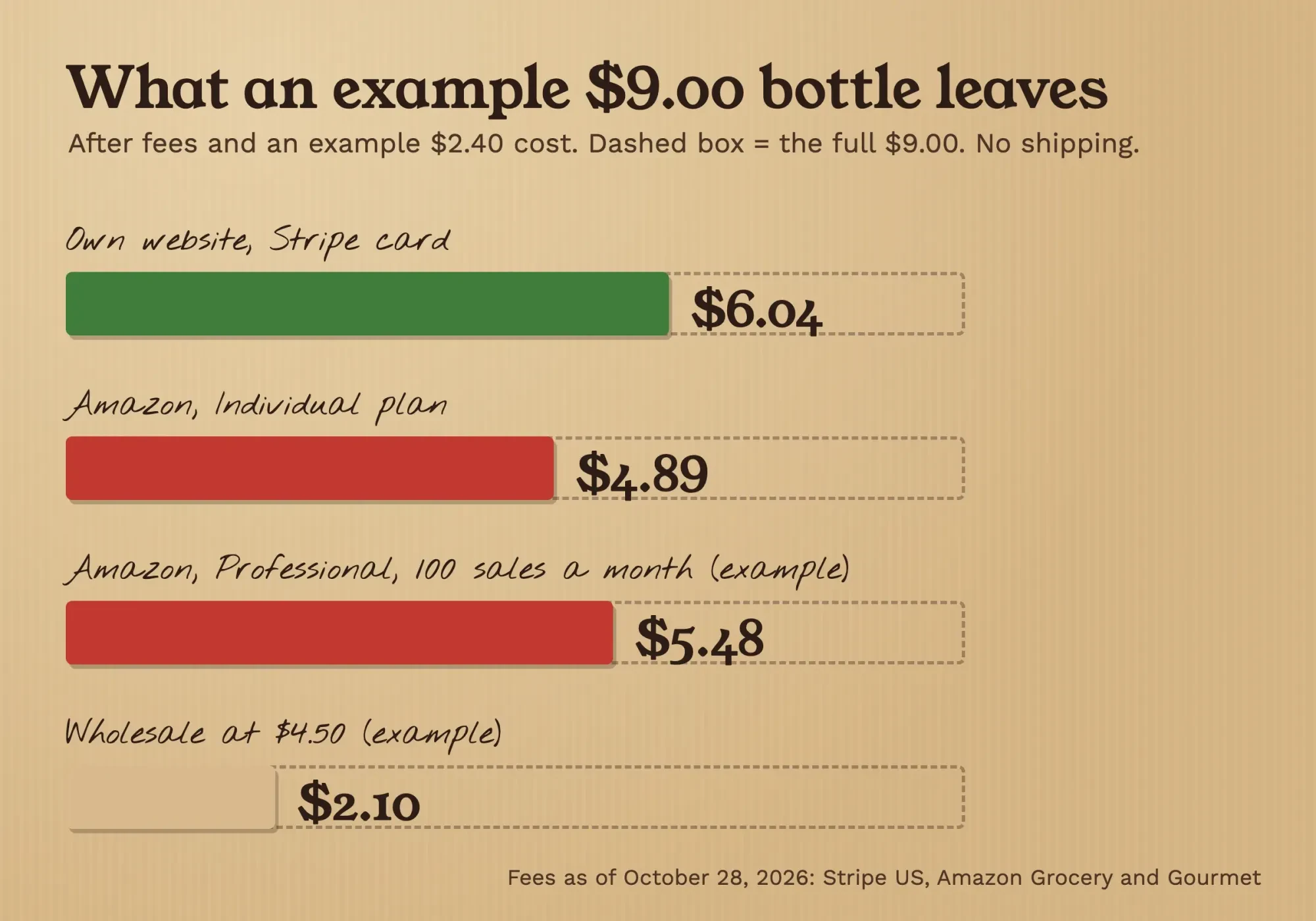 Diagram by DigitalTreed. Example inputs; fees from the Stripe US and Amazon selling fees pages, read October 28, 2026; from test/results.json.
Amazon grocery: no approval step, but strict rules
Now for Amazon, the channel with the most food rules here, though getting into the category isn't one of them. Its overview of categories lists Grocery & Gourmet Foods as new only, with approval required marked "No".
Single products can still ask you to apply. Amazon's page on products that need approval explains that the Add Products search then shows an "Apply to sell" status, and to "Wait for review (2-7 business days)".
The Grocery & gourmet foods guidelines then set rules for you and for every unit you ship. These five come up first for a small brand:
- Account targets: an order defect rate under 1%, a pre-fulfillment cancel rate under 2.5% and a late shipment rate under 4%.
- Food that is "properly prepared, packaged, sealed, and labeled".
- A license or approval from the relevant government agency for what you sell.
- An expiration date permanently marked on every unit, unless the product is exempt; a best-by date counts as one.
- The manufacturer's UPC on every listing.
That last rule sends you to GS1 US. Its barcode price page lists, as of October 28, 2026, a single GS1 US GTIN at $30 with no annual renewal fee. A prefix for up to 10 items costs $250 up front, plus $50 a year. Three flavors as single GTINs come to $90, so start there and price the prefix once the line grows. A GTIN identifies one product, so a 5 fl oz and a 10 fl oz bottle of the same sauce each need their own number.
Then pick a plan: Professional costs less than Individual above 40 sales a month, because $39.99 / $0.99 = 40.4.
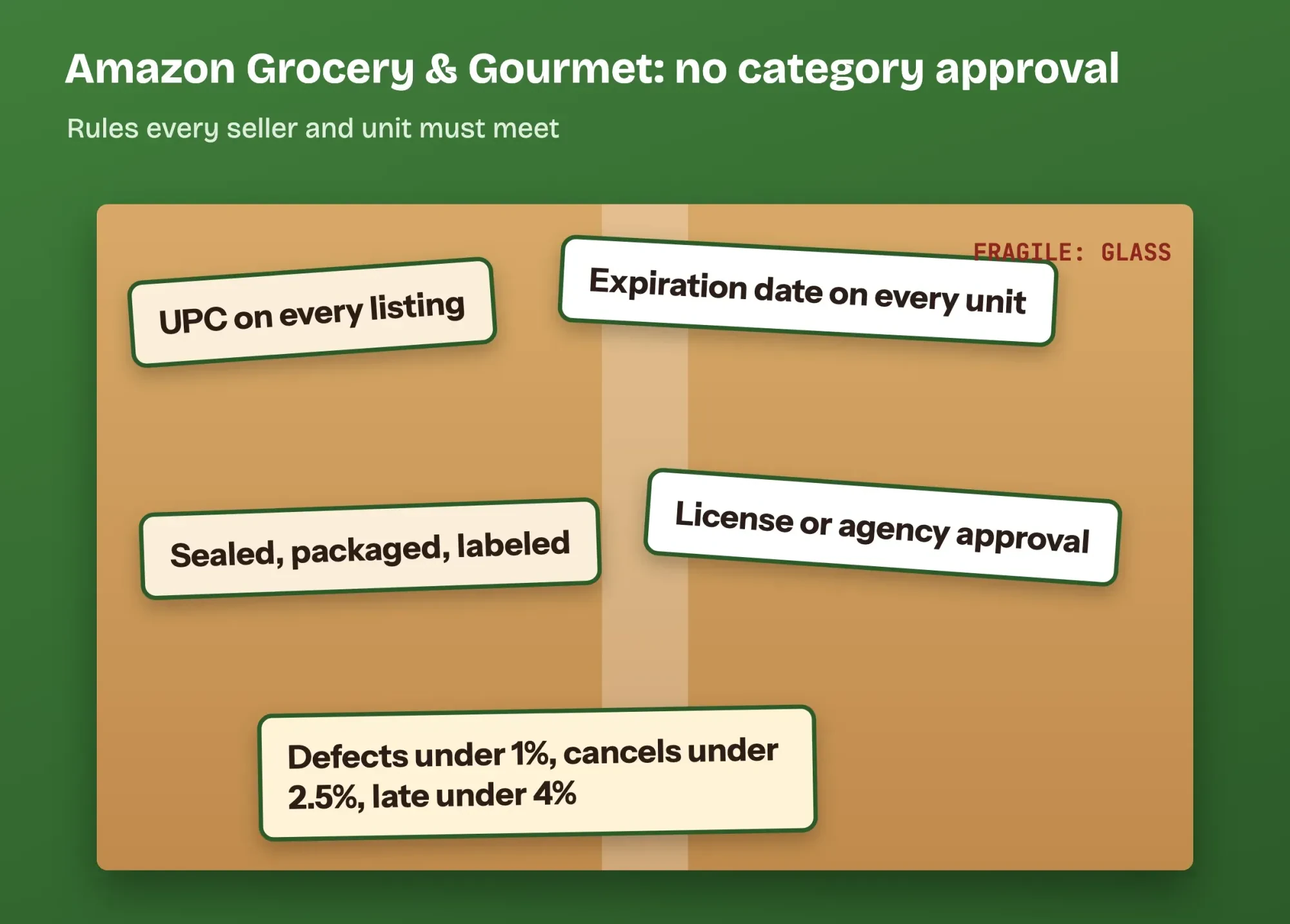 Drawn by us. Rules from Amazon Seller Central, Grocery & gourmet foods, read October 28, 2026; some products are exempt from the date rule.
Faire puts your sauce in front of shop owners
Unlike Amazon, Faire sells to shops. Faire's help page on brand accounts says "To sell products on Faire, you'll need to apply for a brand account".
Faire's orders help page tells retailers "Each brand fulfills and ships your order directly". So you pack and post every wholesale order yourself, and the shipping cost belongs inside your wholesale price.
The part that helps a small brand sits on the shop owner's side. Faire's returns help page tells retailers "We offer free returns on the first order you place with any brand". They typically get 60 days to send items back, which takes most of the risk out of a store's first case of an unknown hot sauce.
We couldn't read Faire's brand fees, because its brand pages loaded blank in our browser on October 28, 2026. So check the fee terms in your brand application, and take that fee out of the $4.50 in the table above.
Pitch a grocery buyer with a one-page sell sheet
Beyond Faire's reach, the store across town is a walk-in, so bring a printed one-page sell sheet. A buyer can keep it and hand it to whoever places orders.
Selling to a store is a business sale, and the B2B and B2C marketing comparison on our blog explains why that pitch reads differently from a shopper ad. Here's what Hearthstone's sheet lists:
- Product name, size and the ingredients line from the label.
- Wholesale price and suggested retail price, here an example $4.50 and $9.00.
- Case pack, such as an example 12 bottles.
- Shelf life and how the date is marked on each unit.
- The UPC from GS1 US.
- How to order: a contact name, an email and your minimum order.
- A QR code that opens the product page.
Make the QR code with our free QR code generator, and bring two sealed bottles with the sheet. Leave both behind, and call the following week to ask whether the buyer tasted it. Note the visit date on your own copy. Start with independent stores before regional chains, since a store that already stocks you is a fact for the next buyer's sheet. A buyer who tastes the sauce at the desk and then scans your sheet sees the same name, price and ingredients you just showed them. If your buyers are other food makers, such as a co-packer, that's industrial selling. Our manufacturing marketing guide covers that buyer.
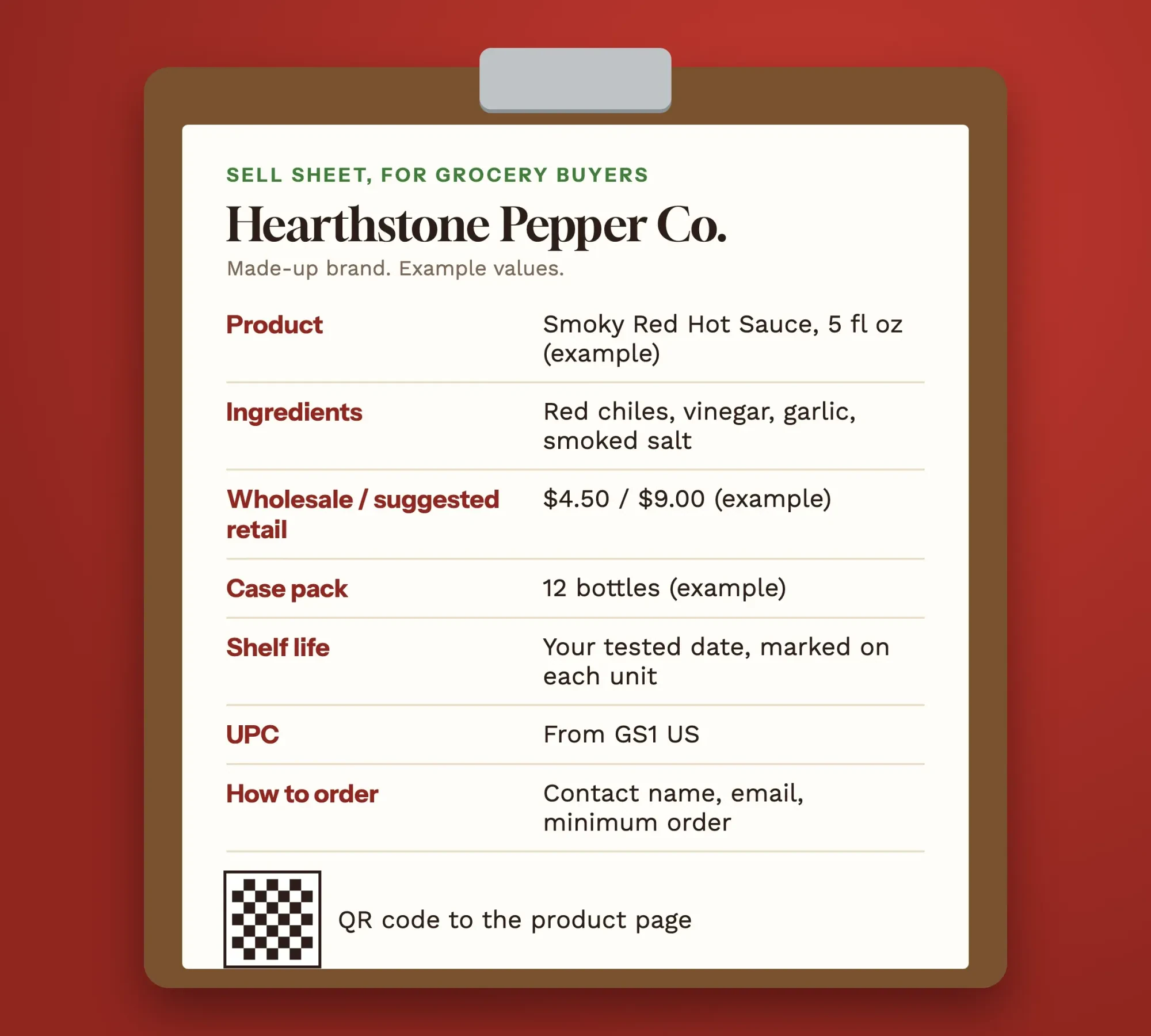 Drawn by us. Sell sheet for Hearthstone Pepper Co. (made up); prices and case pack are example values.
Sampling at farmers markets
That sell sheet works on buyers, but sampling is the one channel where a stranger tastes the sauce before paying an example $9.00. The job at the table is to send that taster to the product page. USDA's National Farmers Market Directory lists markets that "feature two or more farm vendors selling agricultural products directly to customers". A sauce maker isn't a farm. Read each market's vendor rules before you apply, and ask the health department whether you can hand out open samples.
Treat every tasting as traffic for your product page. Print a small card with a QR code that opens it. Tag that link in our UTM link builder so analytics splits market sales from social ones, and on Hearthstone's card we'd set utm_source=farmers-market and utm_campaign=smoky-red. The card needs four things: the sauce name, the price, "Scan to reorder" and the code. After three Saturdays, your analytics will show whether the booth also earns online orders beyond the cash taken at the table. That tells you whether to book the next season. We'd print 200 cards for a first season, and we wouldn't reprint until the scan count says the card's doing its job.
Social posts and free bottles for creators
After the market, social is where the page, the market table and the store shelf get seen by people who weren't there. Show the food in use: the pour, the drip on a taco, the bottle beside a skillet of eggs. Don't post it alone on a white table. Link every post to the product page, never to a bare home page. A ten-second clip of sauce hitting a fried egg tells a stranger more about heat and texture than any caption under a studio shot. For launch week, borrow a few formats from the Instagram Story ideas for business list, such as a poll on how hot people like it.
Free bottles cost you the sauce and the postage, and they come with a federal rule. The FTC's endorsement Q&A, What People Are Asking, says that if you get free products expecting to promote them, "the FTC Act applies to you". It puts disclosure on "the influencer and the brand – not the platform". So ask for a clear disclosure in the note that ships with each bottle. That's your job as much as theirs. For paid posts, our influencer rates guide lists what US creators charge.
Our take: build the page and run the fee table with real costs, then start with the channel you can try this month, which for Hearthstone is a market table. Amazon or Faire come next, and store buyers once the sell sheet is printed. Judge each by what it leaves per bottle. A market table that sells an example 40 bottles on a Saturday and a creator post that sells none deserve very different shares of next month's time. Our small business tech stack picks cover the software behind it.
Would you rather hand off the product page and its markup? DigitalTreed's web development service builds both as paid work. Since we profit from it, price the job against a freelancer before you choose.
Questions small food brands ask
Frequently asked
Is there a minimum referral fee on Amazon grocery sales?
No. Amazon's fee table charges the greater of a percentage or a minimum, and Grocery and Gourmet shows no minimum.
What date goes on a multi-pack of sauces sold on Amazon?
The earliest one. Amazon's grocery rules say the multi-pack date "must match the earliest expiration date of the products inside".
Can I make my own barcode image after buying a GTIN?
Yes. GS1 US says its $30 GTIN comes with "a free lifetime subscription to GS1 US Data Hub", a tool to create your own barcode.
Why doesn't my product price show in Google results?
Check the priceValidUntil date. Google's product snippet rules say a snippet "may not display if the priceValidUntil property indicates a past date".
How we made this guide: Fourteen pages from FDA, Amazon, GS1 US, Stripe, Faire, Google, USDA and the FTC were read on October 28, 2026. On October 29, 2026, our 10-check script tested two versions of a made-up product page on 127.0.0.1, scoring 5 of 10, then 10 of 10. It also built the fee table from example inputs. Faire's brand fee pages loaded blank, so no Faire fee is given. Facts checked by the DigitalTreed team on October 28, 2026.
First published May 2023 as a list of tools for starting a food manufacturing business. Rewritten October 29, 2026: now a marketing plan for a small consumer food brand, with a tested product page and per-bottle fee math.
Sources
- FDA: How to Start a Food Business
- Amazon: Standard selling fees
- Amazon Seller Central: Overview of categories
- Amazon Seller Central: Grocery & gourmet foods
- Amazon Seller Central: Categories and products that require approval
- GS1 US: How to get a UPC barcode
- Stripe: Pricing
- Faire Help Center: Can I sell on Faire through my retailer account?
- Faire Help Center: How do I submit a return?
- Faire Help Center: When will I get my orders?
- Google Search Central: Product snippet structured data
- Google Search Central: General structured data guidelines
- Google Merchant Center Help: Free listings for products
- USDA AMS: National Farmers Market Directory
- FTC: FTC's Endorsement Guides: What People Are Asking

Comments
No comments yet. Start the conversation below.