

Quick answer
To get a US shop named in AI answers, keep the same facts on five listings. As of October 29, 2026, four cost $0 to claim: Google Business Profile, Apple Business, Yelp and a BBB profile. Bing Places is the fifth, and only BBB Accreditation charges annual dues. Start with Google, then check AI answers monthly.
Picture a florist on a small-town main street. A customer asks ChatGPT for flowers delivered today, and the answer names the shop two blocks over. Local business AI search is the set of answers that ChatGPT, Gemini, Copilot, Siri and Google's AI features give when someone asks for a nearby business. Those answers lean on listings you can fix yourself.
First we map where each assistant gets local facts. Then come the Google Business Profile, Apple Business, Bing Places and Yelp, and whether BBB Accreditation is worth paying for. After that: review requests, "best florist" lists, and checking every listing against your website, ending with a monthly prompt check. Our view: fix the listings before you buy any AI visibility tool.
Key takeaways
- Wrong hours on one listing can end up in an AI answer.
- Google's own help page says a local ranking can't be bought.
- Yelp tells businesses never to ask customers for reviews.
- Our test found 3 mismatches in 25 listing fields for a made-up florist.
- Six prompts in four assistants make 24 answers to read each month.
Five assistants, five different sources of shop facts
Each assistant pulls local facts from a different place, so before you change a single hour or phone number anywhere, find out which listing feeds which answer. We read each company's own page to find out.
Google's page on AI features and your website names one local step for AI Overviews and AI Mode: "checking that your Merchant Center and Business Profile information is up-to-date." For Gemini, Google's Gemini Apps help page says Gemini can use public information from Google Maps when the user's Keep Activity setting is on. So a single Google listing, kept current, reaches two of Google's AI products at once, and a mistake in it reaches both just as fast. That's the main reason the Google profile gets its own section below.
Microsoft's answer is plainer. Its page on web search in Microsoft 365 Copilot Chat says Copilot Chat "generates a short query based on your prompt and sends it to Bing." OpenAI's crawler page says sites that opt out of OAI-SearchBot "will not be shown in ChatGPT search answers." OpenAI's help pages returned a 403 to our checker, so we can't say which map data ChatGPT uses for local results.
Apple runs everything through one account, which Apple's Apple Business announcement says reaches customers across Apple Maps, Mail, Wallet and Siri.
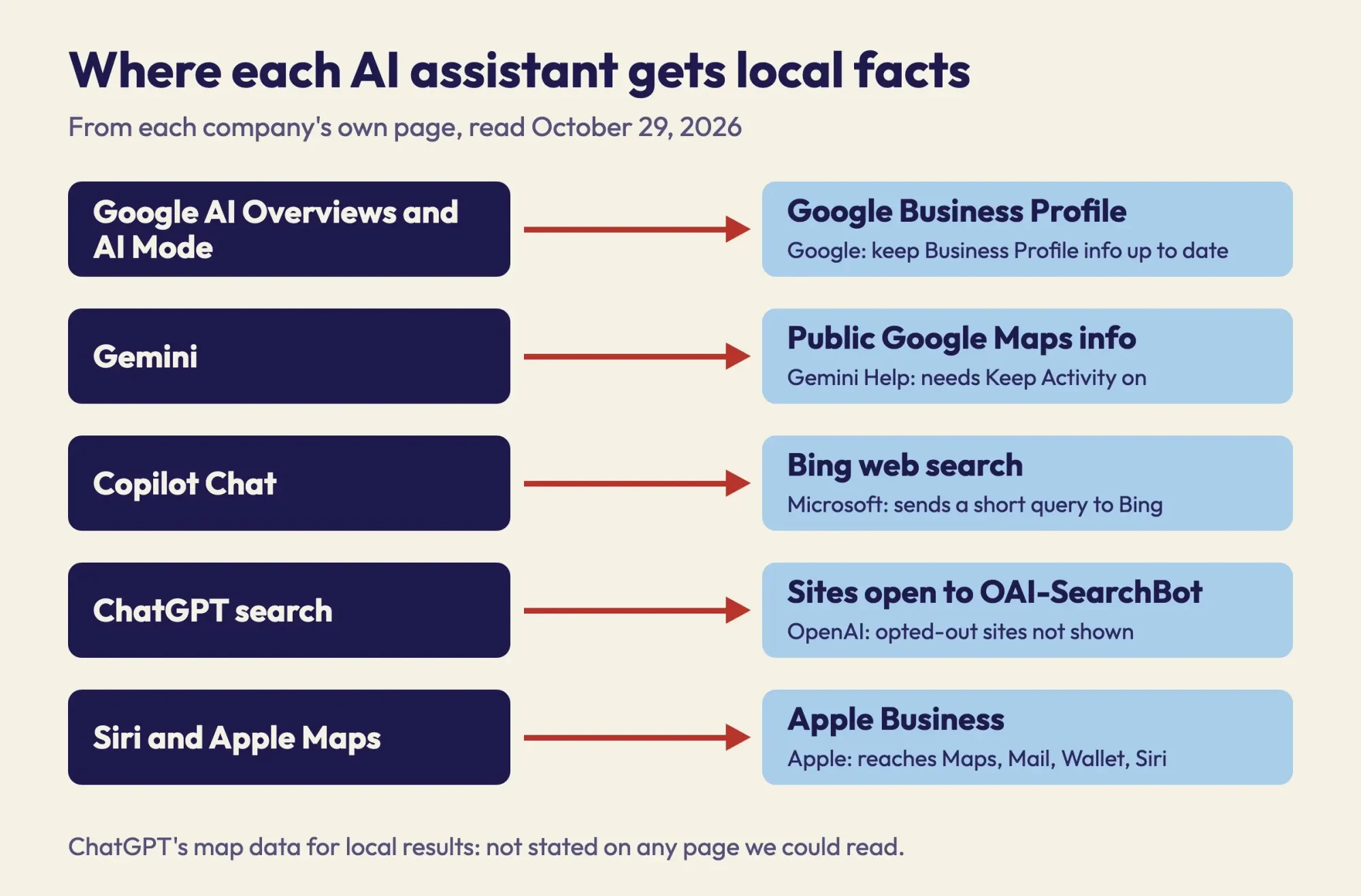 Diagram by DigitalTreed from Google, Microsoft, OpenAI and Apple pages read October 29, 2026
So there's no single "AI listing" to claim, only one set of facts kept on several platforms. Your own site has to stay open to the crawlers as well. If someone once added AI-bot rules to your robots.txt, our explainer on Google-Extended shows what that one Google rule blocks and what it leaves alone.
Start with the Google Business Profile, because two Google AI products read it
That diagram has two of its five answer sources running on Google data, which is why this listing comes first. Google doesn't sell anything here. It calls the listing a free Business Profile that decides how your shop shows up in Google Search and in Maps. New to it? Our steps for setting up a Google listing cover sign-up and verification.
Once it's live, the ranking rules are short. Google's local ranking help page says local results are "mainly based on relevance, distance, and popularity." It adds that prominence draws on how many sites link to you and how many reviews you have. The same page is blunt about money: "There's no way to request or pay for a better local ranking on Google."
For a florist, relevance comes from the details you fill in. Pick the primary category that names what you sell. List the services people ask for by name, such as same-day delivery, sympathy arrangements and wedding flowers, because those are the words in the prompts. Keep holiday hours current, since a florist often changes hours around Valentine's Day and Mother's Day, right when people ask. Add photos of real arrangements, not stock pictures. Write the business description the way a customer would describe you to a friend, naming the town and what you deliver. If the profile still says open on Sunday, an answer built from it can send a customer to a locked door.
Then watch what the profile brings in. Google's performance help page counts calls, direction requests and website clicks. It also shows the searches that found you, updated at the start of each month and sometimes up to 5 days late.
Log those four numbers on the 6th of each month, once the late searches figure is in.
Apple Business, Bing Places and Yelp cover the answers Google doesn't
Once Google is done, three more listings remain, and only Apple says its listing reaches an assistant: Siri.
Apple Business comes first among them for any shop whose customers carry iPhones. Apple's announcement says it's "a free service in the U.S." from April 14, 2026, for new users and for existing Apple Business Connect users. It took over the brand and location tools that used to live in Apple Business Connect. Apple's feature availability page lists Brand and Location Management for the United States, which covers the place card people see in Apple Maps. If you claimed your shop in Apple Business Connect years ago, sign in once and check that the hours and phone survived the move. Apple's Grow page adds that the place card can carry seasonal promotions and action buttons for bookings and orders.
Bing Places is harder to pin down. The Bing Places for Business site loaded only a sign-in screen in our browser on October 29, 2026, so we quote nothing from it. What we can say is the Microsoft line above. If Copilot answers with Bing results, as Microsoft describes for Copilot Chat, a Bing listing with an old phone number can end up in a Copilot answer.
Claim it anyway, because the one wrong phone number in our test sat on the Bing record.
Yelp is the third. Its review rules differ most from Google's. Yelp's business page says "It's free to be on Yelp" and offers paid upgrades on top. Yelp's Content Guidelines say "Businesses should never ask customers to write reviews." So on Yelp you claim the page, fix the facts and add photos, then let reviews arrive on their own. The same guidelines tell reviewers not to use AI tools to draft or revise a review. A review drive that works on Google can therefore break Yelp's rules, so keep Yelp out of your review emails and keep the facts identical on both.
Is BBB Accreditation worth paying for?
Beyond those three, the Better Business Bureau is the only listing here that sells a membership, so split the free profile from paid Accreditation before any sales call.
The free part is the profile. BBB's get-listed page invites businesses to "Claim your business's free BBB Business Profile," or to request a new one.
Claim it, then match the name, address, phone and hours to Google's, down to the suite number and the Saturday closing time.
The paid part is Accreditation. BBB's accreditation page says "Accredited businesses pay an annual dues investment." It says the seal adds credibility to "more than 400,000 businesses across the US and Canada." The page doesn't print the dues, and the form says your local BBB will contact you by phone or email. As of October 29, 2026, we can't give you a dollar figure.
Our take: claim the free profile now, and decide on Accreditation for customer-trust reasons, not AI ones. None of the AI pages we read names BBB as a source for local answers, so paying dues for AI reach would be paying for a guess. If your local BBB calls about it, ask for the yearly dues in writing.
Review requests that Google, Yelp and the FTC allow
Now for reviews, which feed Google's prominence factor and which customers read before they call. How many shoppers ask AI first? One data point is the Local Consumer Review Survey 2026 from BrightLocal. There, 45% of 1,002 US adults said ChatGPT or a similar tool was a source of local recommendations, up from 6% a year before. BrightLocal sells local SEO software, including an AI visibility tracker, so it's one company's poll, not a census.
Replies count as well, since the same survey found generic or templated replies put off 50% of consumers.
Asking is allowed on Google as long as you ask everyone, and Google's review help page suggests sending customers a Google link or a QR code to scan. Our free review link tool for Google builds that link from your Place ID. Print it on the small card that rides along with every delivery, so each customer gets the same ask.
The limits come from two places. Google's Maps content policy bans offering "payment, discounts, free goods and/or services" for reviews, and bans selectively asking happy customers. It also bars asking for specific content in a review, so a request that tells the customer which service or which words to mention is out. Federal law adds the FTC rule on consumer reviews, as printed in the eCFR, Part 465 of Title 16, which covers fake reviews, review suppression and insider reviews.
For a shop that hands out coupons, the section to read is 16 CFR 465.4. It makes it a violation to give a reward for reviews "expressing a particular sentiment, whether positive or negative." This is a summary of public rules, not legal advice, so have a lawyer read any review program that offers rewards. Section 465.7 separately bars groundless legal threats, intimidation or public false accusations, made knowingly or recklessly, meant to stop a review or get it removed.
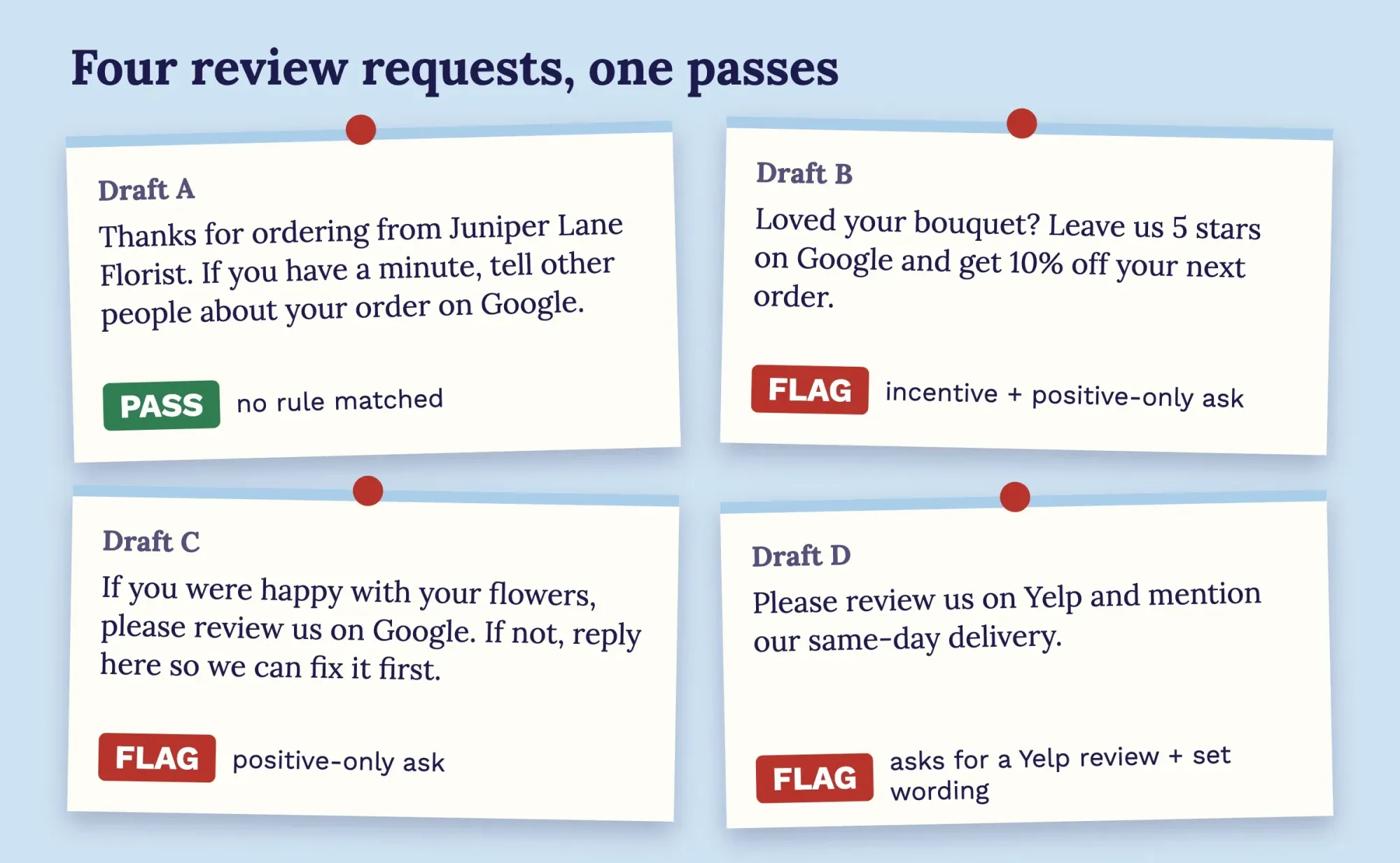 Drawn by us from Part 2 of our local test (test/output.txt, October 29, 2026); the drafts are our own, written for a made-up florist
We ran four draft requests through a rule check. Only one passed: a plain thank-you asking the customer to "tell other people about your order on Google," with the link. It didn't offer a reward or hint at stars. The draft offering "5 stars" and a discount broke two rules at once. The one that began "If you were happy" is the selective asking that Google's policy describes, even though it sounds polite. The Yelp draft broke Yelp's rule, and asking customers to mention same-day delivery hit Google's ban on requesting specific content. Send the plain version to every customer, and reply to new reviews within the week, in your own words rather than a template.
Getting onto "best florist" lists without paying for a spot
Next come best-of lists, which Google treats as a feature of their own. Google's Top Places List page says your search result can show the "top places" lists that mention your business. It's only for businesses with a physical location, so an online-only flower seller won't get it.
The list has to earn it, too. Google says it must be "genuine, independent, and not sponsored," and not built from templated sentences or automated metrics.
So a paid slot on a "10 best florists" page can't qualify for Google's Top Places List, however good the page looks. A local paper's gift guide, a wedding blog or a neighborhood newsletter that picked you on its own merits is the kind of list that counts. For a florist, those are the people who already write these lists in your town. Pitch the editor before the season, with a photo of a real arrangement and the towns you deliver to. Offering money or asking for the top spot turns the list into the sponsored kind Google excludes.
Check every listing against your website
Those listings only help if they agree with each other and with your site. Your website is the master copy. Google's LocalBusiness structured data page lists just two required properties: name and address. Our schema markup generator writes that block with the hours and phone included, so the site carries the same facts you're about to check each listing against. Then compare field by field: name, street address, phone, hours for each day and website URL, from every listing, next to the site. Abbreviations like "Ln." for "Lane" aren't real conflicts. A second phone number or a shorter Saturday is. Fix the side that's wrong, then compare again.
What we tested
For the test, a one-page site for the made-up Juniper Lane Florist in Maple Ferry, Ohio, ran on 127.0.0.1 on October 29, 2026. A Python script confirmed its LocalBusiness block had both required properties. It then compared five listing records we typed by hand, 5 fields each, with the site:
- Google Business Profile: 5 of 5 match.
- Apple Business: 4 of 5; Saturday closes at 17:00, not 18:00.
- Bing Places: 4 of 5; old phone (614) 555-0187.
- Yelp: 4 of 5; name reads Juniper Lane Florist & Gifts.
- BBB: 5 of 5, reading "Ln." as "Lane".
That's 22 matching fields out of 25. We typed the five records by hand, not from platform exports, and the review-draft check only matches keywords.
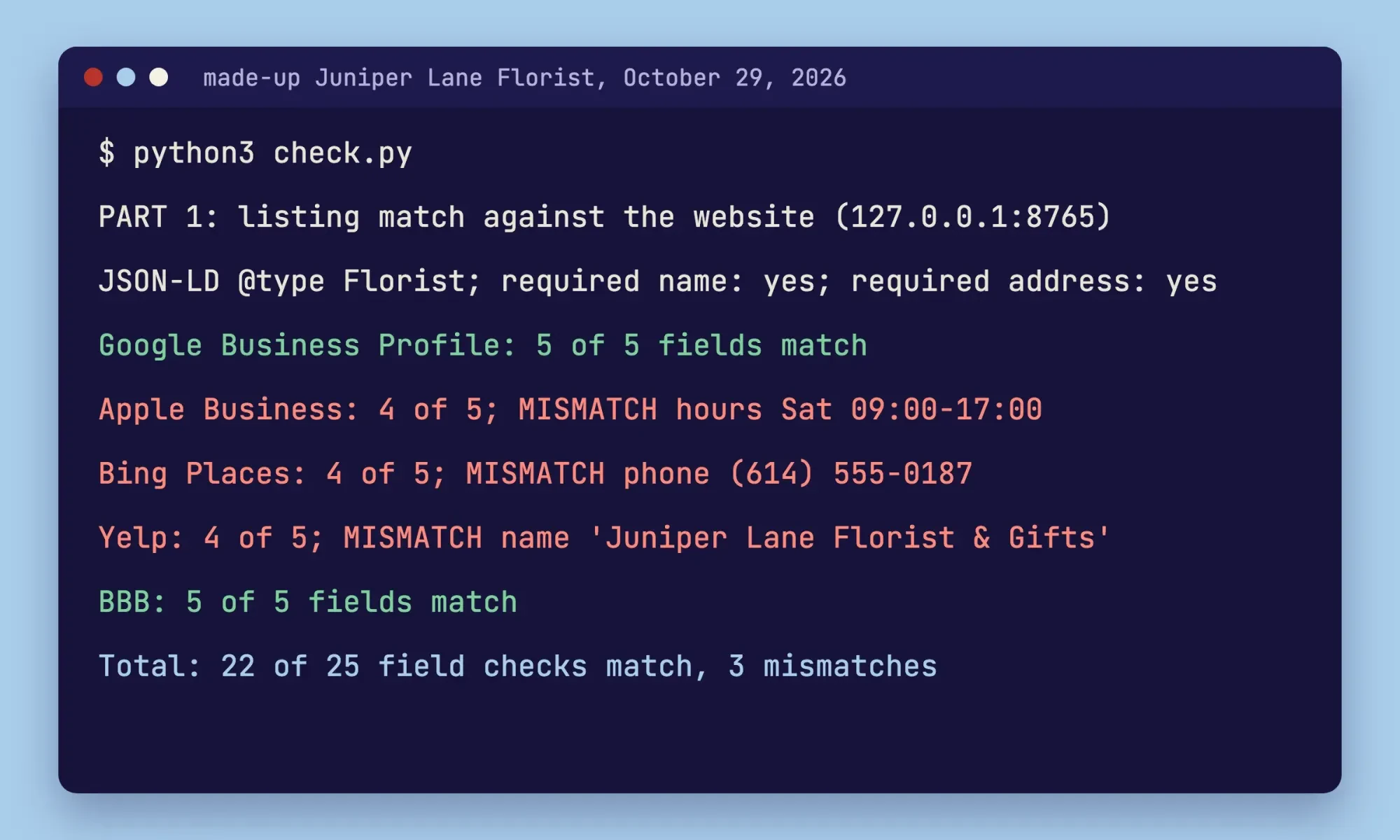 Source: our local test on 127.0.0.1, test/output.txt, October 29, 2026 (lines shortened)
What should a monthly AI prompt check for a shop record?
Once the listings match, the last step is to see what the assistants actually say, and our GEO guide already covers the general prompt log for any business. The local version below is shorter. It's built to catch wrong facts, not only missing names.
Pick six prompts your customers would type, run each in ChatGPT, Gemini, Copilot and Google AI Mode, and note the same things every month. Six prompts in four assistants make 6 x 4 = 24 answers. These rows use the made-up florist as an example:
| Example prompt | What to write down |
|---|---|
| Florist near me that delivers today (location set to Maple Ferry) | Named or not, and its place in the list |
| Best florist in Maple Ferry, Ohio | Which list or site the answer cites |
| Is Juniper Lane Florist open on Sunday? | Hours given against the real hours (closed Sunday) |
| Phone number for Juniper Lane Florist | Phone given against (614) 555-0142 |
| Florist in Maple Ferry for wedding flowers, good reviews | Rating or review count quoted, and from which site |
| Same-day sympathy flowers in Maple Ferry | Competitors named in place of you |
When an answer gets your hours or phone wrong, trace it back to the listing that holds the wrong value and fix it there, not on your website alone. In our test, the Bing record we typed carried an old phone number while every other source had the current one. We didn't ask any assistant about it, so we can't show one repeating that number; the check above is how you'd catch it if one did. Next month, don't reword the prompts. Run them on the same day and device, with the same location setting, so a change in an answer means the data changed.
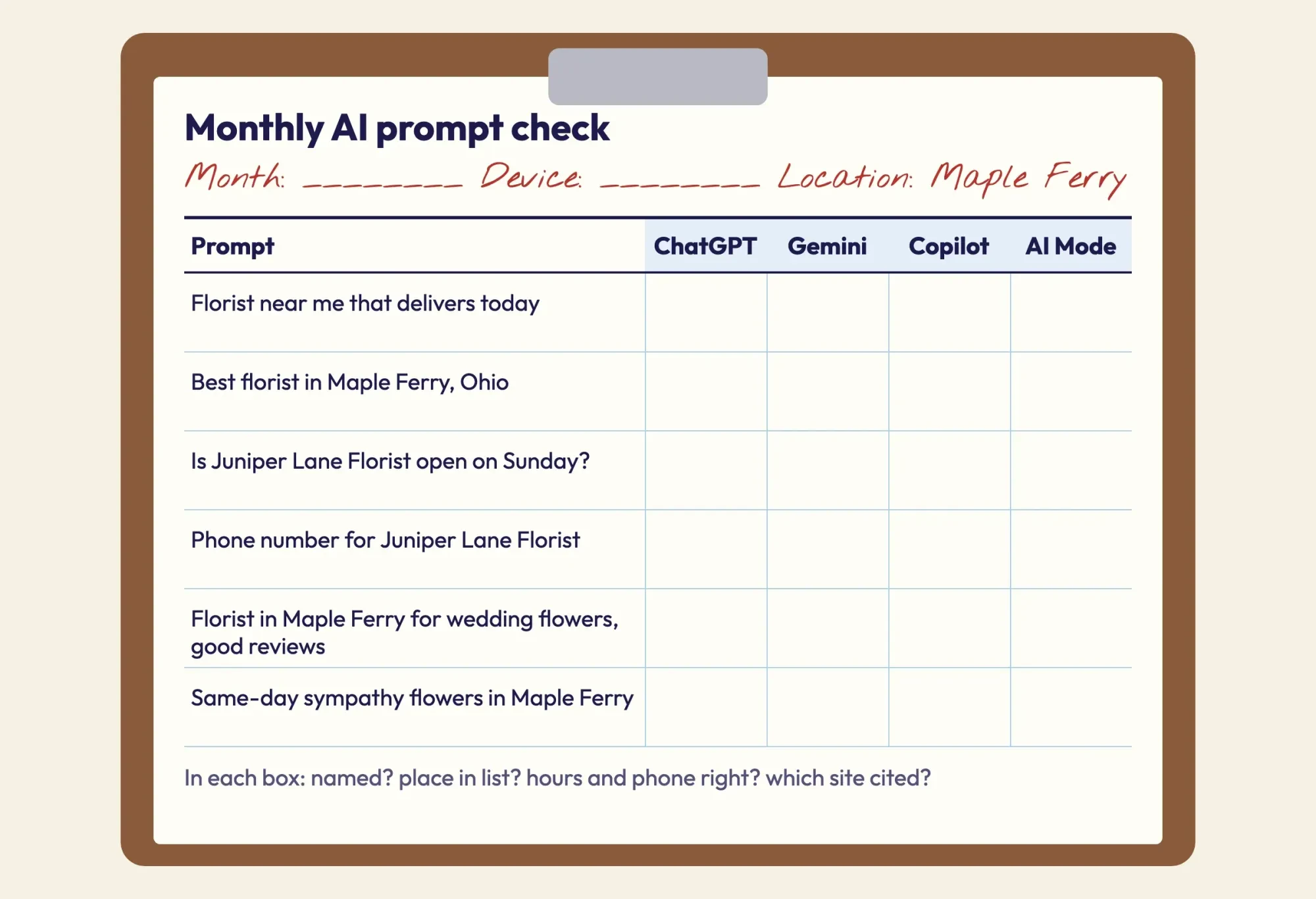 Drawn by us: a blank example sheet for the made-up Juniper Lane Florist, not output from any assistant
Two reports add numbers to the sheet, and the first one is Bing's June 2026 AI visibility update, which added an Intents view with Local among its categories. The second is your Business Profile numbers, which the local chapter of our intermediate guide explains one by one. If you also sell products online, our guide to product visibility in AI search handles feeds and product data.
Our take: skip the paid tracker. Once the listings agree, 24 answers a month is a job one owner can handle. Rather not do the clean-up yourself? It's part of our SEO service for local businesses. Our stake: DigitalTreed bills for that clean-up work, while Google, Apple, Microsoft, Yelp and BBB have no deal with us. For the wider local SEO picture, start with what local SEO is and how it works.
Frequently asked
Can a business pay Apple to show up higher in Maps?
Ads are separate from the free listing. Apple's Grow page sells ads on Apple Maps and, as of October 29, 2026, says "the first $150 is on us" when you start, with eligibility limits and terms.
Can I reply to Google reviews before my profile is verified?
No. Google's help page on managing reviews says you must verify your business before you can reply to reviews.
How fast does ChatGPT notice a robots.txt change?
OpenAI's crawler documentation says it can take about 24 hours after a robots.txt update for its systems to adjust.
How we made this guide: Every page linked here, 23 in all, was opened on October 29, 2026, and each quote was matched to its page. They come from Google, Apple, Microsoft, OpenAI, Yelp, BBB, BrightLocal and the eCFR. The made-up florist test ran on 127.0.0.1, and nobody logged in to a listing tool or asked an AI assistant anything for it. Facts checked by the DigitalTreed team on October 29, 2026.
First published January 2026. Rewritten October 29, 2026, as a step-by-step guide for US local businesses, with a listing match test and a monthly prompt sheet.
Sources
- Google Search Central: AI features and your website
- Gemini Apps Help: public information from Google services
- Microsoft Support: how web search works in Microsoft 365 Copilot Chat
- OpenAI: overview of OpenAI crawlers
- Apple Newsroom: introducing Apple Business
- Apple Support: Apple Business feature availability
- Apple Business: Grow
- Google Business Profile
- Google Business Profile Help: improve your local ranking
- Google Business Profile Help: performance and insights
- Google Business Profile Help: get more reviews
- Google Business Profile Help: manage customer reviews
- Google Maps user contributed content policy
- Google Search Central: Top Places List
- Google Search Central: LocalBusiness structured data
- Microsoft Bing: Bing Places for Business
- Microsoft Bing Blog: new AI visibility insights, June 2026
- Yelp for Business
- Yelp: Content Guidelines
- BBB: get your business listed
- BBB: get accredited
- eCFR: 16 CFR Part 465, use of consumer reviews and testimonials
- BrightLocal: Local Consumer Review Survey 2026
Comments
No comments yet. Start the conversation below.