
Quick answer
A free backlink generator isn't safe to use: as of November 2026, Google lists "Using automated programs or services to create links to your site" among 11 link spam examples. Such links can lose all credit; a pattern can bring a manual action. Earn links with useful pages instead.
A backlink generator is a web tool that posts your URL on other pages automatically, with no editor choosing to link.
Free links for one pasted URL sound like a shortcut. We'd skip them all.
Key takeaways
- Google names automated link-building programs as one of 11 link spam examples.
- In our test, 10 of 11 made-up generated links matched a Google example.
- Since December 2022, SpamBrain strips credit from unnatural links it detects.
- Google says it doesn't evaluate or endorse any third-party SEO tool.
What a backlink generator does, in Google's terms
This page once offered such a tool and answered "Will it harm my ranking?" with "No, of course not." It worked the usual way: paste a URL, press submit, and get back a mix of followed and nofollow links. Nobody on the receiving pages chose to link. That's the part Google's rules care about.
These tools sell on a real fact: links carry weight in search. Google's link best practices page says "Google uses links as a signal when determining the relevancy of pages and to find new pages to crawl." Its ranking systems guide says link analysis systems "understand how pages link to each other as a way to determine what pages are about." The same guide traces this to PageRank, which it calls "one of our core ranking systems used when Google first launched." If the term's new to you, the basics live in our backlinks explainer.
Google judges a link by why it exists. Its spam policies for Google web search call links made "primarily for the purpose of manipulating search rankings" link spam. One example on that page names this tool type outright: "Using automated programs or services to create links to your site." The policy judges how a link came about, not what it cost. A free tool gets no pass. Google's sample article text shows the anchor side, with links sitting on phrases like "best ring" and "buy flowers."
That 2020 edition also pushed a ping site for indexing; our post on indexing backlinks covers which of those tricks Google treats as spam.
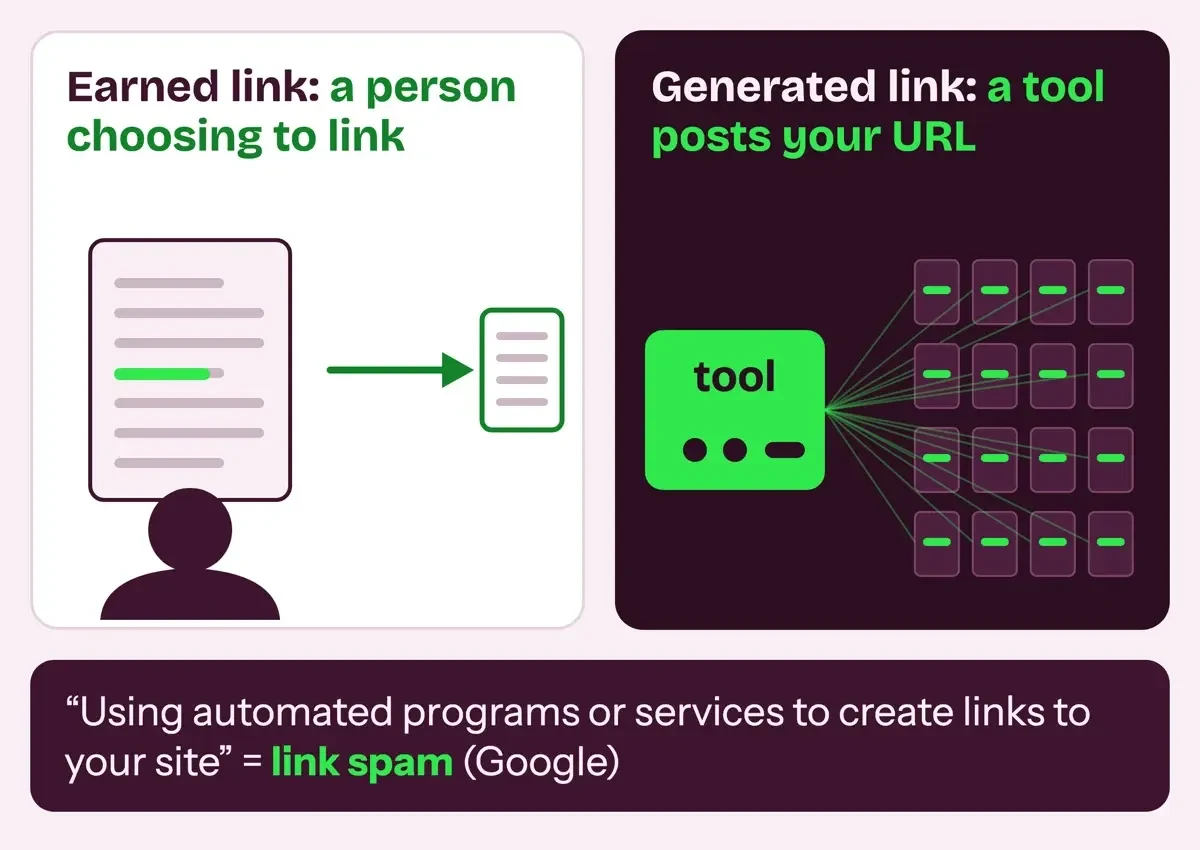 Diagram by DigitalTreed: an earned link starts with a person choosing to link; a generated link starts with a tool, based on Google's spam policies page.
Which link spam examples do generated links match?
Automated link building is one of 11 top-level examples our test script counted in Google's list on November 11, 2026. Links that land without anyone choosing them fit several others. The table pairs four common landing spots, plus auto-made profiles, with Google's own wording.
| Where the link lands | Google's example, word for word |
|---|---|
| Blog comment or forum signature | "Forum comments with optimized links in the post or signature" |
| Free link directory or bookmark site | "Low-quality directory or bookmark site links" |
| Widget code pasted on other sites | "Keyword-rich, hidden, or low-quality links embedded in widgets that are distributed across various sites" |
| Theme or template footer | "Widely distributed links in the footers or templates of various sites" |
| Auto-created profile page | "Using automated programs or services to create links to your site" |
The comment and signature rows also break a rule on someone else's site. Google's spam policies class "Comment spam on blogs" and "Spammy posts on forum threads" as user-generated spam, and Google's own sample signature links the phrase "best pizza san diego." Its page on preventing abuse notes that "comment moderation is a built-in feature in most CMSes." For sign-up forms, the same page suggests reCAPTCHAs or similar tools "to only allow human submissions." Google's outbound link page also asks site owners to mark "comments and forum posts" with rel="ugc". So a blog's owner may delete a generated comment or tag its link ugc.
What Google does with links it calls unnatural
Google's pages describe two outcomes for these links. In the first, software drops their value. On December 14, 2022, Google's link spam update post said SpamBrain, its "AI-based spam-prevention system," would "neutralize the impact of unnatural links on search results." It can spot "both sites buying links, and sites used for the purpose of passing outgoing links." Then comes the blunt line: "any credit passed by these unnatural links are lost." The post said the update would "take about two weeks to fully roll out" and that "This launch will affect all languages," English included. Google's ranking systems guide still lists SpamBrain as of November 2026.
The second outcome is a manual action. The Manual Actions help page describes an "Unnatural links to your site" action for "a pattern of unnatural, artificial, deceptive, or manipulative links pointing to your site." It warns this "can result in some or all of your site getting a manual action." The report page puts it more bluntly: "If a site has a manual action, some or all of that site will not be shown in Google search results." Google's spam policies add that sites breaking its rules "may rank lower in results or not appear in results at all."
Cleanup follows the order on that help page. Download your links from Search Console, then ask each site owner to remove the bad ones or add rel="nofollow". Disavow only what you couldn't get removed: our free disavow file generator formats that file, and our Domain Authority checker guide explains when Google thinks a disavow is worth it. Try removal first. The help page itself says "We often see the Disavow links tool used incorrectly." Last, you file a reconsideration request, which asks Google to review the site after the fix.
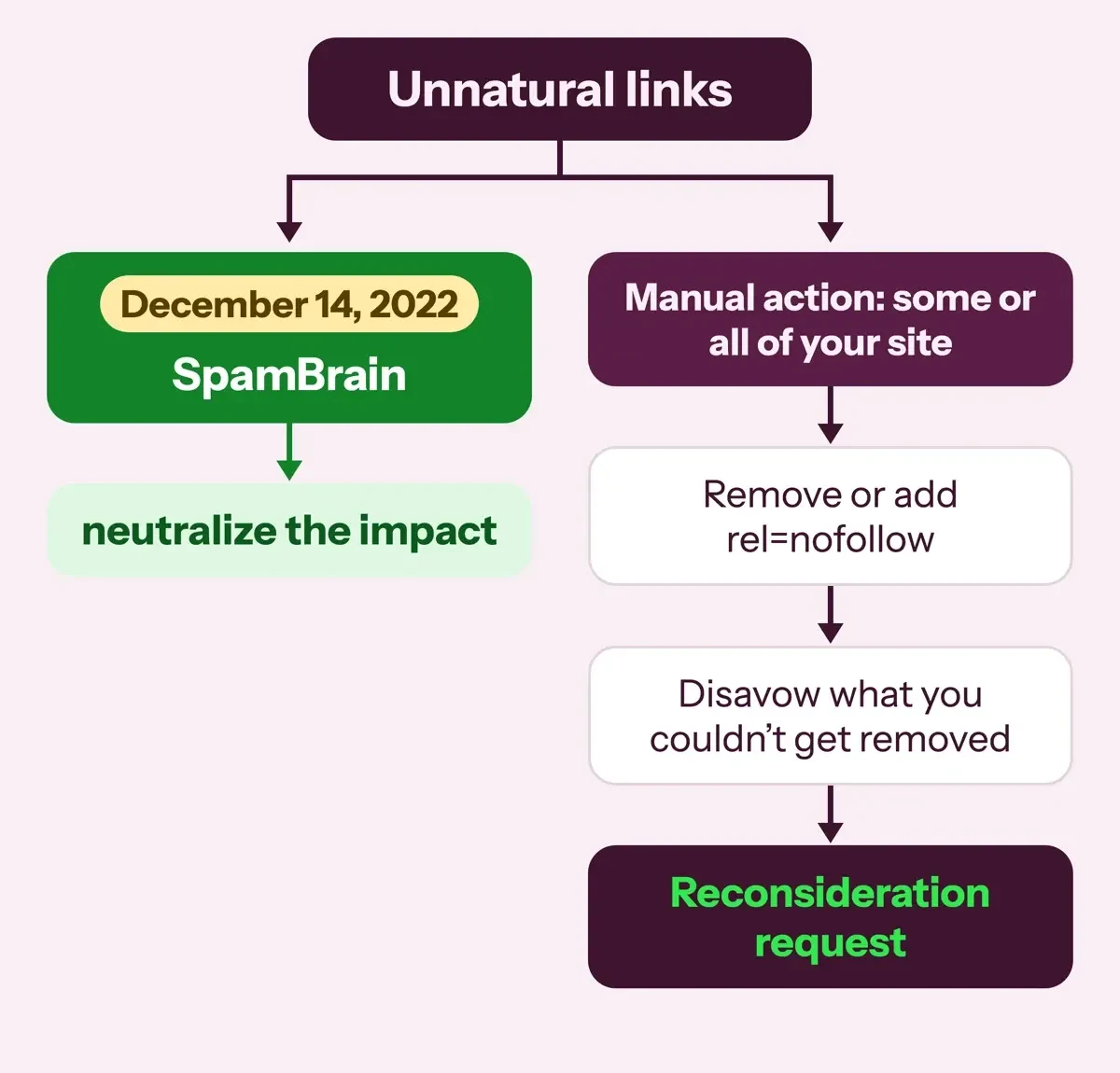 Diagram by DigitalTreed: the two outcomes Google describes for unnatural links, from its December 2022 update post and Manual Actions help page.
Is there a Google-approved backlink generator?
This page's 2020 edition also pointed readers to a "Google Backlink Generator." Google's page on hiring an SEO says "Google doesn't evaluate or endorse third-party SEO tools." It tells readers to be wary of tools claiming Google Search has called them acceptable or approved. It also says "No one can guarantee a #1 ranking on Google."
We'd treat a free-rankings promise the way Google treats cold SEO email. That page says to "Reserve the same skepticism for unsolicited email about search engines" as for "burn fat at night" diet pills. It adds "Be careful if a company is secretive or won't clearly explain what they intend to do," and a generator that won't list where it posts fits that warning.
The same page puts the risk on the site owner: "you are responsible for the actions of any companies you hire." Your real link data sits in Search Console, which reports links and doesn't create them.
Checking links a tool says it built
If you've already run a generator, its links sit on pages you can open and read. Four checks cover what Google's examples describe:
- Placement: a comment, signature, profile, directory, widget or footer, or the body of an article?
- Anchor text: your business name, or a keyword phrase like "cheap sofa reupholstery"?
- The rel value: nofollow, ugc, sponsored, or nothing?
- The page: would anyone read it, or is it a list of unrelated links?
Google's link best practices page says good anchor text "is descriptive, reasonably concise, and relevant to the page that it's on and to the page it links to." A link that fails the first two checks and has no rel value fits the pattern in the spam policy. Ask that site's owner to remove it. Save the disavow step for a manual action, or one you think is coming.
Finding the links is the slow part, unless the tool gave you a full list of every page where it posted. Google's Manual Actions help page points to two Search Console exports. Top linking sites groups links by host, and Latest links under the Links report gives a dated list. It suggests starting with the sites that link to you most, or links created in the last few months, and checking each one against the link spam policy. Sorting the dated export groups anything made around the day you ran the tool, so you end up with a few pages to open and judge.
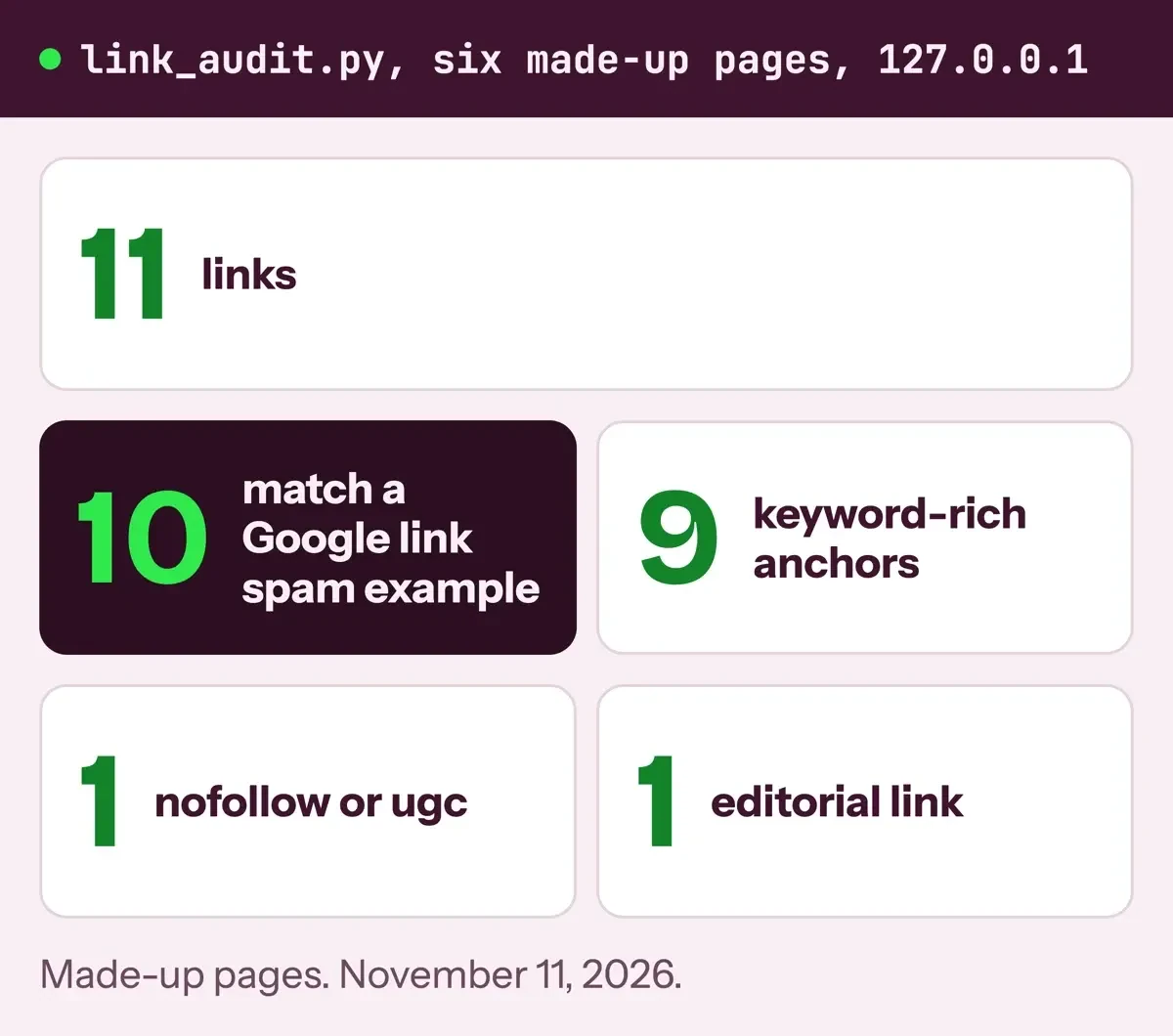 Diagram by DigitalTreed: results of our link_audit.py run on six made-up pages served on 127.0.0.1, November 11, 2026.
What we tested
On November 11, 2026, we served six made-up pages on 127.0.0.1: five copying placements from the table, plus a local news story. Every link pointed at a made-up shop, Gullwing Upholstery, and our script, link_audit.py, sorted each one by placement, anchor text and rel value.
It found 11 links. Ten matched a Google link spam example, 9 used keyword-rich anchors, and 1 carried nofollow or ugc. The only editorial link sat in the news story. We wrote every page. This says nothing about any real tool.
Safe ways to earn links people choose to give
Google's Starter Guide lists social media promotion, community engagement, advertising and word of mouth. It calls word of mouth "One of the most effective and lasting ways" to promote a site, though it's slow. These six habits build on Google's own pages:
- Print your URL on "business cards, letterhead, posters, and other materials."
- Send newsletters, but only "With their permission," as the guide puts it.
- Publish something worth citing, such as a table of your own job prices.
- Join local business groups and trade associations near you.
- Mark ads and paid placements with rel="sponsored".
- Write guest posts for readers, with the rel values Google's 2021 link spam update post asks for.
Google's helpful content page asks whether a page offers "insightful analysis or interesting information that is beyond the obvious." A table of your own past job prices passes that test, since those numbers come from your own jobs and no other site has them.
Gifts count as payment too. Google's examples include "Sending someone a product in exchange for them writing about it and including a link." The FTC's endorsement rule, 16 CFR 255.5, lists "the provision of free or discounted products" as a material connection. That connection must be "disclosed clearly and conspicuously." The FTC's endorsement FAQ says the FTC Act applies to bloggers who get free products expecting a write-up. It adds that a platform's built-in disclosure tool is no guarantee the connection has been disclosed well enough. Our sponsored blog post guide covers the wording, but this summary isn't legal advice, so ask a licensed attorney before you sign any specific deal.
Instead of running a generator, we'd spend the time on one page. Improve it until it answers a customer question better than any nearby rival, check it with the DigitalTreed website audit tool, then tell the people who already know you. Our blog promotion plan and off-page SEO checklist cover what comes next, and the Intermediate SEO guide has a full chapter on links.
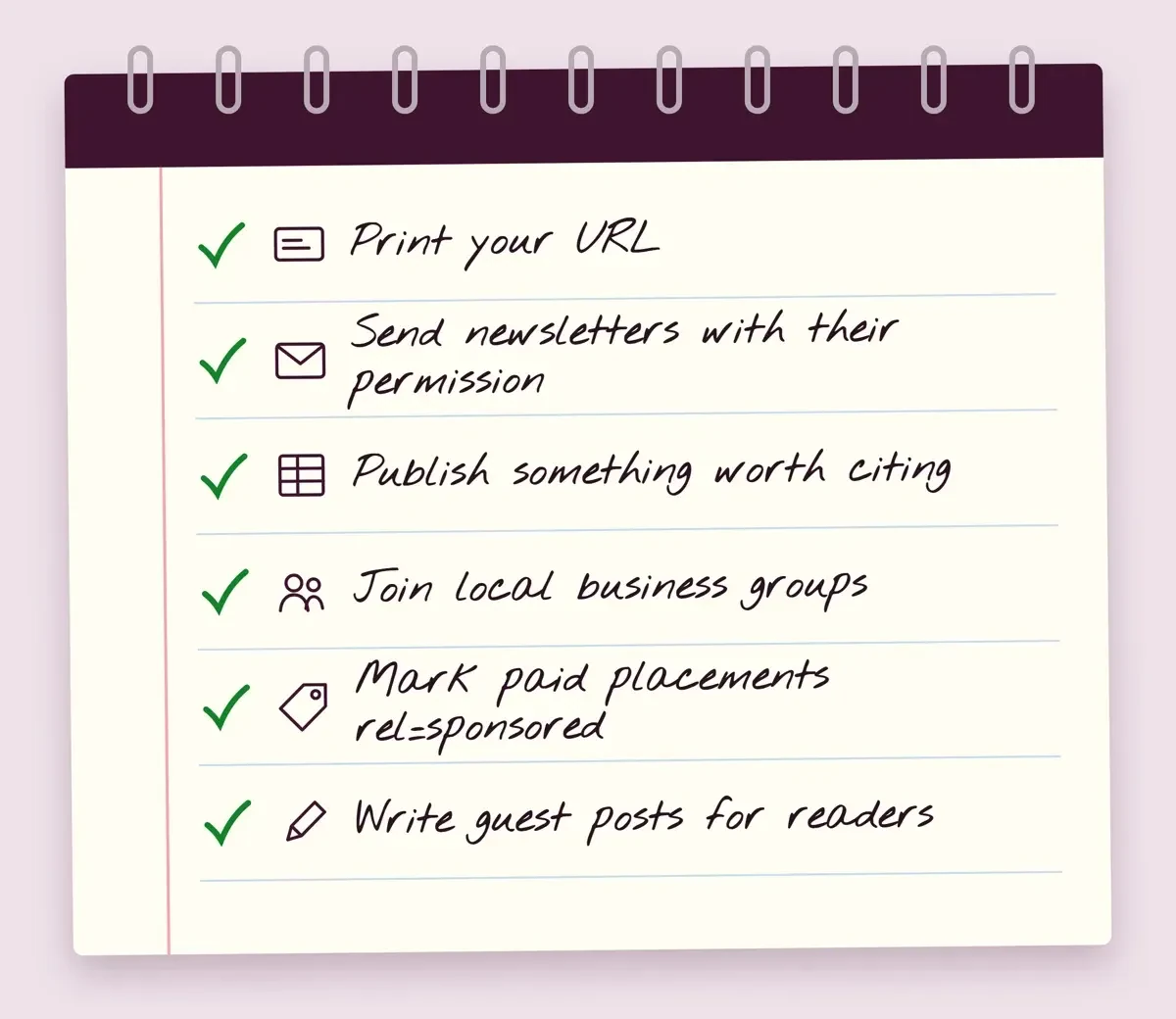 Drawn by us: six link habits from Google's Starter Guide, helpful content page and outbound link guidance.
Frequently asked
Are nofollow links from a backlink generator safe?
Google's spam policies excuse paid links marked nofollow; the automated-programs example has no such exception. Its outbound link page says nofollow means a site would rather Google not "associate your site with, or crawl the linked page from, your site."
Can a competitor hurt my site by pointing spam links at it?
Google tries to stop it. Its disavow help page says "Google works very hard to make sure that actions on third-party sites do not negatively affect a website."
Are guest posts link spam?
Not by default. Google's 2021 post flags "low quality sponsored and guest posts primarily intended to gain links."
How do I know if Google took action over my links?
Check Search Console's Manual Actions report. Google says it will "notify you in the Manual actions report and in the Search Console message center," per its help page.
How we made this guide: We saved all 15 Sources pages on November 11, 2026 and searched those copies for each quoted line. We ran no backlink generator and posted to no real site. Facts checked by the DigitalTreed team on November 11, 2026.
First published April 2020 as a free backlink tool page. Rewritten November 2026 as a link spam guide, with the tool, form, ping site and no-harm claim cut.
Sources
- Google Search Central: Spam policies for Google web search
- Google Search Central: Link best practices for Google
- Google Search Central: Qualify your outbound links to Google
- Google Search Central: A guide to Google Search ranking systems
- Google Search Central Blog: December 2022 link spam update
- Google Search Central Blog: Link tagging and link spam update (July 2021)
- Google Search Central: Prevent user-generated spam
- Google Search Central: Do you need an SEO?
- Google Search Central: SEO Starter Guide
- Google Search Central: Creating helpful, reliable, people-first content
- Search Console Help: Manual Actions report
- Search Console Help: Disavow links to your site
- Search Console Help: Reconsideration requests
- Cornell LII: 16 CFR 255.5, Disclosure of material connections
- FTC: FTC's Endorsement Guides, what people are asking

Comments
No comments yet. Start the conversation below.