

Quick answer
No. Google doesn't penalize content because AI wrote it. It acts on pages made mainly to game rankings, "no matter how it's created." On October 1, 2026, Google added a line calling it "critical" to fact-check AI content by hand, titles and alt text included. That's a documentation edit, not a new penalty, and no ranking update came with it.
AI content is a page, image or piece of page data, like a title or alt text, that a generative model drafts for you. So does Google penalize AI content? If you use ChatGPT, Gemini or Claude, you've probably seen the reels: "Google just changed its AI content rules." Some of that is true. Some of it turns two edited help pages into a crackdown that never happened, and Google's own pages show which is which.
We read those pages on November 27, 2026, compared them with copies saved before the edit, and asked three free chatbots what changed. Below you'll find how Google judges AI pages and the exact October 1 changes, then scaled content abuse, AI detection and ranking data. We finish with how to tell a penalty from a normal drop, and a review routine that matches Google's new wording.
Key takeaways
- Google judges the page, not the tool that wrote it.
- Two Google pages changed on October 1, 2026; no policy did.
- Mass-made pages with little value break the scaled content abuse policy.
- Google now names titles, meta descriptions, structured data and alt text for review.
- A real penalty shows up in Search Console's Manual actions report.
Google ranks the page, not the tool that wrote it
Google answered the big question back in 2023, and it hasn't taken that answer back. Its February 2023 post on AI content says "Appropriate use of AI or automation is not against our guidelines." The same post puts it more bluntly: "Using AI doesn't give content any special gains. It's just content."
So the test is purpose, not origin.
Google draws the line at pages made "primarily to manipulate search rankings," and it says that's spam whether a person or a model wrote them. Its people-first content page asks you to check the Who, How and Why of each page. The Why matters most: if the main reason a page exists is to pull in search visits, it's working against you. In other words, a helpful page drafted with AI and checked by a person can rank, while a thousand thin pages typed by hand can still be spam.
It also helps to get one word straight. People say "penalty" for any drop, but Google means something narrow by it. A penalty, in Google's terms, is a manual action: a person at Google flags your site for a spam policy, and you get a notice. Most aren't. They're something else, like a ranking system deciding other pages answer the search better, and we'll show you how to tell the two apart further down.
What changed on October 1, 2026, word for word
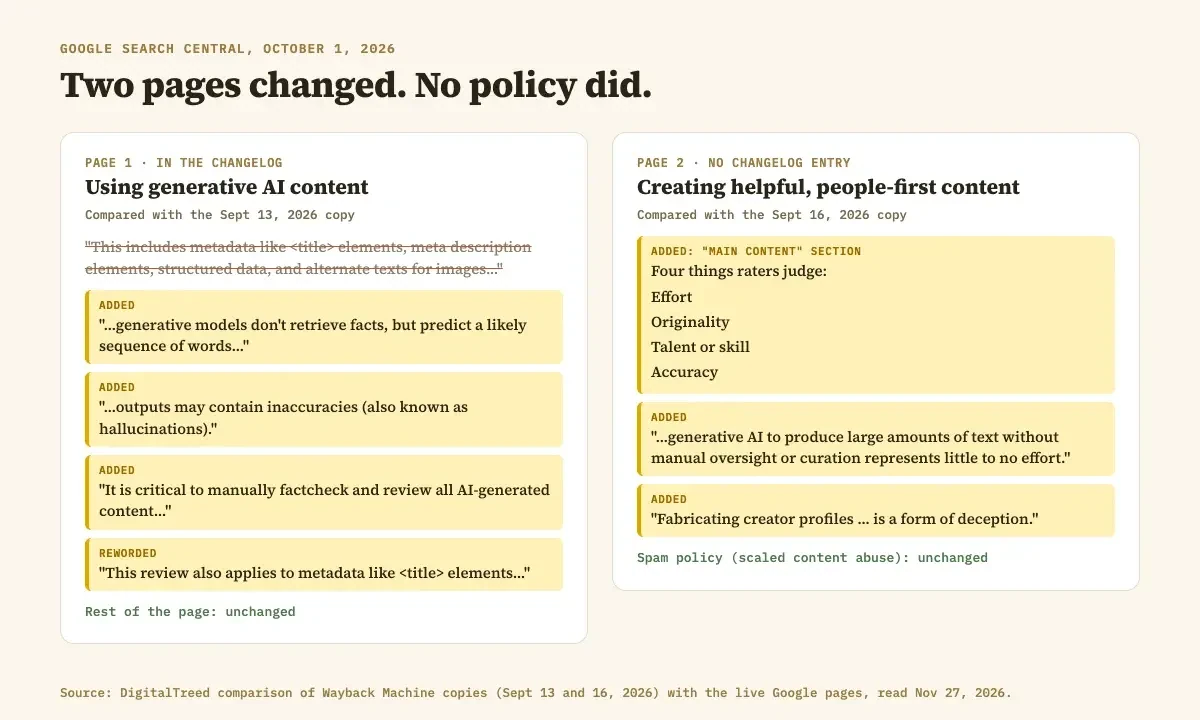
That rule still stands, so what did October 1 change? Two Google pages, and only one was announced. Google's documentation changelog lists one edit for that day, to its guide on using generative AI content. We compared today's guide with a copy saved on September 13, 2026. Three sentences were added, one was reworded, and every other line on the page is unchanged.
 Source: our comparison of Wayback Machine copies from September 2026 with the live Google pages, read November 27, 2026.
Here are the three new sentences, in order:
- "Keep in mind that generative models don't retrieve facts, but predict a likely sequence of words based on their training data."
- "Because of this, generative AI outputs may contain inaccuracies (also known as hallucinations)."
- "It is critical to manually factcheck and review all AI-generated content for accuracy and trustworthiness before publishing."
The reworded line came right after them. "This includes metadata like" became "This review also applies to metadata like," followed by title elements, meta descriptions, structured data and image alt text. Before, metadata was just part of "accuracy, quality, and relevance." Now it's named as one of the things to check by hand. That small change matters because those four fields are what searchers see first, often before they open your page, so a mistake there travels further.
The second page changed the same day with no changelog entry. Google's people-first content page now has a "Main content" section, which our September 16, 2026 copy doesn't. It lists four things raters judge: effort, originality, talent or skill, and accuracy. One line goes straight at AI: "using generative AI to produce large amounts of text without manual oversight or curation represents little to no effort."
It's the plainest AI line Google has published.
The same edit added a warning about fake authors. "Fabricating creator profiles," with AI headshots, made-up names or false credentials, "is a form of deception," it now reads.
What didn't change
The spam rule didn't move. We compared the scaled content abuse section of Google's spam policies with a copy from September 20, 2026, and it's the same, character for character. If Google had tightened the rule itself, that section is where the new wording would sit, and not a single character of it changed. No ranking update started in October either, per Google's Search Status Dashboard. The September 2026 spam update was still rolling out on October 1; it began September 24 and ran 13 days. Google hasn't linked the two, and we wouldn't read a pattern into one overlap of dates that Google itself has never mentioned anywhere.
Is it a crackdown? No. Google's own reason for the guide edit is dull, which is a good sign. The changelog says it was "to get our documentation in sync with our presentations we use at our developer events." That's a team tidying its docs. Not a new penalty. What it does tell you is what Google wants you to do, and that's worth taking seriously.
Scaled content abuse: where AI use turns into spam
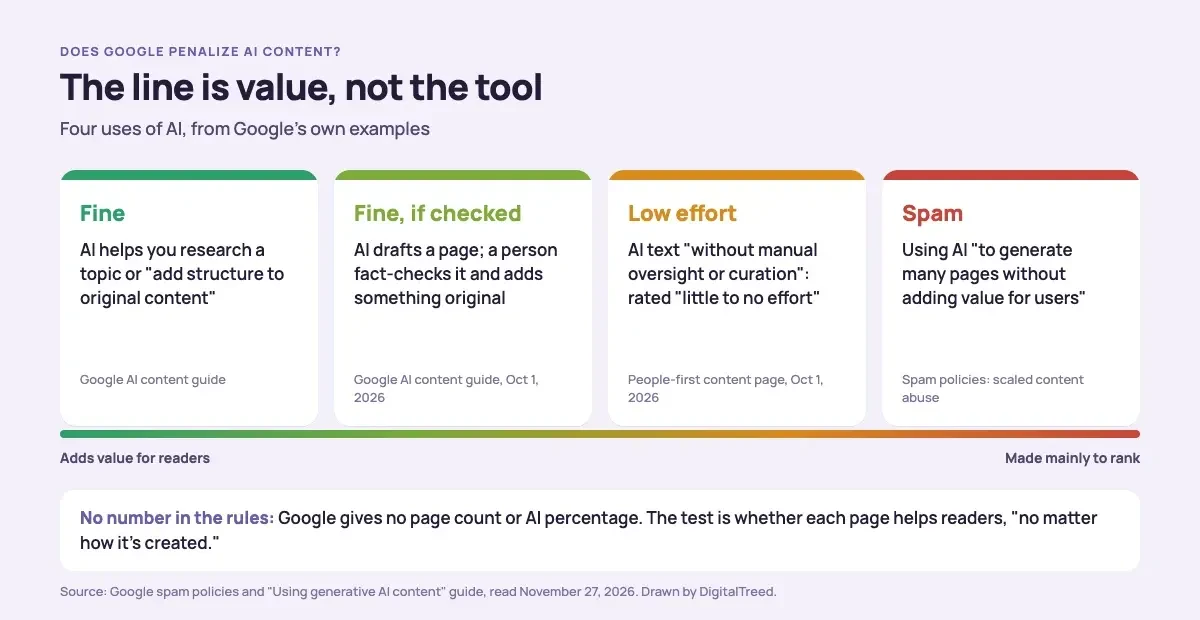
The October edits point to one policy that hasn't moved since March 2024. Google defines it this way: "Scaled content abuse is when many pages are generated for the primary purpose of manipulating search rankings and not helping users." Its March 2024 announcement says it applies "no matter whether content is produced through automation, human efforts, or some combination."
Google's spam policies give five examples. Three of them catch most AI misuse:
- "Using generative AI tools or other similar tools to generate many pages without adding value for users"
- Scraping or rewording other sites' content, including "synonymizing, translating, or other obfuscation techniques"
- "Stitching or combining content from different web pages without adding value"
 Drawn by us from Google's spam policies, generative AI guide and people-first content page, read November 27, 2026.
Google's raters get the same picture in more detail. The Search Quality Rater Guidelines, sections 4.6.5 and 4.6.6, describe spammy sites by their "abundance of content with little effort or originality with no editing or manual curation." Raters give such pages the Lowest rating. They're told to do it even when they can't tell whether AI was used. Rater scores don't change rankings directly, Google says, but they show what its systems are built to find, so they're a fair guide to where the line sits.
There's no page count or AI percentage in any of this. Twenty great pages are fine, and 2,000 thin ones aren't, whoever typed them. A site can publish hundreds of pages and be fine, as long as each one gives readers something the pages already ranking for that search don't.
Grokipedia, the AI-written encyclopedia from xAI, is the case everyone points to. Third-party estimates from Sistrix and Semrush, collected in an SEO Engico case study, put it near 3.2 million Google clicks a month in January 2026. It started losing visibility in early February, and by mid-February it had lost much of its earlier search visibility, according to the same case study. Google hasn't said why, so treat any single cause as a guess.
Size alone didn't protect it.
Lily Ray's May 2026 study shows the wider pattern. She tracked more than 220 sites named as customers of AI content platforms, using Ahrefs estimates checked against Sistrix. 54% had lost 30% or more of their peak organic traffic, and 22% had lost 75% or more. She's clear that it's a correlation, not proof that the tools caused it.
Can Google detect AI-written content?
Not in the way most people mean, as far as Google has said, since no Google Search page says ranking runs an AI-text detector. Its 2023 FAQ says Google uses "a variety of systems, including SpamBrain," to spot spam "however it is produced." That's a hunt for spam patterns, like thousands of near-identical pages appearing on one site in a few weeks, not a search for the fingerprint of a chatbot.
Google does have one AI detector, and it isn't for Search. SynthID adds hidden watermarks to content from Google's own AI, including text "generated by the Gemini app and web experience." Its public Detector checks images, video and audio from Google and partners like OpenAI and NVIDIA. It doesn't judge a ChatGPT blog post, and Google hasn't said Search uses it for ranking. Even a perfect AI detector wouldn't tell Google whether a page was accurate, useful or worth showing to anyone, and that's what ranking is about.
Third-party detectors only guess, and each one guesses differently. Even Ahrefs, which built a detector for its 2026 study, warns that "AI content detection is not perfect."
So making your draft "pass" a detector isn't the goal. Making it worth reading is.
Can AI-written pages still rank? What the data shows
Yes, and the best data we found says they rank less often when they're mostly AI. Ahrefs studied 1,000,000 pages from 100,000 searches in June 2026, using its own detector. It found "5.3% of top-ranking (positions 1–3) pages are 100% AI-generated." Pages under 50% AI held 82.2% of top-3 spots.
The same study also looked at Search Console data for about 81,000 pages, split into four groups by how much of each page its detector flagged as AI. "Low and moderate AI level content received 2–3x the impressions of high or very high AI-generated content." Ahrefs adds that "it would be wrong to assume that there is any kind of automatic suppression happening." Our reading is simple: mostly-AI pages tend to say what other pages already say, and Google's new originality line is about exactly that. Getting cited inside AI answers is a separate question, and our GEO guide covers it.
Origin isn't the problem. Sameness is.
We asked three chatbots what changed on October 1
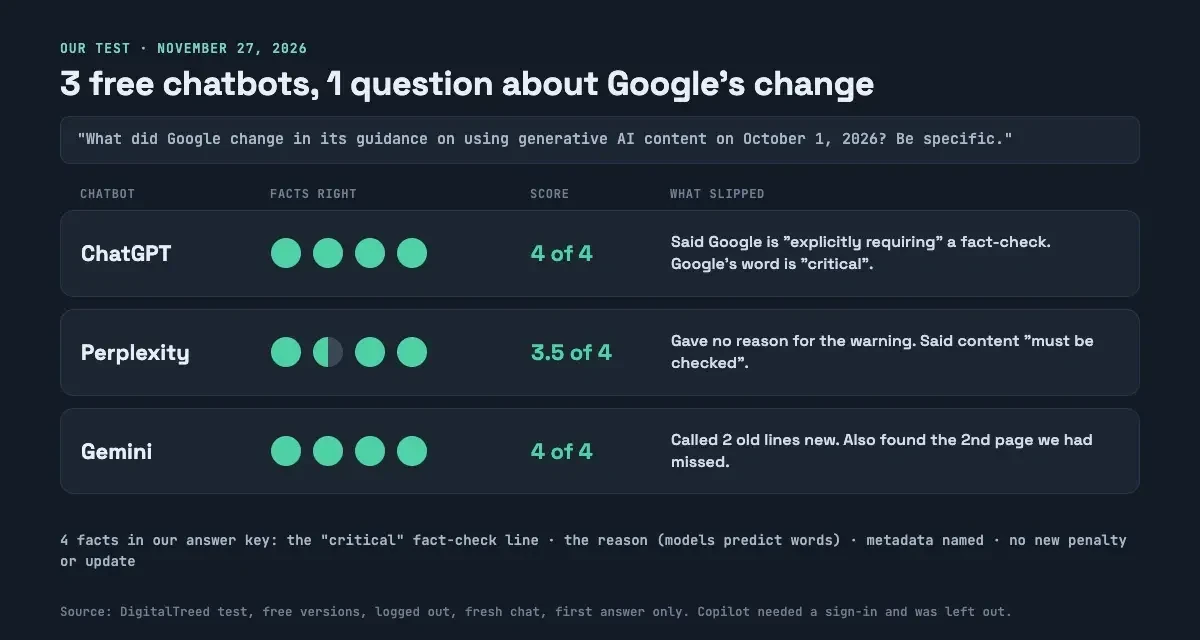
Here's the risk behind Google's new sentence, tested on this very topic, with a question any site owner might type after watching one of those reels. On November 27, 2026, we asked ChatGPT, Perplexity and Gemini the same question, logged out, in a fresh chat each. We wrote the answer key first: four facts from our comparison. Microsoft Copilot asked us to sign in before it would answer, so we left it out. We wanted to see whether a free chatbot, asked the kind of question our readers type into one, would repeat the facts or bend them.
 Source: our test on November 27, 2026, free versions, logged out, one prompt, first answer only.
All three got the main change right, because they all searched the web first. Each still slipped, though, and the slips are worth a close look because they're exactly the kind a busy editor would wave through without opening the source. ChatGPT said Google is now "explicitly requiring" a fact-check, and Perplexity said content "must be checked." Google's word is "critical," which isn't a rule. Gemini said two lines were new that were already in the December 2025 version.
Gemini also caught something we'd missed. It said the people-first content page had changed the same day, and it was right. We'd only compared the page named in the changelog. That's the whole lesson in one test: a draft, from a person or a model, is only as good as the check against the source page.
Penalty, demotion or a core update: check which one you have
If your traffic fell, find out what kind of drop it is before you rewrite anything. Rewriting pages before you know which kind of drop you have can waste weeks, and it can remove the very parts that were still ranking. Start in Search Console, under Security and Manual actions. If a person at Google flagged your site, it's listed there. Google's manual actions help describes one called "Major spam problems," for sites using "aggressive spam techniques such as scaled content abuse."
An empty report means no manual action. That's most drops.
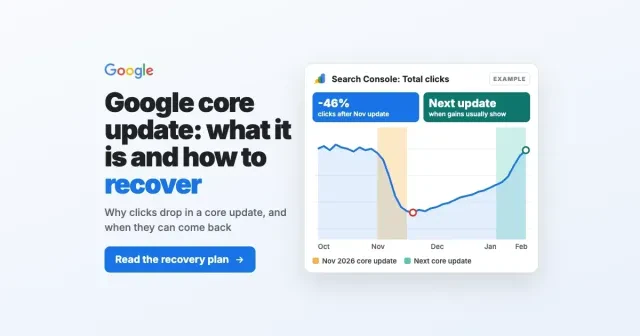
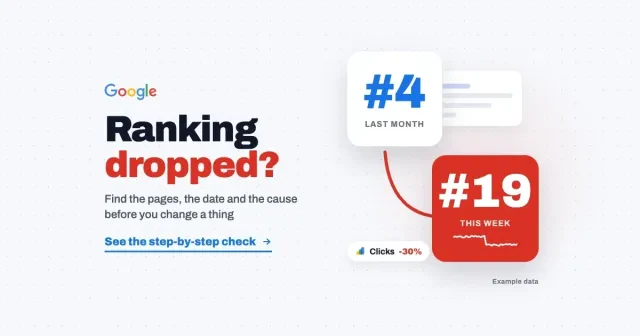
Next, line up your drop with Google's ranking update dates. The November 2026 core update ran from November 10 for 13 days and 20 hours, and a December 2026 core update was announced on November 24. If your drop starts inside one of those windows, start with our Google core update explainer. If it doesn't, our ranking drop checklist walks through the other causes, from lost links and site changes to a competitor who simply published a better page.
A manual action is the only case where you ask Google to look again: fix the pages first, then click Request Review in the report. Google asks you to "provide examples of bad content that you removed and good content that you added." Our advanced SEO guide covers the spam recovery steps in full. To spot thin or repeated pages across a whole site first, run our website audit tool.
Ranking drops from algorithms have no review button.
A review routine that matches Google's new wording
So what does "manually factcheck and review" look like on a normal Tuesday? Here's the routine we'd run on any AI-assisted page before publishing it. The more numbers a draft leans on, the longer the first step takes.
- Open the source for every number, date, price, name and quote. Cut what you can't find.
- Read the title, meta description and image alt text out loud. Fix anything the page doesn't back up.
- Check structured data against the visible page: hours, prices, FAQ answers.
- Put a real person's name on the page, with a bio that's true.
- Add one thing only you have: a test, a photo, a number from your own work.
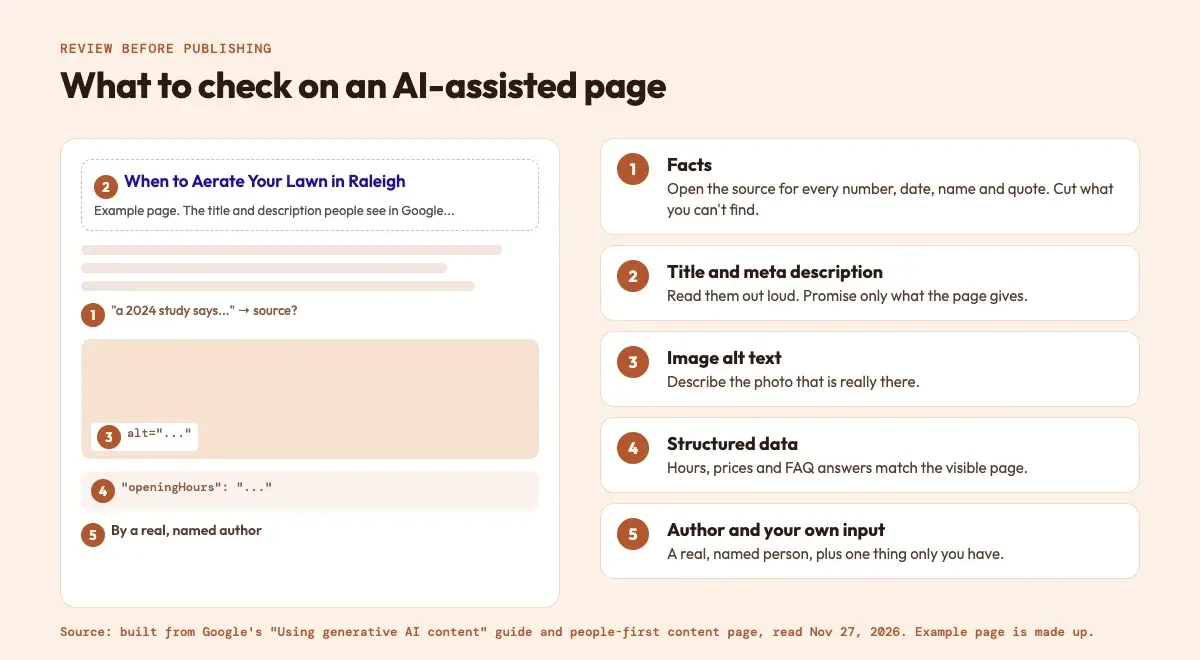 Source: our checklist, built from the wording of Google's generative AI guide and people-first content page.
For step 2, our free meta tag analyzer shows the title and description Google will read. A title that promises more than the page delivers is an easy slip for a model, because it writes what sounds likely rather than what's true for you. For step 3, compare each value in your markup with what a visitor sees. Google's guide says structured data should also follow its general guidelines and the rules for each search feature.
Example: one AI draft, four fixes
Example: Cedar Hollow Landscaping in Raleigh, North Carolina, is a made-up business whose owner asks a chatbot for a page on when to aerate a lawn. The draft reads well, but it has four problems. A statistic is credited to "a 2024 study" that we couldn't find, so it goes. The meta description promises same-day estimates the business doesn't offer. The alt text says "lawn aeration image" on a photo of mulching. And the LocalBusiness markup lists template hours, not the real ones. Each slip is small on its own, but together they tell a careful reader that nobody at the business read the page.
None of those would show up in a plagiarism check or an AI detector, yet all four can reach searchers, because titles, descriptions and markup feed what Google shows. That's why Google names them now.
Two more rules from Google's pages round this out. Tell readers how a page was made when they'd reasonably wonder, and don't invent authors. None of this needs a special tool or a paid plan; it needs one person who knows the business to read the page as a customer would. Shops get a stricter rule: AI product images in Merchant Center "must contain metadata" marking them as AI-made, per the generative AI guide. For more on bylines and E-E-A-T, see our Intermediate SEO chapter on AI-assisted writing. Google's self-check questions are in our SEO content writing tips.
Want AI to help with research rather than writing? Our guide to AI tools for SEO has prompts with a check after each. DigitalTreed's SEO services can take the content review off your plate.
Frequently asked
Does Google penalize AI content in 2026?
No new rule arrived in 2026. The scaled content abuse policy dates from March 5, 2024, per Google's changelog, and the October 2026 edits only added guidance.
Is there a percentage of AI content Google allows?
No. Google's pages give no percentage or page count. Its 2024 policy covers automation, human effort "or some combination," per the announcement.
Can Google remove my whole site for AI content?
Only for spam. Google says sites that break its spam policies "may rank lower in results or not appear in results at all," per its 2024 post.
Does Google penalize AI images?
Not on normal web pages. Merchant Center is stricter: AI images need IPTC "TrainedAlgorithmicMedia" metadata, per Google's AI content guide.
Can I list AI as the author?
Google advises against it. Its 2023 FAQ says an AI byline "is probably not the best way" to show readers that AI helped.
What we tested
On November 27, 2026, we saved three Google pages: the generative AI guide, the people-first content page and the spam policies. We compared each with Wayback Machine copies from September 2026, sentence by sentence, and noted every line that was added, removed or reworded between the two versions. We checked four more Wayback copies of the people-first page to date its change. We asked ChatGPT, Perplexity and Gemini one question each, logged out, and graded the answers against a key written beforehand.
How we made this guide: We compared Google's pages with their September 2026 copies, ran the chatbot test and checked every study figure on the study's own page. Facts checked by the DigitalTreed team on November 27, 2026.
Sources
- Google Search Central: Guidance on using generative AI content (updated October 1, 2026)
- Wayback Machine: the same guide on September 13, 2026
- Google Search Central: Latest documentation updates
- Google Search Central: Creating helpful, reliable, people-first content
- Wayback Machine: the same page on September 16, 2026
- Google Search Central: Spam policies for Google web search
- Google Search Central Blog: Google Search's guidance about AI-generated content (February 8, 2023)
- Google Search Central Blog: March 2024 core update and new spam policies
- Google: Search Quality Rater Guidelines (PDF)
- Search Console Help: Manual actions report
- Google Search Status Dashboard: Ranking history
- Google DeepMind: SynthID
- Ahrefs: Google doesn't punish AI content (July 27, 2026)
- Lily Ray: It works until it doesn't (May 13, 2026)
- SEO Engico: Grokipedia SEO case study (February 20, 2026)
Comments
No comments yet. Start the conversation below.